









We’ve already seen two Premier League managers receive their marching orders in November.
Michael Carrick was the first to go, shortly followed by Pierre Sage. Regis Le Bris, Gary O’Neil and Oliver Glasner are all flirting with danger and could be on their way to joining them.
But, despite sitting in the top half of the table, there’s another who could find himself in danger of a premature dismissal. Xabi Alonso.
Alonso wrote his name into the history books in his first top-flight managerial job, leading Bayer Leverkusen to an unbeaten domestic double and a run to the 2023/24 Europa League final before joining Real Madrid. He lasted just seven months in the Spanish capital before getting the axe, but it wasn’t long before he was back on his feet at Chelsea.
Chelsea’s ownership generously backed Alonso in the summer with a transfer spree of £340.4million. Only Manchester City (£457.5m) spent more in Europe. And, initially, it seemed that their investment was paying dividends. After beating Fulham 3-2 in their opening game, Chelsea prevailed 4-3 against Brighton and Hove Albion.
Progress halted
But the Blues were stopped in their tracks in September. Chelsea lost for the first time in the league with a 2-1 defeat to Arsenal, and followed that up with a home draw against Hull City. The Blues went into the first international break of the season off the back of a 3-0 loss at Brentford.
Chelsea did manage to steady the ship with wins over Bournemouth and Everton, but they lost their bearings again in late October. Alonso’s side were beaten 2-0 at home by Tottenham Hotspur, before being knocked out of the Carabao Cup by Liverpool. Since beating 10-man Manchester United at the end of October, Chelsea have suffered a 1-0 defeat to Sunderland and a 4-1 thrashing at the hands of Leeds United.
Chelsea will be looking to get back on track against relegation-threatened Nottingham Forest and Crystal Palace over the coming weeks. But if they fail to do so, Alonso could very well find himself in danger of a second-straight mid-season sacking.
Misleading attacking return
Hindsight is always 20/20, and so too is Chelsea’s goal tally at either end of the pitch. Only Coventry City (21), Ipswich Town (22), Manchester United (23) and Crystal Palace (27) have conceded more goals than the Blues. They have already shipped three or more goals against Brighton, Brentford and Leeds.
Alonso might point to the progress he’s overseen in attack, with Chelsea scoring 1.82 goals per game this season — up from 1.53 in 2025/26. And he could argue that he simply needs more time to iron out Chelsea’s defensive deficiencies. However, that argument begins to unravel when you examine the underlying numbers.
Chelsea sit eighth in the table, one point behind Leeds and Brentford, and two off Bournemouth. But evidence suggests that their league position actually Flatters them. Our Expected Goals table has Chelsea hovering above the relegation zone with just three wins from their 11 games. While they have marginally improved the expected value of their chances through shot execution, Chelsea have scored considerably more goals than either their pre-shot or post-shot xG would suggest.
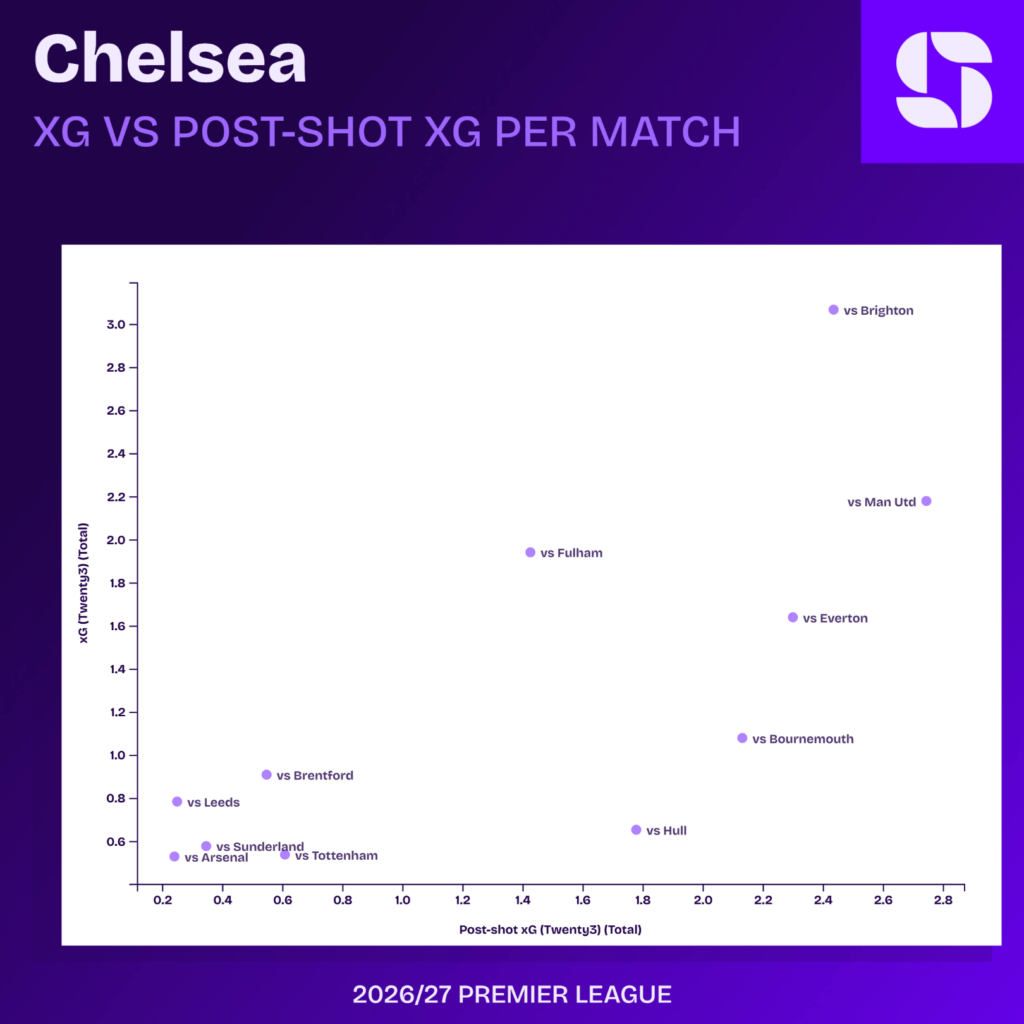
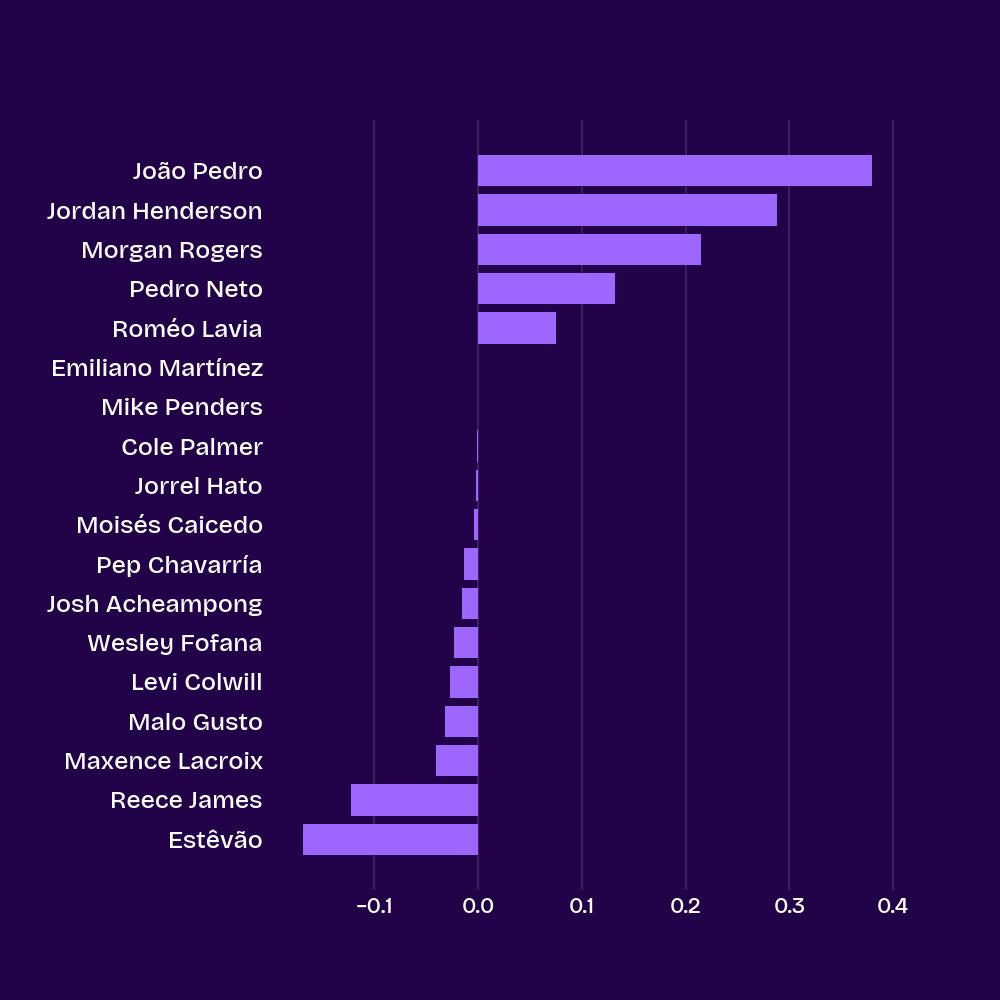
Chelsea are the biggest xG overperformers in the Premier League this season, with a difference of +6.26. They’ve leaned heavily on Morgan Rogers and Joao Pedro, who have accounted for half of their league goals. The Blues haven’t suddenly developed a knack for manufacturing high-quality opportunities. On the contrary, their big chances have dropped from 1.97 per game last season to 1.73 in 2026/27. And they’ve generated less xG than their opponents in seven of their past nine league games.
xG overperformance
While Joao Pedro continues to demonstrate his credentials as a fox in the box, Rogers has provided Chelsea with flashes of individual brilliance, converting chances from considerably less favourable positions. It’s not as though Chelsea are sacrificing defensive solidity in pursuit of a devastating attack. Rather, they’re relying on the individual brilliance of their forwards to paper over the cracks in their collective chance creation.
While Chelsea are creating 10.36 chances per game this season, just 16.7% of those are classified as big chances.
The numbers paint an equally worrying picture at the other end of the pitch. The Blues are operating with a razor-thin margin for error, averaging 13.64 shots (5.45 on target) per game while conceding 13.27 shots (approximately 5.55 on target). For all the money invested in their squad, Chelsea are barely managing to outshoot their opponents.
What’s more, Chelsea have repeatedly proven to be the architects of their own downfall. One in five of their goals conceded has stemmed directly from an individual error, while they’ve committed an additional 12 errors leading to opposition shots. In comparison to last season, Chelsea are conceding more goals (+32.8%) and shots (+21.2%) while committing 66.7% more errors leading to opposition shots or goals per game.
Too easy to face
Chelsea aren’t necessarily being bombarded with shots. But when opponents do manage to breach their defensive structure, they’re doing so to devastating effect. Despite conceding fewer shots per match than the Premier League average, Chelsea are conceding 33% more big chances, with only two sides affording their opponents more clear-cut opportunities. Only five teams have accumulated more expected goals against than Chelsea (17.30). It’s a particularly damaging combination: opponents are finding it far too easy to carve open Alonso’s defence and manufacture high-quality opportunities without having to exert sustained attacking pressure.
Unlike Arsenal, Brighton, Manchester City, Liverpool and Bournemouth, all of whom sit above them in the table, Chelsea aren’t having to juggle European commitments with domestic football. Despite benefiting from a comparatively lighter schedule, the Blues have repeatedly wilted as matches have progressed, squandering early leads against Arsenal, Leeds and Hull and struggling to regain their composure in the face of adversity.
This was particularly evident against Tottenham and Brentford. Chelsea entered both games level at half-time, only to concede multiple goals after the break.
Perhaps the most damning example came at Brentford, where Chelsea enjoyed their most sustained spell of attacking momentum midway through the second half. Rather than finding an equaliser, however, the Blues conceded twice more in the closing stages.
Poor organisation
Chelsea don’t need to be pinned back for prolonged periods to come undone. Opponents have proven capable of inflicting considerable damage in fleeting attacking sequences, raising questions about Chelsea’s defensive organisation, their management of risk when chasing matches and their ability to respond to setbacks. It’s a particularly concerning trait for a team that aspires to dictate proceedings through possession.
From Frank Lampard to Thomas Tuchel, from Graham Potter to Enzo Maresca to Liam Rosenior, Chelsea have already made five mid-season managerial changes this decade. Their current league position might not ordinarily warrant a sixth, but the underlying numbers suggest that eighth place is more a reflection of their clinical finishing than the quality of their collective performances.
Unless Alonso can engineer a substantial improvement at both ends of the pitch, it might not be long before his name is added to that list.