





Brentford sit sixth in the Premier League this season, but not everything is rosy.
The Bees have won just two of their opening seven league games, drawing four and losing one. Keith Andrews‘ side only lost for the first time at the weekend, beaten 2-1 by Liverpool. But it was another familiar story.
Keane Lewis-Potter gave Brentford the lead just before half-time but Yehor Yarmolyuk’s red card deep into first-half injury time started the turning of the tide. Victor Munoz equalised just after the hour-mark and Alexander Isak completed the turnaround in the 70th minute. To make matters worse, Vitaly Janelt was sent off in second-half injury time, halting any dreams of a dramatic equaliser.
Brentford have now dropped 11 points from winning positions in the Premier League this season, more than any other club. While the defeat to Liverpool may be treated as an outlier due to the numerical disadvantage, it’s a worrying trend.
But why have Brentford struggled?
Brentford’s lost leads:
A change in tactics
Brentford have led in all seven of their Premier League games this season, and only Tottenham Hotspur and Chelsea have failed to get a point off the Bees. Andrews’ men led for 40 minutes against Leeds United before Dominic Calvert-Lewin’s equaliser in the draw. There were 25 minutes between Vitaly Janelt’s opener and Enzo Le Fee’s equaliser as Brentford drew with Sunderland. Brentford were ahead for just four minutes against Bournemouth, but did then have to come from behind to secure their 2-2 draw. It was a similar story in the draw against Aston Villa, though Brentford’s lead only lasted two minutes. In fact, in both of those matches, Brentford’s lead and the time it took for them to later draw level were the same. And, finally, Brentford led Liverpool for 28 minutes before Victor Munoz’s equaliser, including stoppage time.
While Andrews hasn’t drastically changed Brentford’s system when leading this season, there have been minor alterations. And they’ve been enough to make a negative difference.
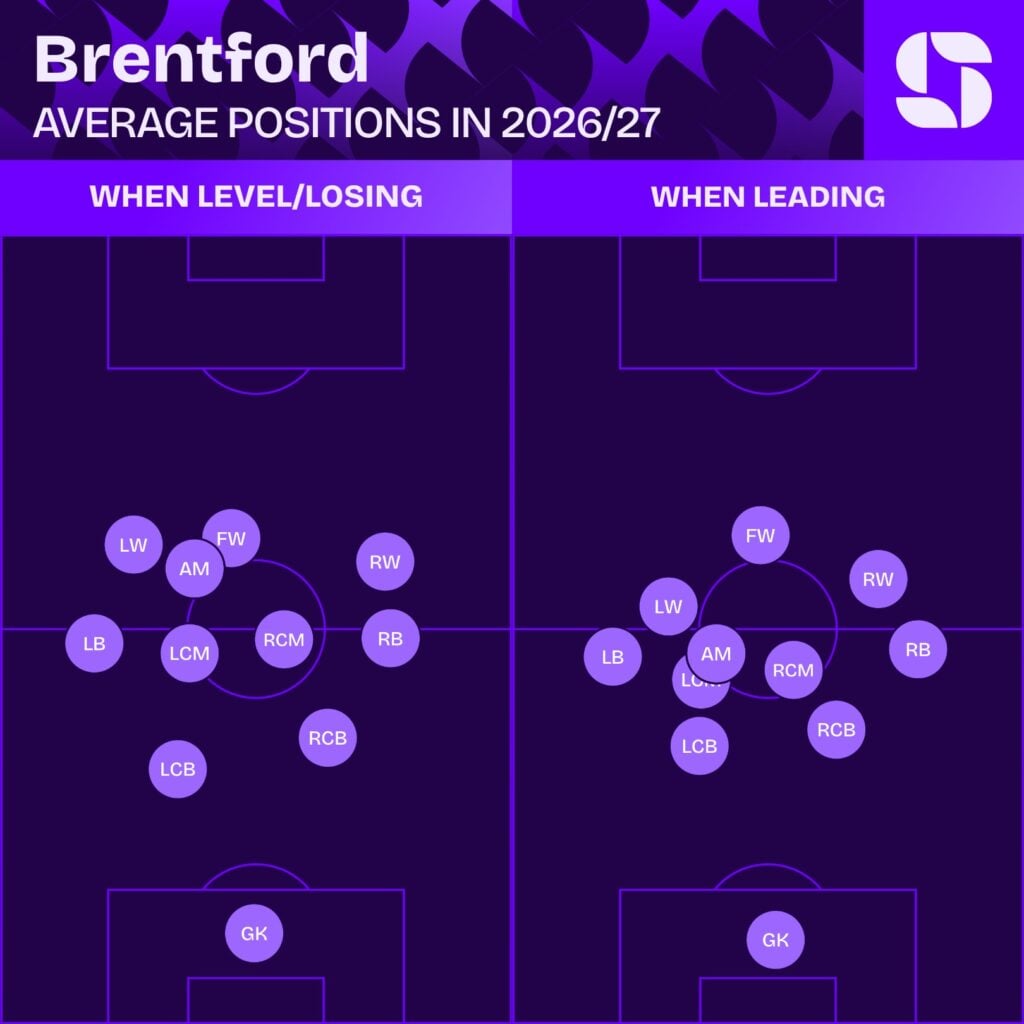
One of the changes has been the reduction of width. Brentford aren’t the widest team in the Premier League, but they do utilise their wingers. Kevin Schade is one of the most-advanced players when Brentford aren’t leading, while Jaidon Anthony has a good relationship with Michael Kayode on the right. However, when Brentford lead, the two wingers tuck in quite a lot. It leaves the two full-backs as the widest players, but neither are getting forward — as you’d expect with a lead to protect.
The other major change is in the No.10’s positioning. When Brentford are seeking a goal, the No.10 — Mathias Jensen, Mikkel Damsgaard, Yarmolyuk and Keane Lewis-Potter have all started there this season — links up well with Igor Thiago and is in line with the other attacking players. It’s this unit that works so well for Brentford in attack. But when Brentford are ahead, the No.10 starter drops deeper into the midfield to form a trio alongside the initial double pivot. Although this should add more midfield solidity, it leaves the striker isolated.
Busier in attack
The change in width would be expected to limit Brentford’s attack. But they are actually more dangerous in front of goal when looking to add to a lead. The Bees average 12.54 shots per 90 minutes when either level or losing in the Premier League this season. This ranks them ninth in the Premier League. But when Brentford are leading, they’ve averaged 15.63 shots per 90 — the sixth-most in the division.
Brentford have been doing this with less of the ball. The Bees aren’t a possession-based team, so again this shouldn’t be a surprise. Andrews’ men average 44.9% possession in the Premier League, the fifth-lowest so far this season. They also rank third-lowest for passes attempted per game at 367.29, with only Coventry City and Hull City below them.
And the Bees concede possession when they’re ahead. They have averaged 293.66 passes per 90 when ahead in the Premier League, with only three teams averaging fewer. It’s a drop from the 400.20 passes per 90 when Brentford are level or behind, though they still rank 17th out of 20.
More leaky defensively
This is perhaps less surprising. When teams are trying to defend a lead, they allow opponents more of the ball. As a result, they do end up facing more shots. Like most sides, Brentford’s defensive actions move further back when they are protecting a lead. The Bees average 4.61 possesions won in the attacking third per 90 when they are level or behind in the league this season. Only Bournemouth (5.70) and Brighton and Hove Albion (6.02) average more per 90. That number drops to 3.80 possessions won in the attaacking third per 90 when leading, the ninth-most in the Premier League.
There’s a similar drop in possessions won in the middle third too. Brentford average 15.68 possessions won in the middle third per 90 when they’re looking for a goal, compared to 13.52 when defending a lead. Naturally, this leads to more work in the defensive third. And Brentford do average more possessions won in the defensive third per 90 when ahead, at 23.24 compare to 20.84 when level or losing.
But Brentford are also facing more shots per 90 when ahead. They average 12.54 shots faced per 90 when drawing or losing, ranking around mid-table among Premier League teams. That number jumps to 16.90 shots faced per 90 when leading, the seventh-most in the Premier League. Brentford’s difference of +4.36 is the sixth-most in the Premier League. While that may not feel alarming, it places Brentford among the likes of Nottingham Forest (+4.47) and Aston Villa (+3.84). Brentford will want to be mimicking Liverpool (+1.18), Manchester City (+1.15) and especially Arsenal (-4.0).