




It’s still early in the year but there are some worries about Burnley.
The Clarets were relegated from the Premier League in May and currently sit in the Championship‘s relegation zone. Nicky Hayen was brought in to replace Scott Parker in the summer but he only lasted 12 league games before being sacked. Fabio Celestini has been tasked with turning things around at Turf Moor.
But if Burnley were to continue to struggle, they wouldn’t be the first team to suffer back-to-back relegations from the Premier League to League One. They’d be the sixth, and would follow in some recent footsteps.
We’ve taken a look at the infamous five teams below.
Tote sign-up offer: Bet £10, get £30 in free bets
Not signed up to Tote yet? Here's how eligible readers* can take advantage of their welcome offer:
- Open an account at Tote using this link.
- Use code B10G40 on registration.
- Deposit and place a £10 bet on sports or racing at 1/1 or greater.
- When it settles, unlock £30 in free bets

#AD 18+ New customers online only. Eligibility restrictions apply. Bet min of £/€10 at odds of 1/1 (2.0) or greater across sports or racing (if EW then min £/€10 Win + £/€10 Place) within 7 days of registration. Receive £/€20 Tote Credit and £/€10 Free Sports Bet. Qualifying bet is the first racing pool or sports bet added to the bet slip. 7-day expiry. Full T&Cs apply. Gambleaware.org.
Swindon Town (1993/94 & 1994/95)
Swindon Town were the first team to suffer successive relegations from the Premier League to the third tier. And they did it very early on.
The 1993/94 campaign was Swindon’s first in the Premier League, gaining promotion the previous year. But their stay in the top flight was very short-lived. One season, in fact. The Robins finished rock bottom in the Premier League with 30 points in their 42 games. They won just five matches and conceded a whopping 100 goals — a Premier League record they held for 20 years.
Swindon’s fortunes didn’t change in the First Division in 1994/45. The Robins did have a good cup run after changing their manager midway through the season, with Steve McMahon coming in as player-manager to replace John Gorman. But the League Cup semi-final appearance was later overshadowed by relegation, with Swindon finishing six points from safety. They had the second-worst defence in the league, conceding 73 goals. But Swindon were also slightly unlucky, as this was a rare season with four relegation places. And they finished in the fourth spot.
There was no risk of a third successive relegation, as Swindon won the Second Division at the first time of asking.
Wolves (2011/12 & 2012/13)
Wolverhampton Wanderers had spent a lot of time between the Premier League and Championship. But they weren’t a yo-yo club. The 2011/12 campaign brought a three-year stay in the Premier League to an end. And it was coming. Wolves won just five of their 38 games in 2011/12, with Mick McCarthy sacked in February. Terry Connor replaced him but couldn’t turn things around. Wolves finished bottom of the table, having won just one of their final 24 league games.
The freefall continued into the Championship. There was another mid-season managerial change, as new boss Stale Solbakken struggled in his first job in English football. While Wolves weren’t in the relegation zone, they were in danger. But Dean Saunders couldn’t do any better and his managerial stint saw Wolves finish 23rd, four points from safety. To make matter worse, this wasn’t the first time Wolves had suffered back-to-back relegations from the top flight. They’re the only club to have suffered back-to-back relegations from the top flight twice — previously doing so in the early 1980s, before the creation of the Premier League.
Like Swindon, though, Wolves secured automatic promotion back to the Championship at the first time of asking. It was the start of their quest to eventually become Premier League regulars.
Sunderland (2016/17 & 2017/18)
This may have been the most widely-publicised back-to-back relegation in football history. Immortalised by the first season of the Netflix series Sunderland ‘Til I Die. But let’s not get ahead of ourselves. Sunderland were in their 10th successive Premier League season, but had spent the previous four battling relegation — including two 17th-placed finishes. David Moyes was the man on the touchline and he remained in charge for the entire season, despite Sunderland’s struggles. The Black Cats took just 24 points from their 38 games, with 26 defeats proving the killer. They were a whopping 16 points from safety.
Then came 2017/18. Sunderland had three permanent managers during the campaign, starting with Simon Grayson who had replaced Moyes in the summer of 2017. But he was sacked in November with Sunderland 22nd, and replaced by Chris Coleman. Coleman made it to April but could not turn Sunderland’s fortunes around. In fact, he had taken them to the bottom of the table. Jack Ross was the man to see out the season. Although Sunderland were only six points from safety, they did finish 24th and won just seven out of 46 matches.
Unlike Swindon and Wolves, Sunderland didn’t gain immediate promotion back to the Championship. They lost the play-off final to Charlton Athletic.
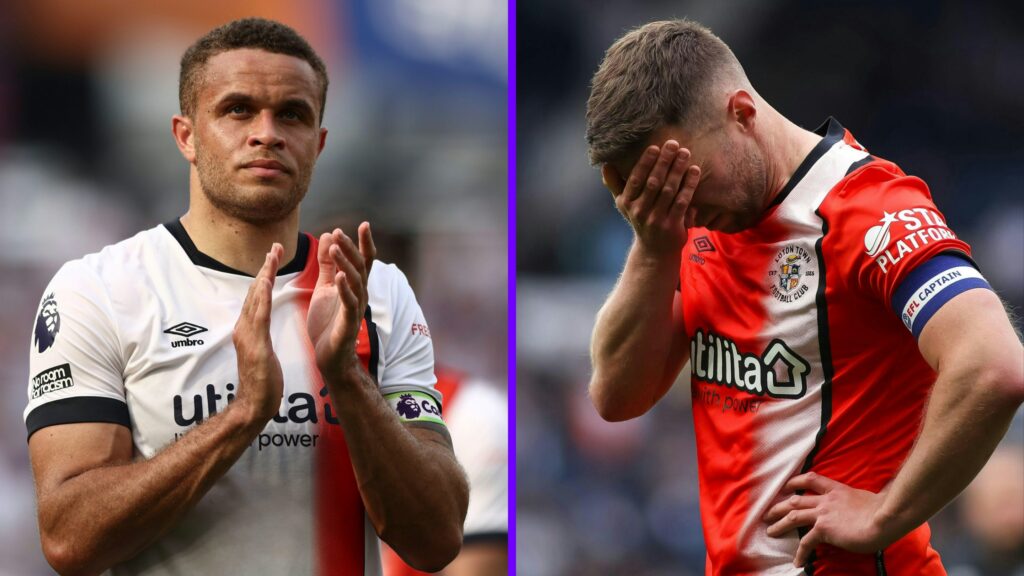
Luton Town (2023/24 & 2024/25)
Luton Town started the recent trend of back-to-back relegations from the Premier League. And it rocked the club. The Hatters had been one of the stories of the 21st century, sinking as far as non-league at the start of the 2010s to eventually return to the top-flight after over 30 years away. But their return was short-lived. Rob Edwards tried to keep his style of football going in the Premier League and Luton did cause some teams problems. But it wasn’t enough to save the Hatters. They finished 18th, six points from safety. But it would have been a bigger gap had Nottingham Forest not suffered a points deduction.
The Hatters kept their faith in Edwards, even after a poor start to life back in the Championship. But their patience ran out at the start of 2025 and Matt Bloomfield was brought in to replace him. Luton were 20th at the time, but Bloomfield could not life them up the table. They were ultimately let down by their defence, conceding 69 goals — the fourth-worst record in the division. Luton were relegated on goal difference, having finished level on points with 21st-placed Hull City.
Luton missed out on the chance of an immediate return to the Championship, finishing one point outside the League One play-off places. They paid the price for a couple of winless runs across the campaign.
Leicester City (2024/25 & 2025/26)
Finally, Leicester. The Foxes had already suffered relegation from the Premier League after winning the title. And their drop in 2022/23 had been a bit of a shock, following on from an eighth-placed finish and a run to the Uefa Conference League semi-finals. They returned immediately thanks to Enzo Maresca‘s work in 2023/24. But Maresca left the club and was replaced by Steve Cooper, who just couldn’t get up and running. Nor could Ruud van Nistelrooy, who replaced Cooper in December. The Foxes were 13 points from safety having won just six of their 38 games, conceding 80 goals!
Things got worse in the Championship. Leicester had two permanent managers and one caretaker last season, and they all struggled more than they should have. The Foxes did have to deal with big squad changes in the summer, including losing Jamie Vardy, Wilfred Ndidi and Mads Hermansen. A lack of consistency was Leicester’s main problem, never winning more than two consecutive league games. But their 2026 was also killer. The Foxes won just three of their 22 league games between the start of the year and the end of the season, form which saw them relegated. That was also helped by a six-point deduction given in February, though.
The 2026/27 season didn’t start too well either, but Leicester have been slowly climbing the table as they seek an immediate return to the second-tier.