







Over the past few years, several Premier League clubs have gatecrashed the VIP section of European football.
Aston Villa, Newcastle United, Nottingham Forest have all ended lengthy continental exiles over the past few years, while Brighton and Hove Albion, Crystal Palace and Bournemouth have secured their first-ever tastes of European competition.
Now Brentford are looking to join the party.
The Bees missed out on a maiden European voyage due to goal difference last season, but they currently sixth in the league, one point behind fifth-placed Bournemouth. With just four points separating them from 13th-placed Newcastle, there’s still plenty of time for the table to take shape. But there’s reason to believe that Brentford have the credentials to go the distance in the race for European football.
Defensive shortcomings a distant memory
Last season, Brentford finished ninth despite outscoring both Sunderland and Brighton. Their defensive shortcomings ultimately cost the Bees a European berth. Only Liverpool and Bournemouth conceded more goals among teams in the top half of the table than Brentford’s 52. This season, however, Brentford have tightened things up considerably, conceding just 11 goals in 11 matches.
Since returning to the top flight in 2021, Brentford have established themselves as a Premier League mainstay by adhering to several core principles. They’re physical and boast tactical flexibility, set-piece proficiency, verticality in possession and a preference for shot quality over quantity.
However, in Keith Andrews’ second season in west London, the Bees are deviating from some of the tactical tenets that have buttressed their top-flight success.
Brentford’s data-driven approach to recruitment has long been mirrored by their decision-making on the pitch. In Thomas Frank‘s final season at the helm, the Bees boasted the Premier League’s highest shot accuracy (39%) and joint-highest proportion of shots from inside the six-yard box (14%). They were the pickiest eaters at the Premier League dinner table, resisting the temptation to shoot until a sufficiently tantalising opportunity presented itself. At the opposite end of the pitch, they were content to invite speculative long-range efforts while barricading the more dangerous avenues to goal: no Premier League goalkeeper made more saves from outside the box than Mark Flekken (46).
Improvements from last season
Under Andrews, Brentford have continued to wreak havoc on the counter-attack while developing a more nuanced approach in possession. They’re attempting virtually the same number of passes as last season, but a considerably greater proportion of those passes are coming in the final third (31.7%, up from 26.6%). And their final-third pass accuracy has risen from 62% to 67.9%.
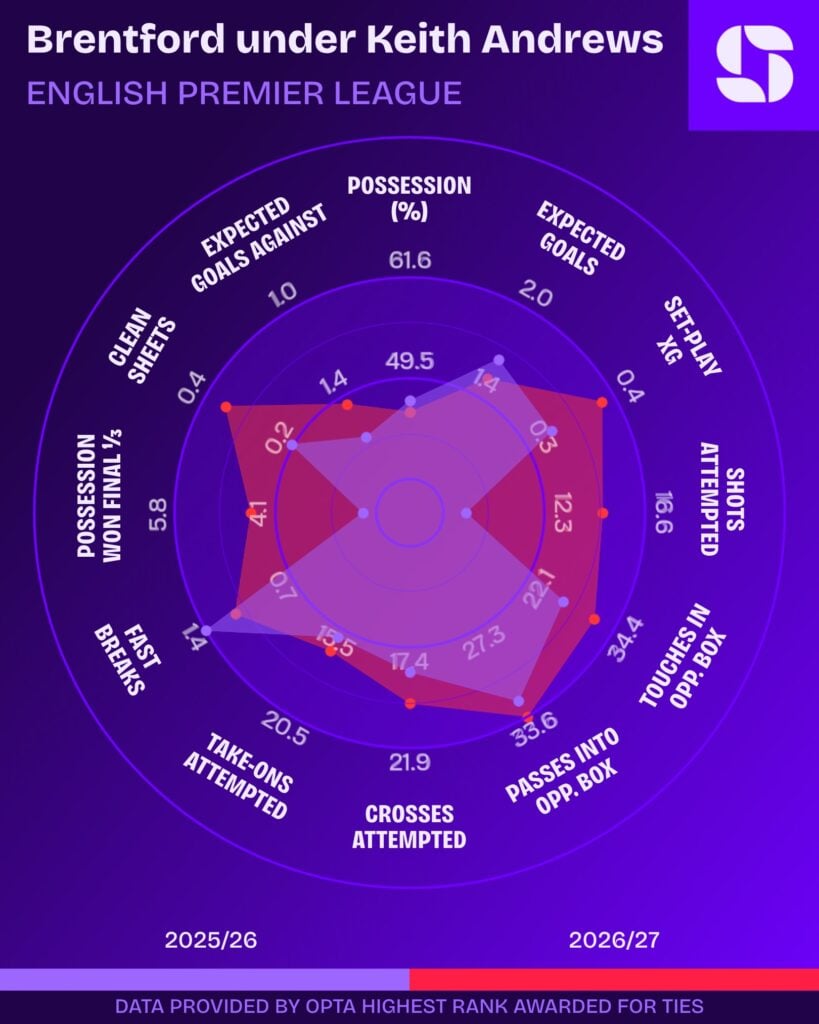
While Brentford have traditionally looked to bypass the pressure with long balls over the top, they’re becoming increasingly comfortable drawing opponents out with measured passing sequences before threading the needle with a well-timed through-ball. Their long-ball frequency has dropped from 14.6% to 12.9%, while they’re completing 51.5% more through-balls and 31.1% more final-third passes per game than last season.
This evolution is also evident in their strategy out of possession. Brentford are registering more high turnovers, regaining possession more frequently in the attacking third and allowing the opposition fewer passes per defensive action. Rather than simply lying in wait to catch opponents on the break, they’re becoming more adept at manufacturing those opportunities themselves by disrupting opposition buildup.
But while Brentford are spending more time on the front foot, they aren’t churning out better chances. Despite attempting nearly 30% more shots per 90 than last season, their big chance creation has dropped from 2.29 to 1.55 per 90, while their shot accuracy has fallen from 36.3% to 28.3%. For a club that have traditionally prided themselves on their selectivity in front of goal, this represents a salient departure from their attacking blueprint.
Mamadou Sangare’s influence
Over the past few years, Brentford have grown accustomed to seeing their prized assets plucked away by rival clubs. Christian Eriksen, David Raya, Ivan Toney, Yoane Wissa, Christian Norgaard and Bryan Mbeumo have all left in recent summers. This past summer, however, they managed to preserve the nucleus of their squad while making targeted reinforcements. Jannik Schuster has succeeded Ethan Pinnock in central defence, while the departures of Jordan Henderson and Frank Onyeka have paved the way for the arrival of Mamadou Sangare.
Having established himself as one of Ligue 1‘s premier ball-winners at Lens, Sangare has wasted little time in acclimatising to the rigours of English football. Only Xaver Schlager (33), James Garner (29) and Boubacar Kamara (29) have registered more tackles among Premier League midfielders than Sangare’s 28. He and Vitaly Janelt (27) account for nearly a third of Brentford’s total tackles. The Mali international also ranks joint-eighth in the Premier League for duels won (52) among midfielders.
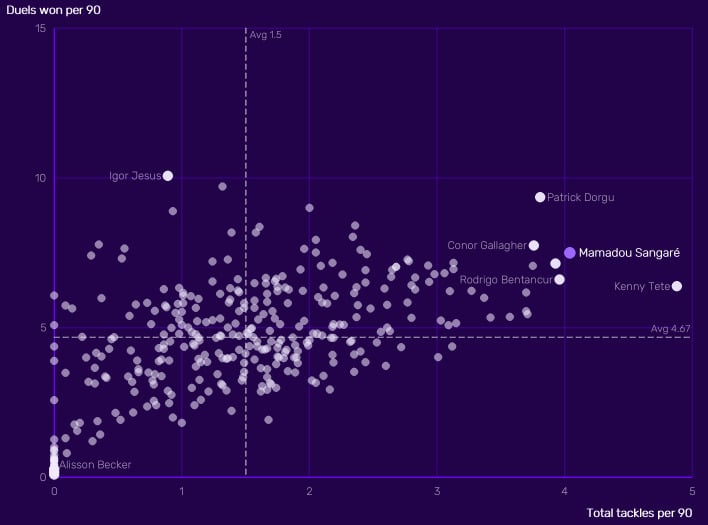
Sangare’s arrival has coincided with a 28.4% increase in Brentford’s interceptions per game and a 39.3% increase in their possession recoveries in the attacking third. However, his value extends beyond his capacity to wrestle possession away from opponents. His ability to progress the ball forward after regaining possession makes him particularly well-suited to Andrews’ style of play, providing Brentford with a midfielder who can both extinguish opposition attacks and ignite their own.
What the underlying numbers show
The underlying numbers suggest that Brentford’s start to the season should be viewed with a degree of caution. They have scored 20 goals from 16.98 Expected Goals and conceded 11 from 15.77 xG against. Their actual goal difference (+9) far exceeds their expected goal difference (+1.21), suggesting that their lofty position owes plenty to their efficiency in both penalty areas.
Only Chelsea and Brighton have exceeded their attacking xG by a greater margin, while only the Seagulls’ opponents have underperformed their xG to a greater extent. Irish goalkeeper Caoimhin Kelleher deserves considerable credit for Brentford’s defensive improvement, but the Bees have also been beneficiaries of opposition profligacy.
At the other end of the pitch, Brentford’s increased shooting volume has come at the expense of chance quality. Should their finishing efficiency wane and their opponents rediscover their shooting boots, Brentford could find themselves sliding down a congested Premier League table. Even so, there’s plenty of evidence to suggest they can remain in the hunt for European qualification, particularly if England is once again afforded nine European berths, as has been the case in each of the past two seasons.
Just five years after ending a 74-year exile from the English top flight, Brentford find themselves knocking on the door of European football. Having spent five years building their hive in England’s top flight, the Bees are now looking to spread their wings beyond English shores and savour their first taste of European nectar.