





Brighton and Hove Albion are thriving in the Premier League under Fabian Hurzeler.
The Seagulls did not let their 0-2 loss to Liverpool affect them and bounced straight back with consecutive wins against Manchester City and Brentford.

Up next are struggling sides Hull City and Newcastle, which could mean the streak goes on for Brighton. Could be an opportunity for them to cut the five-point gap to Arsenal at the top of the table. And perhaps to distance themselves from Man City in third just one point behind them.
Many people have accurately pointed out their out-of-possession work as one of the driving forces behind their incredible start. Another factor that has been talked about is how everyone in the squad seems to be thriving. We even took a deep dive into how and why so many players have scored for them so far.
- READ MORE: How Brighton’s squad have shared goalscoring responsibility and why it may be a good thing
But we should also focus on their squad building and how it has suited Fabian Hurzeler’s way of working.
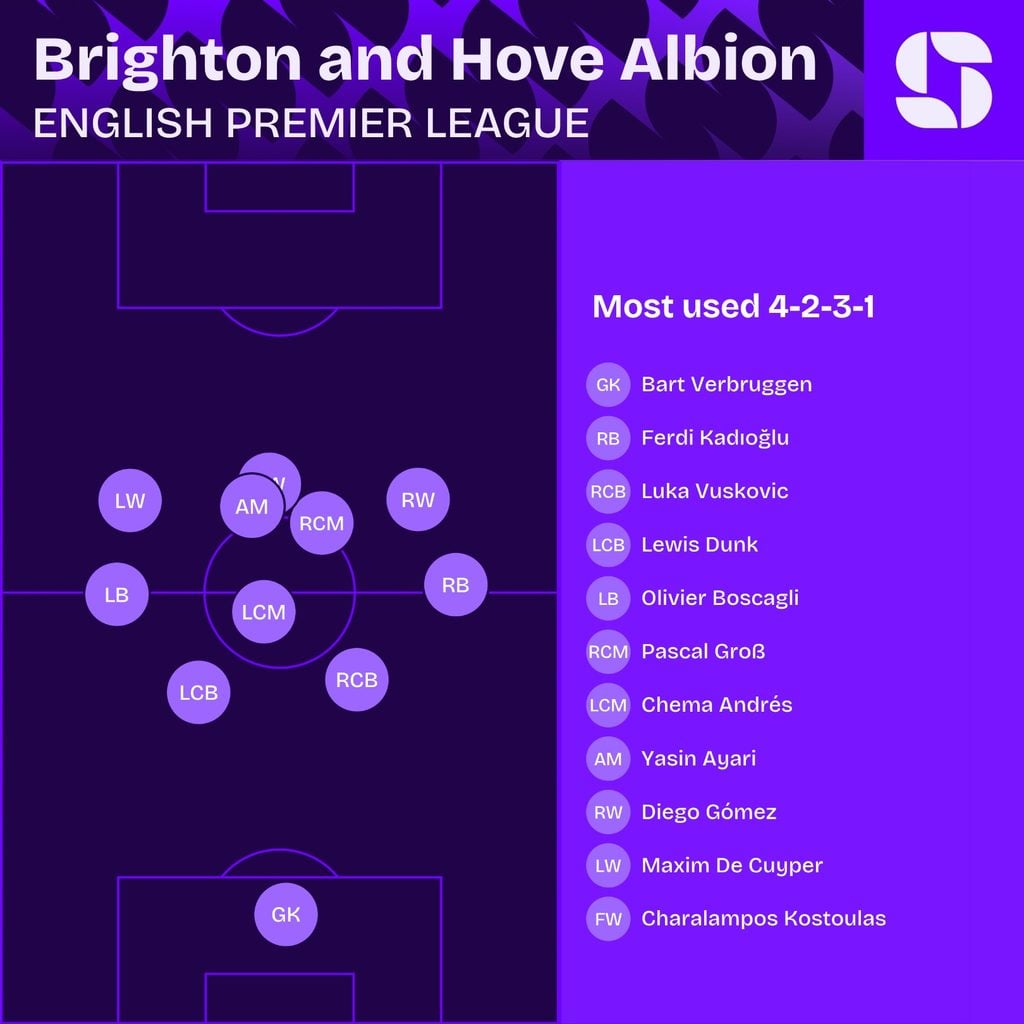
The German has lined the Seagulls up in a 4-2-3-1 in every single Premier League game they have played this season. Of course, it can shapeshift into a 4-1-4-1/4-3-3 or a 3-1-6 when they have the ball.
But Hurzeler is trying to solidify one main unit. The Seagulls have made just eight changes to their starting XIs this league season, which is the second fewest (Bournemouth with six). For perspective, every other side has made 10+ changes and 12 have made at least twice as many as Brighton.
This, however, doesn’t mean that everyone plays the same role every time. Hurzeler seems to be edging closer towards a ‘positionless’ type of football, in which many players can perform multiple roles. Arsenal have also done that and steered their recruitment this way.
Yasin Ayari has spent 59% of his playing time as the central attacking midfielder, but has also played a lot as a defensive midfielder (35%). And doing both roles – joining the centre-backs in their preferred 3+1 build-ups or further forward looking to attack the half-spaces or receive the ball with his back to goal.
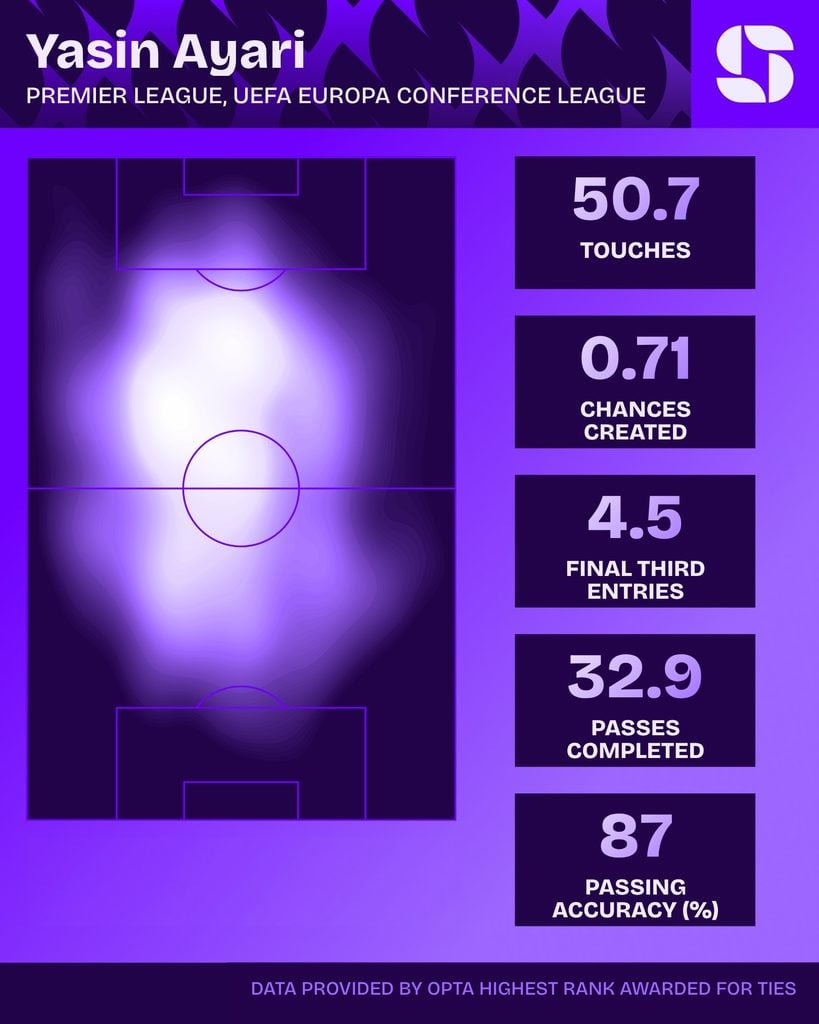
One may look at his heatmap and think he is an all-around kind of midfielder who does a little bit of everything during games, which isn’t false. But the reality is more that he usually performs different – sometimes opposite – roles depending on the game.
Jack Hinshelwood is another prime example. Hurzeler moved him further up the pitch to get the most out of his energy and work rate to recover possession close to goal. Not by chance, the Seagulls have the joint-lowest PPDA of the Premier League (8.7, alongside Tottenham Hotspur) and rank second in pressed sequences (13.9 per match).
The 21-year-old has played 73% of his minutes as central attacking midfielder, but has recently gone wide more often. 17% of his minutes have come on either wing (11% on the left, 6% on the right). Not to mention the remaining 10% as a defensive midfielder.
Speaking of playing on both flanks, Ferdi Kadioglu has mastered this specific art. The Turkish full-back has played at right-back for 77% of his playing time, but 18% have come on the left (5% as a right winger).
Meanwhile, actual left-back Maxim De Cuyper has basically turned into a full-time left-winger under Hurzeler (90% of his playing time). Though he has still spent 9% of his minutes in the backline.
Malick Yalcouye is also an extreme example of versatility. A central midfielder by nature, he has operated as an attacking midfielder for 67% of his playing time, but also 26% on the left flank and 6% as a defensive midfielder. But he gave the Seagulls an important win over Getafe by playing as a right winger.
We haven’t even mentioned jack-of-all-trades Mats Wieffer, who has only played four games in an injury-plagued campaign so far and who could be full-back, defensive midfielder or even centre-back if needs be.
Having this many players capable of contributing in different parts of the pitch comes in extremely handy out of possession as well. Hurzeler employs a tight man-to-man press that often sees players dragged out of their original position. And he also tries to have his defenders tracking their man individually even in deep, zonal situations at the back as well.
And one of the best ways to counter man-marking is precisely by moving players around. But since Brighton are great at recovering possession, sometimes it happens with a defensive midfielder or even a centre-back finding himself getting the ball back near the opposition box. That’s why it’s so important to have versatile footballers in the squad.
If this is the future of football, we will look back in a few years and see that Brighton were one of the pioneers.