






After two games of the new Premier League season, Chelsea were being tipped for a title race.
The Blues won their opening two games, beating Fulham and Brighton and Hove Albion. It had them fourth, one of four teams still perfect.
But Chelsea are now winless in three in the league, with one draw and two defeats. They were held at home by Hull City and lost London derbies against Arsenal and Brentford. It leaves Chelsea down in 10th, with negative goal difference and the worst defence in the league.
But why have Chelsea suffered so much? And what does Xabi Alonso need to do to turn things around after the international break?
In this article, we’ll cover:
A change in control
There was a lot of emphasis on Chelsea’s possession, or lack of, in their opening two games. Alonso’s men averaged 32% possession across their first two games, the second-lowest in the league. Only Hull (29.9%) had less of the ball in that time.
But Chelsea made it work. In their win over Brighton, Chelsea had just 25.92% possession, the second-lowest of any team in a single Premier League games this season. The Blues were more rigid in formation, showing clear signs of a set system lining up in Alonso’s 3-4-2-1. Everyone had their space on the pitch and executed their role well. On the ball, Chelsea were constantly looking to get up the pitch as quickly as possible. It’s a system Chelsea fans are familiar with.
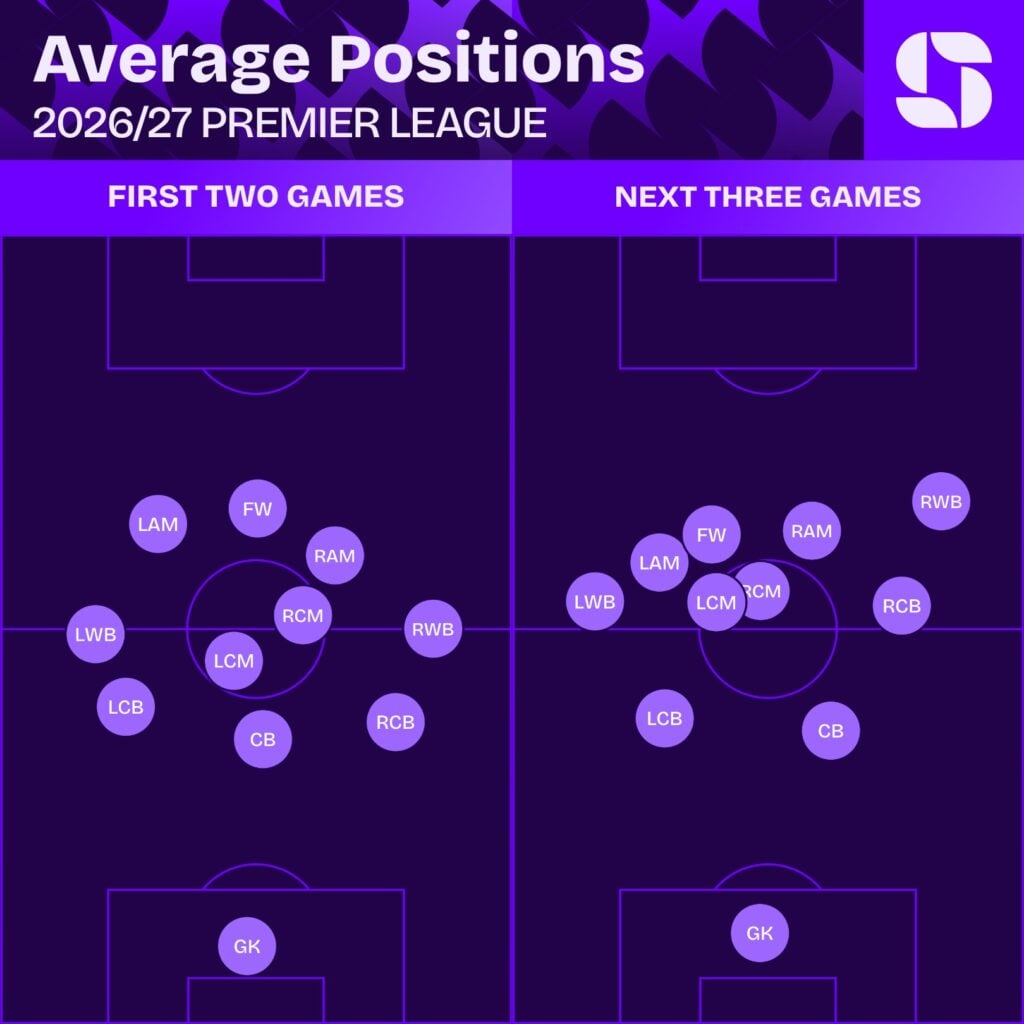
However, counter-attacking football is not the way Chelsea’s hierarchy want the Blues to play. Attacking control has been a long-term goal for Chelsea. And Alonso has tried to implement that. Chelsea’s last three games have seen them average 57.87% possession, the fourth-most in the Premier League. And that includes the defeat to Arsenal, when the Blues still only held 45.5% of the ball.
But with that added control has come more chaos. Alonso hasn’t stuck to the formation, changing to a back four against Hull. His back three has also been more of a back four in practice, with the right centre-back operating much higher up the pitch. The midfield and forward line have also been less structured, opening up gaps in the Chelsea team.
Defensive weaknesses not fixed
On paper, it might look as though Chelsea have more defensive control. It would be easy to understand at its most basic. If you have more of the ball, the opponent has less chance to hurt your defence. Across their past three matches, Chelsea’s opponents have only averaged 6.33 sequences per game with 10+ passes. That’s a massive decrease from the 21.5 sequences with 10+ passes average from Chelsea’s opening two games.
Chelsea are also facing fewer sequences ending in the final third at 60.33, down from 79.5 per game. And a lower percentage of their opponents’ sequences are ending in the final third, dropping from 45.95% to 41.51%.
But Chelsea haven’t seen much difference in the shots they are facing. The Blues have conceded 14.33 shots per game across their past three matches, only a minor change from the 14.5 in their opening two. When you look at the number of sequences faced ending in the final third, Chelsea have been weaker. They’ve averaged a shot conceded every 4.21 sequences faced ending in the final third across their past three games — up from 5.14 in their opening two matches.
Alonso’s men have been given up better opportunities too. Across their first two league games, Chelsea averaged 1.22 Expected Goals conceded per game , with 1.51 post-shot xGC. In their past three matches, the averages have gone up to 1.68 xGC and 2.42 post-shot xGC per game.
More possession, less shooting
To add to it all, Chelsea aren’t hurting opponents their increased possession. It’s possession for possession’s sake. Looking back to their first two games of the season, Chelsea were a lot more direct with their attacking. Despite only attempting 310.5 passes per game, 39.13% of those went forward.
There was meaning to Chelsea’s possession. It got them into shooting positions often, averaging 17.5 shots per game, with 6.0 hitting the target. They were good opportunties too. Chelsea averaged 4.5 big chances created per game across their opening two matches, posting an average of 2.5 xG. Even with the slightly poorer finishing, with 1.93 post-shot xG per game, Chelsea were constantly putting opponents under pressure.

But now, Chelsea aren’t doing enough with their time on the ball. The Blues are averaging 13.33 sequences with 10+ passes per game, resulting in 12.33 shots. That’s an average of a shot every 1.22 sequences with 10+ passes. Of course, not every shot comes from a sequence with 10+ passes. And an average of close to one looks strong. But, again, it’s about the comparison.
In their first two games, Chelsea only needed 0.34 sequences with 10+ passes per shot. Their possession wasn’t prolonged, and a lot of shots would have come in sequences with fewer than 10 passes. But the Blues were doing more with less of the ball. And it might be that Alonso needs to get Chelsea on the back foot, prioritising counter-attacking football in order to lift them up the table.