




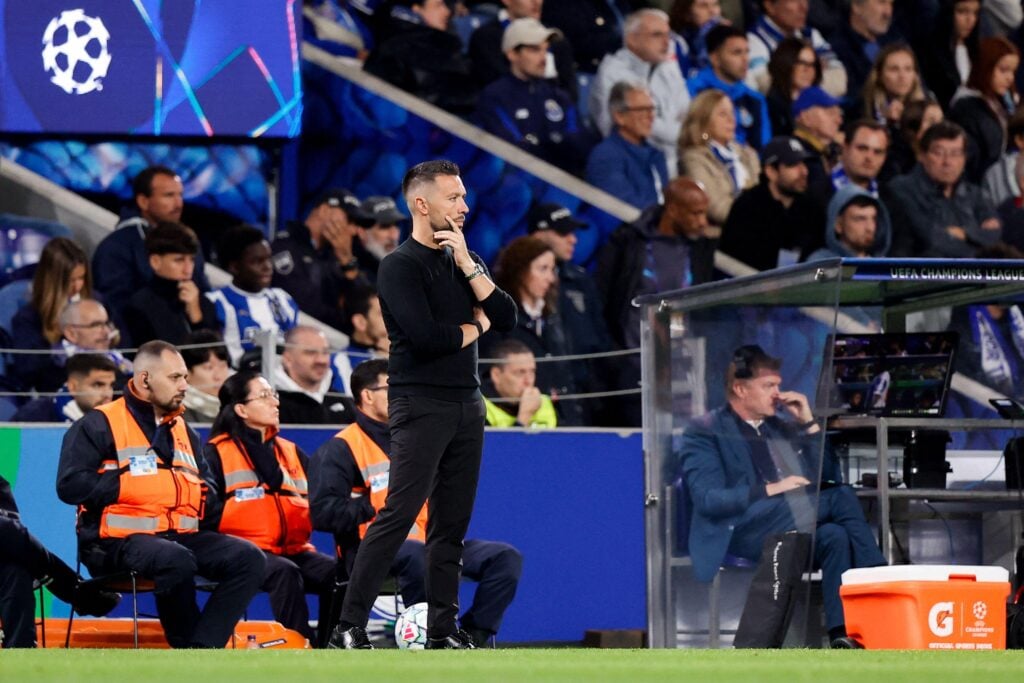
Porto have 10 wins from 10 games in the Primeira Liga but have lost all three of their Champions League matches so far.
Their perfect domestic start actually extends beyond the league. They have won their other two games from cups, one in the Taca da Liga and also the Supercup back in August. This leaves them on 12 from 12 in national matches.
However, it has been the exact opposite in Europe. The Dragons have started the Champions League with back-to-back-to-back defeats to Manchester City, Real Betis and PSV. Only Lille (zero points, -6 goal difference) and Slovan Liberec (zero points, -12 goal difference) are behind them in the league phase table so far.
Why can’t Porto recreate domestic success in the Champions League?
Farioli’s style
Let’s begin with how they play. Francesco Farioli is a pragmatic, rigid and defensive-minded manager who, in fairness, has shown his qualities in this department so far. After all, Porto have conceded just four goals in 10 league games so far.
The Italian feels no real need of having the ball just for the sake of it. So much so that the Dragons rank ‘just’ fourth in possession in the Primeira Liga, with 56%. Given the size of the club and the level of opponents, one would probably guess 60+ and either first or second alongside Benfica or Sporting.
But he takes inspiration from Roberto De Zerbi in his in-possession approach, after being a part of the Tottenham Hotspur manager’s coaching staff in Italy.
Broadly speaking, the 37-year-old likes to bait the opponent’s press in deep build-ups in order to manufacture artificial transitions and play fast with space to run into.
Tougher challenges
Domestically, this works. They are actually sixth in direct speed in the Portuguese top flight (1.3 m/s upfield). And also in big chances (4.4), expected goals (2.3) per game. Not to mention second to Benfica (2.9) in goals scored (2.5) per match.
And, given how weak most of the other Portuguese sides are, they still dominate the ball as we mentioned before, averaging 56% possession despite not being their priority.
The problem comes when facing higher-level opponents. Suddenly, the Dragons sometimes don’t even need to bait the press, as it arrives ‘naturally’. And they are mostly forced to go long and end up giving the ball straight back to the opposition.
In fact, their three losses so far this season have come in the single three games in which they faced the most pressures playing against high blocks, according to advanced Opta metrics. And also three of the four games in which the opponent had the fewest PPDA.
| Opponent | Competition | Pressures received vs high block | Opponent PPDA | High turnovers conceded | Result |
|---|---|---|---|---|---|
| Manchester City | Champions League | 94 | 10.2 | 13 | L |
| PSV | Champions League | 90 | 9.8 | 10 | L |
| Real Betis | Champions League | 86 | 10.5 | 13 | L |
| Maritimo | Primeira Liga | 34 | 9.8 | 13 | W |
The Man City and Betis losses are also two of their three games in which the opposition had the most high turnovers against them (15 vs Academico de Viseu).
Then, it’s a typical case of ‘be careful what you wish for’. Porto usually embrace facing pressure because it’s what allows them to find space and run into in domestic competitions. In the Champions League it becomes a nightmare.
Even more defensive-minded and reactive sides like Manuel Pellegrini‘s Real Betis suddenly aren’t too reluctant to take a few steps up and press. And when teams with better players do that, the results are different.
Porto haven’t managed to get their attacking game going in the Champions League. They are taking way fewer shots and creating way fewer opportunities overall compared to their great returns in the Primeira Liga.
| Porto stats (per game) | Champions League | Primeira Liga |
|---|---|---|
| Goals scored | 0.7 | 2.5 |
| Expected goals | 0.9 | 2.3 |
| Shot attempts | 10.0 | 16.6 |
| Big chances | 2.0 | 4.4 |
| High turnovers conceded | 12.0 | 8.1 |
Even narrowing it down to fast breaks, they do get more counter-attacking sequences in the Champions League (11.7) than in the Primeira Liga (10.4). But they lead to far less danger in Europe (0.8 shots, 0.4 big chances) than in Portugal (0.3 shots, 0.0 big chances).
It has to be said that any tactical changes to their approach wouldn’t also magically lead them to start winning games in the Champions League. Losing 0-2 to Man City at home is nothing to be embarrassed about, for instance.
The competition will still give teams tough games and it’s almost impossible to go unbeaten all the way through it. Especially for a team like Porto that lacks the investment other giants do across the top five European leagues.
But the manner in which they found it hard to compete against PSV and Real Betis does raise a few questions.