








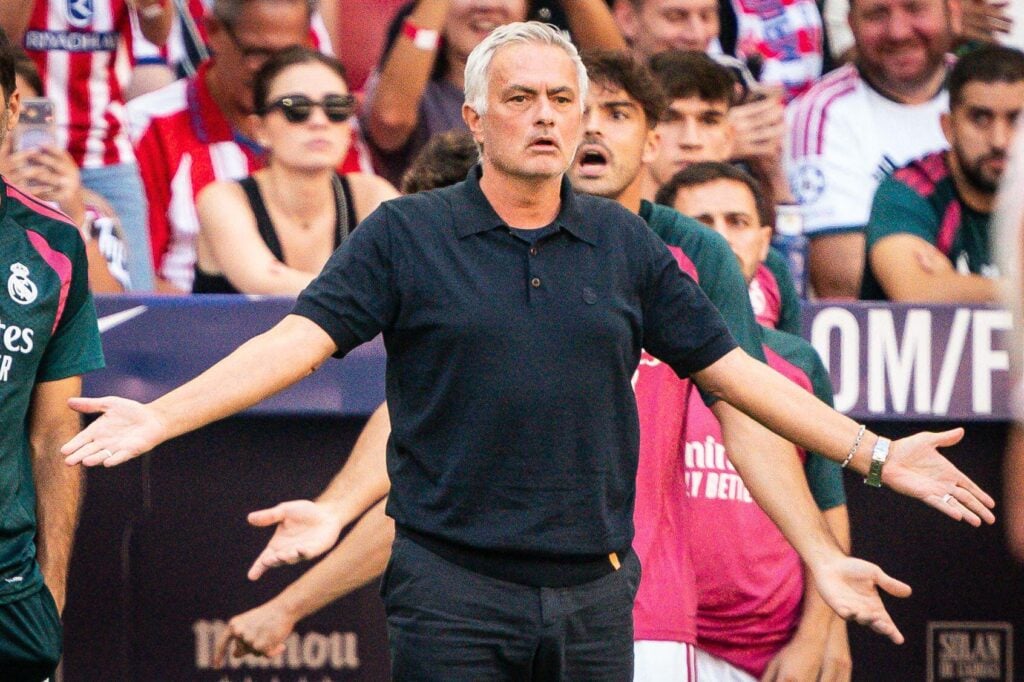
Jose Mourinho returned to Real Madrid this summer with one job at hand, restore Los Blancos to their best.
Real Madrid haven’t gotten off to the best start, sitting fourth in La Liga after seven games played, having won five and lost twice.
Already six points adrift of Barcelona who sit top of La Liga winning seven from seven, Mourinho has a big task on his hands this campaign.
While they did manage to win their only Champions League game so far, beating Inter Milan 2-1, the same question marks were there.
So what is going wrong for Mourinho’s Real Madrid?
In this article, we’ll cover
Data
The data can help us to understand what exactly Mourinho’s Real Madrid side looks like.
Starting off, they are holding just 52.5% possession on average this season after seven games, while Barcelona for example are averaging 68.6%, a drastic difference.
Of course, possession numbers aren’t everything, there are plenty of different ways to be effective with and without the ball, which is clearly something Mourinho is trying to lean into.
Real Madrid have the second-highest number of direct attacks so far this season (21), with the second-most goals coming from direct attacks (2). They also rank fifth for direct speed (1.85) and have generated the second-highest expected goals tally this season (18.50 xG).
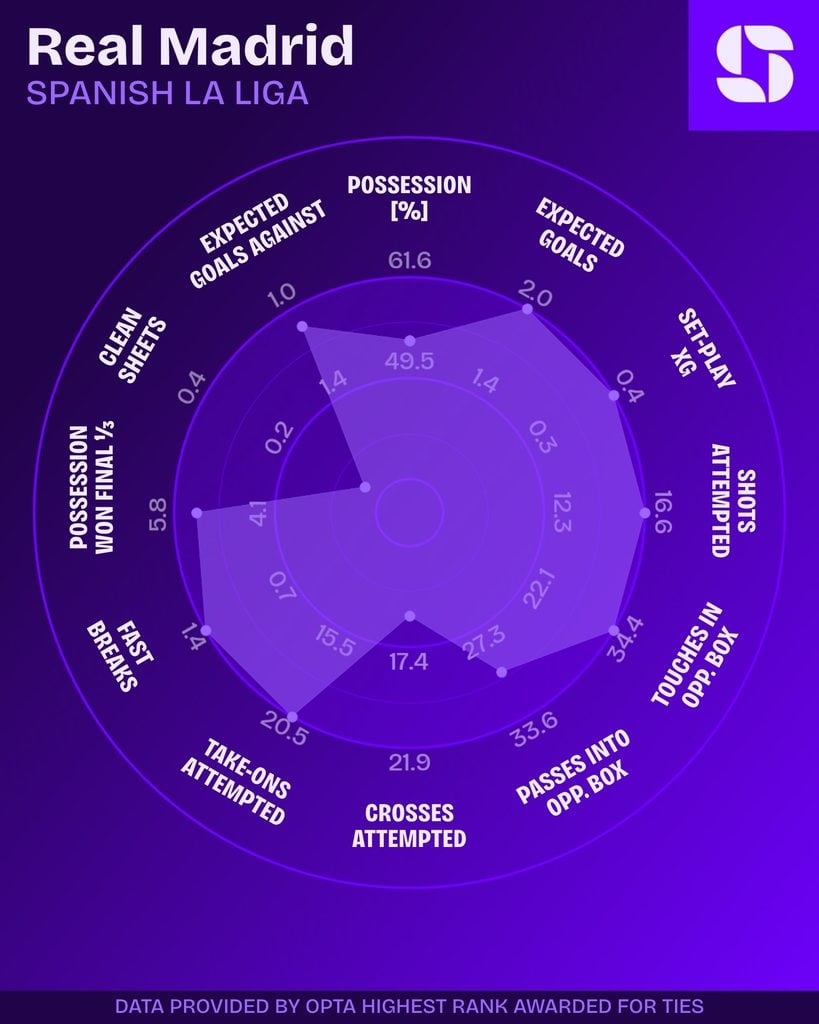
However, being a team that looks to speed up play and hit teams utilising fast breaks and direct attacks, Real Madrid naturally have that lower possession share as previously mentioned, which is a factor when it comes to their out-of-possession phase.
Spending less time on the ball does mean Real Madrid have to absorb pressure within their defensive block more frequently, which they have managed relatively well according to the numbers, only conceding 7.70 xG in their seven games played, with only Barcelona (7.62 xG) and Atletico Madrid (7.08 xG) conceding less.
In comparison to those sides though, Real Madrid have conceded quite a few more shots, ranking closer to mid table for shots conceded (89) and shots on target conceded (31), often relying on the brilliance of Thibaut Courtois to bail them out.
Lastly, Real Madrid rank as one of the least intense pressing teams in La Liga this season, with a PPDA (passes per defensive action) of 14.3.
Midfield issues?
When it comes to Real Madrid’s build up ideas, it’s all fairly simplistic. Mourinho often wants his side to form a back three on the ball, whether Marc Cucurella is staying low at left-back or Aurelien Tchouameni is dropping into the backline to release Cucurella to move higher.
On the opposite side, it has either been Denzel Dumfries pushing on to provide the width on the right, with Arda Guler drifting inside, or Trent Alexander-Arnold drifting inside and rotating with the likes of Federico Valverde to disrupt the opposition press.
But the problems begin to arise when you look at how Mourinho instructs his team to play and the midfield profiles within it. The midfield unit at Real Madrid lack two key components right now, control and penetration.
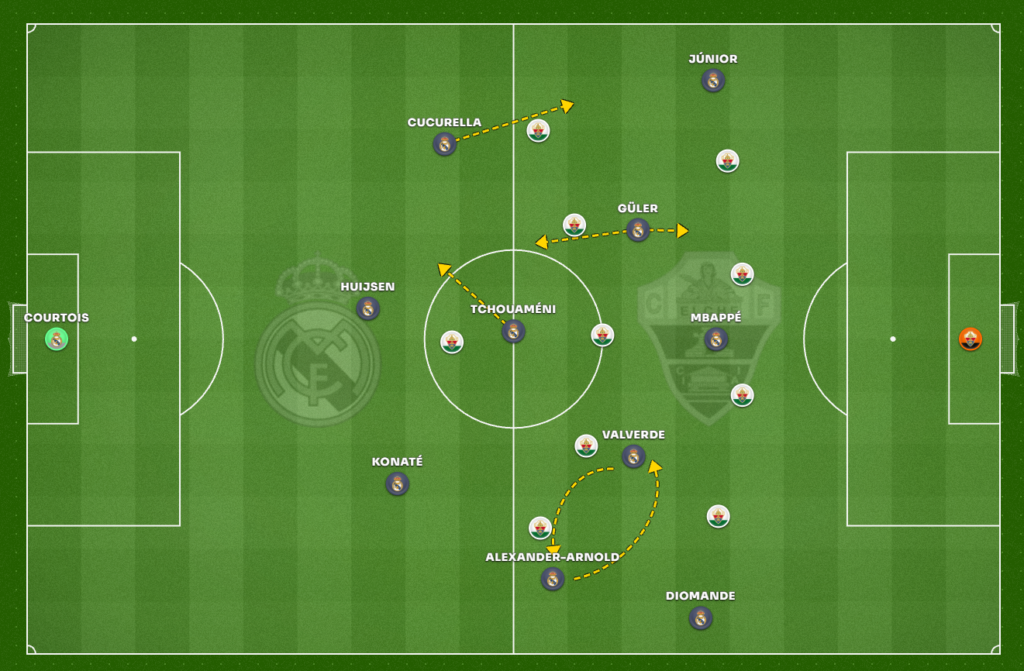
Mourinho’s system isn’t based on possession control, instead, much like another former Real Madrid manager, Carlo Ancelotti, the Portuguese coach prefers to empower his players to make decisions and find solutions.
By allowing them to play to their instincts, control in the game will often come from having a midfield group that have the instinct of managing games/moments, slowing it down when needed, but also speeding it up and progressing play through the lines.
Right now, Real Madrid lack this, instead of trying to play through the thirds and progress play, they are often forced wide or direct, where the game speeds up and the team loses control. While the directness and willingness to have less of the ball is likely a method of Mourinho’s to gain advantages for his star players up top, it can also lead to more stress being put on the defensive unit.
A potential solution to this would be the usage of summer signing, Bernardo Silva, in the double pivot, who is used to controlling the tempo at Manchester City and having those instincts to manage games but also shift the tempo and find progressive solutions through the centre.
Clashing tendencies
When it comes to the balance at Real Madrid, the clashing tendencies among certain players has always been a running theme.
The first obvious one is the positioning of both Kylian Mbappe and Vinicius Junior, who both prefer to drift over into that left channel.
This can be seen in a number of ways, on the one hand, the Real Madrid duo are dragging bodies across with them, creating gravity on the pitch due to the fear factor they strike in the opposition defences, no one really wants to leave them in a 2v2, which forces the opposition defensive scheme to over rotate.
However, this can also lead to the pair getting on each others toes, especially considering both like to be isolated in 1v1 opportunities against defenders and attack larger spaces.
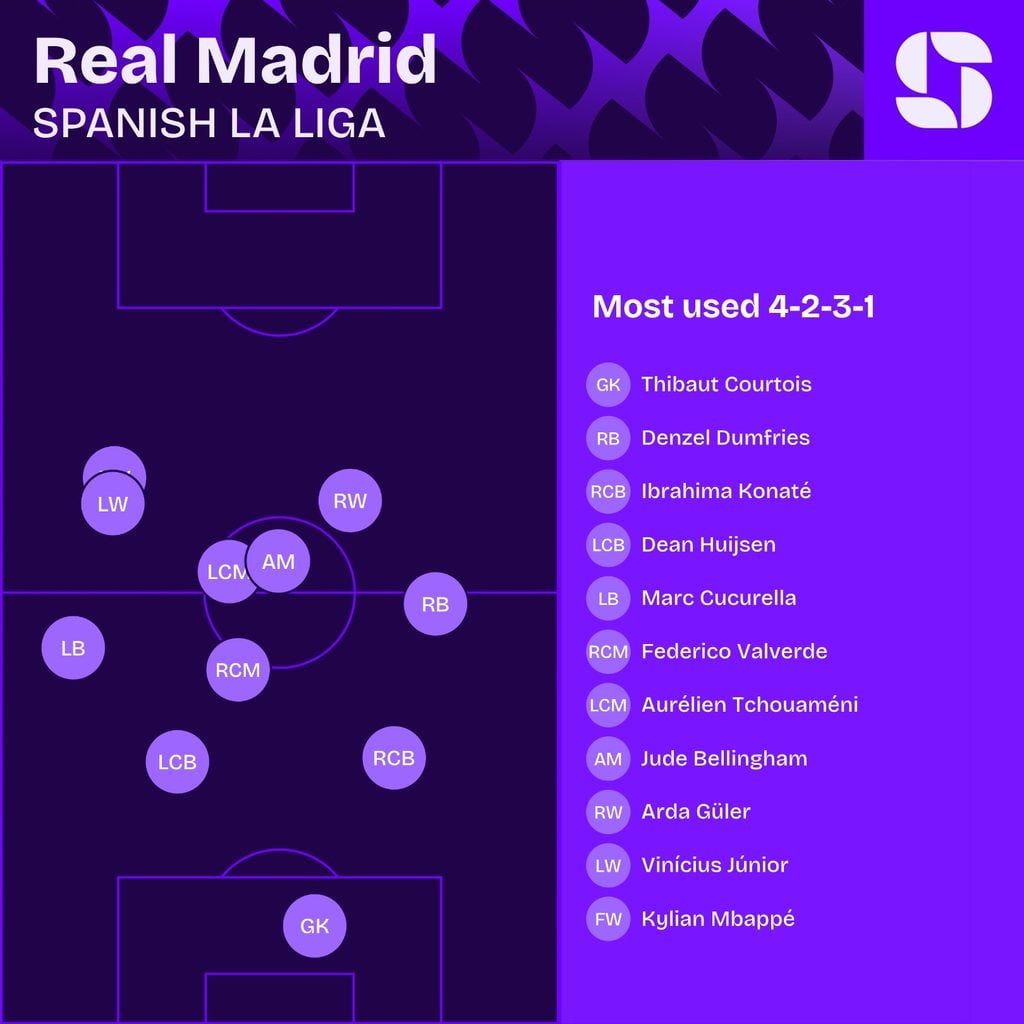
Another factor of balancing issues between Real Madrid’s two superstars is their pressing structure and the sacrifices made within it.
As touched upon in the data section, Real Madrid are one of the lower intensity pressing sides in La Liga, with a PPDA of 14.3. However, Mourinho’s side do have the most high turnovers resulting in a shot (15) which is due to the role of Vinicius Junior.
An advantage created from their pressing structure is the “rest attack” role of Vinicius Junior, who often looks to cheat his defensive role, allowing the full-back to run off of him, but therefore leaving the Brazilian in plenty of space if Real Madrid can retrieve possession, turning this into a dangerous transition opportunity in their favour.
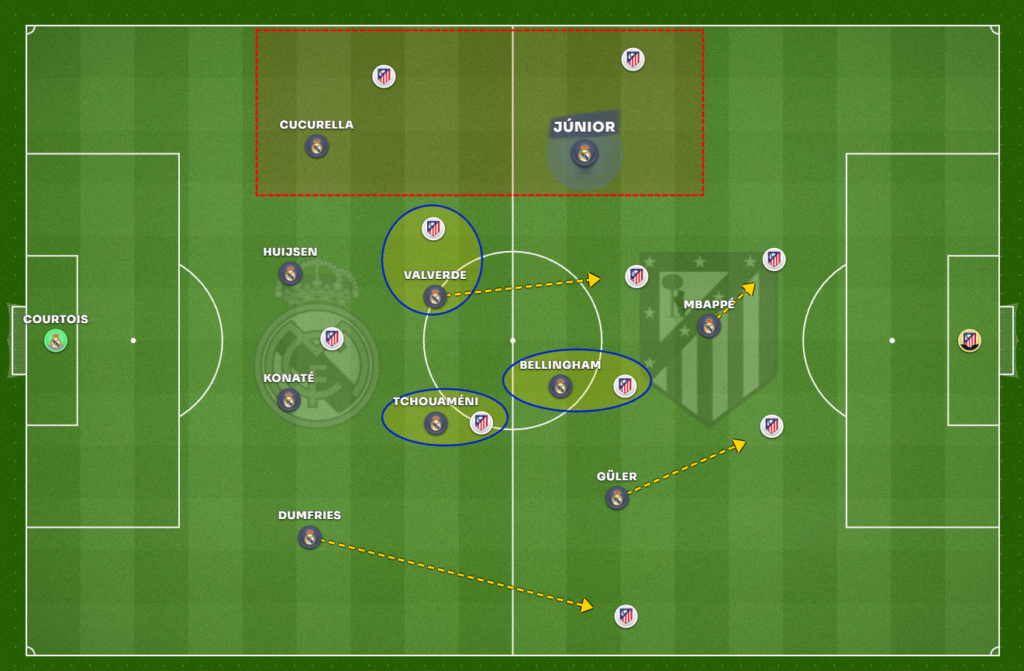
On the other hand, this forces a lot of tension and pressure on Cucurella at left-back, often left in 1v2 situations to deal with down his flank.
While this can be a source of Real Madrid creating chances of their own on the break, it is also a source of chances conceded, so finding the right balance in that department is key.
Absorbing issues?
Lastly, as alluded to earlier on, Mourinho is happy to somewhat cede possession in order to gain advantages on the break, attacking larger spaces and not allowing the opposition to settle into their defensive shape.
But in order to create these advantages on the break, a staple of Mourinho sides of old is the ability to be compact and absorb that pressure coming their way.
Even when defending in their 4-4-2 shape lower on the pitch, Vinicius Junior’s concentration can often lapse, giving the opponent chances to exploit 2v1 overloads down his side.
Mourinho’s attempt to solve this has been the usage of Jude Bellingham, initially pressing as a second striker alongside Mbappe, before dropping into midfield, allowing Valverde to shift across and support Cucurella, still giving them that 4-4-2 shape.
But with these moving parts, compactness is slightly harder to achieve, often leaving spaces at the edge of the box or between the lines for the opponents to exploit during these movements.
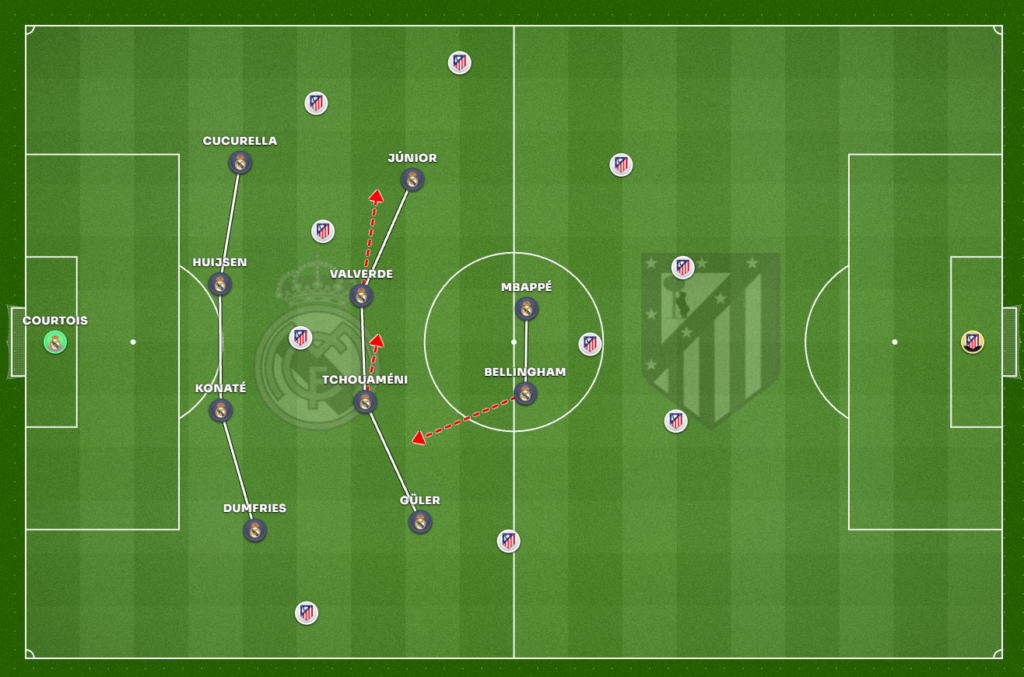
Another clear issue with both looking to defend lower on the pitch, but also when looking to jump out into a press, is the lack of pressure on the ball from the front.
This creates a number of issues for Real Madrid, as the rest of the defensive unit behind the front press lacks clarity in their actions.
Typically speaking, if you cannot get pressure on the ball, the defensive line is supposed to drop off, as the player on the ball will have time to pick passes over the top into the space. While if you can jump to pressure the ball and stop an easy pass being made, the backline can be more aggressive to deny the space between the lines, without the risk of the space being accessed easily in behind them.
Due to Real Madrid’s pressing issues and the workrate of their forwards even when defending low, the midfield and defensive units often look hesitant and stuck in two minds with their actions, which in itself can create gaps for the opponent to exploit.
Luckily, Real Madrid do own one of, if not the best goalkeeper in the world, Thibaut Courtois, who does make absorbing pressure easier, making big saves and giving them the chance to turn a successful defensive passage into an attacking transition. But how long can they sustain it without further improvements and changes to fix certain issues?