





Leeds United defeated Tottenham Hotspur at Elland Road in a game that had high press as its ‘swing factor’.
Not only did this result end the Whites’ five-game winless run in the Premier League, but also interrupted Spurs’ three-match win streak.
A late Noah Okafor goal rewarded the Whites’ strong second half and gave them a well deserved three points.
How did Leeds vs Tottenham play out?
High press the ‘swing factor’
Both Leeds and Tottenham enjoyed spells of dominance in the game, much thanks to their out-of-possession approach.
Daniel Farke and Roberto De Zerbi started the game having their teams press in individual fashion, as most teams do nowadays. But both had a spare man at the back for extra protection in defence.
Around the 15th-minute mark, however, the Italian went more aggressive, ditching the spare man and going full man-marking all across the pitch. Not by chance, it coincides with them retaking control of the game in the match momentum chart.
Though they didn’t do much with it (more on that later), they did manage to recover possession quickly and restart their sequences. Leeds spent over 30 minutes without attempting a shot, between the 9th and 40th minutes.
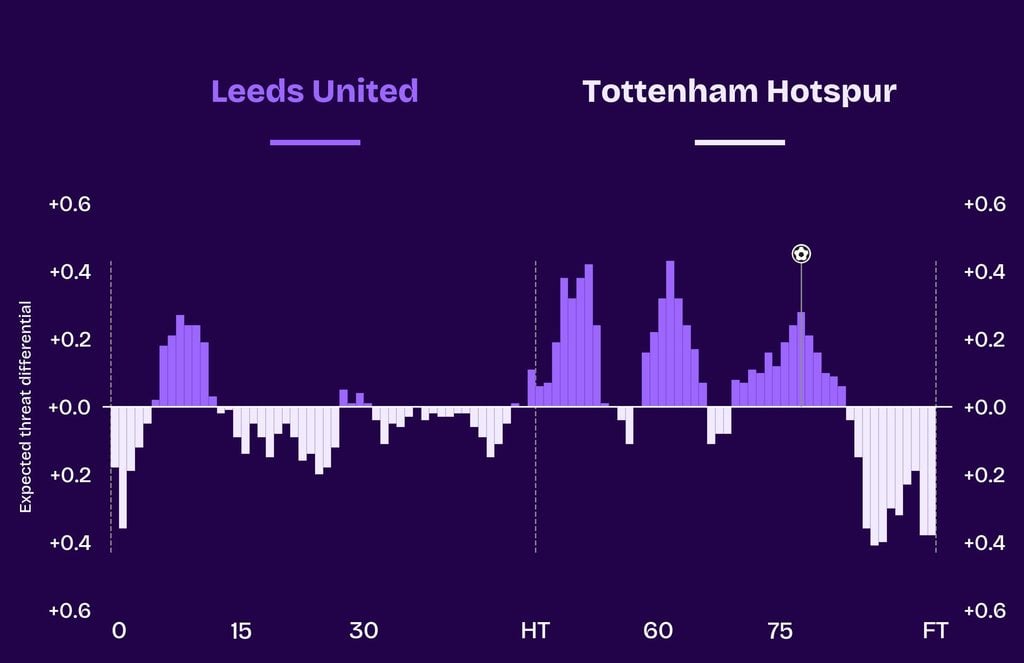
After the break, Farke countered by doing the exact same. He had already instructed his side to go full man to man once or twice in the first half, but ended up going back to having a spare man. Not in the second half.
Again, you can see in the momentum graph they took control of the game right from the jump and maintained it until they scored. Tottenham didn’t stand a chance when they were in that mode, keeping the aggressiveness from the first half but with no spare man.
And they controlled the game out of possession first. So much so that, between the start of the second half and Okafor’s goal, Leeds only had 45% possession. They limited Spurs’ movements going forward, recovered possession and quickly went the other way.
For the entire second half, both sides were pressing full man to man, leading to a more chaotic scenario. It favoured the Whites heavily who even turned Tottenham counter-attacks into fast breaks of their own. Their best chance other than the goal, in fact, happened exactly like this.
Ao Tanaka stopped a Spurs 2v2 counter by tackling Mohammed Kudus and initiating a 5v5 for Leeds. He sent Dominic Calvert-Lewin through, who got past Micky van de Ven and Andy Robertson to set Tanaka up for a shot inside the box. However, the Japanese midfielder hit it over the bar.
All five big chances of the whole game happened in the second half, with four of them for the home side and just one for the visitors. It was the late Rodrigo Bentancur attempt, which was more of a failed touch than an actual shot.
De Zerbi’s poor game plan
Tottenham went into the game with a different in-possession formation from the three-game win streak. Instead of the 3-1-3-3 that saw them have lots of success pushing opponents deep into their own halves, De Zerbi changed the structure to a more traditional 4-3-3 (4-1-2-3 to be more accurate).
Mateus Fernandes (later Bentancur) acted as the sole pivot, with Archie Gray and Sandro Tonali (later Conor Gallagher and Tonali) further forward.
This left them with fewer players in central areas, making them rely more heavily on wide actions.
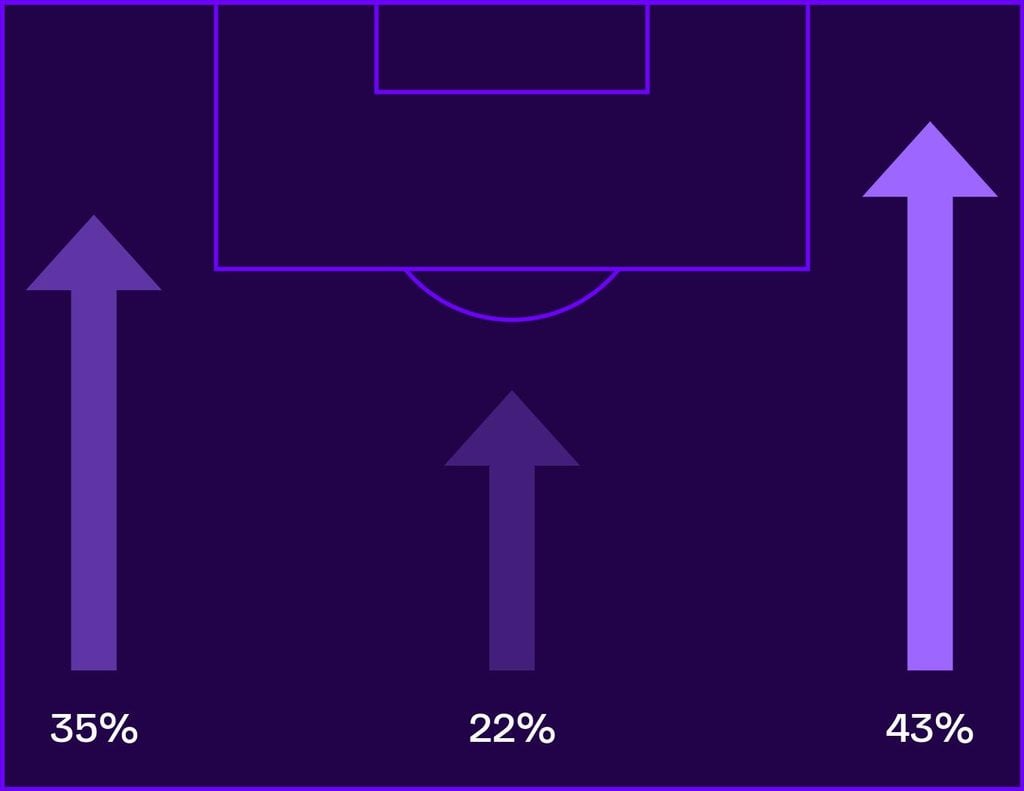
In fact, this was their game with the joint-fewest percentage of attacking actions in the central third (22%) of the Premier League season, alongside the draw with Nottingham Forest.
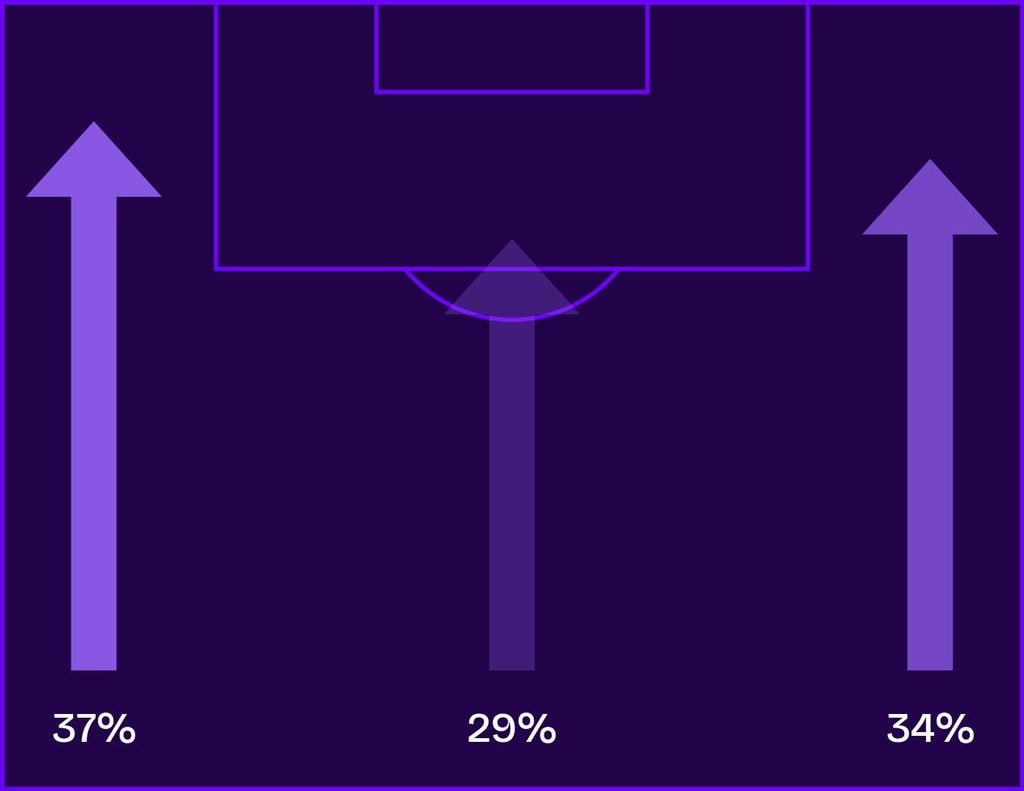
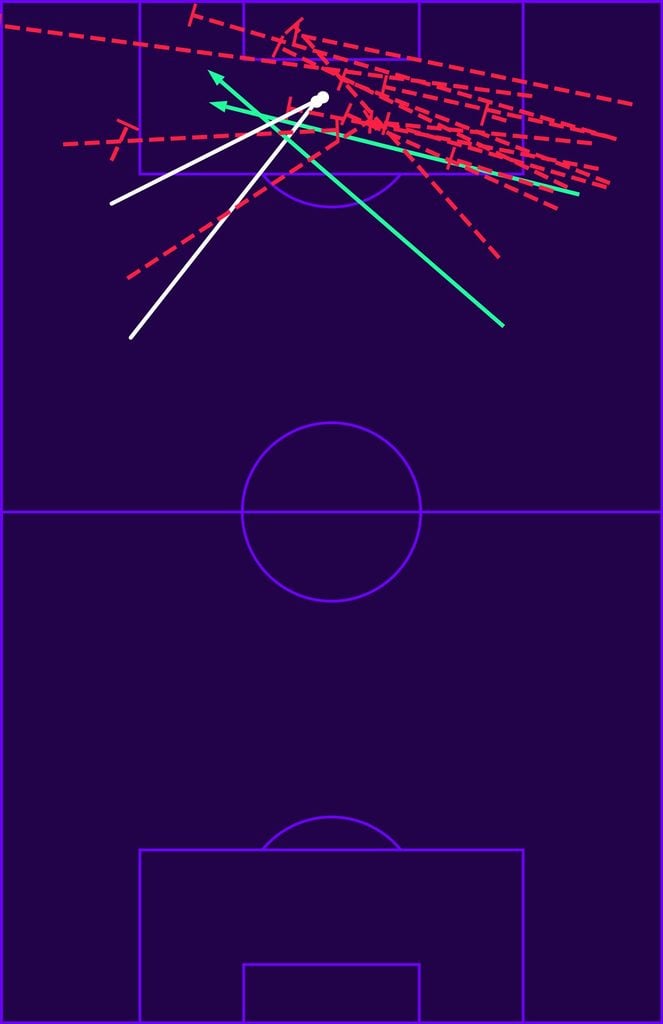
The idea was to work mostly down the right and look for crosses to the far post in the left. Though none of them really worked and James Trafford either collected (1) or cleared away (4 – the most of any goalkeeper in a Premier League game this season) them with ease.
Spurs did record many attempts against Palace, which we said would be the one thing to nitpick from their performance. Though the scenario following Jean-Philippe Mateta‘s early red card didn’t leave them many alternatives.
And Tottenham used this basically as a plan A with no real plan B to follow.