
Outside of winning trophies, there aren’t many sweeter feelings in football than beating your biggest rivals.
Some rivalries are pretty easy to make out. Celtic vs Rangers, Manchester United vs Manchester City, any London derby, Barcelona vs Real Madrid. Either local rivalries or battles between the biggest clubs in a league. Sometimes there are sprinklings of politics in the head-to-heads.
But then there are some with stranger roots. Or rivalries that might not make immediate sense. We’ve picked out 10 of Europe’s strangest football rivalries and delved into the history to see why they exist.
Brighton vs Crystal Palace
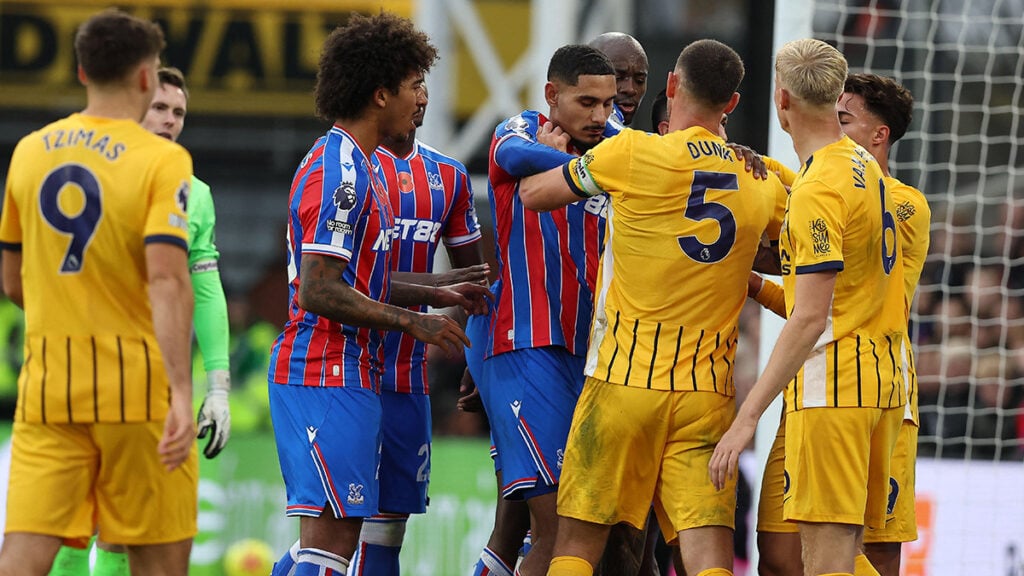
By now it’s fairly common knowledge that Brighton and Hove Albion and Crystal Palace are rivals. Some fans will be averse to calling it the M23 — or A23 — derby, but it is a rivalry. However, every time the game comes around, there seems to be a rise in Google searches on just why it is a rivalry.
One of the simplest explanations is that, in the mid-1970s, neither team had any direct rivals. Brighton were pretty isolated in their area of England, while Crystal Palace were in their own pocket of London with everyone else paired up. So there was a reason to seek something, when the two started to clash more frequently in the 1970s.
There were on-pitch reasons, including both sides vying for promotion from the Third Division, with each team picking up a home win in the league. As the story goes, during that season, Brighton’s nickname started its change from Dolphins to Seagulls, a mockery of Palace’s Eagles name and chant. Things got worse when Terry Venables became Crystal Palace manager and former teammate Alan Mullery took charge of Brighton. The pair reportedly had a personal rivalry stemming from Mullery being the fan favourite at Tottenham Hotspur, and being picked as captain.
To make matters worse, the pair met in the FA Cup in 1976, drawing the first game 2-2. The replay also finished level, meaning a third game had to be played. There, Palace took a 1-0 lead but Brighton later equalised from the spot. However, the penalty was ordered to be retaken due to encroachment. The retake was saved, Palace won, and the rivalry reached a new peak.
Leeds vs Man Utd
Fans of a certain age might know that Leeds United and Man Utd hate each other. They might share in that hate. But they may not know why they need to hate the other. Perhaps more particularly those from outside the local areas.
Although this isn’t a city derby, it is a geographically-based rivalry. The biggest club in Yorkshire against the biggest in Lancashire. Football’s take on the War of the Roses. As rivalries go, that will be one of the longest, stepping back to the 15th century. A quick summary of English history, supporters of the House of York and the House of Lancaster battled to claim control of the English throne. The war was eventually won by Lancastrian Henry Tudor (soon to be King Henry VII), who became king and married Elizabeth of York, eventually bearing their son Henry VIII.
Back to the football, the rivalry really started picking up in the 1960s and 1970s as Leeds and Man Utd became the biggest clubs in England. Man Utd had the early success, but Leeds inserted themselves into the conversation with league titles and success in the Inter-Cities Fairs Cup (Europe’s secondary competition behind the European Cup). The rivalry was stoked by the two managers, Don Revie and Matt Busby, two of the greatest of their generation.
Over the years the rivalry kept its spark, even if games were fewer and far between. It didn’t help that Man Utd signed a handful of players from Leeds, including Eric Cantona, Rio Ferdinand and Alan Smith.
Sheffield United vs West Ham
This is a more recent rivalry, but that shouldn’t take anything away from it. There’s hatred at the heart of clashes between Sheffield United and West Ham. It started in 2006 when West Ham signed Carlos Tevez and Javier Mascherano. The signings did not involve Sheffield United at all, with both players joining from Brazilian side Corinthians. But the arrivals were seen to have breached Premier League rules relating to third-party agreements and influences on players.
West Ham were punished for the transfers, fined £5.5million, but no sporting penalties were applied. Despite the signings of two of world football’s brightest young stars, West Ham still struggled in the Premier League. In fact, they went into the final day of the 2006/07 season battling relegation. The Hammers were joined in the final-day battle by Fulham, Wigan Athletic and — you guessed it — Sheffield United. But the odds were against West Ham who faced champions Manchester United.
Wigan won their game, lifting them from 19th to 17th, while Fulham and Sheffield United both lost. But West Ham — who started the day 18th — secured a shock win over Man Utd thanks to a goal from Tevez. The win put West Ham 15th, three points clear of Sheffield United who were relegated. And so the fallout started. Sheffield United took things to the courts and won £20m in compensation from West Ham, but their relegation remained. Although Sheffield United lost their game on the final day, their case was helped by the fact that Tevez scored seven goals in West Ham’s past nine games, helping them win seven, when they had been 10 points from safety.
Coventry vs Sunderland
Another case of foul play, and this one was sneaky. Coventry City and Bristol City faced off on the final day of the 1976/77 season, both fighting relegation. They were joined in that battle by Sunderland, and the games were set to be played at the same time. Very fair, so no team would get any advantage. But Coventry’s game against Bristol City was delayed by 15 minutes, officially due to traffic. Coventry chairman Jimmy Hill was at the heart of it, which adds to the controversy.
Things got worse when Hill reportedly got the Sunderland result — a 2-0 defeat to Everton — announced on the stadium’s PA system. Coventry and Bristol City were drawing 2-2 at the time, a result that would have kept both sides up. So, with the Disgrace of Gijon still five years away, Coventry and Bristol City played out the 2-2 draw with no intention from either team to attack. Both teams stayed up, Sunderland were relegated and Hill hated by Black Cats fans for his role. Hill was actually reprimanded by the FA but the result was allowed to stand.
Hansa Rostock vs St Pauli
This perhaps isn’t as strange a rivalry as others on this list. But there are still unconventional — and non-footballing — reasons why Hansa Rostock and St Pauli dislike each other. And it’s led to some trouble. Dubbed the Politisches (Political) derby, Hansa Rostock were formed in East Germany in 1965, when the nation was split in two, while St Pauli are based in Hamburg which was part of West Germany.
There is a big difference in the views of the two clubs. St Pauli are known for their activism and anti-fascism and have been a cult club for their standing. Hansa Rostock, meanwhile, have documented far-right elements within sections of the fanbase and the city itself. Things came to a head in Rostock with riots against a building housing asylum seekers. There have been a few big clashes between the fans, and matches are heavily-policed.
Juventus vs Fiorentina
This is a rivalry born from on-pitch clashes, and is relished more by one side. Juventus and Fiorentina went head-to-head for a handful of major trophies during the 1980s and 1990s and — depending on who you ask — some of them weren’t very fair. The first came with the 1981/82 Serie A title, with Juventus and Fiorentina battling it out to lift the trophy. The race went to the final day, with the two sides level on points. Fiorentina drew against relegation-battling Cagliari, with a goal disallowed for a foul on the goalkeeper. Juventus, meanwhile, beat seventh-placed Catanzaro with a penalty, after their opponents were also denied one. These decisions didn’t go down well, with Fiorentina fans saying “better to be second than thieves”.
Fast forward eight years, Juventus and Fiorentina contested the Uefa Cup final. It was still a two-legged affair at the time, but Fiorentina’s stadium was not ready to host their game. It was moved to Avellino, a town with a lot of Juventus fans. To make matters worse, there was contention surrounding one of Juventus’ goals, with Fiorentina feeling Celeste Pin had been fouled as Angelo Alessio scored. The goal stood, and the thieves moniker continued. As if that wasn’t enough, Juventus signed Roberto Baggio from Fiorentina for a then world-record fee of £8million, causing Viola fans to riot.
The rivalry may not be as fierce as it once was, and is felt more by Fiorentina fans, but there is still some animosity. Juventus have quite frequently done their summer shopping in Fiorentina, signing the likes of Federico Chiesa, Federico Bernardeschi and Dusan Vlahovic.
AEK Athens vs PAOK
AEK Athens and PAOK‘s rivalry is strange because they used to be friends — if that’s possible for football clubs. The rivalry is dubbed the double-headed eagles derby, because the animal features on both clubs’ crests. They both have similar origin stories, founded by Greek refugees from Constantinople (Istanbul), with AEK Athens in 1924 and PAOK in 1926.
Things became bad between fans in the 21st century, and haven’t just been limited to football, stretching to a handball match between two clubs in 2009. The main part of the rivalry is due to on-pitch matchups, with the two sides among the best in Greece routinely sharing title battles.
Aberdeen vs Rangers
Everyone knows the Old Firm derby. But Rangers also have a rivalry with Aberdeen, starting in the 1970s. It came to a head in the 1980s and early ’90s, with Sir Alex Ferguson leading Aberdeen to success — having played for Rangers during his career. While Aberdeen thrived, Rangers struggled, and Sir Alex’s men became Celtic’s biggest title rivals. Sir Alex had a personal reason for wanting to consistently beat Rangers too, due to the reception he received at Ibrox after he married his wife Cathy, who is Catholic.
The rivalry was fueled in a 1988 clash when a tackle from Aberdeen’s Neil Simpson shattered Ian Durrant’s knee, one of Rangers’ and Scotland‘s brightest young talents. Some Rangers fans have never forgotten this, and it probably didn’t help that Aberdeen fans sang about the injury in the next meeting between the sides. Nowadays, Aberdeen fans are among many unhappy with Scottish football’s heavy focus on the Old Firm clubs.
Gillingham vs Swindon
A rivalry born from one tackle. Gillingham and Swindon Town were facing off in the Third Division in 1989, a key battle in the promotion race. Gillingham were 2-0 up but went down to 10 men when Danny Westwood was on the receiving end of a bad tackle. But rather than his fouler being punished, Westwood was sent off for a foul-mouthed tirade. As a result, a Gillingham fan found a way onto the pitch and punched the referee. To top it all off, Swindon came back to draw the game 2-2.
Things were made worse in the reverse fixture. Swindon beat Gillingham 3-1, with the Gills again reduced to 10 men. After the final whistle, a fight between players broke out that resulted in two Gillingham stars going to court — though they were both acquitted. There have been further matches between the teams since, at varying levels of importance, that have only served to fuel the rivalry.
Bolton vs Tranmere
Our final rivalry is a strange one, as it came from one team celebrating a goal a bit too much. Bolton Wanderers and Tranmere Rovers met in the Third Division play-off final in 1991, with the Rovers getting a 1-0 win after extra time. But Tranmere’s players celebrated in front of Bolton’s bench, angering Phil Neal in the Trotters’ dugout. That’s pretty much it. Hatred between two clubs because of one celebration. There have been fiery moments since, and the dislike is still quite strong, even if meetings are less frequent.