




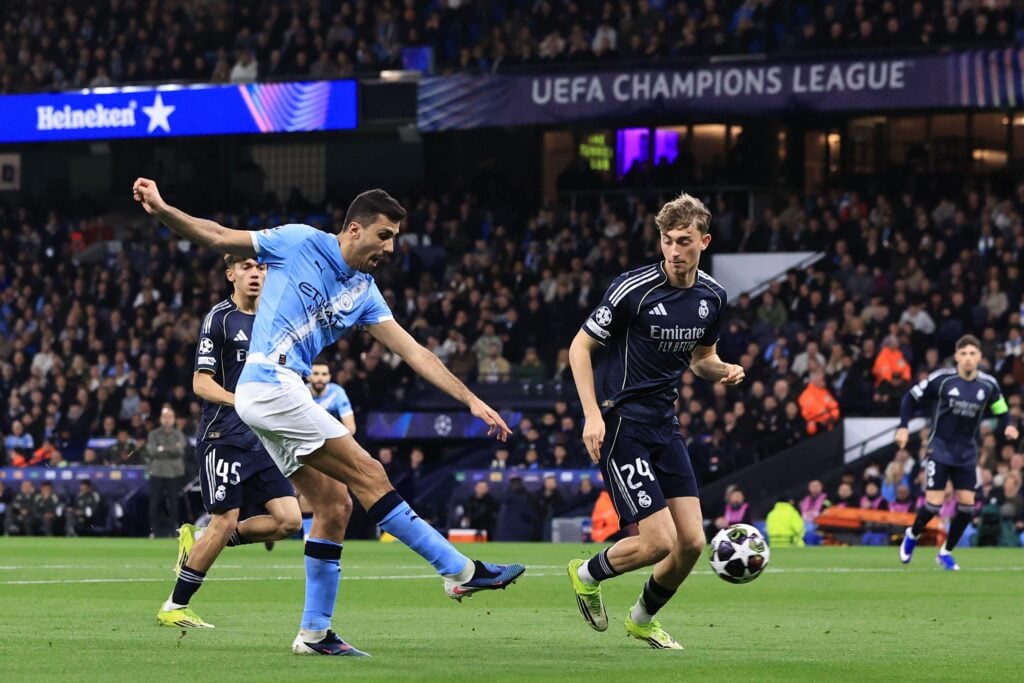
Rodri looks set to leave Manchester City after seven seasons and sign for Real Madrid following World Cup success with Spain.
Multiple reports indicate that both clubs are engaging in transfer talks that would take the 30-year-old back to his native land.
Rodri has arguably been the driving force behind Man City’s recent success in English football. There have been ‘louder’ contributions from the likes of Kevin De Bruyne and Erling Haaland due to the goal contributions.
But the defensive midfielder’s relentless off-ball work and towering presence in the middle of the park is what allows his attacking-minded teammated to flourish up front.
Coincidentally or not, it’s precisely when he started having injury issues in 2024/25 that things went downhill. Rodri ruptured his ACL on Matchweek 5 of that campaign as Man City fell off dramatically to finish third behind Arsenal and champions Liverpool.
Last year, he played just 44% of all possible minutes in the Premier League and often looked like a shadow of himself. Still a good player, given his quality, but below the understandably high expectations. And it was yet another season of the Citizens trying to catch-up with the Gunners – but this time failing to do so.
However, the 2026 World Cup showed his usual self is still very much alive. He spent the whole tournament fully fit and would have played the whole thing if not for an 87th-minute substitution in the opener against Cape Verde and a 99th-minute one in the final vs Argentina.
Apart from leading Spain to the title, he also won the Golden Ball for best player in the tournament. He had already won the Ballon d’Or at Man City in 2024 as well. And now, could be the key to ‘fixing’ Real Madrid’s midfield.
Why is Rodri the perfect piece for Real Madrid?
Rodri’s ‘original game’ in Spain
Rodri first burst onto the scene at Villarreal. He was a valuable academy asset with lots of potential back in 2015 and made his professional debut in 2016.
He played under three different managers there – all defensive-minded ones. Marcelino Toral, Fran Escriba and Javier Calleja. The Yellow Submarine averaged 48.5% possession between 2015/16 and 2017/18, the three seasons in which Rodri featured for the first team.
Then came a transfer to Diego Simeone’s Atletico Madrid in 2018. So Rodri’s game, originally, is one of a defensive anchor in midfield. Of course, he has always had technique, accuracy and range in his passes. But he was more of a combative force than a refined distributor.
Development at Man City
When Rodri arrived in England, he immediately started playing under a different type of manager. Pep Guardiola extracted the most of his off-ball work and placed it into a high-pressing side that wanted to recover possession as soon as possible after losing it.
His energy and ability to cover ground are what allow Man City to set themselves near the opposing goal and not completely collapse if the high press doesn’t work.
It’s also the fact that his absence damaged the Citizens, considering nobody else in the squad had the same attributes. Which is not a shot at Man City, because Rodri is a unique player in the whole world, not just in their team.
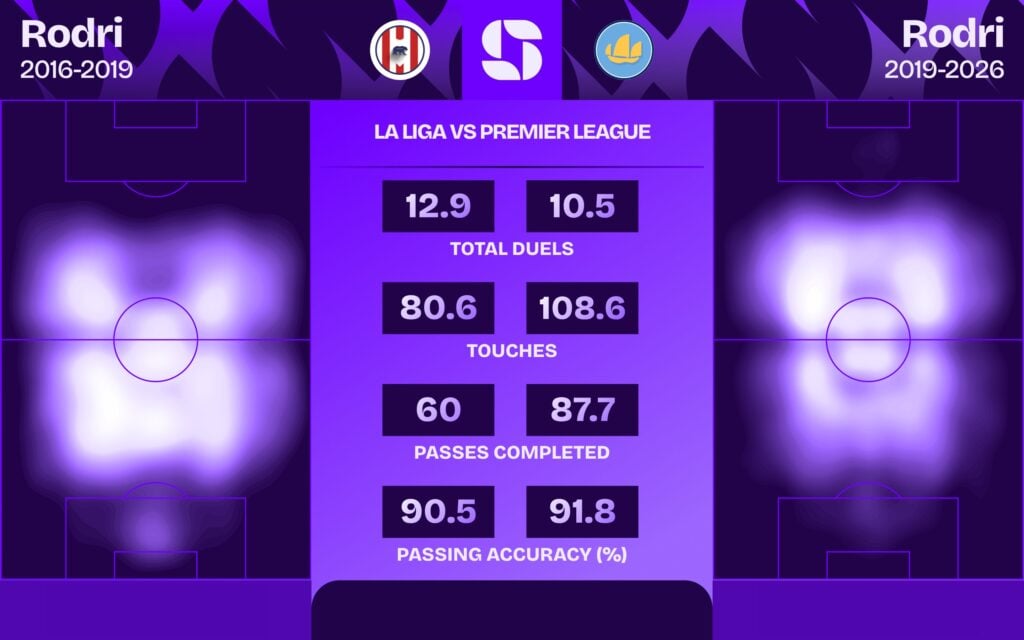
His averages of touches, passes attempted, passes completed, passing accuracy, carries all went up since arriving in England. In terms of raw numbers, a lot of it was expected given Man City’s play style – especially compared to Atletico Madrid and Villarreal.
But he also grew into the role of a distributor, recycling possession and helping his side keep it as a defensive weapon.
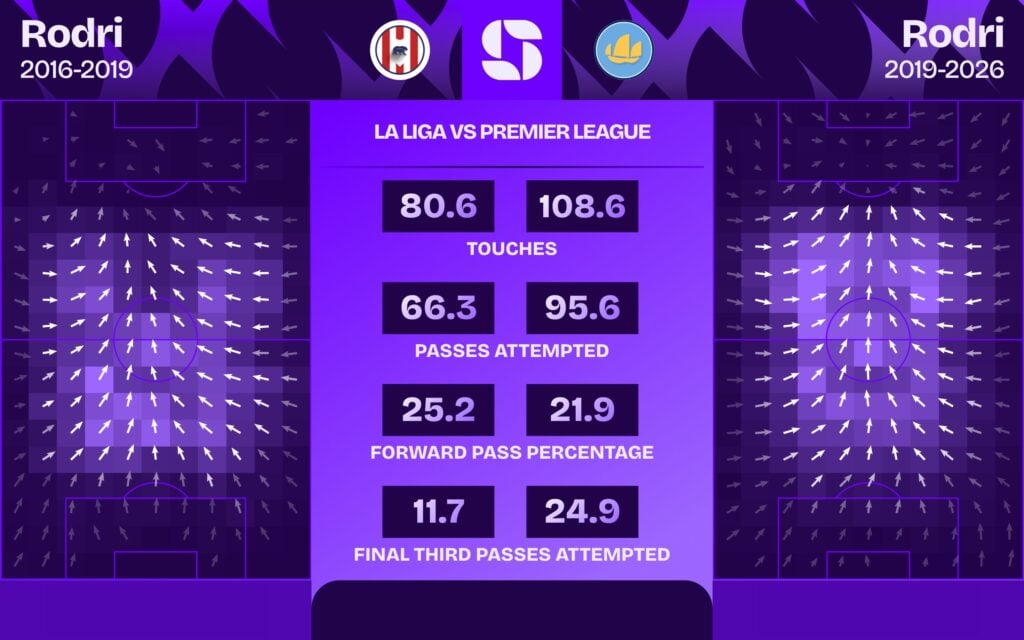
Rodri’s area of action went further up the pitch and the arrows started pointing more sideways than straight forward. What might look like a player taking fewer risks in a negative manner is actually his team keeping possession more often and therefore denying the ball for the opponents.
Best of both worlds at Real Madrid?
Real Madrid recently appointed Jose Mourinho for his second stint at Santiago Bernabeu. Famously a defensive-minded manager, the Special One is also going to have to dominate games against most teams he faces in La Liga.
It was a similar dynamic when he returned to Benfica. A cautious, reactive head coach in a league full of lesser opponents. Looking at their league and Champions League numbers, the idea becomes clear.
| Competition | Possession | Possession (ahead) | Possession (level/behind) |
|---|---|---|---|
| Liga Portugal | 57.5% | 53.7% | 61.2% |
| Champions League | 47.0% | 42.5% | 49.2% |
In a way, this duality in styles could be the ‘perfect storm’ for Rodri. He would likely require a bit of adaptation for playing in a more defensive approach after so many years of dominance for club and country. But staying as a ‘sweeper’ between the lines could also make him spend less energy.
Instead of stepping up and running to press opponents and then chase them tracking back if it doesn’t work, he would just sit deeper in those scenarios. Coming off an extended season due to a tiring World Cup, could be a nice way of managing his legs.
At the same time, he would still have the same old responsibilities whenever Real Madrid have to dominate the ball. His presence would also maintain the defensive upside from Aurelien Tchouameni while also recapturing the control and passing range they lost when Toni Kroos retired.
Rodri was the third outfielder with the most long passes attempted (47) and the first with the most long passes completed (37) in the 2026 World Cup, for perspective. His 79% success rate was the third highest among the top-60 players in long ball attempts, with only Granit Xhaka (82%) and Vitinha (83%) completing a higher share of their long passes in that group.
Should this transfer go through, it could be a good move for both Rodri and Real Madrid. It would, of course, leave Man City with some money but very tough choices to make going forward.