






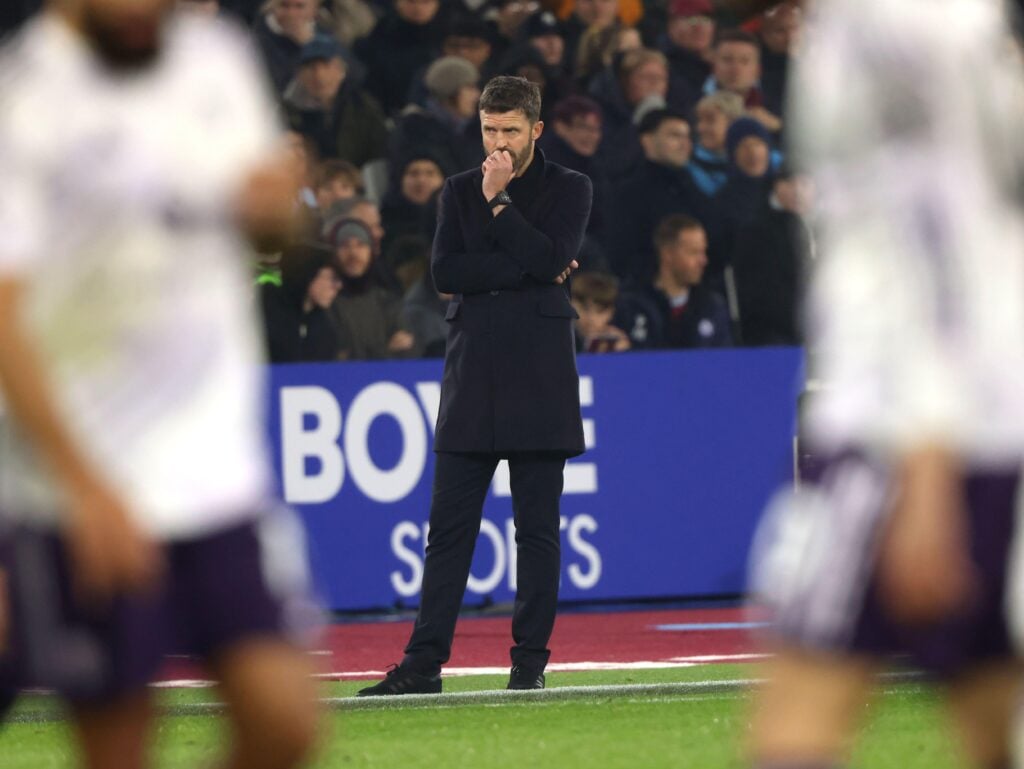
Michael Carrick will become fully accustomed to the Manchester United hotseat as he takes on permanent managerial duties from the 2026/27 season.
Despite a turbulent opening half of the last campaign, the Red Devils dramatically improved this calendar year after replacing Ruben Amorim with Michael Carrick as interim boss.
He steered them to eight wins from his first 12 games in charge, comfortably securing third place and earning Champions League football for the upcoming campaign.
That upturn in fortune also convinced the board to entrust Carrick by handing him a two-year permanent contract as head coach, with the option to extend for an additional year.
Find all of the Man Utd stats ahead of the 2026/27 Premier League season below, from the club’s summer transfer business to Michael Carrick’s tactical approach.
Man Utd opening fixtures 2026/27 Premier League
Man Utd’s season begins with an away trip to newly-promoted Hull City in the season’s first Saturday 12:30pm kick-off. Their first home game also pits them against recently promoted opposition in Ipswich Town eight days later. The following Sunday, the Red Devils travel down the M62 to take on Everton at the Hill Dickinson Stadium. Next up is the first Manchester derby of Enzo Maresca’s Man City career. Closing out Man Utd’s first five matches is an away clash with Alvaro Arbeloa’s Fulham.
| Date | Opponent | Kick-off |
|---|---|---|
| Saturday 22nd August | Hull City (A) | 12:30pm |
| Sunday 30th August | Ipswich Town (H) | 4:30pm |
| Sunday 6th September | Everton (A) | 2pm |
| Sunday 13th September | Manchester City (H) | 4:30pm |
| Sunday 20th September | Fulham (A) | 4:30pm |
Man Utd’s key players for 2026/27 Premier League
Man Utd top Premier League Golden Boot contender: Benjamin Sesko
- Key stat: Benjamin Sesko scored four of his 11 Premier League goals last season when coming off the bench.
The Red Devils lack centre-forward depth, and given their more congested schedule this season, Sesko will naturally see more minutes. Despite making almost half as many league starts as Bryan Mbeumo last term, the Slovenian matched his teammate’s PL goals output, finishing alongside the Cameroonian as Man Utd’s joint-top scorer.
Man Utd primary playmaker: Bruno Fernandes
- Key stat: Bruno Fernandes produced a record-breaking 21 Premier League assists last term.
Operating from his preferred No.10 position under a manager who trusts him implicitly, Bruno could reach similar heights to last season’s crowning personal achievement. With set-piece responsibilities shouldered by the Man Utd captain, there’ll be greater expectations for him to continue creating at an elite level, especially as Michael Carrick aims to challenge across an additional European front this campaign.
Man Utd card magnet and top tackler: Luke Shaw
- Key stat: Luke Shaw averaged a booking every 5.44 fouls committed last season.
With Casemiro having left Old Trafford this summer, Luke Shaw’s tally of nine Premier League yellows last season was the most of any player in this squad. Shaw finished second to only Casemiro’s for tackles (74) and committed the most fouls (49) of any Man Utd player during the 2025/26 Premier League season. However, transfer links to Lewis Hall hint at the long-term availability of the position, especially given the 31-year-old’s alarming injury record.
Man Utd rising star: Jack Fletcher
Between the two promising Fletcher brothers breaking through – sons of former Man Utd midfielder Darren Fletcher – Jack is considered to have the higher ceiling. Playing further up the field as a highly technical, creative ball carrier with a more direct goal threat, his profile could be an extremely useful asset for the Red Devils to call upon.
Man Utd 2026 summer transfers
Man Utd’s summer business focused primarily on recalibrating their midfield engine room and streamlining an expensive frontline squad. The signature addition arrived via the midlands, with Man Utd landing Belgian playmaker Youri Tielemans from Aston Villa in a deal worth roughly £35 million. The club also snapped up Chelsea‘s Brazilian midfielder Andrey Santos to bolster central depth, alongside securing veteran goalkeeper Karl Darlow on a free transfer from Leeds United to add squad cover.
On the outgoings front, Old Trafford oversaw a major structural cleanup. Rasmus Hojlund completed a permanent exit to Napoli for £37 million following his loan spell, while high earners Casemiro, Jadon Sancho, and Tyrell Malacia were all officially released upon the expiration of their contracts. Additionally, several fringe academy graduates embarked on loan stints lower down the English football pyramid to gain first-team minutes.
| Incomings | Outgoings |
|---|---|
| Andrey Santos (from Chelsea) | Rasmus Hjolund (to Napoli) |
| Youri Tielemans (from Aston Villa) | Casemiro (to Inter Miami) |
| Karl Darlow (from Leeds) |
Man Utd tactical analysis and formation
Man Utd’s team stats (average per game in 2025/26 Premier League)
- Corners: 4.76
- Shots on target: 5.65
- Shots on target conceded: 3.80
- Offsides: 1.36
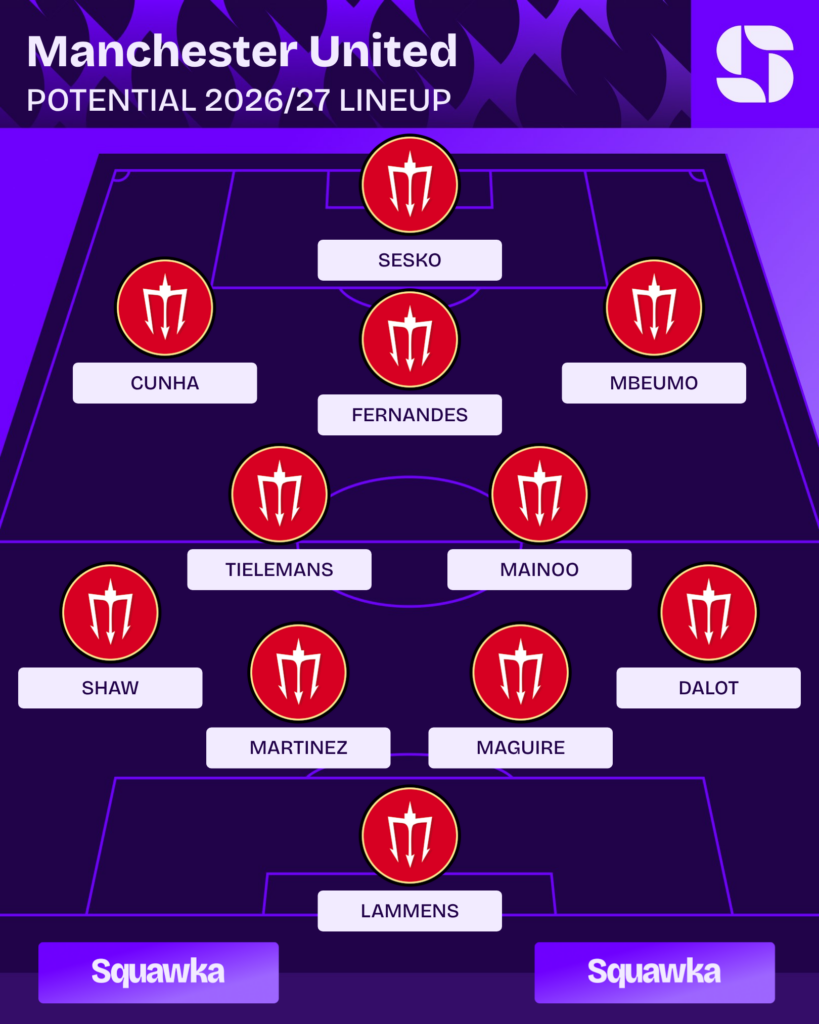
Carrick operates out of a nominal 4-2-3-1, but unlike the rigid positionalism of Pep-inspired managers, his style is defined by fluid rotations and dynamic overload-and-isolate mechanics. In possession, Carrick’s side usually shifts into a 3-2-4-1 or 3-1-5-1 shape. Rather than using an inverted full-back to join the midfield pivot, Carrick typically drops his left-back into a three-man first line of build-up, giving his right-back absolute license to bomb forward high and wide.
His system relies on deliberate asymmetry. It’s a framework built on mid-block baiting: drawing the opposition press forward, breaking the first line through a double pivot, and immediately launching direct, vertical attacks into the space left behind.
Man Utd manager analysis
Michael Carrick’s transition to the dugout began under high pressure, taking temporary charge of Man Utd in late 2021 following Ole Gunnar Solskjaer’s departure. In a three-game unbeaten caretaker stint – including a Champions League win away at Villarreal – Carrick offered a brief glimpse of his managerial potential before stepping away to reset and refine his coaching identity.
That opportunity arrived in October 2022 when Middlesbrough appointed him with the club languishing in 21st place in the Championship. Carrick engineered a transformation, implementing a fast-paced, asymmetric 4-2-3-1 that unlocked attacking talent like Chuba Akpom and propelled Boro into the play-offs with a fourth-place finish. Though subsequent seasons brought frustrating inconsistency and a 10th-place finish in 20244/25 that led to his departure, Carrick built a clear tactical reputation as a manager focused on positional flexibility, line-breaking verticality, and midfield composure.
His path came full circle when Man Utd brought him back as interim manager before securing him as permanent head coach. Tasked with steadying a disjointed side, Carrick’s methodical approach quickly bore fruit, turning Old Trafford into a fortress of measured tempo and incisive central play while steering Man Utd back into the Premier League’s top-four conversation.
| Manager | Team | P | W | D | L | Win % |
|---|---|---|---|---|---|---|
| Michael Carrick | Man Utd | 20 | 14 | 4 | 2 | 70 |