



World Cup What Ifs, Squawka’s new alternative reality series, takes a look at what could’ve happened if some of the biggest moments in football had different outcomes.
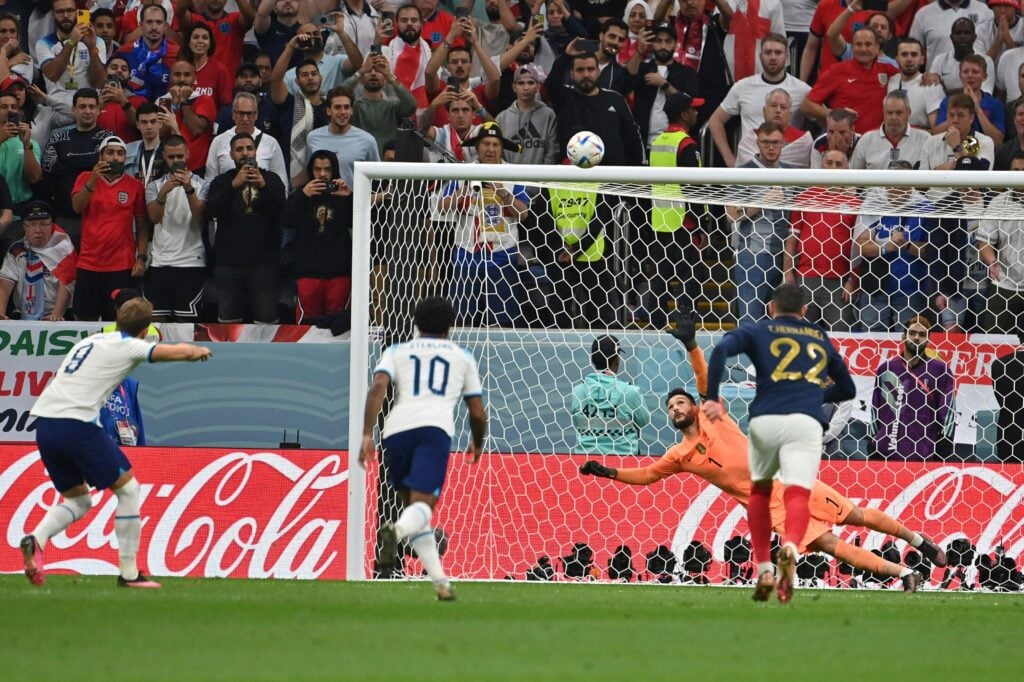
The next in the series examines what could’ve happened if Harry Kane’s penalty against France at World Cup 2022 has nestled in the corner instead of going over the bar. What impact would they have had on the tournament and would England have finally ended 56 years of hurt?
In this article we’ll cover:
The background
This is where one kick becomes an entire tournament model. In the real timeline, Harry Kane stood over a penalty in the 84th minute at Al Bayt Stadium, England trailing 2-1 after Olivier Giroud’s 78th-minute header. Theo Hernández had bundled Mason Mount over, Wilton Sampaio eventually pointed to the spot and Kane, who had already beaten Hugo Lloris from 12 yards in the 54th minute, sent his second penalty over the bar. France protected the lead. England went home. The defending champions moved on to Morocco, then Argentina.
In the alternative reality, Kane does not lean back. He goes right-footed, low and hard, past Lloris for the second time. England’s expected-goals total, already lopsided, finally becomes a scoreline. The actual xG ledger was England 2.36-1.08 France with Kane’s missed penalty valued at 0.76 xG, the same as his converted first-half equaliser.
That is not a half-chance. It is the single biggest probability event in the match, larger than Tchouaméni’s 17th-minute goal (0.02 xG) and Giroud’s 78th-minute winner (0.15 xG) combined by more than four times.
That is the butterfly effect in its cleanest footballing form. Not a tactical revolution. Not an injury crisis. Just 0.76 expected goals becoming one actual goal. England had more possession, more passes, more corners and more shots on target.
The underlying numbers already suggested Gareth Southgate’s side had done enough to extend the game. Kane scoring simply makes the scoreboard catch up.
The alternative outcome
The final six minutes of normal time become a different sport. France, who had been protecting territory, are suddenly exposed to a game state they had avoided. Kylian Mbappé, quiet by his standards in the shot map, has space in transition but not control of the match. England, with Bukayo Saka having won the first penalty and repeatedly drawn fouls, are no longer chasing with desperation. They can reload through Jude Bellingham, Jordan Henderson and Declan Rice, rather than forcing early crosses into traffic.
Our simulation gives England a 43% chance of winning before penalties once the game reaches 2-2, France 37%, and a 20% extra-time stalemate feeding into a shoot-out. The extra-time model is deliberately conservative. France still carry elite counter-attacking threat and a bench containing Kingsley Coman and Marcus Thuram. England still have set piece gravity through Harry Maguire, John Stones and Kane. But the key adjustment is psychological and structural: France’s best route, low-event game management, is removed.
The shoot-out layer is where the model leans towards England by a narrow margin. Kane’s conversion changes more than the score; it changes the emotional sequence. England do not enter penalties around the trauma of their captain missing. Lloris has already been beaten twice from the spot by a club team mate. France, meanwhile, would later lose the actual final shoot-out to Argentina 4-2, with Coman and Tchouaméni failing from 12 yards.
That does not prove a repeat failure, but it gives the alternative model permission to treat France’s penalty profile as vulnerable under tournament pressure. Kane does not leave Qatar as the player who missed. He leaves Al Khor as the player who scored twice from the spot against his Tottenham team-mate and dragged England into the final four.
The rest of the tournament
France’s actual semi-final against Morocco finished 2-0, but the xG was not a procession. France totalled 1.95 xG, Morocco 0.92, with Randal Kolo Muani’s 79th-minute goal alone worth 0.70 xG because it was effectively a finish from point-blank range after Mbappé’s deflected dribble.
Morocco’s resistance was real. Their block had already eliminated Belgium, Spain and Portugal; their run was built on defensive compactness, emotional momentum and a willingness to suffer without becoming passive.
England’s alternative semi-final is therefore not written as a comfortable win. It is written as control without avalanche. Southgate’s side had scored 12 goals in five matches before the France exit, including six against Iran, three against Wales and three against Senegal, but Morocco were the tournament’s great suppressors of rhythm. England’s route is through volume rather than chaos: territorial possession, switches to Saka and Phil Foden, Kane dropping off to pin Sofyan Amrabat and Bellingham attacking the left half space.
In the alternative reality semi-final, Kane scores again. England keep their fourth clean sheet of the tournament. Southgate reaches the World Cup final, and the country’s entire conversation about his caution, substitutions and ceiling is rewritten in 72 hours.
The temptation is to crown England but that is not what the model does.
Argentina’s actual final against France finished 3-3, with Argentina winning 4-2 on penalties. Argentina’s xG stood at 3.35 xG and France at 2.28 xG, a reflection of both Argentina’s first-half control and Mbappé’s late penalty-driven eruption.
Against England, the game state is different. There is no Mbappé hat-trick event. There is also no French disconnection for Argentina to exploit in the same way. England defend the box better than France did for long spells, but they offer less transition terror than Mbappé and less one-v-one panic than Ousmane Dembélé, even with Saka in excellent form.
Argentina’s edge comes from Lionel Messi manipulating England’s double pivot. Southgate can use Rice as the primary screen and Henderson as the pressure trigger, but Messi’s tournament was not merely about goals. It was about choosing when a match happened. England can compress central space for 30 minutes; they cannot do it for 120 without leaving something open.
The model projects a tight final. England have their moment but are unable to hold onto the lead, with Argentina taking the game to extra time. Argentina’s bench and game craft decide it. They do enough to find a goal in extra time and run out 2-1 winners.
England’s tournament doesn’t end with a penalty miss but, instead, a hard fought final loss against an Argentina team that found their rhythm and a Lionel Messi that cemented his status as the best player of all time. England might not have won the competition but they are, rightly, lauded as heroes for their display in Qatar and continue their momentum under Southgate.
Kane’s legacy
Even without England winning the World Cup, Kane’s tournament legacy is transformed.
In reality, his miss became a brutal visual shorthand: England close, England credible, England eliminated. In the alternative reality, he finishes with a goal against France, the semi-final winner against Morocco and the equaliser in a World Cup final. His knockout stage output becomes historic rather than haunted.
He also breaks the national scoring record in a different emotional register. In the real timeline, the first France penalty took him level with Wayne Rooney on 53 England goals. In this timeline, the second takes him past Rooney in the same match, under maximum pressure, against the defending world champions.
By the end of Qatar, Kane is not just England’s record goalscorer. He is the player who scored in a quarter-final, semi-final and final of the same World Cup campaign.
The Ballon d’Or does not move away from Messi. Argentina still win. Messi still completes football. But the podium conversation changes. Mbappé loses a final stage on which he scored three. Kane gains one. Bellingham’s breakout becomes a global coming-of-age rather than a quarter-final footnote. Southgate’s reputation pivots from nearly-man to tournament manager who reached two European Championship finals and a World Cup final in consecutive major tournaments.
Football history often pretends to be inevitable after the fact. The data says otherwise. England did not need to become a different team to alter Qatar. They did not need Mbappé injured, Messi muted or Morocco overawed. They needed the highest-value chance of their tournament, a 0.76 xG penalty, to behave like a 0.76 xG penalty.
One kick. One degree of body shape. One ball under the bar instead of over it. In the real world, France advanced and England left with another scar. In the alternative one, Kane scores, England go deeper than they have gone since 1966, and the entire mythology of Qatar 2022 bends around 12 yards.
The effect on Southgate
Southgate is viewed as many things by England fans. As a player, his legacy is that of a missed penalty against Germany and of a paper bag over his head in a pizza advert. As a manager, it’s of a man that reunited the footballing nation, restoring national pride in the process but of someone who was too cautious, too pragmatic and not quite good enough to get over the line.
While the alternative reality doesn’t change that fact that he was unable to win anything while leading the Three Lions, it does affirm him as a manager that has the ability to lead a team through an international tournament.
His legacy for England is enhanced and he garners sympathy for losing so cruelly in three consecutive finals, instead of having the question marks over his substitutions and ability to think on the front foot.
It’s unlikely that Southgate continues as manager past the fallout of the final of Euro 2024, the emotional turmoil of three final losses being enough for any manager, but it separates him from the likes of Bobby Robson and Terry Venables as someone who was able to lead his country to the World Cup final.
The verdict
The course of history might’ve been completely redefined by one missed penalty kick.
World Cup 2022: England don’t win the tournament but their standing in world football is enhanced greatly by overcoming France and reaching the final, before eventually losing to Argentina. The Three Lions are seen as one of the world’s true elite nations and the good feeling around the national team is enhanced heading towards Euro 2024.
Kane’s legacy: Kane still becomes England’s highest ranking goalscorer of all time but the circumstances surrounding him reaching that milestone are ones of genuine triumph. He is cemented as the greatest England striker of all-time, achieving things that the likes of Lineker or Rooney were unable to do and dragging his nation to the World Cup final.
Southgate’s standing: Most England fans hold Southgate in high regard for leading the Three Lions to consecutive European Championship finals but adding a World Cup final to that list enhances his reputation even further. He becomes one of the most sought after managers around, both domestically and internationally, taking his career further than in the actual reality.
That penalty miss hurt England fans, providing evidence to the narrative that they were never quite good enough to go all the way. But, in the alternative reality, the effects are clear: they are able to go further, they can beat the top nations and they were just a little bit of luck away from achieving greatness. Unfortunately, that is just an alternative and that hurt remains real and raw.
Read more:
Squawka Suggests