








Despite winning two of their opening three games of the Premier League season, Chelsea have conceded seven times already.
A lot of the talk in the early stages of Xabi Alonso’s tenure has been around their low possession numbers, averaging 36.3% possession across their opening three fixtures, only Hull City having less.
But having conceded seven times already this season, the Blues are conceding 15.0 shots per 90 minutes, with only five teams conceding more shots per 90.
So what exactly is leading to Chelsea’s defensive issues?
In this article, we’ll cover
Chelsea’s press
In the opening games of the season, Alonso has been setting Chelsea up to press from a 5-2-3 shape with an underload in their front press.
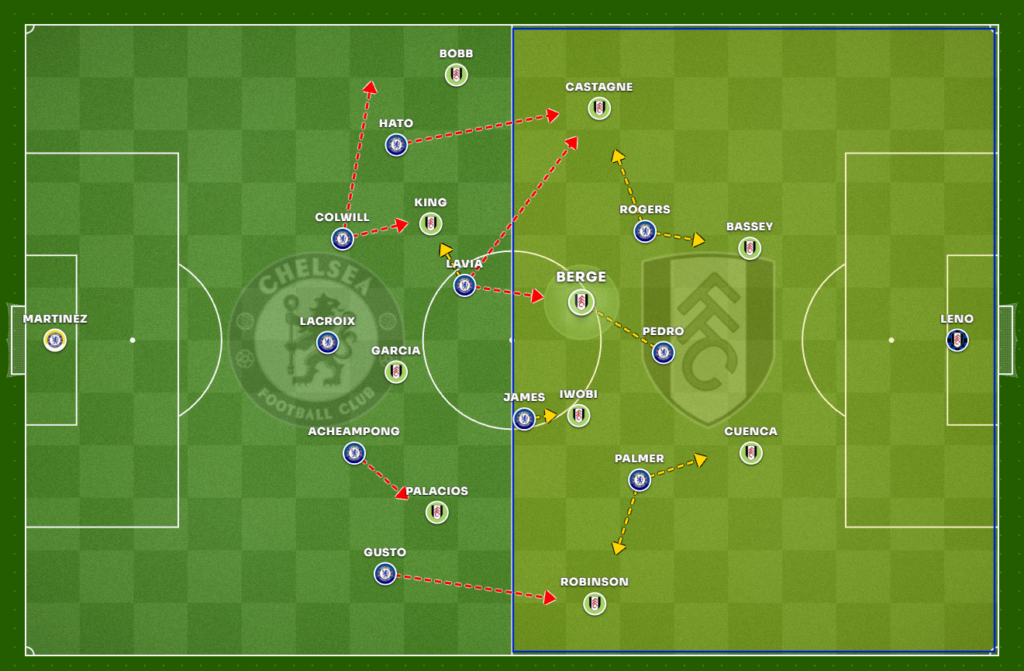
Against Fulham, the front three sat narrow, looking to manage the two central defenders and one of the pivot, with Joao Pedro looking to shadow mark Sander Berge while Reece James stepped up to mark Alex Iwobi.
When they moved the ball down one side, either the ball side wing-back would step up to the Fulham full-back or, if the wing-back was pinned, it would be down to the inside forward to track across or a midfielder to step across with someone else taking their reference.
This allowed Fulham to find ways of building out and finding the spare man with their overload in the build up.
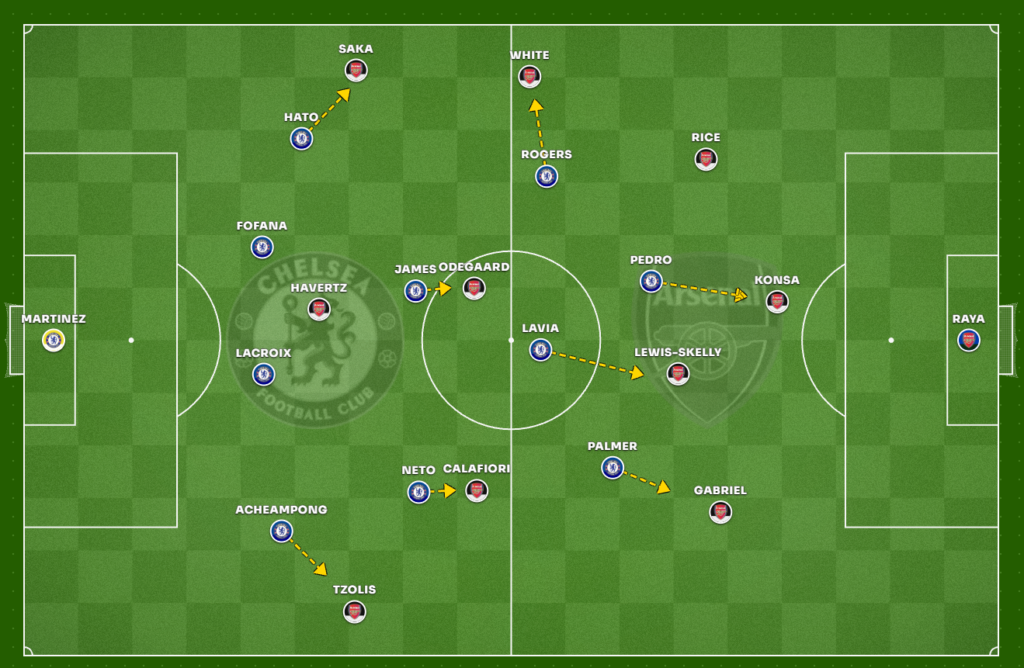
Against Arsenal, the press was slightly different instructionally, while still retaining a -1 in the front press and a +1 on the opposition centre-forward.
While Palmer and Pedro were looking to jump onto the two Arsenal centre-backs, Rogers was tasked with following Ben White as he advanced, allowing Arsenal to utilise their +1 in the build up by dropping them into the backline and bringing the ball forward down the right side under little to no pressure.
Neto also followed Ricardo Calafiori on the opposite side, meaning if Palmer stayed narrow on one of the midfielders dropping into the Arsenal backline, Gabriel could receive in a slightly wider position to bring the ball forward in a similar way down the left.
Wide management
With teams finding ways to build through Chelsea’s front press with relative ease, the next important details are what they do once they progress and have more settled phases of possession.
With Alonso wanting his defensive block to remain active, looking to transition from a lower 5-4-1/5-2-3 shape to apply pressure on the ball with triggered jumps.
However, due to the active mindset of Chelsea’s defensive block, teams have found ways to exploit their jumping references, especially when it comes to building in wide areas.
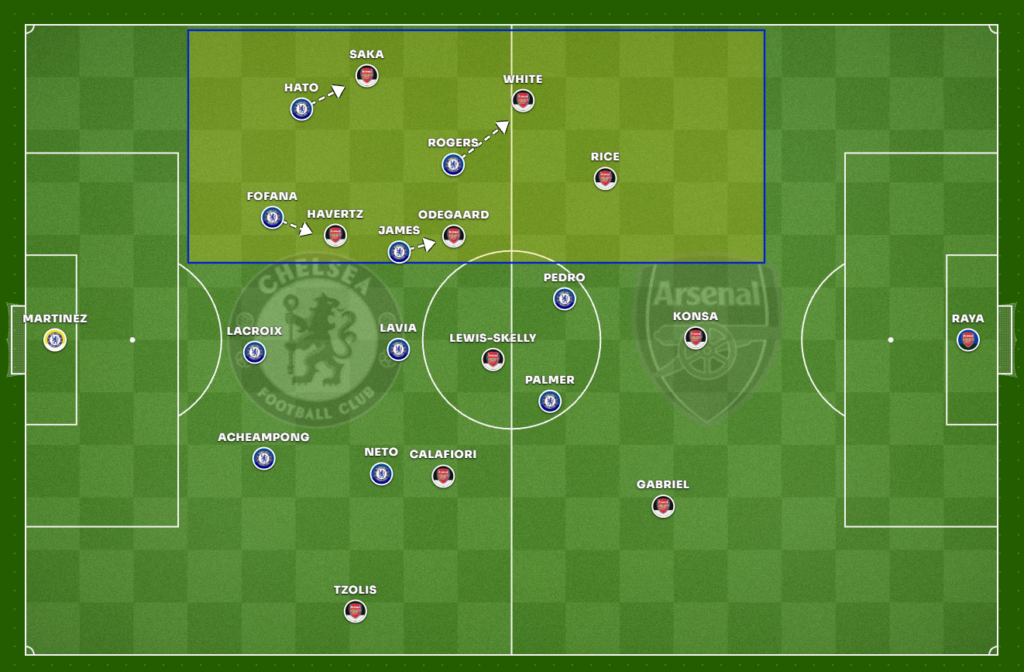
Against Arsenal, Rice’s position was key to kick starting these phases of play, becoming the +1 to beat Chelsea’s press in a right centre-back position, then advancing down the Blues left side.
With White already advanced dragging Rogers deep, Reece James looking to occupy Martin Odegaard inside, Kai Havertz drifting over onto Fofana and Jorrel Hato managing Bukayo Saka, Arsenal were able to create 5v4 overloads down that side.
Arsenal players were then looking to combine and rotate in these areas, forcing marker switches between the Chelsea players and looking to entice them to apply pressure on the ball.
This often allowed them to find the spare man, forcing to the next jump from the defensive or midfield line to apply pressure on the ball, which continuously opened space for Arsenal to exploit between the lines or beyond Chelsea’s last line.
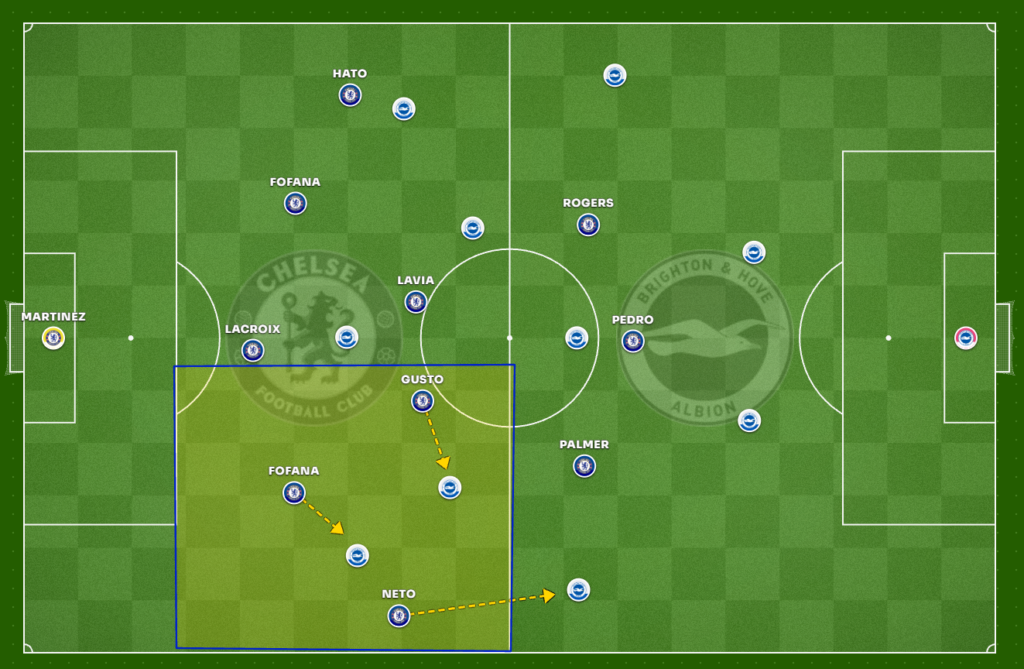
Against Brighton, there were examples of similar moments down Chelsea’s right flank, with Wesley Fofana, Malo Gusto and Pedro Neto having to deal with Brighton’s rotations.
An example of this was evident early in the first half, when Neto was dragged deeper by Maxim De Cuyper holding the width, Gusto had to jump out to apply pressure to Ferdi Kadioglu and Fofana then had to jump out to Malick Yalcouye on the ball.
On this occasion, each of the three players had swapped marking responsibilities, but in the early implementation of Alonso’s defensive schemes, the moments of indecision when switching markers and jumping out in the press has lead to good opportunities for the opposition to find advantages.
Midfield issues
But it isn’t just wide areas Chelsea are being opened up in, their activity within a defensive block is also leading to spaces between the defensive and midfield lines.
A good example of this from the Arsenal game was how Odegaard’s positioning was causing problems for Alonso’s side.
With Rice dropping into the backline and Myles Lewis-Skelly dropping deep as a single pivot, only one midfielder (often Romeo Lavia) would step out to mark the single pivot, leaving James as the only player protecting central areas between the front press and the defensive line.
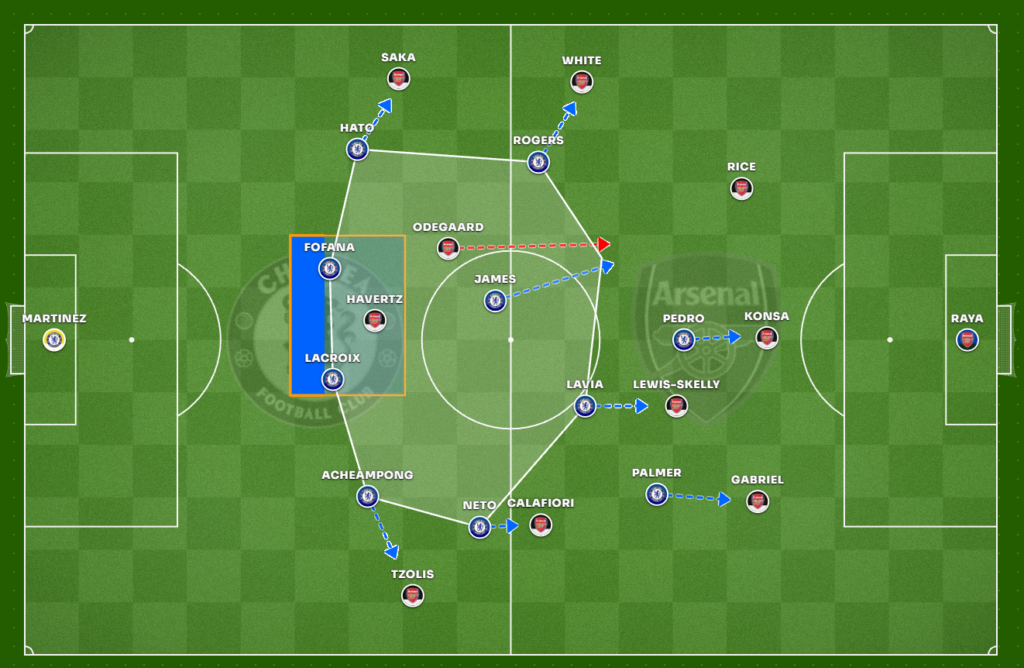
However, Odegaard’s dropping movements from high to low became an issue, as James would then be inclined to follow the Norwegian midfielder.
This often saw a huge gap appearing between the lines, as the defensive line didn’t opt to step up, keeping a +1 in the last line with a 2v1 against Havertz.
Clarity is a word that comes to mind when it comes to teams looking to implement new pressing ideas and defensive schemes, as moments of indecision can leave open spaces for the opposition to exploit.
All three of the issues discussed in this analysis have a mixture of structural and implementation issues, so it will be interesting to see how things develop over time for Alonso’s Chelsea.