




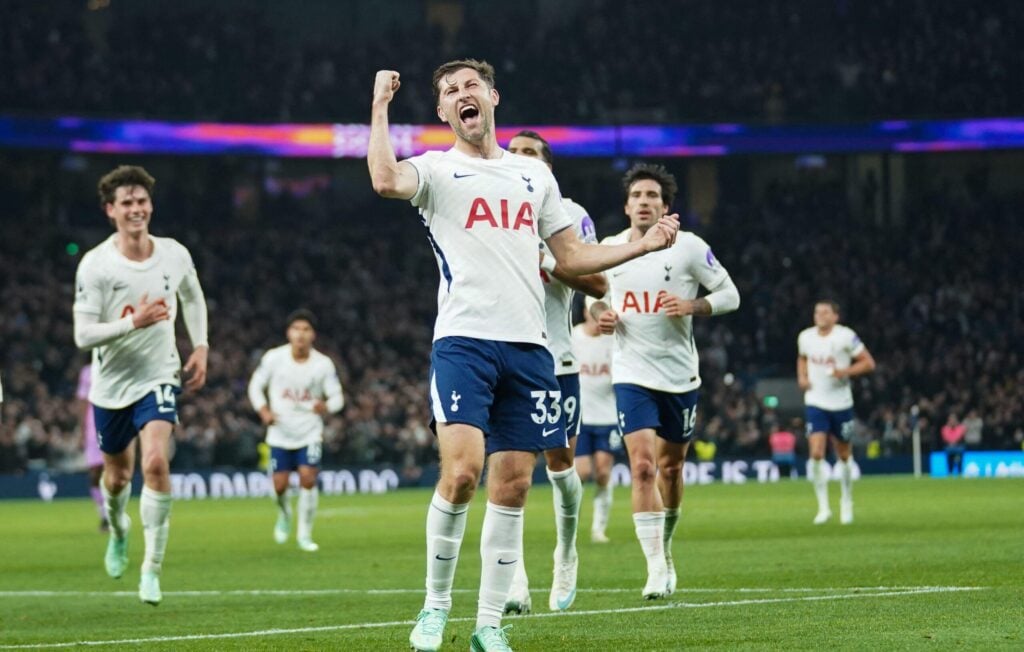
Tottenham Hotspur defeated Coventry City 3-1 to earn their first win of the new Premier League season.
It was an odd game in North London as Spurs finally celebrated a win and got out of the relegation zone.

For starters, it was the first time a team scored three goals from outside the box in a single Premier League match in three and a half years. The last time had been Fulham against Leicester City back in May 2023.
Not only that, but neither side managed to accumulate 1 expected goal. As per Opta, Spurs had 0.87 xG and the Sky Blues 0.82. This was one of just three games this season in which this has happened. The other two were Ipswich Town vs Liverpool and Nottingham Forest vs Leeds United.
And while this could definitely be a turning point for Roberto De Zerbi‘s men, they should also try to scrap tonight’s performance altogether.
Why was Tottenham’s win over Coventry positive short term and negative long term?
Long-range fest (with help)
We mentioned before, but it’s worth approaching this theme again. Tottenham needed a James Maddison stunner to break the deadlock. This in itself is not exactly an issue. As Aston Villa proved last year, you can very much challenge all logic and overperform expected goals tallies for a whole season.
And Maddison in particular is a very dependable shooter from outside the box. In fact, no other player has scored as many long-distance goals as him in the Premier League since his debut in the top flight in 2018. And he missed almost the entirety of last season.
His return is highly important not because of his overall play, but because he helps in low-percentage chances that could be decisive to unlocking tough matches. Whether it’s by taking long-range shots or dishing out assists in set pieces.
But his wondergoal was not enough to win the game, as Coventry responded through Jack Rudoni. Instead, it took them two more goals from outside the box to get all three points. And Carl Rushworth played a big part in both.
Omar Marmoush‘s effort went into the side netting, making it look like a beautiful strike with no chance of saving. In reality, however, Rushworth basically parried the ball there. Not to mention Milan van Ewijk giving up on the play after making contact with the Egyptian’s elbow. It gave Marmoush the perfect conditions to adjust his body and take the shot with nobody around.
To top it all off, Ben Davies had an attempt of his own in stoppage time. Rushworth also touched the ball before it went in, going under his arm. Two shots that could – and should – have been saved and, in ‘normal’ circumstances, would not have gone in.
For perspective, Marmoush’s and Davies’ goals were worth 0.07 expected goals on target, according to the Opta model. Rushworth’s negative performance of -2.17 goals prevented was the third worst return of any goalkeeper in a Premier League game this season.

Even with shots he did save, Rushworth looked awkward and uncomfortable, not fully in control of the ball.
Exposed defence
Roberto De Zerbi likes to takes risks, which is why many of his teams deliver entertaining football matches. And also why they usually struggle defensively as well.
Tottenham pressed Coventry in full man-to-man fashion, establishing 11 different mini 1v1 battles throughout the pitch. Having three centre-backs helps in aggressive defensive approaches in case one of them is dragged out of position. He also made this change, going to a back-three for the first time since his Marseille days.
It was a 3-1-3-3 with Sandro Tonali between the defence and midfield lines, a trio of Archie Gray, Maddison and Marmoush, Mohammed Kudus and Andy Robertson holding the width and Dominic Solanke as striker.

However, Sidiki Cherif‘s presence complicated things for Tottenham. He often dropped deep, taking Tosin Adarbioyo along with him. Brandon Thomas-Asante was always ready to infiltrate and occupy the space left in-behind.
That was actually the very first play of the game, but in a long ball from Rushworth rather than a settled possession in the attacking half. And it dictated how Frank Lampard was trying to gain advantage over De Zerbi.
In fairness, it did work a few times. Cherif had a solid game doing this ‘dirty work’ off being used as bait and a hub for vertical passes and dragging defenders out of position.
It also generated the best chance of the game according to Opta’s expected goals model. It was the same connection between Cherif dropping deep and Thomas-Asante infiltrating. This time, the Ghanaian forward set Tatsuhiro Sakamoto up for a shot worth 0.21 xG, though Spurs managed to block it.
The Sky Blues actually took three of the four shots with the highest xG values of the game. And they generated basically the same amount of expected goals (0.82) as Tottenham (0.87) with four fewer shots (12 to 16) and a lot less possession (35% to 65%).
This is why Roberto De Zerbi never looked satisfied with what he was watching, and looked relieved rather than happy when the Andy Madley blew the final whistle.
Spurs should definitely celebrate the three points and let out a sigh of relief for finally winning in the Premier League. But move on from the performance completely.