




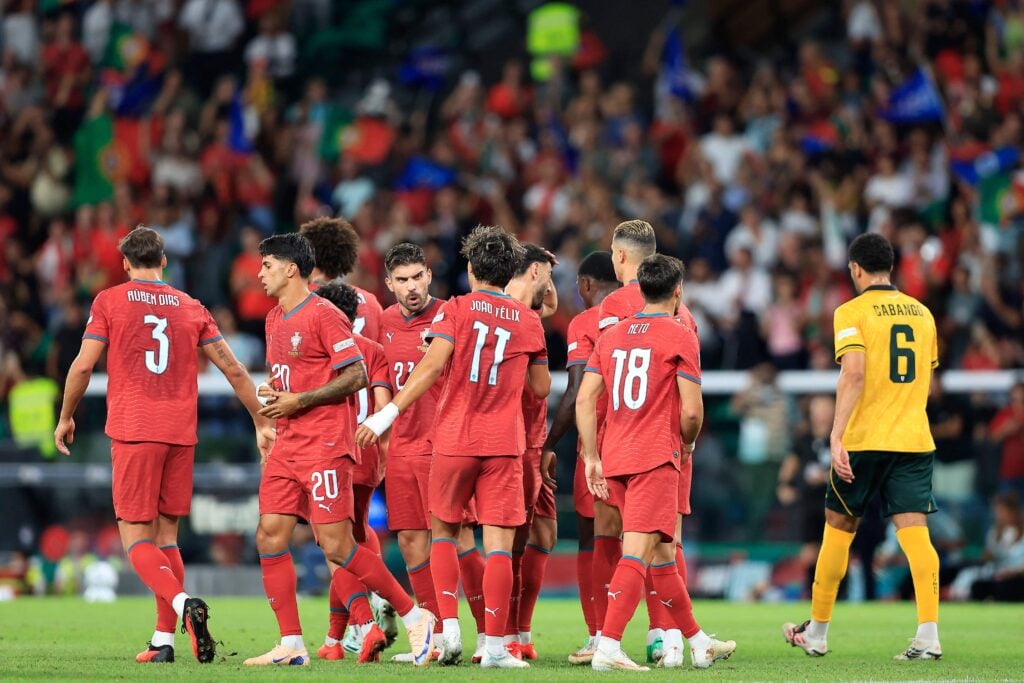
Portugal opened their Uefa Nations League campaign with a 1-0 win over Wales.
Joao Felix scored the only goal of the game midway through the first half, set up by Nuno Mendes — the first goal of the Jorge Jesus era.
The Selecao dominated proceedings in the second half, with 10 shots and one big chance created. But they were unable to find a second. However, Portugal did manage to keep Wales out to secure the victory.
In this article, we’ll cover
Portugal’s high press
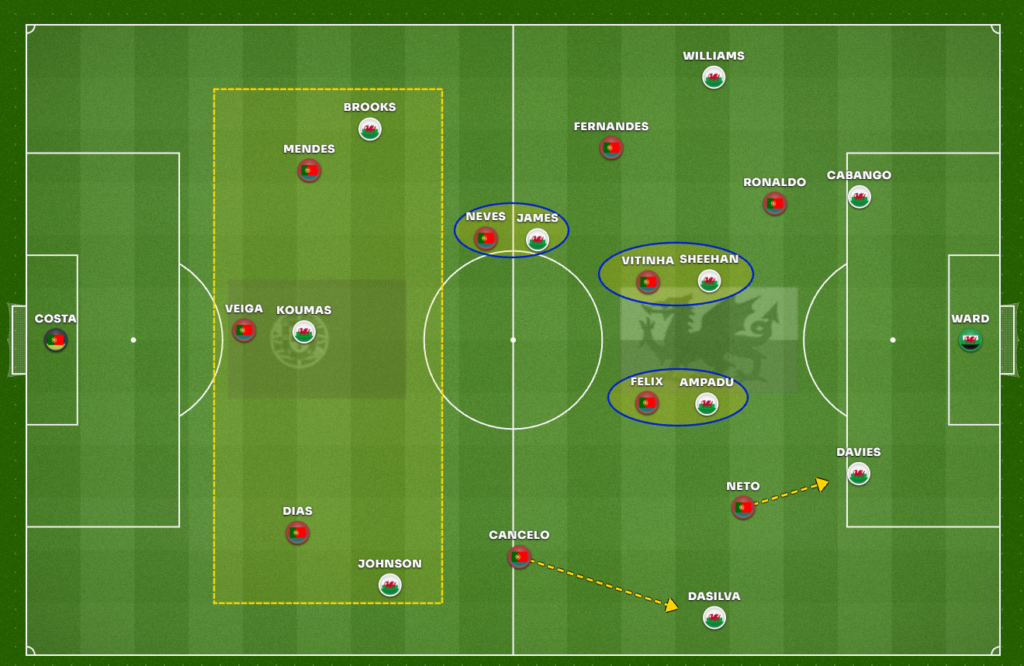
Portugal looked to press in a man-for-man fashion from goal kicks, with Pedro Neto on Ben Davies, and Cristiano Ronaldo taking Ben Cabango. When Neto did push onto Davies, Joao Cancelo then jumped onto Jay Dasilva, with Ruben Dias shuffling across to mark Brennan Johnson.
Renato Veiga and Mendes also took up man-marking roles, on Lewis Koumas and David Brooks, respectively. Felix then dropped to cover Ethan Ampadu in the pivot, with Vitinha jumping onto Josh Sheehan. Bruno Fernandes was ready to apply pressure if the ball went out to Nico Williams.
Ruben Neves was then looking to follow Jordan James, whether he pushed forward to make it a 4v4 on the last line, or dropped deeper to try and overload the midfield.
Open-play press
In more settled play, Felix would still press as the second striker alongside Ronaldo in a 4-4-2 shape. Neves jumped to apply pressure to Sheehan, while Dias also jumped to mark James.
This led to Neto marking Dasilva from his right-midfield position, allowing Cancelo to stay deeper to cover Johnson out wide.
In a man-oriented fashion, Neto and even Fernandes at left-midfield would drop if the full-backs advanced, while Mendes and Cancelo would stay with their man and follow them inside/deeper if they dropped.
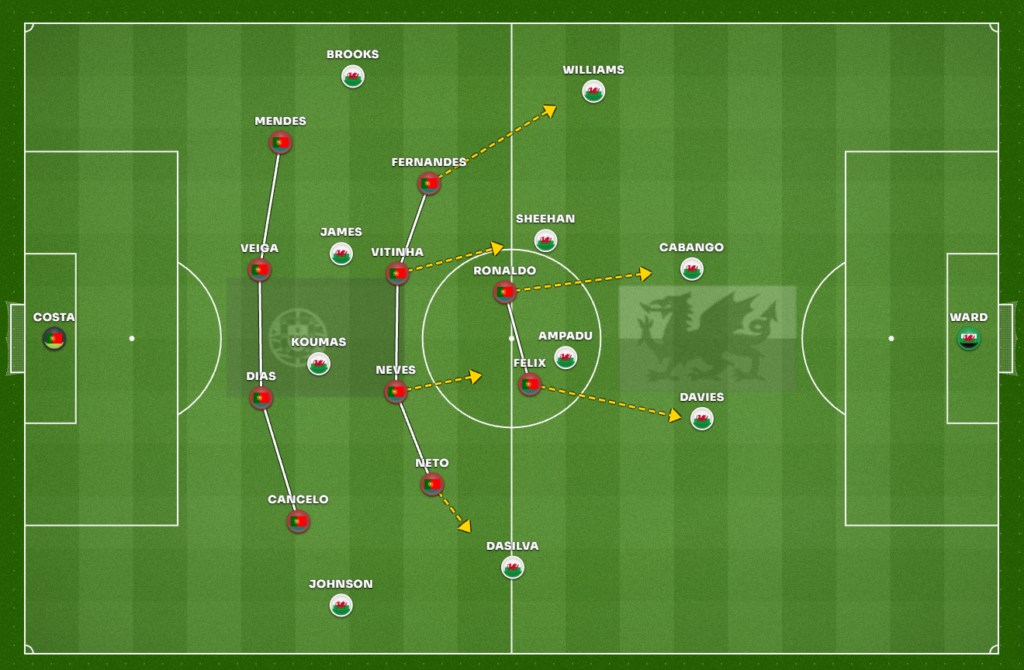
Even as Portugal began to sink into their 4-4-2 shape, there was a clear intent to jump out in the press. The frontline looked to apply pressure and the midfield looked to step up with the press, which saw the defensive line step too.
The key was keeping the lines compact. A full commitment to jumping from each unit to keep the spaces between as tight as possible, with the defensive line often stepping high in order to do so.
Joao Felix’s role
Joao Felix’s role was key to Portugal, both on and off the ball.
Off the ball, Felix was working hard to stop Wales getting possession in central areas from restarts, disrupting their buildup and looking to force turnovers. Even when he dropped in as the second striker in a 4-4-2 shape, Felix was working hard to keep a midfielder in his cover shadow, before jumping to apply pressure to Davies at centre-back.
But it was on the ball where Felix won Portugal the game, receiving possession in a pocket of space between the midfield and defensive line, before getting his strike away which deflected past Danny Ward in goal.
Felix did a great job of dropping deep to connect play and receive between the lines when Ronaldo was occupying the last line, with Neto and Mendes often making forward runs to drag Wales back too, opening pockets between the lines for Felix to operate and connect play.
Tensions and overloads
Portugal found a number of ways to manipulate Wales’ defensive scheme, creating an overload in the buildup and tensions down Wales’ right-hand side.
The first key detail was the positioning of Neves, who dropped between the two centre-backs to overload Wales’ front two and create a three-on-two in the buildup.
Vitinha was then acting as the single pivot, forming a 3-1 base shape, where it would often trigger a jump from Sheehan in the Wales midfield.
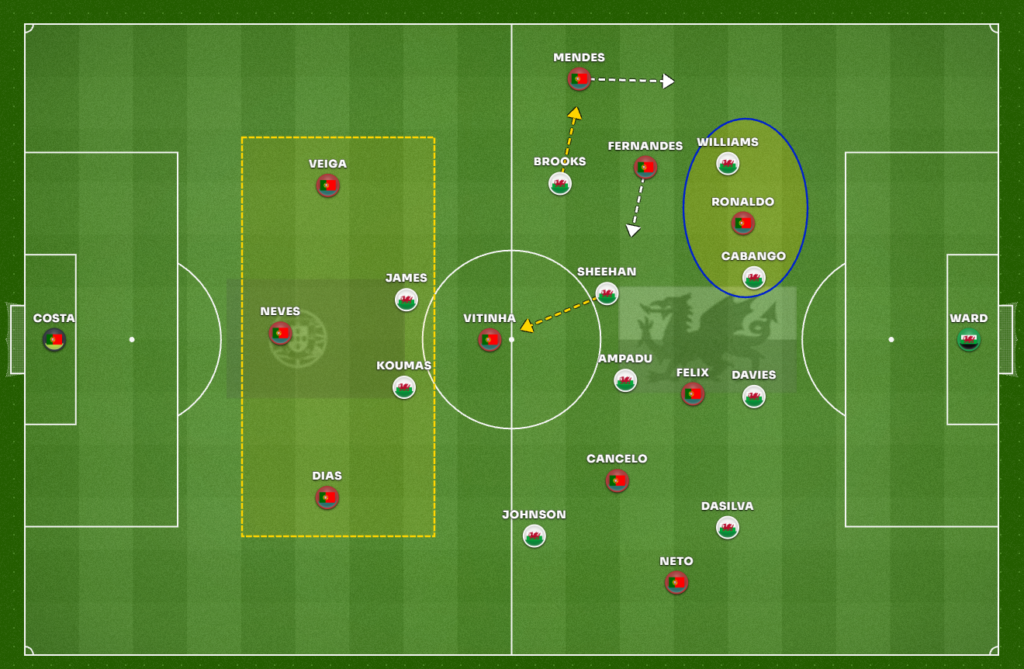
With that jump often being triggered, it was then the movement from Fernandes drifting inside from the left in tandem with Mendes pushing forward that created an issue for Wales down their right side.
Ronaldo was peeling into the gate between the Wales right-back and right centre-back, often keeping both of the pair pinned deeper.
This allowed Fernandes to drift into the pocket of space left by Sheehan, with David Brooks often worried about Mendes arriving on the overlap.
Portugal were able to generate good advantages through this, either with Fernandes receiving in space as the block was pulled apart, or when Brooks followed Fernandes inside, opening an easy pass into space for Mendes to arrive in dangerous areas himself.
Clear intentions
Even though this was Jesus’ first game in charge of Portugal, there were clear intentions to their style of play.
Despite Ronaldo often being labelled a player you cannot account for out-of-possession, there was a clear desire to press with intensity from Portugal, with Jesus finding a system that allowed them to do this effectively.
On the ball, there were clear patterns of play forming, with a midfielder dropping between the centre-backs, wingers and full-backs occupying different lanes and a good use of countermovements to create space in front of the defensive line and beyond it.
The question now will be how they match up against different types of opponent. Their next test is Erling Haaland and Norway, which will provide another set of problems for Jesus to solve and test his side against.
Read more: