

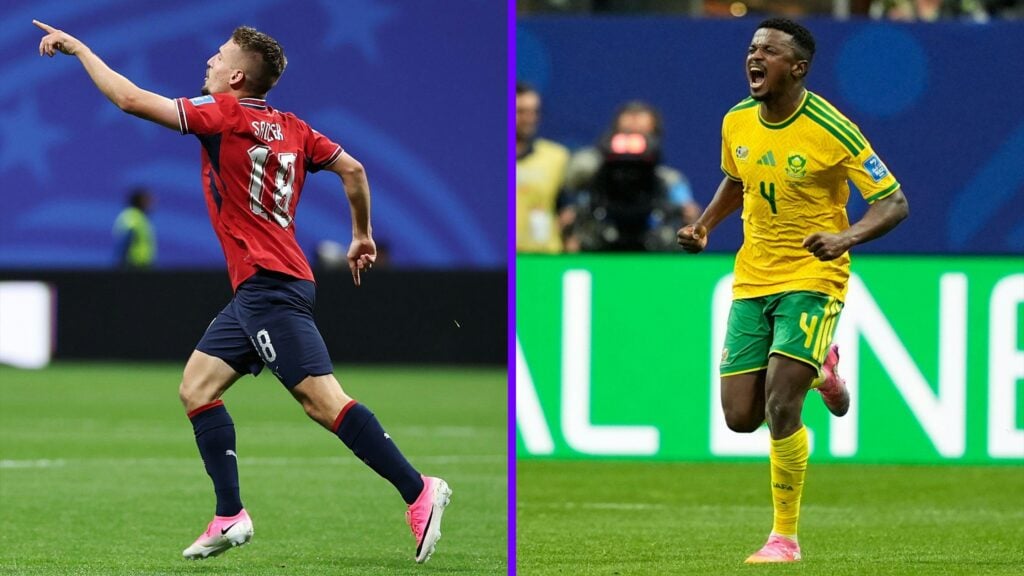
Czech Republic and South Africa played out a 1-1 draw as they kicked off the second round of World Cup 2026 fixtures.
Michal Sadilek gave the Czech Republic the lead in the sixth minute, with a neat finish following a long throw-in. For a long time it looked to be the winning goal, but South Africa were awarded a penalty for handball inside the final 10 minutes. Teboho Mokoena stepped up and coolly converted, for his nation’s first goal at the 2026 World Cup.
It was a result that didn’t do much for either team, though. They both sit on one point and face the toughest teams in their final matches. Czech Republic must beat Mexico, while South Africa need a victory against South Korea if they are to qualify for the knockout stages.
- Bet £10 get £40
- Super Fast Withdrawals
- Trusted Brand
#AD 18+. Play Safe. Online only. Ends 31.12.26. New UK customers only, registering with promo code FB40. Make your first deposit of £10+, then place a £10 single bet from main balance at odds of EVS+ (2.00+) on any sports market (excluding Virtuals). Get £40 in Free Bets (4x£10) after settlement. Each £10 Free Bet is valid on any Bet Builder, expires in 7 days, non-withdrawable and must be used in full (£10 each). Deposits via PayPal, Neosurf, Paysafe, Apple Pay, NETELLER, Skrill, ecoPayz, Kalibra/Postpay and WH PLUS Card excluded. One per customer. Full T&Cs apply. https://www.gamcare.org.uk/ . #ad
Czech Republic vs South Africa analysis:
Czech Republic their own enemies again
It looked as though Czech Republic had done enough. They came flying out of the blocks and were well worth their goal in the sixth minute. Sadilek’s strike was Czech Republic’s fifth of the game. But they wouldn’t have their sixth until the 41st minute. And that was Adam Hlozek’s inaccurate effort from about 30 yards out.
Instead of looking to build on their lead, and go with the cliched gameplan of “it’s still nil-nil lads”, Czech Republic tried to defend their advantage for 84 minutes. They sat off the ball and were happy to let South Africa keep possession, which was only asking for issues. Even with South Africa’s poor possession (more on that shortly).
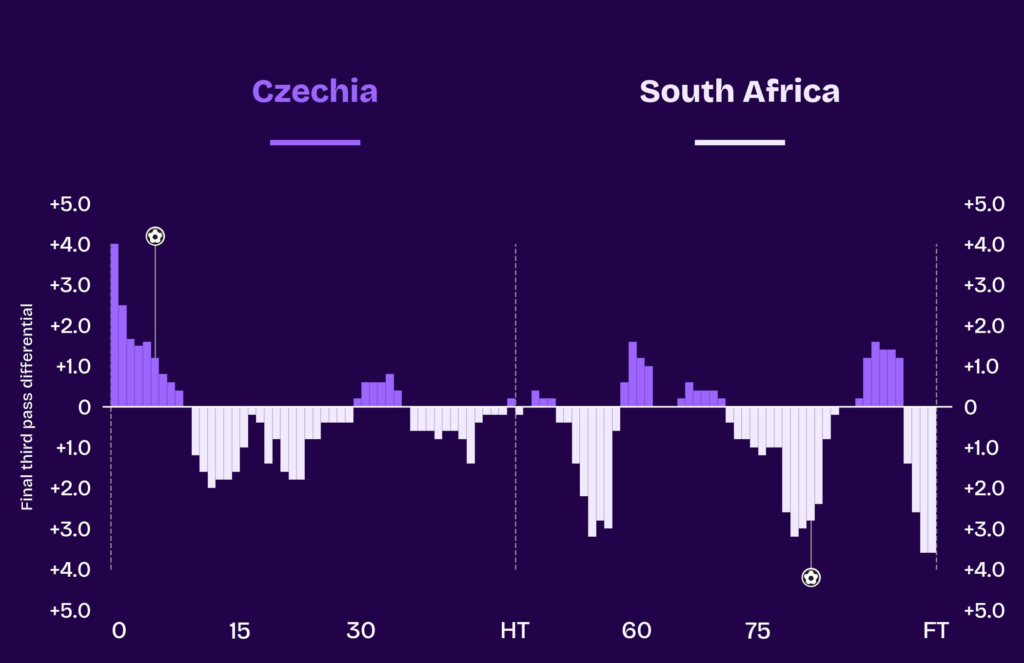
While a defensive setup can be good if you hit the opponents on the counter, Czech Republic didn’t offer much threat there. They barely won the matchup on final third pass differential in key periods. And even when they did, it was still close. Not at all compared to South Africa’s attacking moments.
Even though the equalising goal eventually came from the penalty spot, it had been coming. And it was an all-too-familiar feeling. It’s the second time this World Cup that Czech Republic have tried and failed to protect a lead. At least this time they came out of the game with a point. Not that that has done them any favours, though.
South Africa’s struggles in possession
South Africa had a lot of the ball against the Czech Republic, with 61.9% possession. But they didn’t do much with it.
Bafana Bafana struggled to get striker Iqraam Rayners on the ball in key positions. He was involved, albeit only with 19 touches in his 66 minutes on the pitch. But he wasn’t gaining possession to hurt the Czech defence. He was either pushed out wide, or linking up with teammates, completing eight of his nine passes. Rayners had just one shot, in the first half, but did not trouble the goalkeeper with his 0.06 Expected Goals.
Across the team as a whole, South Africa had four shots in the first half but none hit the target. There were a couple of moments thanks to excellent passes either from the midfield or out wide, but nowhere near enough for the possession they had. Bafana Bafana attempted 563 passes against the Czech Republic, but only 27% of those were forward. That’s even less than their opponents (33.63%).
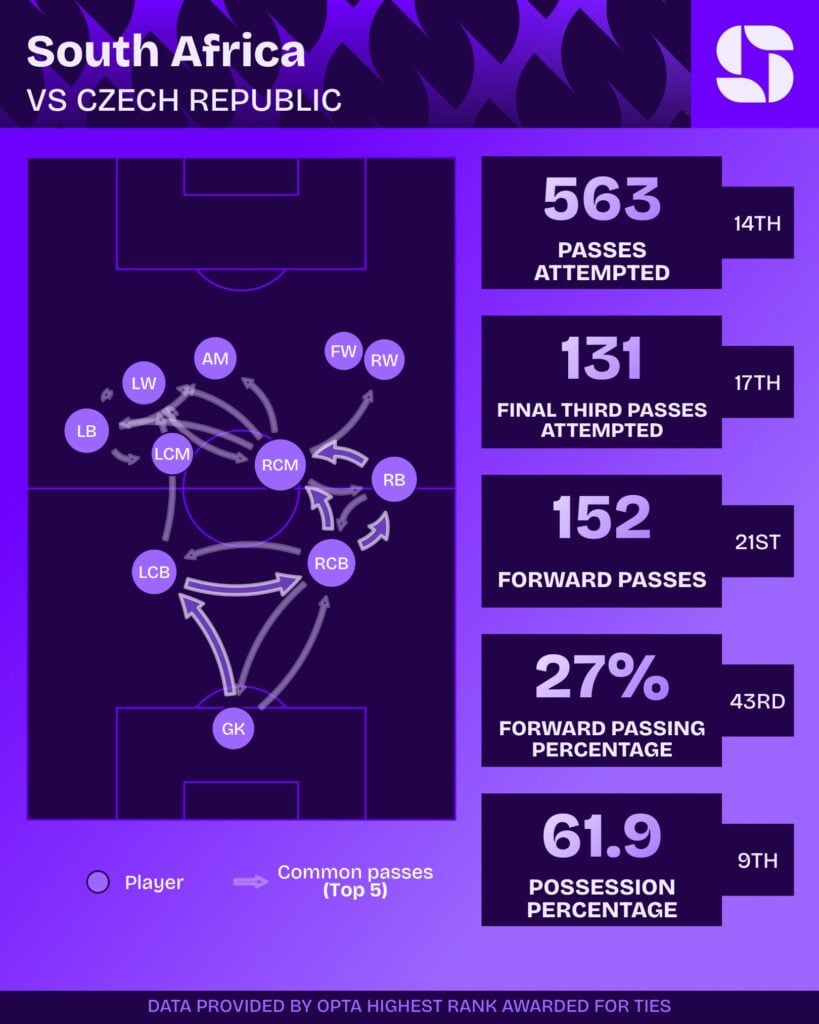
Thing did improve for South Africa after half-time, with Relebohile Mofokeng coming on to replace Jayden Adams in the midfield. Thalente Mbatha dropped into the holding role, with Mofokeng and Teboho Mokoena moving more advanced. They finally got a shot on target in the 74th minute, but Evidence Makgopa’s header was tame and an easy stop.
Of course, South Africa did equalise from the penalty spot, earning themselves a point. And it came as a result of good play, and a dangerous ball into the box. But it felt like they were only going to score from a penalty. If they want to make it to the knockout stages, South Africa will have to do a lot better in their final group game.
- Bet £10 get £40
- Super Fast Withdrawals
- Trusted Brand
#AD 18+. Play Safe. Online only. Ends 31.12.26. New UK customers only, registering with promo code FB40. Make your first deposit of £10+, then place a £10 single bet from main balance at odds of EVS+ (2.00+) on any sports market (excluding Virtuals). Get £40 in Free Bets (4x£10) after settlement. Each £10 Free Bet is valid on any Bet Builder, expires in 7 days, non-withdrawable and must be used in full (£10 each). Deposits via PayPal, Neosurf, Paysafe, Apple Pay, NETELLER, Skrill, ecoPayz, Kalibra/Postpay and WH PLUS Card excluded. One per customer. Full T&Cs apply. https://www.gamcare.org.uk/ . #ad
Miroslav Koubek’s use of wing-backs
Czech Republic’s wing-backs were key to their gameplan against South Africa, at both ends of the pitch. They were both involved in the opening goal just six minutes in, in more ways than one.
Miroslav Koubek set up early to press South Africa man-for-man particularly on goal kicks. Vladimir Coufal and Alexandr Sojka were involved in this, moving up the pitch to mark potential passing options. A goal kick in the fifth minute saw the system work to perfection, as South Africa were panicked and ended up conceding a throw-in just inside the Czech Republic half.
Coufal got on the ball and launched a long throw down the line, to Adam Hlozek. The Czech striker managed to get to it just before the byline and cut the ball back to the edge of the area. Sojka was there waiting and, instead of looking to go for goal himself, the wing-back played a neat one-touch pass through to Michal Sadilek to open the scoring. It was a well-worked routine, with both wing-backs playing their part in different ways.
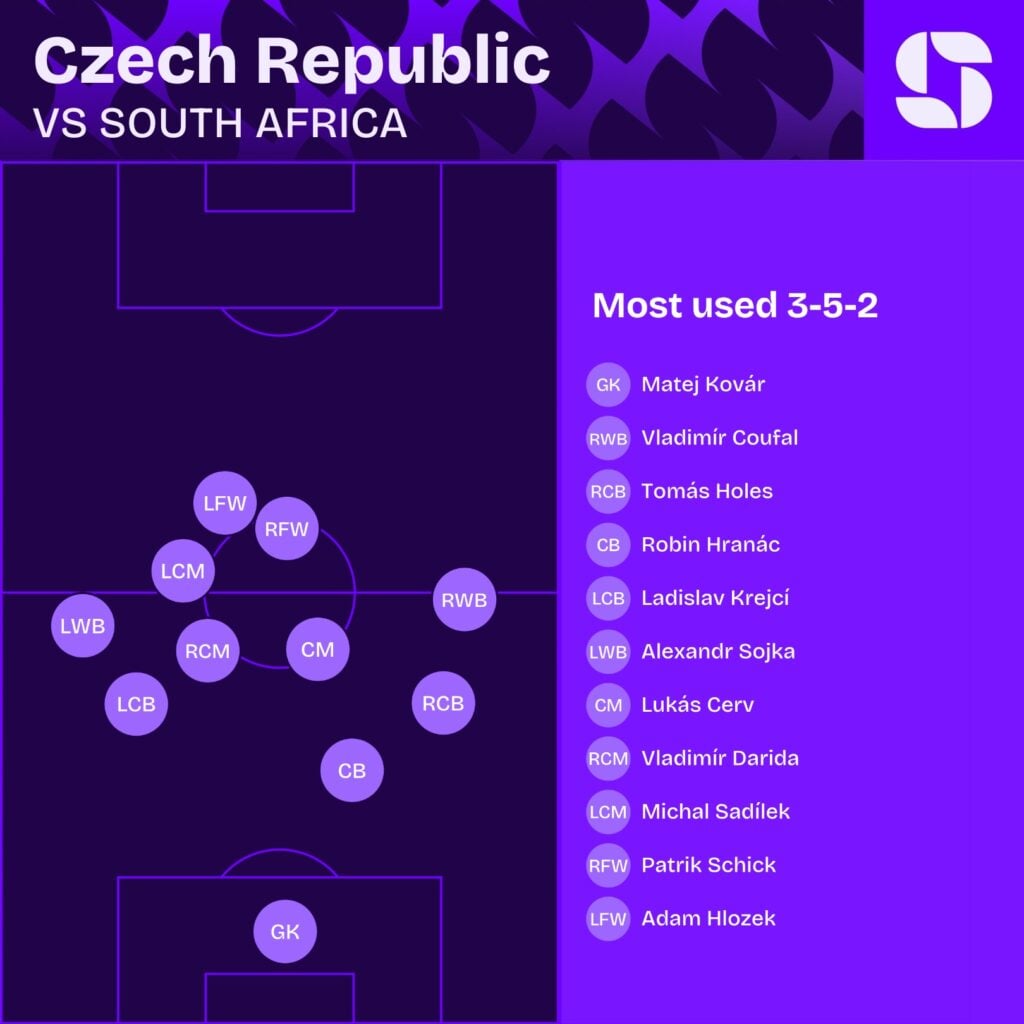
Once they were ahead, the system changed slightly. Coufal continued to push high off the ball to press the South African defence, but Sojka became more narrow to form back four. But he had enough time and space to stretch wide if South Africa played the ball down his flank.
Things were a bit more flexible after half-time, particularly when Jaroslav Zeleny came on to replace Sojka. The wing-backs would alternate who pushed, depending on where the attack was. If South Africa had the ball down their right, Zeleny would press while Coufal formed the four. If it was on South Africa’s left, Coufal pressed with Zeleny stepping inside.
Read more: