




There are more good teams in League One than there used to be.
Back in 2021/22, there was a ‘split league’ in England‘s third tier. Plymouth Argyle missed out on the play-offs with 80 points, while Fleetwood Town stayed up with just 40. And Kieran McKenna‘s Ipswich Town finished as low as 11th.
After that came a period where the cream rose to the top, and the big boys filtered their way out. There were promotions for Ipswich, Sheffield Wednesday, Bolton Wanderers, Portsmouth, Derby County and Charlton Athletic across the next four seasons.
Rise in quality coaching
This year, while there’s still a handful of big clubs — namely Huddersfield Town, Sheffield Wednesday and Leicester City in particular — the strength of League One is more down to the quality of coaching across the board.
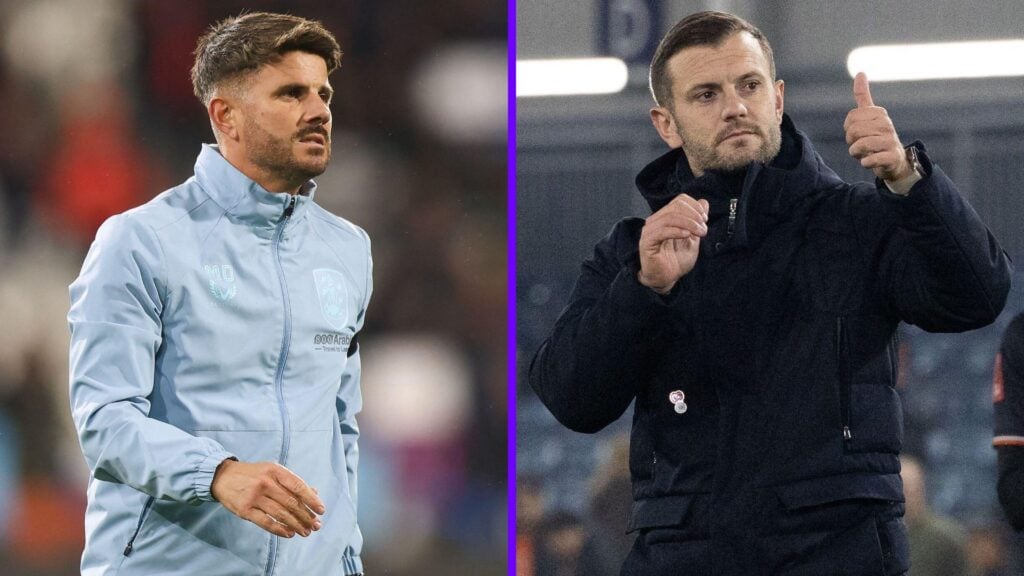
Although managerial unknowns in EFL terms, Martin Drury, Jimmy McNulty and Aaron Ramsey have taken the league by storm at Huddersfield, Stockport County and Oxford United, respectively. Likewise, to a lesser extent, Jack Wilshere at Luton Town and Tom Cleverley at Plymouth.
Huddersfield, for instance, have had the most shots on target in League One this season with 85. Withdrawn forward Joe Taylor — deeper out-of-possession but given full licence to utilise his pace on turnovers — also leads League One with 25 shots on target, scoring 10 goals.
Stockport, meanwhile, have created the most chances in League One this season. By some distance too, with 208, thanks to some lovely wide triangle passing exchanges in McNulty’s 3-4-3.
Then there’s Reading, who have almost surprisingly been one of the most creative sides in League One under Leam Richardson. Not to mention clean sheet specialists Bradford City, and newly-promted Cambridge United, who punch above their weight with one of the best managers in the division in Neil Harris.
Weaknesses exposed
The strength of competition means Russell Martin and Henrik Pedersen have been exposed for their managerial limitations. The latter has subsequently been replaced by Dave Challinor at Sheffield Wednesday.
Martin, I think, is a fantastic in-possession coach, but he neglects the out-of-possession side to his, and Leicester’s, detriment. Pedersen, meanwhile, is a top technical coach but doesn’t quite have all the leadership skills required to back it up as a number one.
Nonetheless, both squads are jam-packed with individual quality. So, regardless of management, they’re always likely to drive up the standard of the league.
And then there’s MK Dons. I felt they had a top-half League One squad even when they were in League Two with a budget of around £9million. They’ve since added to that with experienced former Champions League players like Charlie Goode, Cohen Bramall, Daniel Barlaser, Ryan Wintle, Sammy Silvera and Sam Nombe, putting them comfortably in the top six for spend.
It was a slow start for Paul Warne’s side, beginning eight winless in the league. But they’ve since won five of their last six, scoring 19 goals in the process. That includes six-goal hauls in successive home games against Doncaster Rovers and Burton Albion – with Aaron Collins in outstanding form.
The Buckinghamshire outfit are gathering momentum, and could be quite the force under a manager who has won four of his five career promotions at this level.
We’ve already mentioned 11 good teams, of which at least eight will expect to be in the top six this season. That highlights how strong you have to be to make the cut.
Rising standards
As such, I think the standards have really been driven up. Based on points-per-game projections, Wycombe Wanderers would finish 13th with 64 points. Nobody has finished in the bottom half with that tally in six years.
Stevenage, for example, I think are actually a bit better than they were last season, when they reached the Play-Offs.
Yes, they’ve lost Goode and Harvey White, but Alex Revell’s side have laudable depth. Recruits Josh Magennis, Olly Sanderson, Terence Vancooten, Michael Mellon, Tommy Setford and Ben Broggio have all made positive impacts, with the likes of Wanya Marcal and Matt Smith to come into that equation too.
Stevenage can attract a very high calibre of player for a club of their modest stature, and so they have 20 players who could all be capable of starting. And yet, they’re 16th, albeit with games in hand.
As the league grows stronger, previous top six regulars at this level, like Barnsley and Peterborough United, are getting squeezed down into the bottom four, without the kind of significant off-field changes that you’d typically associate with such a decline.
Those two clubs have merely stood still – and, if you do that in this iteration of League One, you’re inherently going backwards.