






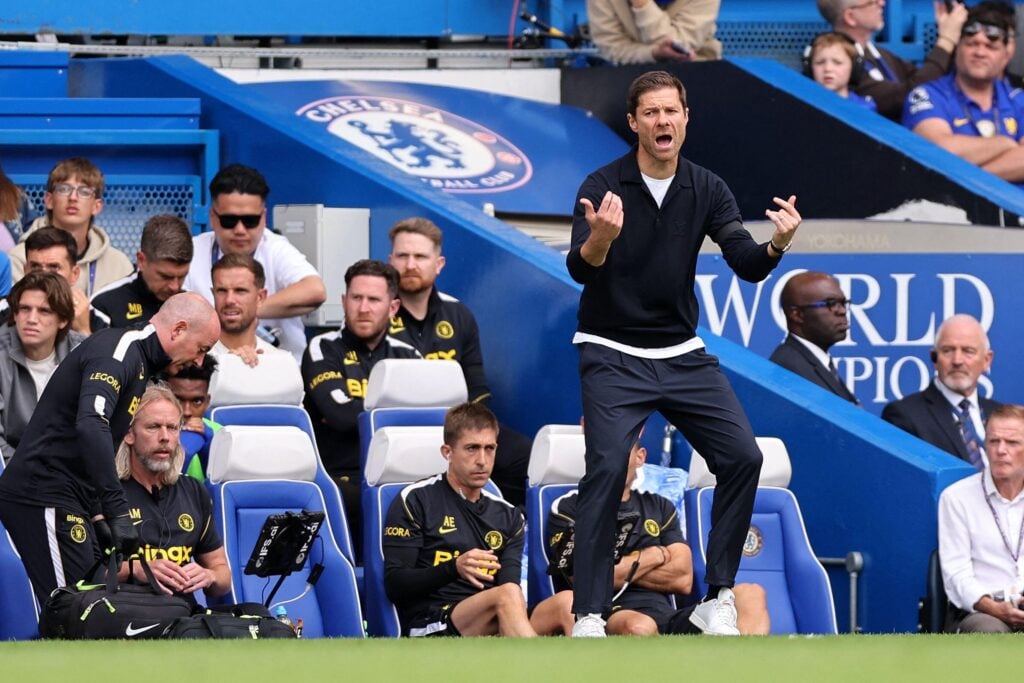
Chelsea remain perfect in the league under Xabi Alonso, winning both of their opening two matches.
The Blues have scored seven goals in that time, the joint-most in the Premier League. But they have also conceded five, with only two teams letting in more.
Alonso has already dramatically shifted Chelsea’s playing styule from last season, with new defensive ideas and attacking conditions.
But can Chelsea mount a title charge with this set of tactical principles? It’s the question of everybody’s lips right now.
Xabi Alonso’s Chelsea tactics
Low possession, high verticality
Both of Chelsea’s Premier League games under Alonso have seen focus on the Blues’ possession statistics. They had just 38% possession in their opening game against Fulham, while holding just 26% of the ball in the win over Brighton and Hove Albion. The latter was Chelsea’s lowest Premier League possession number on record since 2003/04.
But what is the truth behind these numbers and Alonso’s attacking plan?
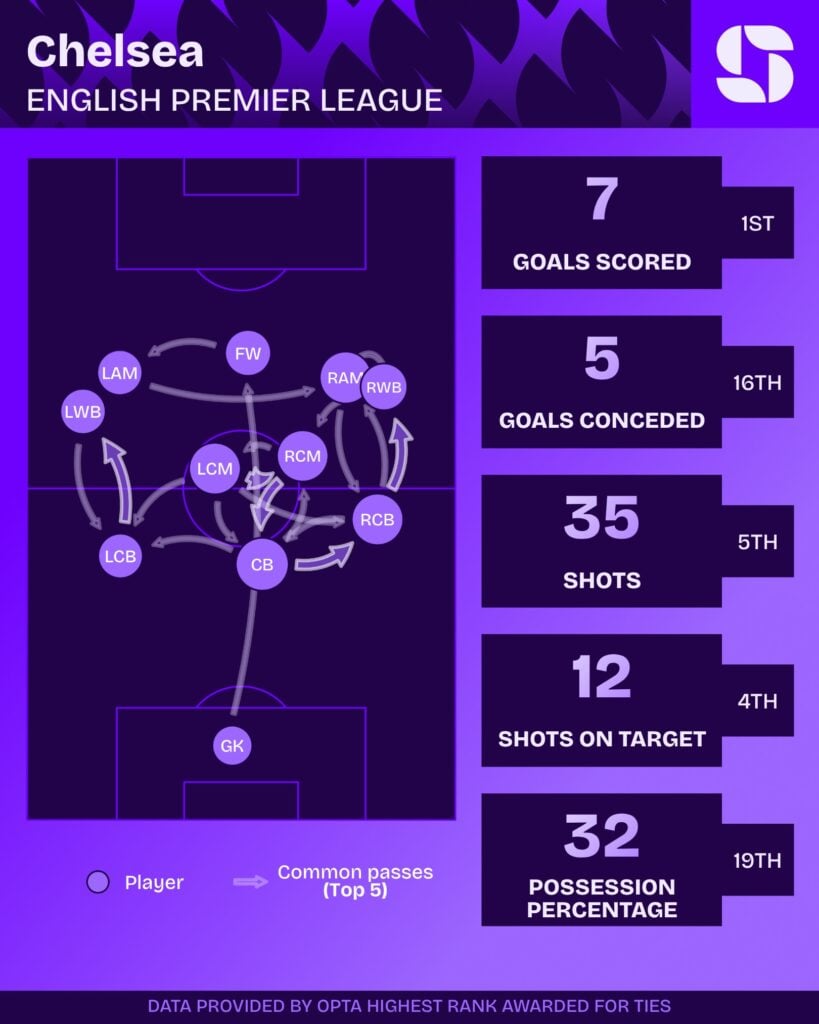
Chelsea have added some exciting profiles this summer. Morgan Rogers and Marco Palestra are two very important ones to understand. Alonso is looking to add verticality and directness to his Chelsea side, giving the forwards the best possible conditions to excel.
This directly links to the low possession numbers. Chelsea allow the opposition more of the ball, looking to hurt them in transition. After absorbing pressure, space begins to appear for Chelsea to hurt teams on the counter attack, with opponents committing more bodies forward.
This suits Chelsea’s attacking profiles. Joao Pedro can link and drive attacks, Rogers excels in larger spaces and Palmer excels with runners ahead of him into space. Then there are wing-back profiles who like to stretch their legs.
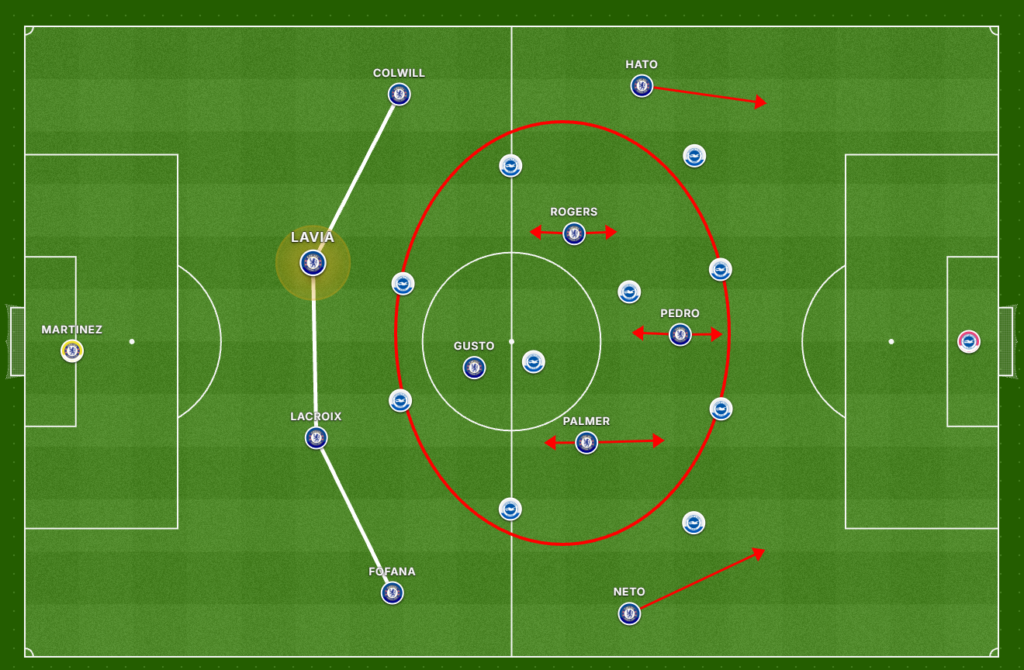
Even during more settled phases of possession, Alonso is looking to generate vertical conditions purposefully to suit the attacking profiles. One of Chelsea’s midfield duo will often drop into the first line. This forms a temporary back four and gives the likes of Rogers, Palmer and Pedro space to drop into.
The wide players will look to stretch the opposition block vertically with runs beyond, while the front three also make counter-movements to pull and push the defensive line.
Playing with such verticality does have its negatives alongside its positives. But to understand the collective framework, you first need to understand the defensive ideas.
Defensive ideas
Alonso has been vocal on his philosophies. The Spaniard has previously spoken of controlling games not just being based on possession. He has also talked about knowing how and when to suffer.
So far under Alonso, Chelsea have been set up in a 5-2-3 defensive block. They’ve ceded possession to the opponents, looking to control the game without the ball.
While a more zonal structure is the starting point in settled possession phases, there are key references that allow this to shift into more man-oriented pressure.
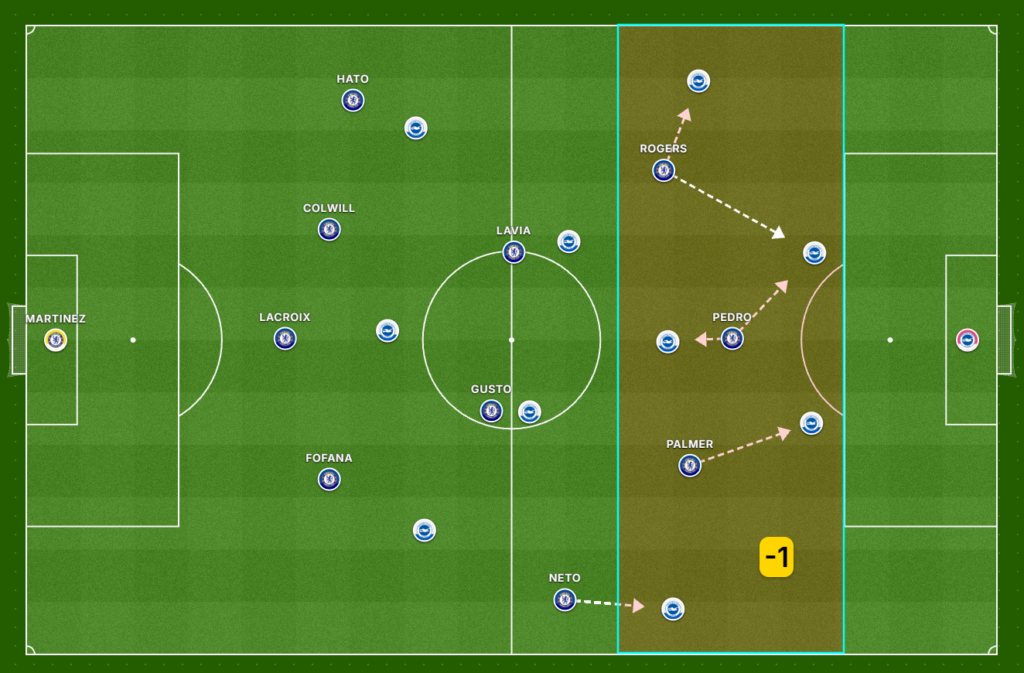
Against Brighton Chelsea pressed with a -1 in the frontline, as Rogers managed the right-back and left centre-back. Pedro looked to shadow mark the pivot, while Palmer was ready to jump onto the right centre-back. And Pedro Neto jumped onto the Brighton left-back from his wing-back position. Malo Gusto and Romeo Lavia were then more man-oriented with the two advanced Brighton midfielders.
However, Brighton were able to successfully build out against Chelsea’s press, forcing the Blues deeper and giving them more control of the game. This allowed Brighton to progress easily into Chelsea’s half, where the wide management in their defensive scheme needed some work.
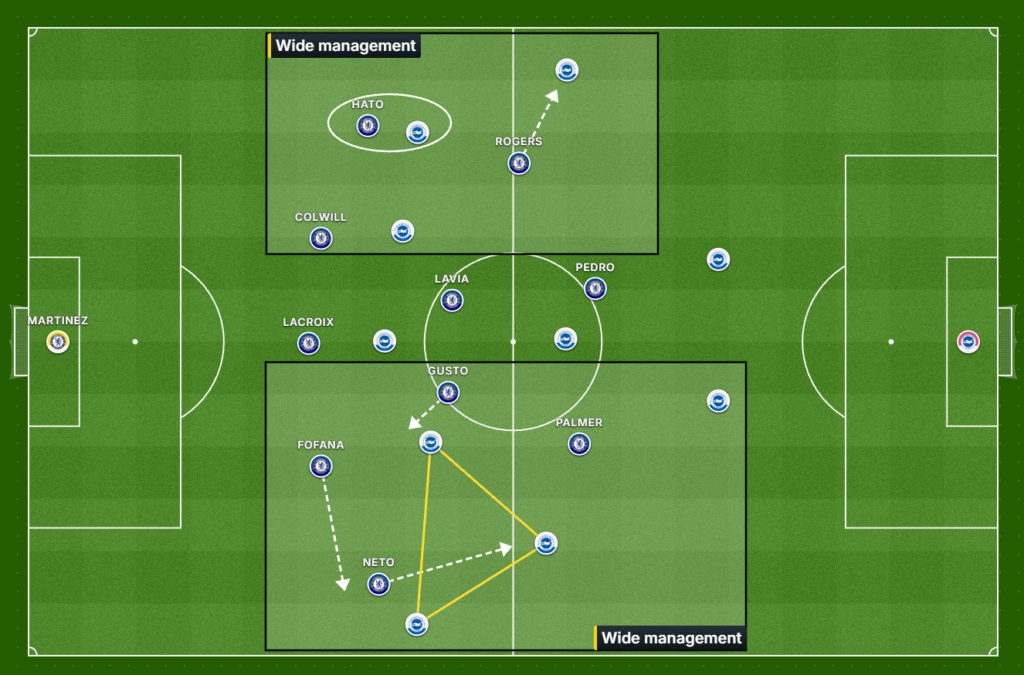
Down the right, Neto’s hybrid role between a right wing-back and a right midfielder was manipulatable. The Portuguese star was often the one to step out to apply pressure.
Wesley Fofana was then expected to slide across to cover the Brighton wide man. But this created space between himself and Maxence Lacroix, which Gusto would then look to cover.
Similar problems occured down the left, despite Rogers dropping into a left-midfield position in comparison to Palmer on the right who stayed slightly higher. If Jorrel Hato was pinned in a wing-back position, Chelsea would struggle to put pressure on the ball, leading to balls over the top or overloads down that side with Rogers losing his man.
Tweaks needed
When there is more willingness to defend crosses and stay compact, defending in a block was better. The addition of Lacroix is already making a big difference.
However, when looking to be active with their block, transitioning to apply pressure and switch markers is the bigger problem. And one which Alonso will be working to fix.
This largely comes from understanding and time with the group, creating a synergy within the defensive block where everyone understands their individual and collective roles.
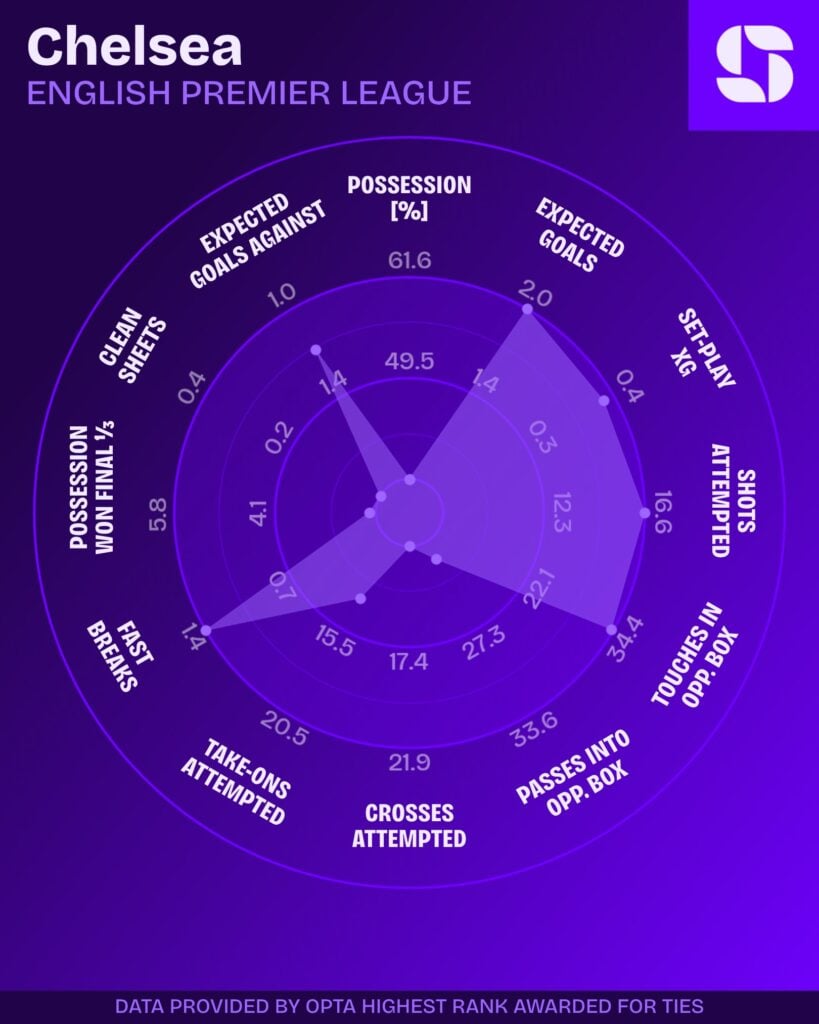
Something else that should improve in the coming weeks to provide more balance to Chelsea’s approach is their control with the ball.
Their willingness to defend low, absorb pressure and hit teams in transition has led to little control with the ball, which can exacerbate any defensive frailties. When verticality is a focus to the attacking ideas, the ball comes back at you just as quickly on turnovers, which can lead to more chaotic end to end games.
Keeping the ball for periods of control (doesn’t have to be a drastic shift towards a 70% possession team) can provide respite defensively and limit defensive transitions.
The return of midfield profiles such as Moises Caicedo and perhaps more responsibility being given to Valentin Barco could help to provide a better balance to their on-ball ideas, which helps to balance the relationship between the on- and off-ball stuff too.