




Argentina are through to the last-16 of the 2026 World Cup. But the defending champions may not be as convincing as first thought.
La Albiceleste went perfect in the group stage, winning all three of their matches. They were expected to cruise to victory in the last-32 against Cape Verde, too, even with the Blue Sharks being one of the tournament’s surprise packages.
But Argentina were made to labour to their 3-2 win after extra-time, twice taking the lead only to be pegged back each time. Argentina face Egypt in the last-16 and could then face either Switzerland or Colombia in the quarter-finals should they get there.
The question is, can Argentina get there? And if they can get past these next fixtures, do Argentina have the quality to win the World Cup again?
Argentina’s World Cup problems
Worrying creative numbers
Only France (13) went into the last-16 having scored more goals at the 2026 World Cup than Argentina’s 11. The defending champions haven’t reliant on one big win to boost their numbers either, scoring three goals in three different games — as opposed to Germany who scored seven of their 11 in one game before being knocked out in the last-32.
On the face of it, that brings no worries. But the deeper numbers may give cause for concern. Chance creation numbers aren’t the best metric for assessing a team. They’re the sum of all players’ chances created, and don’t completely show all the chances a team will have had across a game. But, they can still be used for a general show of how creative a team is as a collective. And Argentina haven’t been creative.
Of the 32 teams that made it to the knockout stages of the 2026 World Cup, Argentina ranked 25th for their chances created. Their 30 chances created placed them lower than the likes of Cape Verde (33), Sweden (39) and Ecuador (45). Of the teams to reach the last-16, only Paraguay (22) created fewer chances than Argentina.
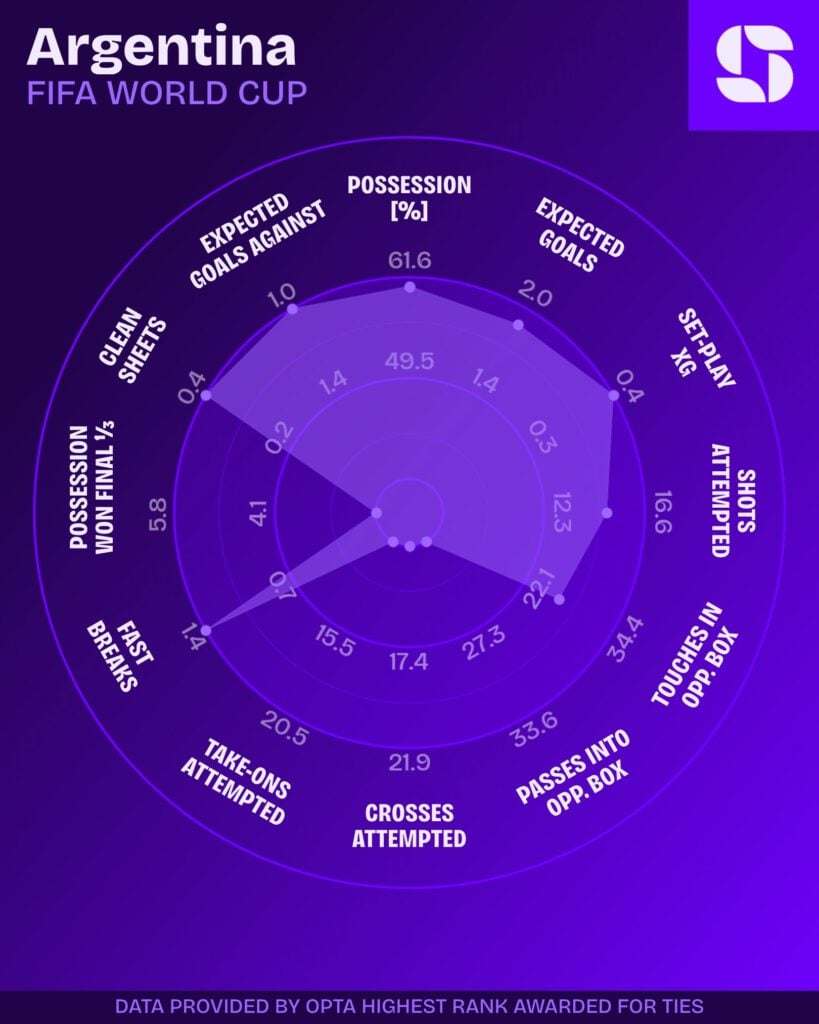
They’re slightly better on big chances created (seven), but still rank 19th out of the 32 knockout-stage teams. But, again, only Egypt (six) and Paraguay (three) created fewer among teams to make it to the last-16.
Of Argentina’s 11 goals, only six have come from open play. While we’re not playing down set-pieces and the quality they bring, there’s a problem with overreliance. Only six of the last-32 teams had a lower percentage of goals scored from open play than Argentina’s 55%. They were Ecuador, South Africa, Ghana (all 50%), United States (40%), Paraguay (33%) and Bosnia-Herzegovina (20%). Largely not the company Argentina want to be keeping.
All roads lead to Messi
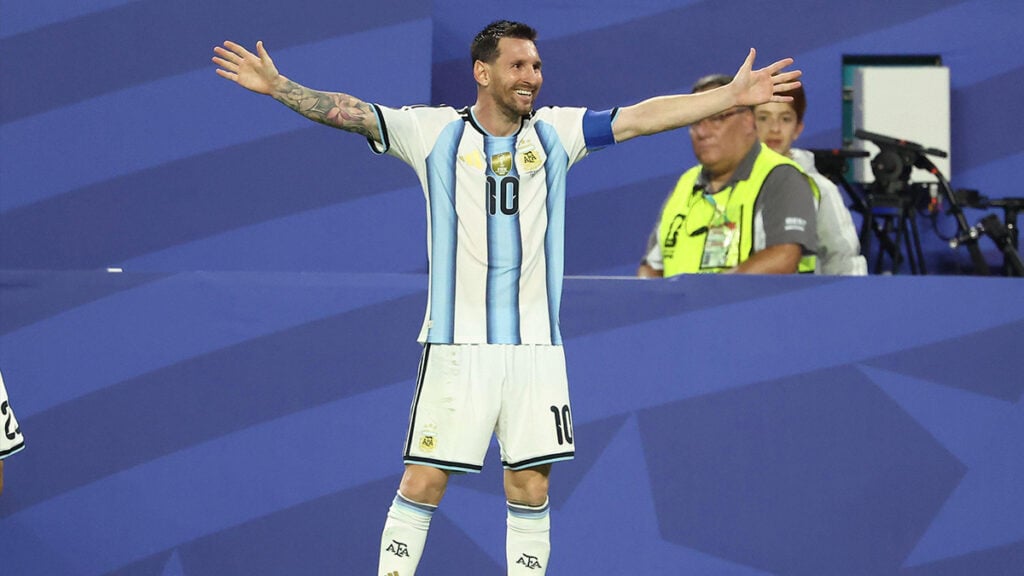
Argentina have taken 56 shots at the World Cup so far. That’s the joint 12th-most of the teams still in the tournament. But, Lionel Messi has taken 24 of those. Enzo Fernandez is the only other Argentina player to have taken more than five shots (six). Bringing in percentages, Messi has taken 42.86% of Argentina’s shots.
It’s even worse when it comes to shots on target. Argentina have had 25 efforts hit the target at the World Cup this summer, and only 10 haven’t come from Messi. That’s 60% of Argentina’s shots on target coming from one man. When that man is Messi, of course, it’s not too bad. But he can’t do it all himself every game, not at 39 years old.
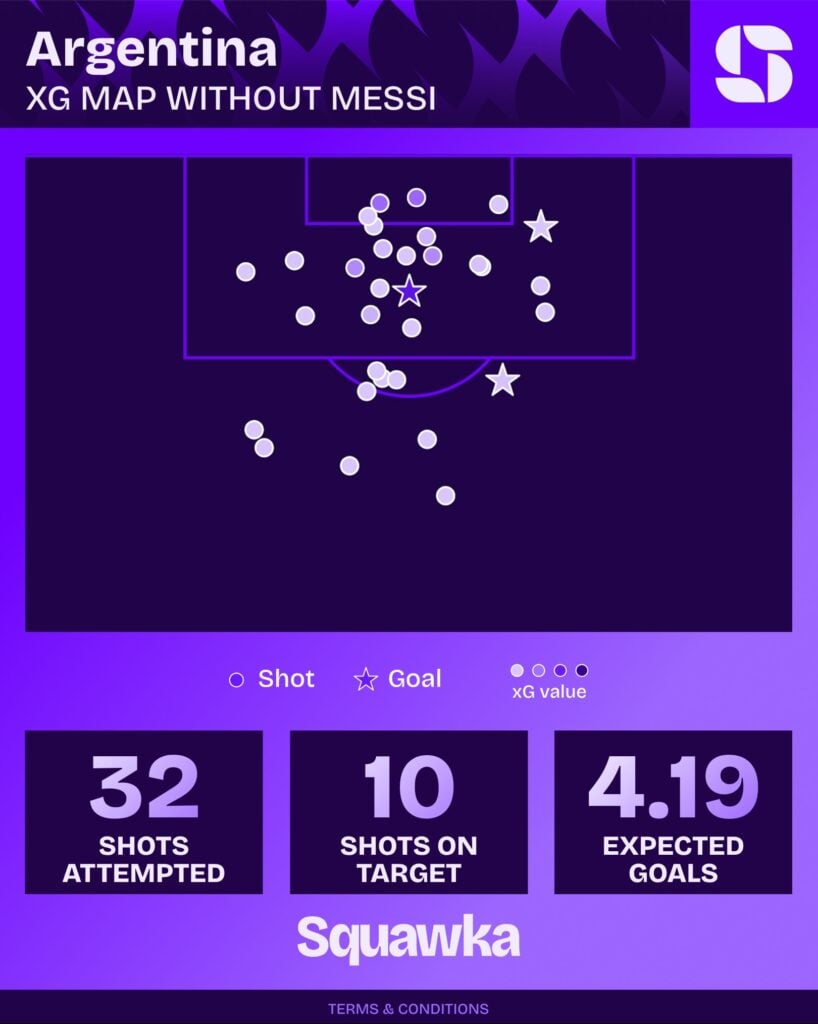
As the leader of the Golden Boot race, Messi is unsurprisingly Argentina’s top scorer with seven goals. But, again, there’s a worry. They’ve only scored 11 goals across the tournament. And Cape Verde centre-back Diney is Argentina’s joint-second highest scorer with one goal. He’s scored as many for Argentina as Giovani Lo Celso, Lautaro Martinez and Lisandro Martinez.
As a team, Argentina have produced 7.41 Expected Goals across the World Cup so far. That’s increased slightly to 7.85 post-shot xG, meaning the team as a whole have increased their chances of scoring based on shot placement. And 5.89 of their xG have come from open play.
Messi is a big part of those numbers, though. He has recorded 3.22 xG on his own, with 4.07 post-shot xG. So it’s actually Messi’s finishing that has vastly improved Argentina’s chances of scoring. Without him, their shot placement will be making them less likely to score. And he’s responsible for 2.45 of their non-penalty xG.
The fact of the matter is, Argentina have built their entire team around feeding Messi. So when Messi isn’t open to receive the ball in key areas, or on the pitch at all, they don’t have too much going for them.
All roads start at Messi
Things can’t be too bad for Argentina if they know they’ll have Messi at the end of their attacks, right? Well, what if Messi is also the one mostly at the start of those attacks? He’s arguably the greatest player of all time, but he can’t officially assist himself.
As mentioned, Argentina have created 30 chances at the World Cup so far this summer. Messi has created more than any of his teammates, on nine. This time, there are eight other players with at least two chances created — Alexis Mac Allister has the second-most, with four. But Messi has created four of Argentina’s seven big chances.
When it comes to testing passes, Argentina have made 86 penalty area entries at the World Cup this summer. Those are passes where the ball moves from outside to inside the penalty area. It’s the 25th-most at the World Cup altogether, not too great from the defending champions. Messi has produced 30 penalty area entries on his own, more than any Argentina player and 34.88% of their total. Rodrigo De Paul is second for Argentina, with 15 penalty area entries, but he’s the only other in the double digits.
So, yet again, Argentina are relying a bit too much on Messi to provide the danger passes into the box. Passes that they also want him to be on the end of, to score.
At the moment, Argentina’s reliance on Messi is working. But can it really take them all the way to back-to-back World Cup successes?
Read more: