





To play craps, you bet on the shooter’s rolls, and the simplest bet is the pass line. On the first roll, 7 or 11 wins and 2, 3 or 12 loses. Any other total sets the point, which must repeat before a 7. The pass line’s house edge is 1.41%.
A round of craps in 5 steps
- Bet the line. Before the come-out roll, bet the pass line (with the shooter) or don’t pass (against).
- Come-out roll. 7 or 11 wins for pass, and 2, 3 or 12 loses. Don’t pass wins on 2 or 3 and pushes on 12.
- The point. Any 4, 5, 6, 8, 9 or 10 becomes the point, and you can add free odds.
- Roll to a decision. The point before a 7 wins for pass, and a 7 first (a seven-out) wins for don’t pass.
- Next round. A shooter who makes the point rolls again. After a seven-out, the dice move to the player on the left.
How a Round of Craps Works
A round of craps starts with a come-out roll and ends when the shooter rolls the point again or rolls a 7. New Jersey’s craps rules define the come-out roll as the first roll of a game and the first roll after a pass or don’t pass bet is settled.
Two dice can land 36 ways: six make 7, five each make 6 and 8, four each make 5 and 9, three each make 4 and 10, two each make 3 and 11, and one each makes 2 and 12. Seven is the most likely total, which is why it decides so many bets.
The Come-Out Roll and the Point
On the come-out roll, a 7 or 11 (a natural) wins for the pass line and a 2, 3 or 12 (craps) loses. A 4, 5, 6, 8, 9 or 10 becomes the point, which the dealers mark with a disk called the puck. The come-out produces a natural 22.2% of the time, craps 11.1% and a point 66.7%.
Once a point is set, only two totals matter to the pass line: the point wins it and a 7 loses it. New Jersey’s regulation calls that 7 a “loser 7”, and players call it a seven-out.
The Shooter and the Crew
The shooter is the player throwing the dice, and New Jersey requires the shooter to make a pass or don’t pass bet first. The shooter picks two dice from a set of five or more and throws them so both leave the hand together and hit the far end of the table. A shooter who makes the point keeps the dice. After a seven-out, they move to the player on the previous shooter’s left under New Jersey’s and Pennsylvania’s rules.
The boxperson supervises the game, the stickperson calls each total and collects the dice with a stick, and dealers pay and collect bets.
A Worked Round
Say you bet $10 on the pass line and the come-out roll is 6, so 6 is the point. You add $50 in free odds behind the line, five times your pass bet. The shooter rolls 9, 4 and 11, which settle nothing for you, then a 6. The pass bet pays even money, $10, and the odds pay 6 to 5, $60, so you win $70. Had a 7 come first, you would have lost both bets, $60.
I’d learn this loop before any other bet, because most of the layout either follows it or ignores it.
The Craps Table Layout
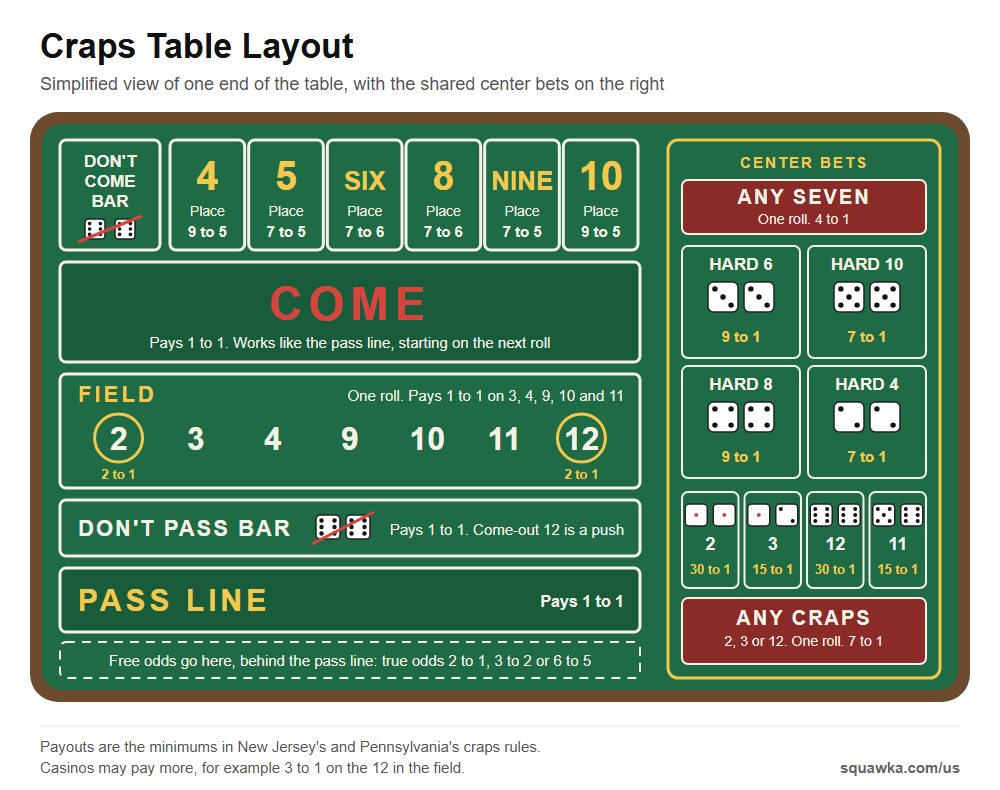
A craps table layout is the printed felt that marks where each bet goes, with the line bets, come, field and place numbers on each side and the one-roll proposition bets in the center. Pennsylvania’s rules call for an oblong table with rounded corners and high walls, no more than 14 feet long, with a marked area for each bet and the words “no call bets”.
Both ends of a full table repeat these areas around a shared center. From the rail inward:
- The pass line is the outer strip, and free odds chips go just behind it.
- Inside it runs the don’t pass bar, with the 12 printed as barred.
- The field marks its higher payouts on 2 and 12.
- Come is the largest box, and the don’t come bar sits beside the numbers.
- The place numbers run 4, 5, SIX, 8, NINE and 10, where come bets also move once they have a number.
- Any seven, the hardways, any craps and single-number bets on 2, 3, 11 and 12 fill the center.
Pass Line and Don’t Pass
The pass line bets that the shooter wins the round and don’t pass bets that the shooter loses, and both pay even money (1 to 1). Don’t pass is the mirror image of pass: it wins on a come-out 2 or 3, loses on 7 or 11 and, after a point, wins if a 7 comes first.
The exception is the come-out 12: New Jersey’s and Pennsylvania’s rules make don’t pass void and return the bet. Without that “bar 12”, don’t pass would win more bets than it loses.
By our count of the 36 outcomes, pass wins 49.29% of the time, for a 1.41% house edge. Don’t pass wins 47.93% of the time and pushes 2.78%, for a 1.36% edge, or 1.40% with the pushes left out.
That gap is 0.05 percentage points, so I’d pick the side you’re comfortable rooting for. The odds you add behind it matter far more.
Free Odds: The Only Bet With No House Edge
Free odds is an extra bet behind a pass, don’t pass, come or don’t come bet once its point is set, and it pays true odds, so the house edge is 0%. New Jersey’s regulation pays odds behind pass or come at 2 to 1 on a point of 4 or 10, 3 to 2 on 5 or 9 and 6 to 5 on 6 or 8, and Pennsylvania’s match. Laying odds behind don’t pass or don’t come pays 1 to 2, 2 to 3 and 5 to 6 in both states.
Those payouts match the dice. A 6 rolls five ways and a 7 six ways, so 6 to 5 is exactly fair.
Odds Limits by State and Casino
New Jersey’s rules let a casino allow odds up to 100 times the pass or come bet, and Pennsylvania’s cap them at 10 times. The common 3-4-5x limit (three times the line bet on 4 or 10, four times on 5 or 9, five times on 6 or 8) is a casino’s choice, not a rule in either state.
More odds lower the combined edge, because the pass line’s 1.41% is spread over more money. At 3-4-5x you’d average 2.78 times the pass bet in odds across all pass bets, and the combined edge falls to 0.37%.
| Odds behind a pass bet | Where it comes from | Combined house edge |
|---|---|---|
| None (pass line only) | Every table | 1.41% |
| 1x | Casino’s table limit | 0.85% |
| 2x | Casino’s table limit | 0.61% |
| 3-4-5x | Casino’s table limit (a common choice) | 0.37% |
| 10x | Pennsylvania’s maximum (New Jersey casinos may also offer it) | 0.18% |
| 100x | New Jersey’s maximum | 0.02% |
I’d take full odds before adding any other bet, and on a tight bankroll I’d cut the pass bet to make room for them.
Come and Don’t Come
A come bet is a pass bet made after the point is set, so the next roll is its own come-out. New Jersey lets you place it any time after the come-out roll. A 7 or 11 next wins it, 2, 3 or 12 loses it, and any other number becomes its point.
Don’t come mirrors don’t pass, and New Jersey makes it void if a 12 rolls right after you place it. The edges match the line bets: 1.41% on come and 1.36% on don’t come, and you can take or lay odds once the bet moves to a number.
In New Jersey, come bet odds are off during a come-out roll unless you call them on, so a come-out 7 loses a come bet on a number but returns its odds.
For more numbers working, I’d use come bets with odds before place bets, since the come line’s 1.41% is lower than any place bet’s edge.
Place, Buy and Lay Bets
A place bet wins if your number (4, 5, 6, 8, 9 or 10) rolls before a 7, and it pays less than true odds. New Jersey’s and Pennsylvania’s rules set the minimum payouts at 9 to 5 on 4 and 10, 7 to 5 on 5 and 9 and 7 to 6 on 6 and 8. A $12 place bet on the 6 pays $14, which is why 6 and 8 are usually bet in multiples of $6.
The house edge is 1.52% on 6 and 8, 4.00% on 5 and 9 and 6.67% on 4 and 10. In New Jersey, place bets are off on the come-out roll unless you call them on.
A buy bet is a place bet paid at true odds for a commission. New Jersey’s rules cap it at 5% of the bet and let a casino collect it only on wins if its rules say so, and Pennsylvania’s include that win-only version. A $20 buy bet on the 4 costs $1 in commission and wins $40.
Paid up front, the commission costs 5.00% of the bet, or 4.76% of the $21 you put down. Paid only on wins, the edge falls to 1.67%, well below placing the 4 or 10.
A lay bet is the reverse of a buy bet: you bet a 7 rolls before your number, at true odds of 1 to 2 on 4 and 10, 2 to 3 on 5 and 9, and 5 to 6 on 6 and 8. New Jersey and Pennsylvania cap the commission at 5%. New Jersey figures it on the amount wagered, Pennsylvania on the amount you could win, and either state lets a casino charge it only on wins.
On the 4 and 10, I’d buy only where the commission comes off wins, and otherwise leave both numbers alone.
Field, Hardways and Proposition Bets
The field, the hardways and the center proposition bets pay more per win than the line bets and carry higher house edges, from 2.78% on the best field to 16.67% on any seven.
The Field
The field is a one-roll bet that wins on 2, 3, 4, 9, 10, 11 or 12 and loses on 5, 6, 7 or 8. New Jersey’s and Pennsylvania’s minimum payouts are 1 to 1 on 3, 4, 9, 10 and 11 and 2 to 1 on 2 and 12. At those minimums the field wins 44.44% of the time with a 5.56% house edge, and a casino paying 3 to 1 on the 12 cuts the edge to 2.78%.
Hardways
A hardway bet wins if 4, 6, 8 or 10 rolls as a pair before it rolls any other way and before a 7. New Jersey’s and Pennsylvania’s rules set minimums of 7 to 1 on hard 4 and hard 10 and 9 to 1 on hard 6 and hard 8, for house edges of 11.11% and 9.09%. In New Jersey, hardways are off on the come-out roll unless you call them on.
One-Roll Proposition Bets
Proposition bets in the center settle on the next roll. New Jersey’s and Pennsylvania’s minimums are 4 to 1 on any seven, 7 to 1 on any craps (2, 3 or 12), 30 to 1 on 2 or 12 and 15 to 1 on 3 or on 11, which the rules call “11 in one roll”. Their edges run from 11.11% to 16.67%.
A horn bet covers 2, 3, 11 and 12, paid as four separate bets, and Pennsylvania’s C and E bet is half any craps and half 11. Hop bets pick one exact dice combination, at New Jersey minimums of 30 to 1 for a pair and 15 to 1 otherwise.
Big 6/8 and Yo don’t appear in the New Jersey or Pennsylvania regulated bet lists.
The center is where the edge climbs: any seven gives up 16.67%, nearly 12 times the pass line. I’d keep center bets small, or put that money into odds.
Craps Odds and House Edge on Every Bet
The lowest house edge in craps is 0% on free odds, and the highest below is 16.67% on any seven. Payouts are the minimums in New Jersey’s and Pennsylvania’s craps rules, which match on every bet in the table, hardways and laying odds included. A casino paying more has a lower edge.
Every edge and chance comes from our own count of the 36 dice combinations. Edges are per bet resolved, so a multi-roll bet counts only the roll that settles it, except don’t pass and don’t come at 1.36%, which count a barred 12 as a push (1.40% per bet resolved). Per-roll figures are lower, so place 6 and 8 is 0.46% per roll. For the same kind of house edge breakdown at baccarat, see our how to play baccarat guide.
| Bet | Minimum payout (NJ and PA) | House edge | Chance of winning |
|---|---|---|---|
| Pass line or come | 1 to 1 | 1.41% | 49.29% |
| Don’t pass or don’t come | 1 to 1 (12 on the come-out is a push) | 1.36% | 47.93% (push 2.78%) |
| Free odds, taking | True odds: 2 to 1 on 4 or 10, 3 to 2 on 5 or 9, 6 to 5 on 6 or 8 | 0% | 33.33% to 45.45%, by point |
| Free odds, laying | True odds: 1 to 2 on 4 or 10, 2 to 3 on 5 or 9, 5 to 6 on 6 or 8 | 0% | 54.55% to 66.67%, by point |
| Place 6 or 8 | 7 to 6 | 1.52% | 45.45% |
| Place 5 or 9 | 7 to 5 | 4.00% | 40.00% |
| Place 4 or 10 | 9 to 5 | 6.67% | 33.33% |
| Buy 4 or 10, 5% commission up front | 2 to 1, for a commission of up to 5% | 5.00% of the bet (4.76% of bet plus commission) | 33.33% |
| Buy 4 or 10, 5% commission on wins only | 2 to 1, less a commission of up to 5% | 1.67% | 33.33% |
| Field (2 and 12 pay 2 to 1) | 1 to 1; 2 to 1 on 2 and 12 | 5.56% | 44.44% |
| Field (12 pays 3 to 1) | Above the minimum, where a casino pays it | 2.78% | 44.44% |
| Hard 6 or hard 8 | 9 to 1 | 9.09% | 9.09% |
| Hard 4 or hard 10 | 7 to 1 | 11.11% | 11.11% |
| Any seven (one roll) | 4 to 1 | 16.67% | 16.67% |
| Any craps: 2, 3 or 12 (one roll) | 7 to 1 | 11.11% | 11.11% |
| 3 (one roll) | 15 to 1 | 11.11% | 5.56% |
| 11 in one roll | 15 to 1 | 11.11% | 5.56% |
| 2 or 12, each (one roll) | 30 to 1 | 13.89% | 2.78% |
Crapless Craps and Bubble Craps
Crapless craps changes the rules and raises the pass line’s edge. Bubble craps changes the equipment.
Crapless Craps
In crapless craps, the pass line can’t lose on the come-out roll: a 7 wins, and every other total, 2, 3, 11 and 12 included, becomes the point. Pennsylvania authorizes it under a temporary regulation in effect from November 15, 2025 to November 15, 2028, with place bets of 11 to 2 on 2 and 12 and 11 to 4 on 3 and 11.
Losing the come-out 11 as a winner costs more than removing craps saves. The Wizard of Odds puts the crapless pass line’s edge at 5.38%, against 1.41% in standard craps, and notes the game has no don’t pass bet.
I’d play standard craps where both are offered, since the crapless pass line costs nearly four times as much.
Bubble Craps
Bubble craps is an electronic craps machine. In the usual design, an air jet tumbles the dice inside a sealed clear dome and a sensor reads the result, and with no dealers each player places their own bets. Payouts vary by machine.
One example is a Shoot to Win electronic craps game at Clearwater Casino in Washington, whose rules sheet carries a Washington State Gambling Commission stamp dated June 18, 2025. It pays New Jersey’s minimums on place bets, hardways and the field (2 to 1 on 2 or 12), caps odds at 2x and adds a randomly triggered Power Odds feature that raises some payouts. That’s one machine at one casino, so read the rules card on the cabinet you play.
Craps Strategy That Holds Up
The craps strategy that holds up is bet choice: pass or come with full odds, don’t pass or don’t come with lay odds, and place bets on 6 and 8. Those edges run from 1.52% on place 6 and 8 down to 0.02% on a pass bet with 100x odds.
Betting systems that raise or cut your stake after wins and losses don’t change any edge. Each roll is independent, so a system changes how your results swing and leaves the expected loss where it was. You win at craps in the short run when the dice favor your bets, and over many rolls the house edge decides.
Does Dice Control Work?
No convincing evidence shows that dice control works. Dice control is the claim that a shooter can set and throw the dice to roll fewer 7s. Michael Shackleford of the Wizard of Odds wrote in 2013 that he had yet to see convincing evidence of it, and the 2004 experiments he describes were too small to show anything either way.
The claim survives because the margin is thin: at 3-4-5x the combined edge is 0.37%, so a slight influence would beat it. New Jersey’s throwing rule works against it by requiring the dice to hit the far end of the table.
I’d treat dice control as unproven and set a budget where losing a pass bet plus full odds on one seven-out is money you can spare.
Playing Craps Online in the US
Real-money online craps is limited to states with legal online casinos. FanDuel Casino‘s New Jersey lobby lists three craps games, all from Evolution: Live Dealer Craps, First Person Craps and FanDuel First Person Craps, badged Exclusive.
Who Rolls the Dice Online
Online there’s no player shooter: FanDuel says its dice rolls are “powered by certified random-number generators or mechanical arms”. FanDuel says it operates in Connecticut, Michigan, New Jersey, Pennsylvania and West Virginia, so check the craps games in its lobby for your state.
Michigan’s casino rules say payouts follow each game’s board-approved rules, so check the game’s help screen there.
Our New Jersey, Pennsylvania, Michigan and West Virginia guides list the licensed casinos in each state, and our casino apps ranking compares their apps.
On any online craps game, I’d check the field’s 12 payout and the odds limit first, since those move the edge most.
Free Craps and Sweepstakes Craps
Sweepstakes and social casinos let you play with virtual coins instead of cash. McLuck, a sweepstakes casino, lists Bubble Craps and Bubble Crapless Craps from Iconic21 on its craps page. Our guide to how sweepstakes casinos work explains the coins, our sweepstakes legal states page shows where they’re banned, and our social casinos list covers free-to-play apps.
FAQs
No, not once a point is set. New Jersey’s craps rules bar removing or reducing a pass or come bet after its point is established. Don’t pass and don’t come bets can be taken down at any time but not put back, and since the don’t side is favored once a point is set, removing it helps only the house.
Only if the crew confirms it. New Jersey’s rules say bets should be made before the dice are thrown, and a bet made while they’re in the air stands only if a dealer and the boxperson confirm it out loud.
The Fire Bet is an optional side bet made before a new shooter’s first come-out roll. It wins if the shooter makes at least four different points before a seven-out. New Jersey’s rules set two minimum pay tables for four, five and six points: 24 to 1, 249 to 1 and 999 to 1, or 39 to 1, 199 to 1 and 499 to 1.
No. New Jersey’s rules offer the dice to the player on the previous shooter’s left and, if that player declines, to each player clockwise. Anyone who shoots must first make a pass or don’t pass bet, but you can bet every roll without touching the dice.
Play responsibly. 21+. Real-money online casino games are only for players physically located in a state where they’re legal. For help, call or text 1-800-MY-RESET or 1-800-GAMBLER, and see our responsible gaming help page.