







To play baccarat, you bet on which of two hands, Player or Banker, finishes closer to 9, or on a tie. Aces count 1, and 10s and face cards count 0. Fixed rules decide every draw, so the bet is your only choice. Banker carries the lowest house edge, 1.06%.
Baccarat at a glance: the three main bets
| Bet | Pays | How often it wins | House edge |
|---|---|---|---|
| Banker | 1 to 1, less a 5% commission | 45.86% | 1.06% |
| Player | 1 to 1 | 44.62% | 1.24% |
| Tie | 8 to 1 (the minimum under NJ and PA rules) | 9.52% | 14.36% |
All odds on this page are for an eight-deck shoe. We calculated them ourselves from every possible deal, and they match Wizard of Odds. The rules come from New Jersey’s and Pennsylvania’s casino baccarat regulations.
How a Hand of Baccarat Works
A hand of baccarat deals two cards each to Player and Banker, adds a third card to either hand only when the rules say so, and pays the bets on whichever hand ends closer to 9. Player and Banker are just names: betting on Banker doesn’t make you the bank.
Card Values and Hand Totals
Cards 2 to 9 count their face value, an ace counts 1, and a 10, jack, queen or king counts 0. Suits play no part. When the cards add up to 10 or more, you drop the first digit and keep the last one: 7 + 8 = 15, so the hand is worth 5. New Jersey’s rules say the left digit “shall be discarded having no value.”
The Deal and Naturals
The dealer, or the game software online, deals four cards in turn: the first and third go to Player, the second and fourth to Banker. If either hand totals 8 or 9 on its first two cards, that hand is a natural and the round ends with no more cards for either side. A natural 9 beats a natural 8, and two equal naturals tie.
By our calculation, Player’s first two cards make a natural in 18.94% of hands, and Banker’s in 18.94%. Without a natural, each hand can take one more card at most.
At a live table, New Jersey’s procedure has the dealer turn over the first card of a shoe and burn that many more, counting a 10 or face card as 10. When the cut card near the bottom appears, the dealer finishes that hand, plays one more and reshuffles.
Who Wins
The hand with the higher final total wins, and a Tie bet wins when the totals match. On a tie, Player and Banker bets push and you get your stake back, under both New Jersey’s and Pennsylvania’s rules.
When Player and Banker Draw a Third Card
Player draws a third card on a total of 0 to 5 and stands on 6 or 7. Banker then follows a chart: it always draws on 0 to 2, always stands on 7, and on 3 to 6 its choice depends on the card Player just drew. Neither hand draws if either side has a natural.
The Player Rule
Player acts first and ignores Banker’s cards. New Jersey’s table reads “0 to 5, Draws” and “6 to 9, Stays”, and Pennsylvania’s rule says the same in words.
The Banker Drawing Chart
If Player stood, Banker draws on 0 to 5 and stands on 6 or 7. If Player drew, Banker looks at the value of that third card, not at Player’s new total:
- Banker 0, 1 or 2 always draws.
- Banker 3 draws unless Player’s third card is an 8.
- Banker 4 draws when Player’s third card is 2 to 7.
- Banker 5 draws when it is 4 to 7.
- Banker 6 draws when it is 6 or 7.
- Banker 7 always stands.
| Banker’s two-card total | If Player stood | If Player drew: Banker draws when the third card is | Banker stands when the third card is |
|---|---|---|---|
| 0, 1 or 2 | Draws | Any card | Never |
| 3 | Draws | 0 to 7 or 9 | 8 |
| 4 | Draws | 2 to 7 | 0, 1, 8 or 9 |
| 5 | Draws | 4 to 7 | 0 to 3, 8 or 9 |
| 6 | Stands | 6 or 7 | 0 to 5, 8 or 9 |
| 7 | Stands | Never | Any card |
| 8 or 9 | Natural: no cards drawn | Natural: no cards drawn | Natural: no cards drawn |
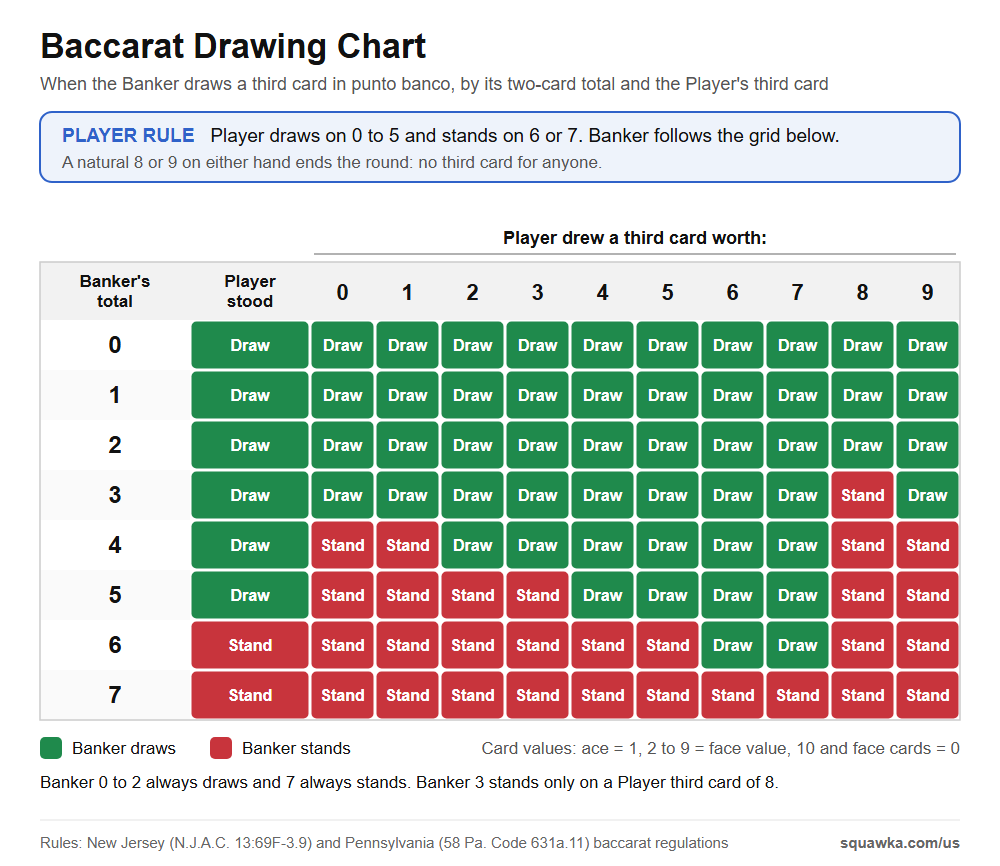
New Jersey’s rules (N.J.A.C. 13:69F-3.9) and Pennsylvania’s (58 Pa. Code 631a.11) print the same chart cell for cell, and our odds calculation uses it. A 10 or face card drawn by Player counts as 0. The dealer or software makes every draw for you.
Learning the chart won’t change a result, but I’d still learn it so you can follow each hand and spot a misdeal at a live table.
Worked Examples
- Player stands, Banker draws. Player holds a queen and a 6, a total of 6, and stands. Banker holds a 2 and a 3, a total of 5. Because Player took no card, Banker draws on 5 and gets a 4, making 9. Banker wins, 9 to 6.
- Both hands draw. Player holds a 4 and an ace (5) and draws a 7, making 12, which counts as 2. Banker holds a 9 and a 7, which make 16 and count as 6. Player’s third card is a 7, so Banker draws on 6 and gets a king, staying on 6. Banker wins, 6 to 2. At a Super 6 table this Banker win would pay only 1 to 2.
- Banker stands on 3. Player holds a 3 and a 2 (5) and draws an 8, making 13, which counts as 3. Banker holds a 10 and a 3, a total of 3. Player’s third card is an 8, so Banker stands. Both hands show 3, so the hand is a tie: Player and Banker bets push, and a Tie bet pays at least 8 to 1.
Baccarat Bets, Payouts and House Edge
Banker is the cheapest of the three main bets, with a house edge of 1.06% at the standard 5% commission, against 1.24% on Player and 14.36% on a Tie paid at 8 to 1. These are our own figures, matching Wizard of Odds. The house edge is the share of each bet you lose on average: about $1.06 per $100 on Banker.
| Bet | Payout | How often it wins | House edge | Average cost per $100 bet |
|---|---|---|---|---|
| Banker, 5% commission | 0.95 to 1 | 45.86% | 1.06% | $1.06 |
| Banker, 4% commission (New Jersey option) | 0.96 to 1 | 45.86% | 0.60% | $0.60 |
| Player | 1 to 1 | 44.62% | 1.24% | $1.24 |
| Tie at 8 to 1 | 8 to 1 | 9.52% | 14.36% | $14.36 |
| Tie at 9 to 1 | 9 to 1 | 9.52% | 4.84% | $4.84 |
| EZ Baccarat Banker | 1 to 1, push on a winning three-card 7 | 43.61% (paid) | 1.02% | $1.02 |
| Super 6 Banker | 1 to 1, or 1 to 2 on a winning 6 | 45.86% | 1.46% | $1.46 |
| Dragon 7 (EZ side bet) | 40 to 1 | 2.25% | 7.61% | $7.61 |
| Panda 8 (EZ side bet) | 25 to 1 | 3.45% | 10.19% | $10.19 |
Costs are long-run averages. The EZ Baccarat row counts only hands where the bet is paid, and the Super 6 row includes Banker wins on 6, which pay half. For the same kind of house edge breakdown at craps, see our how to play craps guide.
Why Banker Pays a Commission
Banker pays a commission because it wins more often: its drawing rule reacts to Player’s third card, while Player’s rule ignores Banker’s cards. By our count Banker wins 45.86% of hands and Player 44.62%, so if you set ties aside, Banker takes 50.68% of the hands that are decided.
At even money with no commission, Banker would give the bettor a 1.24% edge, as Wizard of Odds’ commission table also shows. The commission turns that around: a winning $100 Banker bet pays $95 at 5%.
Commission Rules in New Jersey and Pennsylvania
The commission is 5% in Pennsylvania and 4% or 5% in New Jersey, at the casino’s choice. New Jersey’s rules let a casino charge “either four or five percent of the amount won”, and Pennsylvania’s baccarat chapter sets 5%, except at EZ Baccarat tables, which take none. At 4%, our calculation puts the Banker edge at 0.60%, the lowest of any bet on this page.
At full-size New Jersey tables, a 5% charge may be rounded up to the next 25 cents and a 4% charge to the next 20 cents. New Jersey mini baccarat tables round to the next 5 cents (N.J.A.C. 13:69F-7.3). Pennsylvania allows rounding to 25 cents at baccarat, minibaccarat and midibaccarat. On a $3 Banker win at a full-size New Jersey table or in Pennsylvania, 5% is 15 cents, which can be rounded up to 25 cents, or 8.3% of the win. Bets in multiples of $5 never lose anything to rounding, since 5% of $5 is exactly 25 cents and 4% of $5 is exactly 20 cents.
A live table can also run a commission tab: New Jersey lets the casino collect at the reshuffle or when you finish, and Pennsylvania before a new shoe or when you leave. Online games state their commission in their own rules.
The Tie Bet
A Tie pays at least 8 to 1 under both New Jersey’s and Pennsylvania’s rules, and at 8 to 1 its house edge is 14.36%. Ties come up in 9.52% of hands, about once every 10.5, too rarely for 8 to 1 to cover the losing bets. The rules set 8 to 1 as a floor, and tables that choose 9 to 1 cut the edge to 4.84%.
I’d leave the Tie alone at either price. At 8 to 1 it costs more than 13 times what Banker does, and even at 9 to 1 it costs more than 4 times as much.
Commission-Free Baccarat: EZ Baccarat and Super 6
Commission-free baccarat comes in two different games with different costs. EZ Baccarat pays Banker wins at even money but pushes a Banker win on a three-card 7, for a house edge of 1.02%. Super 6 pays even money except on a Banker win with 6, which pays 1 to 2, for an edge of 1.46%. Both figures are ours, and both match Wizard of Odds.
Some guides mix the two up, so check which rule a “no commission” table uses before you bet Banker.
EZ Baccarat
In EZ Baccarat, a Banker win with a three-card total of 7 is a push, and every other Banker win pays 1 to 1. Pennsylvania’s rules name the game EZ Baccarat and call that hand a Dragon 7: a three-card Banker 7 against a Player total under 7. New Jersey’s rules describe it as a no-commission variation and push the same winning three-card 7.
A Dragon 7 happens in 2.25% of hands by our count, so a Banker bet gets paid in 43.61% of hands instead of 45.86%. Wizard of Odds describes EZ Baccarat as standard baccarat except for the Banker bet.
Super 6
Super 6 drops the commission and pays a winning Banker bet 1 to 2 when Banker wins with a total of 6, so a $10 bet wins $5 on that hand. Banker wins with a 6 in 5.39% of hands by our count. Pennsylvania’s rules call this format commission-free baccarat, and New Jersey’s allow it as one of two no-commission options.
Of the two, I’d pick EZ Baccarat. Its Banker edge is 0.04 points lower than a 5% commission table, while Super 6 is 0.40 points higher. A New Jersey table charging 4% commission beats both.
Baccarat Side Bets
Every common baccarat side bet costs more than the Banker bet. Dragon 7 carries a house edge of 7.61% and Panda 8 10.19% by our calculation, and Wizard of Odds puts the Dragon Bonus at 2.65% to 9.37%, depending on the side you back.
Dragon 7 and Panda 8
Dragon 7 pays 40 to 1 when Banker wins with a three-card 7, and Panda 8 pays 25 to 1 when Player wins with a three-card 8 against a Banker total under 8. Pennsylvania’s rules set those payouts, and New Jersey’s set Dragon 7 at no less than 40 to 1. By our calculation, Dragon 7 hits in 2.25% of hands and Panda 8 in 3.45%, and both edges match Wizard of Odds.
Dragon Bonus
The Dragon Bonus is a side bet on Player or Banker that pays by the margin of victory. It wins if your hand is a natural and the other isn’t, if it’s a natural 9 against a natural 8, or if it wins without a natural by 4 points or more. A tie between naturals pushes, and every other result loses, including a non-natural win by 3 points or fewer.
Both states’ rules list three paytables. Paytable A pays 30 to 1 for a win by 9 points, then 10, 6, 4, 2 and 1 to 1 for wins by 8, 7, 6, 5 and 4, and 1 to 1 on a natural winner. For paytable A with eight decks, Wizard of Odds puts the house edge at 2.65% on the Player side and 9.37% on the Banker side. Paytables B and C pay differently on some margins, so check which one your table uses.
Pair Bets
A Player Pair or Banker Pair bet wins when that hand’s first two cards are the same rank. At 11 to 1 with eight decks, Wizard of Odds’ pair-bet table implies a house edge of about 10.36%.
If you want a side bet, I’d make it the Player Dragon Bonus on paytable A, the only one here under 3%. Every other side bet on this page costs at least 7 times what Banker does.
Baccarat Strategy That Actually Works
The only strategy that changes your odds is choosing the bet: Banker at 1.06% beats Player at 1.24%, and the Tie and side bets cost far more. Betting systems and scorecard patterns leave the house edge where it is.
Bet Banker and Skip the Tie
Bet $10 on Banker for 100 hands and you put $1,000 through the game, with an average loss of about $10.58. The same 100 hands on the Tie at 8 to 1 would lose about $143.60 on average.
Patterns and Betting Systems
Past results in a shoe don’t predict the next hand. Wizard of Odds calls baccarat, “for all intents and purposes”, a game of independent trials, and says studying the pattern of Banker and Player wins won’t help. The scorecards and trend boards at a table only record what already happened.
Progressions such as doubling after a loss change only how much you stake. Every bet carries the same edge, so your expected loss is the edge times the total you bet.
Card Counting
Counting cards helps very little in baccarat. Wizard of Odds’ simplest count, which switches to the Player bet when the running count falls to -4 or lower, trims the combined house edge from 1.06% to about 1.01% with eight decks. Its harder counts gain only about another 0.01 points, so the house keeps its edge against even a flawless counter.
What I’d do instead is set a budget before the first hand and flat bet Banker within it, since no system turns a 1.06% edge into a profit.
Punto Banco, Mini Baccarat and Chemin de Fer
Punto banco is the baccarat dealt in US casinos and online, mini baccarat is the same game at a smaller table, and chemin de fer is an older version in which a player banks.
In punto banco the house banks every hand and the drawing chart decides every card, so bettors only choose Player, Banker or Tie. Wikipedia calls it the most played version of baccarat in the United States.
Mini baccarat keeps the same drawing rules and Tie minimum, at a smaller table with lower limits. The commission is 4% or 5% in New Jersey, where a mini table may instead charge 25% of a Banker wager when the hand ties, and 5% in Pennsylvania. New Jersey’s rules give it its own subchapter, and Pennsylvania’s have separate chapters for baccarat, minibaccarat and midibaccarat, a table size between the two.
Chemin de fer lets one player bank and deal. On the players’ side, the player acting for the other bettors has one real choice, whether to draw on a 5, and New Jersey’s rules also give the banker a choice in two spots. New Jersey still has chemin de fer rules on its books, in which that player calls “Card” or “Stay”. Baccarat banque, a three-way version in which the banker plays against two Player hands, is the other classic form.
Where to Play Baccarat Online in the US
Real-money online baccarat runs at licensed online casinos in states including New Jersey, Pennsylvania, Michigan and West Virginia, in computer-dealt (RNG) and live dealer versions. You must be 21 or older and physically in the state to play. In many other states, sweepstakes casinos offer baccarat played with sweepstakes coins.
Real-Money Online Casinos
Hard Rock Bet’s live dealer page lists two live games, Speed Baccarat and VIP Baccarat. FanDuel’s baccarat page lists a professional series, classic baccarat and First Person Baccarat. Table limits differ by game, so check the limits shown on each table.
The rules here are New Jersey’s and Pennsylvania’s. Michigan, West Virginia, Connecticut, Delaware and Rhode Island also have licensed online casinos, so check the commission and Tie payout in each game’s rules before you bet there.
Our guides to New Jersey, Pennsylvania, Michigan and West Virginia list the licensed casinos in each state. Our casino apps ranking compares their apps, and our real money online casinos hub ranks the sites.
Sweepstakes and Free Baccarat
Sweepstakes casinos run baccarat with Gold Coins, which have no cash value, and Sweeps Coins, which can be redeemed for prizes. McLuck’s own site, for example, lists live dealer baccarat games including Grand Bonus Baccarat by ICONIC21. State gaming regulators don’t set the rules at these tables, so New Jersey’s and Pennsylvania’s payouts don’t automatically apply. The commission and Tie payout are whatever the game’s own rules say.
To play baccarat for free, Gold Coins work as practice chips. Our guide to how sweepstakes casinos work explains the coin system, our sweepstakes casinos list compares the brands, and the sweepstakes legal states page shows where they’re banned.
Wherever you play, I’d open the game’s rules before the first hand and check two numbers: the Banker commission and the Tie payout. They decide whether the house edges above apply.
FAQs
Baccarat is usually dealt from six to eight decks. New Jersey’s rules require at least six, Pennsylvania’s allow six to eight, and mini baccarat dealt through an automatic shuffler uses at least 12 decks in New Jersey and 12 to 16 in Pennsylvania. The deck count barely moves the main bets. Wizard of Odds puts Banker at 1.06% and Player at 1.24% with six or eight decks, while the Tie edge rises to 14.44% with six.
An Egalité side bet can. Egalité bets win on a tie at one specific total, and Wizard of Odds lists a paytable that pays 200 to 1 on a tie at 3. It says these bets are mostly found in casinos in England. No main bet comes close: the regular Tie pays 8 to 1, or 9 to 1 at some tables.
Play responsibly. 21+. Real-money online casino games are only for players physically located in a state where they’re legal. For help, call or text 1-800-MY-RESET or 1-800-GAMBLER, and see our responsible gaming help page.