




World Cup What Ifs, Squawka’s new alternative reality series, takes a look at what could’ve happened if some of the biggest moments in football had different outcomes.
This is the second in the ‘What If’ series and explores what could’ve happened if one of the most famous goals in World Cup history wasn’t given. There’s no denying Diego Maradona’s genius but we’ll look into the potential outcomes if his ‘Hand of God’ goal was, rightly, ruled out.
In this article we’ll cover:
The background
On 22 June 1986, Argentina defeated England 2-1 in the quarter-finals of the World Cup at the Estadio Azteca in Mexico City. The match, played four years after the Falklands War, was already charged with geopolitical tension. But it was the events of the 51st minute that etched the game into footballing infamy.
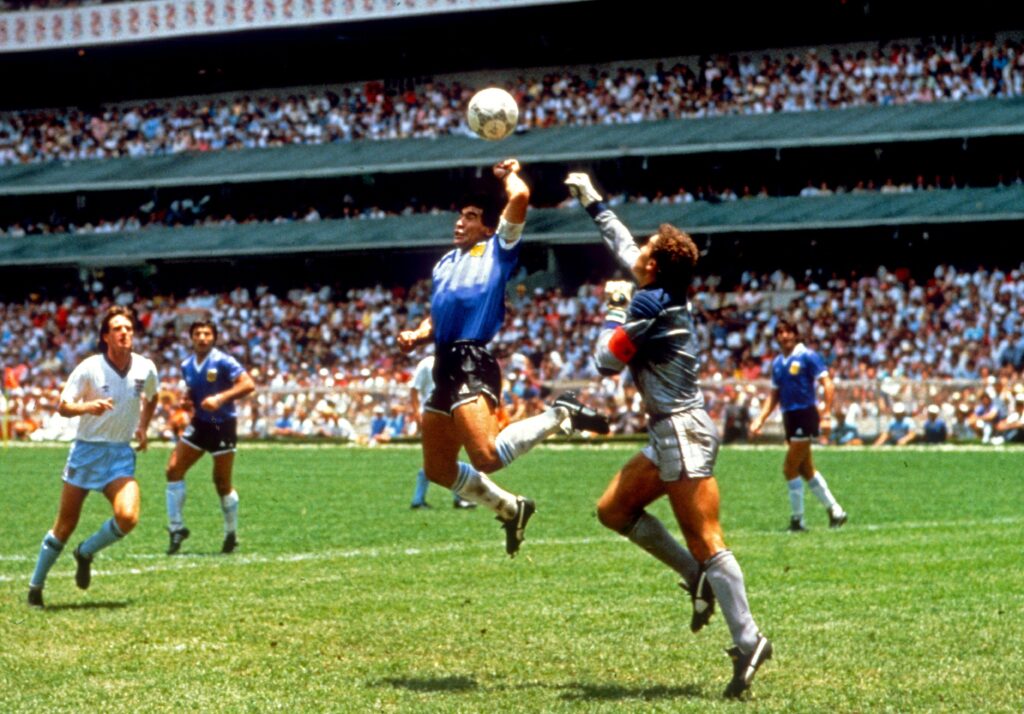
Diego Maradona, the undisputed best player in the world, leapt alongside England goalkeeper Peter Shilton and punched the ball into the net with his left fist. Tunisian referee Ali Bin Nasser, unsighted, allowed the goal to stand. Bulgarian linesman Bogdan Dotchev did not flag. Four minutes later, Maradona scored the ʻGoal of the Century’, dribbling past five England players from inside his own half to make it 2 0.
Gary Lineker pulled one back in the 81st minute from a John Barnes cross, but Argentina held on. They went on to win the tournament. The ʻHand of God’ became a symbol of Argentine defiance and English grievance. It cemented Maradona’s legacy as a flawed genius — half-angel, half-devil. But what if Bin Nasser had seen the handball? What if the goal had been disallowed, and Maradona booked for ungentlemanly conduct?
The match that went to extra time
To understand the alternative reality, we must first reconstruct the match itself. At half time, the score was 0-0. Argentina had dominated possession and territory, but England’s defence, marshalled by Terry Butcher and Terry Fenwick, had held firm. Shilton, the veteran goalkeeper with 86 caps, had made several crucial interventions.
The tension inside the Estadio Azteca was palpable, exacerbated by the searing midday heat and the altitude of Mexico City. An attendance of 114,580 watched on. In the 51st minute, Steve Hodge miscues his clearance. The ball loops into the penalty area. Maradona jumps, punches the ball past Shilton, and wheels away in celebration.
But in this timeline, Bin Nasser blows his whistle. He points for an England free-kick and shows Maradona a yellow card. The score remains 0-0. The Argentine captain’s protests are waved away, and the English players, initially furious at the attempted deception, are vindicated.
The psychological shift is immediate. England, reprieved, gain a surge of defensive resolve. Argentina, frustrated by the decision, lose their rhythm. But what of the Goal of the Century?
The simulation suggests that Maradona’s second goal — a moment of pure, unadulterated genius — was not entirely dependent on the first. However, the game state changes materially. At 0-0, England are not chasing the game. Bobby Robson’s side sit deeper. Maradona still receives the ball in his own half in the 55th minute, but the spaces he exploited in reality are marginally tighter. England’s defensive shape is more compact.
For the purposes of this simulation, we apply a 60% probability that Maradona still scores a version of his wonder goal, given his transcendent form throughout the tournament. He had scored or assisted in every knockout match. That level of individual brilliance does not simply disappear because a previous goal was disallowed. He breaks the deadlock. It is 1-0 to Argentina.
England manager Bobby Robson still makes his attacking substitutions, bringing on Waddle and Barnes, as England trail 1-0. Barnes still delivers the cross for Lineker’s 81st-minute equaliser — his sixth goal of the tournament. The match ends 1-1 after 90 minutes.
Extra time in the Mexico City heat is a gruelling affair. The altitude, which had been a talking point throughout the tournament, begins to take its toll on both sets of players. Argentina, having expended vast amounts of energy in Carlos Bilardo’s high-pressing system, are visibly tiring. England, conversely, have the momentum. The introduction of Barnes and Waddle has stretched the game, creating pockets of space that were previously unavailable. It proves to be enough for the Three Lions and England go on to win 2-1 after extra time.
The implications are seismic. Argentina, the eventual champions in reality, are eliminated. Maradona’s defining tournament ends in the quarter-finals. England advance to the semi-finals.
The alternative semi-final – England vs Belgium
If the quarter-final represents a missed opportunity for England in reality, the semi final represents an averted catastrophe for Belgium.
The actual 1986 semi-final saw Argentina beat Belgium 2-0, with Maradona scoring both goals. In the alternative timeline, England face Belgium in Mexico City on 25 June 1986.
Belgium, managed by Guy Thys, had beaten the USSR 4-3 after extra time in the round of 16 and Spain on penalties in the quarter-finals. They are a capable side featuring Enzo Scifo and Jan Ceulemans, but they are exhausted from two consecutive knockout matches that went beyond 90 minutes.
England, buoyed by their victory over Argentina, are a team transformed. The midfield pairing of Glenn Hoddle and Reid dominates the centre of the pitch. Barnes and Waddle, now established as game changers from the bench, provide width and creativity. Lineker, with seven goals to his name, is unplayable.
The victory sends England into delirium. The scenes back home, with millions watching on television, mirror the euphoria of two decades prior. Robson, heavily criticised before the tournament by a hostile British press following a defeat to Portugal and a goalless draw with Morocco in the group stages, is hailed as a tactical genius. His decision to stick with his core group of players is vindicated. The ʻDad’s Army’ tag attached to his squad is forgotten, replaced by a narrative of experienced, battle-hardened professionals peaking at exactly the right moment. The nation prepares for its biggest footballing occasion in 20 years. England are in the final.
The final that never was – England vs West Germany
The 1986 World Cup final was contested by Argentina and West Germany, with Argentina winning 3-2 in a thrilling encounter at the Estadio Azteca. Jose Luis Brown, Jorge Valdano, and Jorge Burruchaga scored for Argentina; Karl-Heinz Rummenigge and Rudi Voller replied for West Germany. In the alternative timeline, the final is a repeat of 1966: England vs West Germany.
West Germany, managed by Franz Beckenbauer, had beaten France 2-0 in their semi f inal through goals from Andreas Brehme and Voller. They are a formidable, pragmatic side. But they are not invincible — they had needed penalties to beat Mexico in the quarter-finals.
The final, played at the Estadio Azteca on 29 June 1986, is a tense, tactical battle. England’s defence, anchored by Butcher and Fenwick, neutralises the German attack.
The simulation applies a 55% probability of an England victory, based on their momentum, their defensive solidity throughout the tournament, and the historical precedent of their 1966 triumph over the same opposition.
England win the World Cup. The celebrations in London are unprecedented, dwarfing even those of twenty years prior. Robson is knighted immediately, rather than in 2002, becoming Sir Bobby Robson at the peak of his managerial powers. Lineker becomes a national hero on par with Bobby Moore and Geoff Hurst, his eight goals setting a benchmark that remains untouched by any English player in a single tournament. The 1986 squad is immortalised, their names etched into the fabric of English sporting history alongside the boys of ʻ66. The victory also provides a significant boost to the domestic game, which had been suffering from declining attendances, hooliganism, and the aftermath of the Heysel Stadium disaster.
The legacy of Diego Maradona
The consequences of the disallowed goal extend far beyond the tournament itself. Football operates as a complex system, and the removal of its most iconic moment produces cascading effects that compound over decades.
In reality, the 1986 World Cup defined Maradona. He scored five goals, provided five assists, and was directly involved in 10 of Argentina’s 14 goals — 71% of their total output. He won the Golden Ball as the tournament’s best player and cemented his status in the pantheon of footballing greats, compared only to Pele.
In the alternative timeline, Maradona’s tournament ends after the quarter-final. His record reads: one goal (albeit the Goal of the Century), three assists, and a quarter-final exit.
He still scores the greatest individual goal in World Cup history – a moment of brilliance that ensures his status as the best player in the world at that time. But he does not win the trophy.
The immediate effect is on the Pele vs Maradona debate. Without a World Cup winner’s medal in 1986, Maradona’s claim to being the greatest of all time is significantly weakened. Pele’s three World Cup victories stand unchallenged at the summit of the sport. Maradona is viewed as a transcendent talent who could not quite drag his team to the ultimate prize, akin to Johan Cruyff or Michel Platini — brilliant, revolutionary, but ultimately unfulfilled on the grandest stage.
The verdict
The numbers tell a story of extraordinary counterfactual consequence. Had Maradona’s Hand of God goal been disallowed in the summer of 1986, the simulation projects the following outcomes with high confidence:
Individual: Maradona’s legacy is diminished; he is remembered as a great player who failed to win the ultimate prize, rather than a footballing deity. The Pele vs Maradona debate is settled decisively in Pele’s favour, as the Brazilian’s three World Cup victories stand in stark contrast to Maradona’s quarter-final exit.
Team: England win the 1986 World Cup, defeating West Germany 1-0 in the final. Argentina are eliminated in the quarter-finals, prompting a tactical rethink and a period of introspection for the national team. The 1986 England squad is immortalised alongside the 1966 heroes, providing a much-needed boost to the domestic game and altering the trajectory of English football for a generation.
Managerial: Robson is knighted in 1986 and remains England manager well into the 1990s, establishing a dynasty of success and stability. The ʻDad’s Army’ narrative is entirely rewritten, replaced by a deep appreciation for his tactical acumen and man management skills. His continued presence at the helm ensures a smoother transition for the next generation of English talent.
The Hand of God made sense for Maradona. It made sense for the mythos of Argentine football, providing a narrative of cunning and defiance that resonated deeply in the aftermath of the Falklands War. But for English football, for the World Cup, and for the legacy of the game itself, the 51st minute of that quarter-final represents one of the most consequential moments in the history of the sport — a moment whose full cost is still being counted today.
Read more:
Squawka Suggests