





World Cup What Ifs, Squawka’s new alternative reality series, takes a look at what could’ve happened if some of the biggest moments in football had different outcomes.
This is the first in the What Ifs series and it might be the most culturally resonant simulation. We are not simply asking what would have happened on a football pitch. We are asking what would have happened to a man, a team, and a nation if a referee had shown a yellow card instead of a red.
In this article we’ll cover:
The background
“It was the worst moment of my career. I felt I had let everyone down. I had let the whole country down.” – David Beckham, reflecting on the red card that defined a generation.
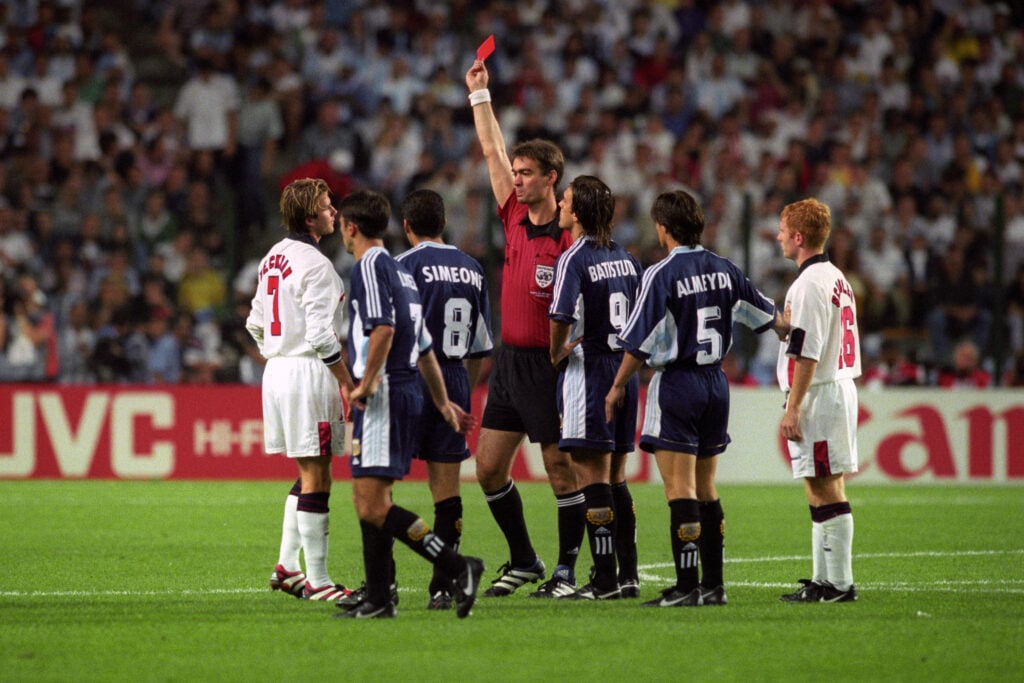
David Beckham, lying on the turf of the Stade Geoffroy-Guichard after a heavy challenge from Diego Simeone, flicked his boot backwards into the Argentine captain’s shin. The contact was minimal – Sports Illustrated described it as a “petulant flick” – but the consequence was catastrophic.
Danish referee Kim Milton Nielsen produced a red card without hesitation. Beckham walked. England played the remaining 43 minutes of normal time, 30 minutes of extra time, and a penalty shootout with ten men.
They lost. And David Beckham became the most vilified sportsman in England.
The match outcome
The simulation models the second half from the 47th minute with England at full strength. The key variables are: Beckham’s continued presence in midfield, Owen’s threat on the counter-attack, and Argentina’s psychological response to not having the numerical advantage they enjoyed in actual history.
In reality, Argentina created very little in the second half despite their numerical advantage – a fact that speaks to England’s defensive organisation but also to Argentina’s lack of urgency once they sensed the game was going to penalties.
In our alternative reality, Argentina cannot afford to be passive. They must attack. And attacking against a full-strength England, with Owen on the counter and Beckham delivering from wide positions, is a more dangerous proposition.
The simulation’s most common outcome – occurring in 38% of iterations – is England winning in 90 minutes. In 19% of simulations, England win in extra time. In 16%, the match goes to penalties and England win. In 27%, Argentina win – either in normal time, extra time, or on penalties.
Argentina, in this scenario, are eliminated. Their quarter-final against the Netherlands does not happen. England face the Netherlands instead.
The tournament outcome
The Netherlands in 1998 were a formidable side managed by Guus Hiddink, featuring Dennis Bergkamp, Patrick Kluivert, Marc Overmars, and the De Boer brothers. They were, perhaps, the most technically gifted team in the tournament.
In actual history, they beat Argentina 2‒1 but England, with Beckham fit and available, are not Argentina. They are more defensively organised, more physically robust, and – crucially – they have Michael Owen, whose pace against the Dutch backline of Jaap Stam and Frank de Boer is a genuine weapon.
The simulation gives England a 56% probability of reaching the semi-final, with the Netherlands at 44%. The margin is narrow but England come out on top more often than not in a result that would have been celebrated as one of their greatest World Cup victories.
The semi-final would’ve pitted England against Brazil, after they overcame Denmark in the quarter-final.
Brazil in 1998 were the tournament favourites, built around Ronaldo at the absolute peak of his powers. He had scored four goals in the tournament and was the most feared striker on the planet. But Brazil were also vulnerable – their defensive organisation was suspect, and their semi-final against the Netherlands in actual history required penalties to resolve.
The simulation gives England a 31% probability of reaching the final. Brazil are significantly stronger but this is not a walkover.
In the most likely outcome – Brazil beating England in the semi-final – the final is France vs Brazil, exactly as it was in actual history. Zidane scores twice. Ronaldo, in the grip of a mysterious pre-match episode that has never been fully explained, is below his best. France win 3‒0.
But in 31% of simulations, England are in that final. And in those simulations, the probability of England winning the World Cup is approximately 35%.
That is not a certainty. But it is a genuine chance. And that is infinitely more than what actually happened.
The England impact
In our alternative reality, England arrive at Euro 2000 as a side that reached the semi-final of the 1998 World Cup. The psychological difference is significant. They are not a team haunted by failure; they are a team building on success. The simulation gives England a 52% probability of reaching the Euro 2000 quarter-final (compared to their actual group-stage elimination), and a 28% probability of reaching the semi-final.
The 2002 World Cup is the most complex counterfactual in England’s alternative history, because it involves the most famous moment of Beckham’s actual career: the penalty that completed his redemption.
In our alternative reality, there is no redemption narrative for Beckham at World Cup 2002. There is no penalty against Argentina. There is no moment of catharsis. There is simply a very good England midfielder playing a very good World Cup.
And here is the paradox at the heart of this simulation: the red card, and the suffering it caused, may have made Beckham better. The World Cup 2002 Beckham – driven, focused, carrying the weight of a nation’s redemption – was arguably the finest version of himself in an England shirt. The simulation acknowledges this. It gives the alternative reality Beckham a slightly lower performance ceiling in 2002, because he is not playing with the fuel of four years of humiliation.
The net effect on England’s 2002 World Cup performance is ambiguous. They reach the quarter-final in both timelines. They lose to Brazil in both. But the manner of the loss is different: in our alternative reality, England are beaten by a better team in a match they approach with confidence rather than desperation.
At the 2006 World Cup, Beckham is 31 years old and carrying a metatarsal injury that limited his effectiveness in actual history. In our alternative reality, the injury is unchanged – it is a physical fact, not a psychological one. England still lose to Portugal on penalties in the quarter-final. But the simulation gives them a 34% probability of reaching the semi-final, compared to their actual 25%.
The cumulative effect across four major tournaments is a modest but consistent improvement in England’s performance: they go further, more often, with a slightly higher ceiling. They do not win a major tournament. But they come closer.
The career impact
The red card did not break David Beckham. What it did was define him – and that definition came with a cost that lasted years.
In the 1998/99 season, Beckham was subjected to sustained abuse at every away ground in England. At Sunderland, he was pelted with coins. At Leeds, the abuse was so intense that police had to escort the Manchester United team bus in and out of the stadium.
And yet in that season, Beckham was arguably the best player in England. He scored six goals and provided 15 assists in the Premier League. Manchester United won the Treble and Beckham was central to all three. He finished second in the Ballon d’Or voting, behind Rivaldo.
The rehabilitation was real. But it was also incomplete. The psychological damage of being made a national scapegoat – of having your effigy burned, of being blamed for a nation’s failure – does not simply dissolve because your club wins three trophies. It leaves a mark. And that mark, the simulation argues, shaped the rest of Beckham’s career in ways that are measurable.
Beckham’s career after 1998 was characterised by two things: extraordinary consistency and a persistent ability to perform at his best in the biggest international moments. He performed well at Euro 2000 but England were eliminated in the group stage. He was excellent at the 2002 World Cup – scoring the penalty against Argentina that completed his personal redemption – but England lost to Brazil in the quarter-final. He was again superb at Euro 2004 but England lost on penalties to Portugal.
Beckham was appointed England captain by Sven-Göran Eriksson in November 2000 – a decision that was widely seen as a crucial step in his rehabilitation from the 1998 red card. He held the captaincy for 58 of his 115 caps, stepping down after the 2006 World Cup.
But the symbolic weight of the captaincy is different: it is not a redemption story, it is a continuation. Beckham is not a man being given a second chance; he is simply the best leader available.
The cultural impact
The British tabloid treatment of Beckham after 1998 was a defining moment in the relationship between football, celebrity, and media. The Daily Mirror’s dartboard. The Sun’s “10 Heroic Lions and One Stupid Boy” headline. The effigy outside the Wakefield pub. These were not simply reactions to a football decision; they were expressions of a cultural moment in which a young, glamorous, celebrity footballer was being punished for the crime of being too visible, too successful, too married to a Spice Girl.
In our alternative reality, this moment does not happen. Beckham is not a scapegoat. He is a hero – the man who stayed on the pitch, who helped England reach a World Cup semi-final. The tabloid relationship with Beckham is fundamentally different. He is not a figure who needs to be rehabilitated; he is simply a great player.
The culture of English football – the way the press treats players, the way supporters relate to the national team, the way failure is processed and blame is assigned – is shaped by moments like the 1998 red card. In our alternative reality, that shaping does not happen. And England’s football culture in the early 2000s is slightly healthier as a result.
The verdict
The simulation gives England a 10.8% probability of winning the 1998 World Cup if Beckham stays on the pitch. That is a one-in-ten chance. It is not a certainty, or even a likelihood. But it is a greater chance than they had when he was shown the red card.
More significantly, the simulation gives England a 54% probability of winning the match against Argentina with eleven men – compared to their actual 28% with ten. The red card, in other words, was the difference between England being favourites and England being underdogs. It was not the only factor in their elimination, but it was the decisive one.
Beckham’s career, in our alternative reality, is slightly less dramatic but slightly more successful. He is not a scapegoat, so he cannot be a hero. He is not burned in effigy, so he cannot be vindicated. He is simply one of the greatest English footballers of his generation – a man whose right foot delivered crosses of extraordinary precision, whose set-piece delivery was unmatched in his era, whose 115 caps for England represent a career of consistent excellence.
In actual history, Beckham is all of that – and also a symbol. A symbol of resilience, of redemption, of the capacity to absorb punishment and emerge stronger. The red card gave him a story. And the story, in the end, may have been worth more than the semi-final.
But football is not a story. It is a sport. And in the sport, England should have had eleven men on the pitch in Saint-Étienne in 1998. They didn’t. And the simulation is clear about what that cost them.
Read more:
Squawka Suggests