







It’s finally happened. Ruben Amorim has shifted away from his coveted 3-4-3 system.
The same manager who said ‘not even the pope could make him change’ has finally steered away from his three-at-the-back play style.
Why now? Well, he is set to lose two key players and his most influential attacking partnership in Bryan Mbeumo and Amad Diallo.
The vigour of the Premier League is such that, often in the chess match-esque games, managers are forced to come up with new solutions.
We’ve seen Amorim do this before. United have leaned into the tactical trajectory of the league, becoming the joint highest scoring team from set-pieces and using more long balls.
But against Bournemouth, the leaked news before the match that Amorim was finally set to change his formation became true.
The results yielded an enthralling 4-4 draw. Amorim has been criticised for his pragmatism in the past, but he finally lifted the shackles to unleash United’s attack.
The Red Devils created chance after chance and bossed the first half in particular, but the new tactics don’t come without their issues.
In a comparison with what Amorim did before, we break down the risks, rewards and permutations of Amorim’s gear shift.
In this article we’ll cover:
Overlapping Defenders
The problem previously with Amorim’s attack was when both number 10s dropped, though it dragged a defender with them when they were fed the ball, they were tasked with doing too much.
For instance, when Bryan Mbeumo and Matheus Cunha dropped into their own half to receive the ball, they previously had to take on two or three players to progress the ball once they had received it.
The beauty of Amorim’s 4-3-3 means there are extra players to make runs in behind, namely the defenders.
At many points, we saw Diogo Dalot pushed up and inverted to form a front five. It meant Bournemouth couldn’t cope with the overloads.
Saliently, Luke Shaw, playing at centre-back, was also making runs from deep.
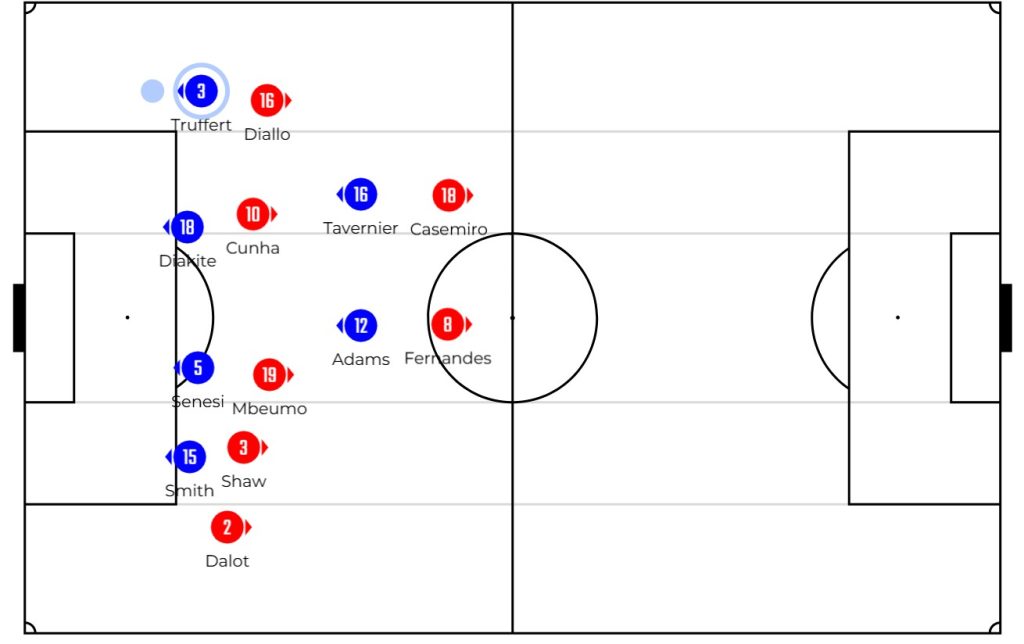
Whether Shaw took it upon himself to do this or whether he was instructed to remains to be seen in the upcoming matches. As Bournemouth pressed high, an overlapping centre-back running in behind meant United could bypass players attempting to trap United in their own half.
It was a frequent sight in the back 3 system to see United trapped wide when playing it to the wide centre-back, as teams would mark off the inside pass to the midfield. However, there are now options up the pitch to aim for.
Improved Progression
As Amorim has played with the 3-4-3 system since arriving at Old Trafford, managers quickly figured out how to press his setup with success.
As the former Sporting CP manager has never changed until now, opposition managers could press his three centre-backs with three forwards. With the tweaks, however, an extra full-back is now available to pass to in deep build-up.
Furthermore, it means Bruno Fernandes can now push up the pitch or wide to drag his marker away from the middle, allowing Casemiro more space in the middle of the pitch.
It also meant that when an opposing full-back attempted to push up and press United’s full-back, they could use the extra man who would normally be a wide full-back (Amad Diallo) to push up and pin back the defence.
We haven’t seen United find these gaps in build-up until now.
Overcommitting in attack
It’s crucial to note that United are almost a different team when playing at home. More aggressive in the press and roared forward by a boisterous Old Trafford crowd.
We may not see players be so brave in other matches or away from home. Though United did a decent job of quickly recovering the ball if an attack broke down, the number of players they committed in attack could be cause for concern.
With a full-back and sometimes a centre-back joining the attack, a pass intercepted or a move breaking down can leave few men at the back.
As we saw for Bournemouth’s third goal from a free-kick, Casemiro was forced to bring an attacker down because United had six players up the pitch and were defending a transition outnumbered.
There is only so long you can lean into the chaos and reap its rewards in a Premier League season where you’ll quickly get found out.
For Amorim’s new tactics to take effect and work week in week out, he must strike a balance between taking the handbrake off and ensuring it doesn’t open the door for teams to score at the other end.
Read more:
- Premier League predictions & tips
- Premier League outright odds
- Latest football news
- Best betting sites
- Best free bet offers
- Football accumulator tips
Squawka Suggests