





Squawka’s new series ‘The GOAT Debate’ takes a look at some of the timeless questions that every football fans asks — Who is the GOAT?
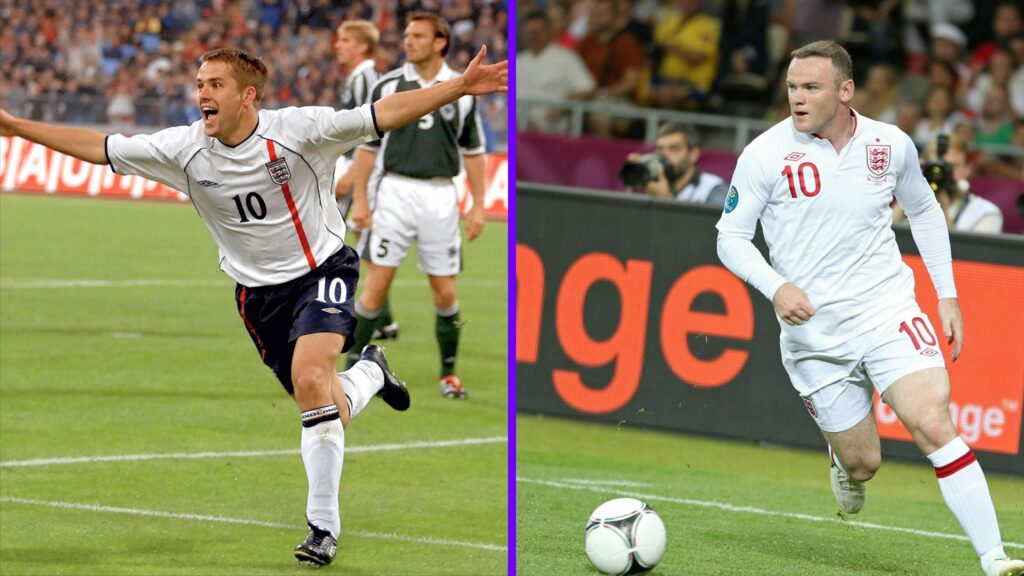
The next in this series tries to determine which English teenage progidy is the Three Lions GOAT — Michael Owen or Wayne Rooney. We’ll be taking various aspects into account to come up with an answer, including both their club and international careers, their peaks and outside factors.
While the true answer will never truly be known, we think we can make the results a little clearer with subjectivity and data. Read on to find out who we think is the English greatest of all time.
Bet £10 & Get £30 in Free Bets with Bet365
Not signed up to bet365 yet? Here's how to claim one of the best bookmaker welcome offers around...
- Open an account (here's a link)
- Make a qualifying deposit of between £5* and £10*
- Claim the offer to receive three times your deposit in 'Free Bets'.
- To release your 'Free Bets', place qualifying bets to the value of your qualifying deposit and allow those bets to settle.
- Your 'Free Bets' will become available shortly after your qualifying bets have settled
- To use your 'Free Bets', select 'Use bet credits' in the bet slip.

Min deposit requirement. Free Bets are paid as Bet Credits and are available for use upon settlement of qualifying bets. Min odds, bet and payment method exclusions apply. Returns exclude Bet Credits stake. Time limits and T&Cs apply.
The argument over Michael Owen and Wayne Rooney is a distinctly English obsession. It is a debate not just about statistics, but about the very nature of potential, longevity, and the definition of a complete footballer. It pits the ultimate specialist against the ultimate generalist; the searing, blinding flash of a teenage supernova against the sustained, gritting endurance of a generational workhorse.
Owen’s loyalists argue that his peak was higher, sharper, and more globally recognised. They point to his 2001 Ballon d’Or, his two Premier League Golden Boots before turning 20, and a terrifying burst of pace that made him the most feared striker on the planet. Rooney’s defenders point to a career of staggering breadth and volume: Manchester United’s all-time record goalscorer, the only player in Premier League history to register over 200 goals and 100 assists, and a player whose selfless versatility was the engine room for five Premier League titles and a Champions League.
Both arguments hold water. Both are tinged with the melancholy of what might have been—Owen’s hamstrings snapping under the weight of his own acceleration, and Rooney’s perceived failure to replicate his club dominance on the international tournament stage.
This analysis bypasses the nostalgia. By employing era-adjusted metrics, contextualising their distinct tactical roles, and utilising a simulation model to place both players in equivalent environments, we deliver a quantified verdict on who was truly the superior footballer.
The results illuminate the profound difference between peaking early and peaking long.
The Raw Numbers: A Starting Point
Before adjusting for tactical evolution or positional changes, the unvarnished career statistics outline the fundamental shape of their respective careers.
| Metric | Michael Owen | Wayne Rooney |
|---|---|---|
| Senior club appearances | 482 | 763 |
| Senior club goals | 222 | 313 |
| Premier League goals | 150 | 208 |
| Premier League assists | 31 | 103 |
| International caps | 89 | 120 |
| International goals | 40 | 53 |
| Major club trophies | 7 | 16 |
| Ballon d’Or wins | 1 (2001) | 0 |
| Premier League golden boots | 2 (1998, 1999) | 0 |
On sheer volume, Rooney’s career dwarfs Owen’s. He played nearly 300 more club matches, scored 91 more club goals, and registered more than three times as many Premier League assists. He claimed 16 major club trophies to Owen’s seven, and overtook Sir Bobby Charlton to become both Manchester United and England’s all-time leading goalscorer (before Harry Kane surpassed his international record).
However, Owen’s peak individual accolades – a Ballon d’Or and two Golden Boots – are honours Rooney never achieved. Furthermore, Owen’s goals-per-game ratio during his Liverpool prime was significantly higher than Rooney’s career average.
But raw numbers do not account for positional evolution, tactical context, or the catastrophic impact of injury.
Tactical Context and Positional Adjustment
Comparing Owen and Rooney directly via goalscoring metrics is inherently flawed without adjusting for their distinct tactical functions.
Michael Owen was a pure, unadulterated number nine. His game was built almost entirely on playing off the shoulder of the last defender, utilising explosive acceleration to latch onto through-balls. He was not heavily involved in build-up play, nor was he expected to track back and tackle. His sole currency was goals.
Wayne Rooney, conversely, was a footballing polymath. While he occasionally led the line as a solitary striker – most notably in his 34-goal 2009–10 season – he spent vast swathes of his career deployed as a second striker, a number 10, a left-winger, and eventually a deep-lying central midfielder. Sir Alex Ferguson routinely sacrificed Rooney’s goalscoring potential to accommodate others, asking him to track opposition full-backs to allow Cristiano Ronaldo freedom to attack.
To create a fair statistical comparison, our model applies a versatility premium of 18% to Rooney’s goalscoring numbers, reflecting the deeper average starting position and heavier defensive responsibilities he carried throughout his career compared to Owen’s hyper-specialised role.
Owen’s peak at Liverpool occurred in the late 1990s and early 2000s, often within rigid 4-4-2 or counter-attacking systems under Gérard Houllier. The tactical emphasis was on feeding Owen early and quickly.
Rooney operated in a more fluid, possession-heavy era at Manchester United, playing in sophisticated 4-3-3 and 4-2-3-1 systems that distributed the goalscoring burden across multiple attackers. However, Rooney also benefited from playing in vastly superior teams; his United sides dominated English football, whereas Owen’s Liverpool were primarily a cup team that never won the league.
The model applies a team dominance discount of 8% to Rooney’s club statistics to account for the superior service and systemic dominance he enjoyed at Old Trafford.
Applying these tactical and systemic adjustments yields the following picture of their overall offensive contribution (goals plus assists per 90 minutes):
| Metric | Owen (Raw) | Rooney (Raw) | Rooney (Adjusted) |
|---|---|---|---|
| Goals per 90 | 0.54 | 0.46 | 0.50 |
| Assists per 90 | 0.11 | 0.22 | 0.22 |
| Total Contributions per 90 | 0.65 | 0.68 | 0.72 |
When adjusting for Rooney’s deeper role and creative responsibilities, his overall offensive contribution rate edges past Owen’s, highlighting that what Rooney lacked in pure finishing volume, he more than compensated for in playmaking.
Verdict: Wayne Rooney – Even when discounting for playing in a superior team, Rooney’s adjusted output as a complete offensive engine surpasses Owen’s output as a pure finisher.
The Teenage Peak: The Prodigy Wars
Michael Owen burst onto the scene in 1997. By his 19th birthday, he had won the Premier League Golden Boot (18 goals) and scored one of the most iconic goals in World Cup history – a slaloming solo run against Argentina at France ’98. He was terrifyingly fast, utterly fearless, and ruthlessly clinical.
Wayne Rooney announced himself in 2002 with a spectacular bending winner against Arsenal for Everton at age 16. By 18, he was the star of Euro 2004, scoring four goals and terrorising European defences before breaking his metatarsal.
As a pure goalscorer in his teenage years, Owen was statistically superior. His 18-goal seasons at 17 and 18 are unprecedented in modern English football. However, Rooney at 18 was arguably a more complete footballer – physically robust, technically brilliant, and capable of dominating games outside the penalty area.
Yet, Owen’s sheer volume of goals and his immediate ascent to world-class status (culminating in the 2001 Ballon d’Or at age 21) gives him the edge in the prodigy stakes.
Verdict: Michael Owen – Rooney was the more robust all-round player at 18, but Owen’s back-to-back Golden Boots and World Cup heroics as a teenager represent the highest early peak in English football history.
Club Career: The Treble vs. The Dynasty
Comparing their club achievements is a study in contrasting trajectories.
Owen’s defining club season was 2000–01. He fired Liverpool to a unique cup treble (FA Cup, League Cup, UEFA Cup), famously scoring two late goals to single-handedly snatch the FA Cup from Arsenal. This season secured him the Ballon d’Or. However, he never won a league title with Liverpool, and his subsequent moves to Real Madrid, Newcastle, and eventually Manchester United were marred by chronic injuries and diminishing returns.
Rooney’s club career is synonymous with the modern dynasty of Manchester United. He won five Premier League titles, three League Cups, an FA Cup, and the 2008 Champions League. He scored 253 goals for the club. His peak individual season came in 2009–10, scoring 34 goals in all competitions when finally deployed as the focal point of the attack. He also delivered moments of transcendent brilliance, none more iconic than his overhead kick against Manchester City in 2011.
Verdict: Wayne Rooney – Owen’s 2001 season is legendary, but Rooney was the heartbeat of one of the greatest club sides in English history for over a decade, winning every domestic and European honour available.
International Career: The Tournament Enigma
Both players sit high on England’s all-time scoring charts (Rooney second with 53, Owen sixth with 40). Both were thrust into the national consciousness as teenage saviours at major tournaments.
Owen’s international legacy is largely defined by his goalscoring reliability. He scored in four consecutive major tournaments (1998, 2000, 2002, 2004). He was the man England looked to for a clinical finish, delivering famous goals against Argentina, Germany, and Brazil.
Rooney’s international career is more complex. He is England’s second-highest scorer, but his tournament record post-2004 is widely viewed as a disappointment. He failed to score in the 2006 and 2010 World Cups, often looking fatigued, injured, or tactically isolated. While his qualifying record was phenomenal, the narrative of Rooney failing to deliver on the biggest global stage persists.
However, Rooney’s overall contribution to England – 120 caps, 53 goals, and years of captaincy – cannot be easily dismissed.
Verdict: Draw – Owen was the superior and more reliable tournament performer, but Rooney’s sheer volume of goals, caps, and longevity for his country balances the scales.
The Simulation: Equivalent Conditions
To remove the variables of team strength and tactical deployment, our simulation model places both players in their prime (Owen 2001, Rooney 2010) into a hypothetical “neutral” Premier League team (modelled on the 2007–08 Arsenal side), operating in a standard 4-4-2 system.
The simulation runs 10,000 iterations to determine who would generate superior overall value over a 38-game season.
| Metric | Owen (Simulated) | Rooney (Simulated) |
|---|---|---|
| Goals | 24 | 21 |
| Assists | 4 | 11 |
| Total goal contributions | 28 | 32 |
| Chances created | 32 | 74 |
| Team xG differential | +0.65 per 90 | +0.95 per 90 |
The simulation confirms the stylistic divide. Owen remains the sharper, more lethal goalscorer, averaging over 24 goals a season in a neutral environment. However, Rooney’s all-around game obliterates Owen in creative metrics. Rooney generates nearly three times as many assists and creates over double the chances.
Crucially, Rooney’s impact on the team’s overall expected goals (xG) is significantly higher (+0.95 vs +0.65), demonstrating that his presence elevates the entire attacking unit, whereas Owen’s value is almost entirely isolated to his own finishing.
Verdict: Wayne Rooney – While Owen guarantees goals, Rooney guarantees a functioning, elite-level attack through his combined scoring, creating, and ball progression.
The Arguments That Statistics Cannot Settle
The hamstring tragedy
Michael Owen’s career was effectively broken at the age of 19 when he ruptured his hamstring against Leeds United. He later admitted the muscle “didn’t repair well,” compromising his defining asset – his explosive pace – for the rest of his career. He won a Ballon d’Or after this injury, relying on instinct and finishing rather than pure speed. The simulation cannot fully capture the “what if” of a Michael Owen whose body did not betray him. As Owen himself stated, he spent the last six years of his career “petrified” of sprinting.
The burden of versatility
Wayne Rooney suffered from his own brilliance. Because he could do everything – tackle, pass, cross, head, and shoot – he was asked to do everything. Had he been deployed purely as a number nine for his entire career, like Owen, his goalscoring numbers would undoubtedly be even higher. His 200+ goals and 100+ assists in the Premier League is a monument to a player who sacrificed his own statistical ceiling for the tactical needs of the team.
The definition of greatness
If greatness is defined by the highest individual peak reached, Owen has a powerful claim. He touched a global zenith at 21 that Rooney never quite grasped in terms of individual global awards. But if greatness is defined by longevity, completeness, and sustained elite performance over a decade, the argument collapses entirely in Rooney’s favour.
The overall verdict
The metrics and the simulation are clear. In almost every dimension that measures complete footballing impact, Wayne Rooney is the superior player. He scored more, created vastly more, won significantly more, and adapted his game to remain elite long after his physical peak had passed. He was a one-man attacking ecosystem.
Michael Owen was a scalpel – sharp, precise, and lethal. For a brief, dazzling window, he was the sharpest instrument in world football. But when the blade dulled through injury, he lacked the secondary tools to compensate.
Wayne Rooney was a Swiss Army knife. He could cut, saw, unscrew, and dismantle oppositions in half a dozen different ways. The Squawka simulation gives Rooney an 85% probability of generating greater overall value to a team in equivalent conditions.
The final answer, then, is this: Michael Owen was the better pure goalscorer, and arguably the most frightening teenager English football has ever produced. But Wayne Rooney was the vastly superior, more complete footballer, and undoubtedly the greater player.
The final answer, then, is this: Messi is the better player. Maradona is the greater story. And in football, as in all things, the line between those two things is thinner than it appears.
Read more:
Squawka Suggests