






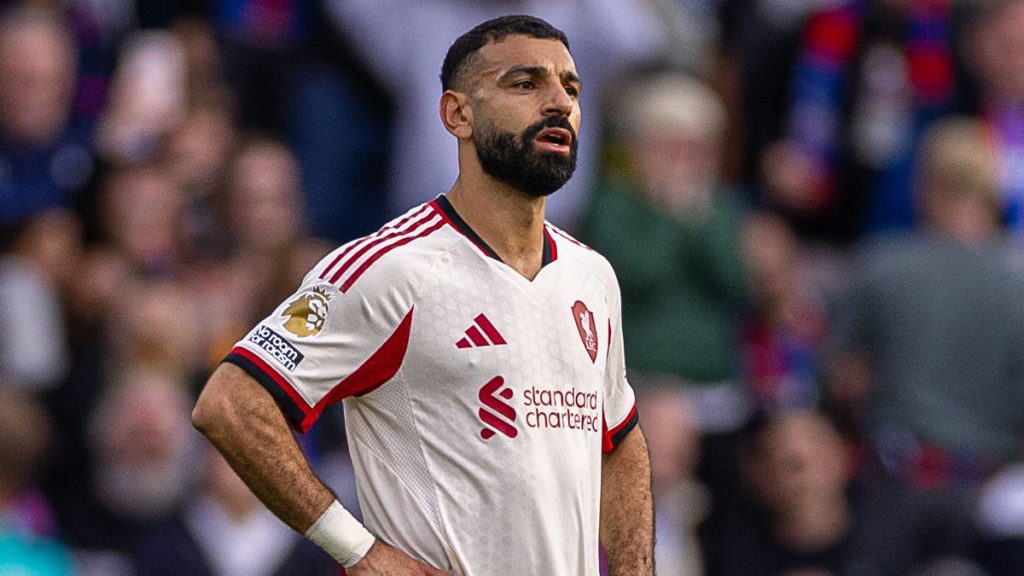
Mo Salah had four goals and assists after six Premier League games last season. This time around, the four-time Premier League Golden Boot has two goals and two assists for Liverpool.
His last open-play goal came in the 94th minute of the season opener against Bournemouth. Salah has blanked against Newcastle United, Arsenal, Everton and Crystal Palace since. His only other goal for the Reds arrived from the spot against Burnley.
Just six months after Salah put pen to paper on a new, two-year deal, some are wondering whether Liverpool made a mistake. The 33-year-old, reportedly on £380,000-per-week, looks to be a shadow of the player he was during his record-breaking 2024-25 campaign. After all, you can’t outrun father time.
And while this is true, playing high intensity football will eventually catch up with you, this isn’t necessarily the case with Salah right now.
In this article, we’ll cover:
Lack of involvement
The legendary No.11’s “decline” is a consequence of the summer signings, coupled with a change in shape. Salah had a prolific relationship for Liverpool down the right flank with Trent Alexander-Arnold.
Even when the right-back was injured last season, it was noticeable that Salah wasn’t anywhere near as involved. The ball wasn’t getting to him and when it did, it was in a manner that didn’t exactly maximise his skillset. Alexander-Arnold would regularly launch the ball forward and free Salah up into space.
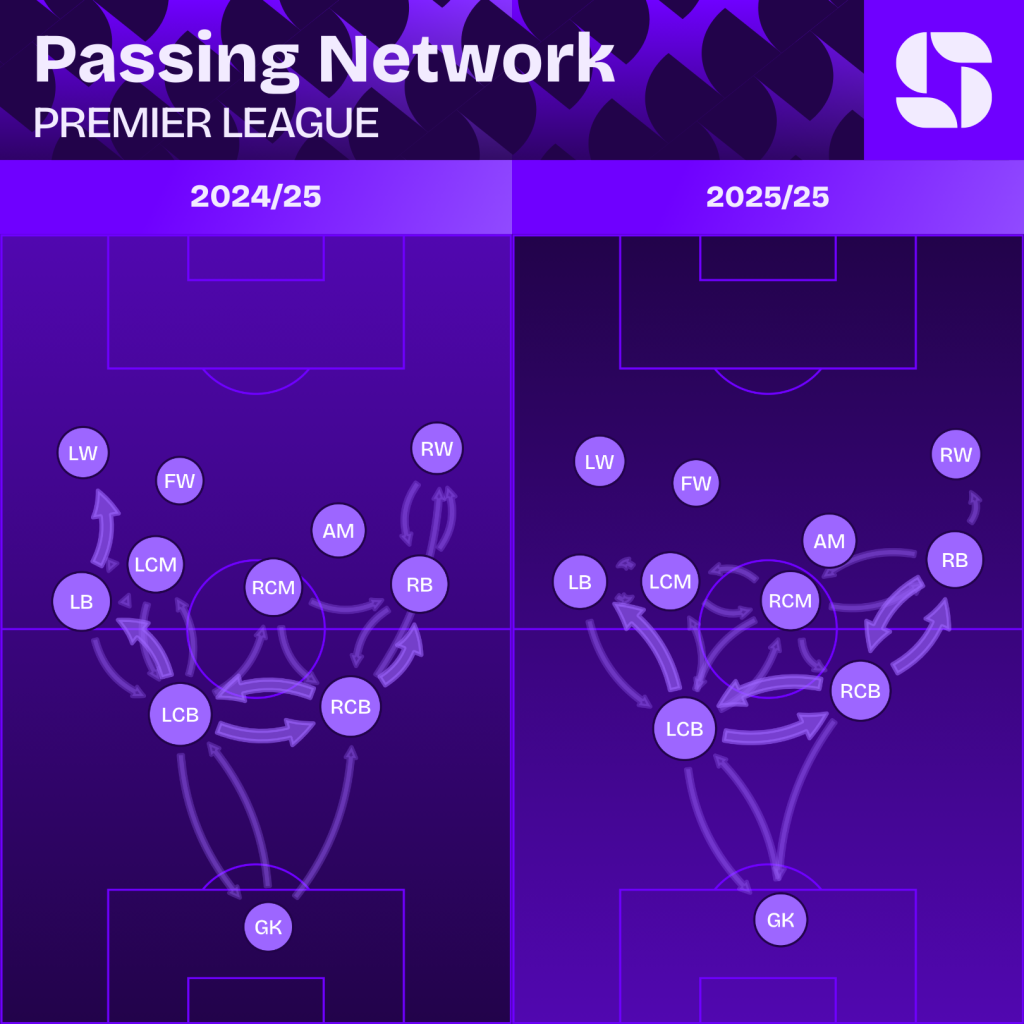
As shown in the passing network graphics above, there’s quite the difference in last season vs this term. And not just when looking at Salah either. There’s a disconnection between the attack and the rest of the team.
The data backs this up too.
In three of the six Premier League matches, Salah has had fewer than 40 touches in the game. The alarming thing here is that in all three matches, the Reds had over 50% possession. It’s not as though they didn’t have the ball as a team. Against Newcastle, Arne Slot’s side had 62%, against Arsenal it was 53% and in defeat to Crystal Palace, they had 72% of the ball.
On Saturday afternoon, with Liverpool chasing a goal at Selhurst Park, the 33-year-old attempted just eight passes in the second half. Simply put, the champions aren’t getting their best player involved in the game. And when they do manage to funnel the ball his way, he’s not in areas you want him to be in.
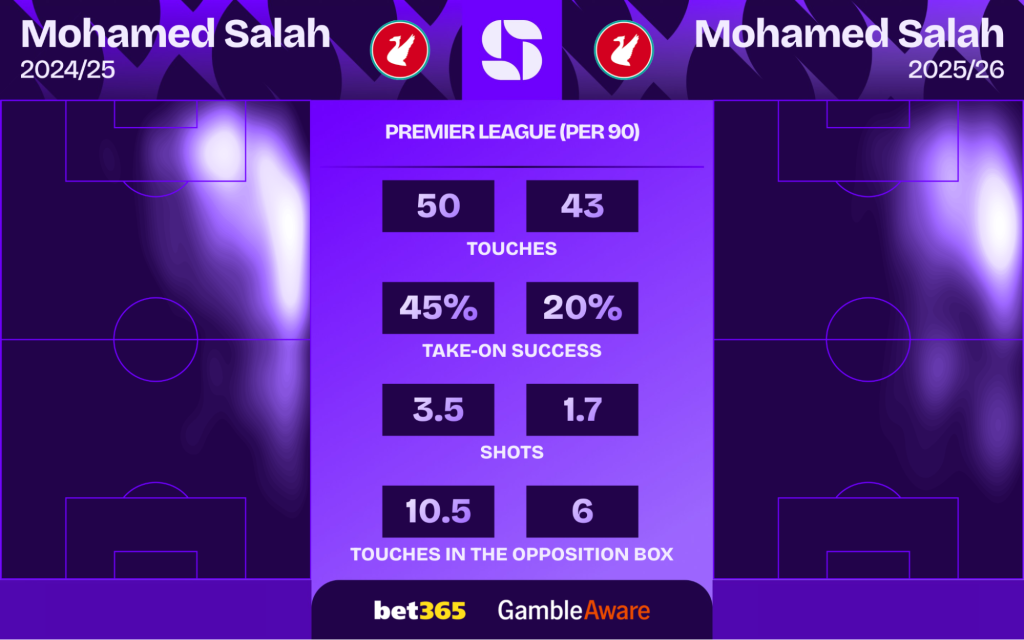
You can see it in the above graphic. Last season, he had more of the ball in the penalty area. The closer he is to the goal, the more dangerous he can be. The fact he’s not as involved and when he is, he’s in wider areas, means he’s essentially been nullified by his own manager.
There’s no beating around the bush.
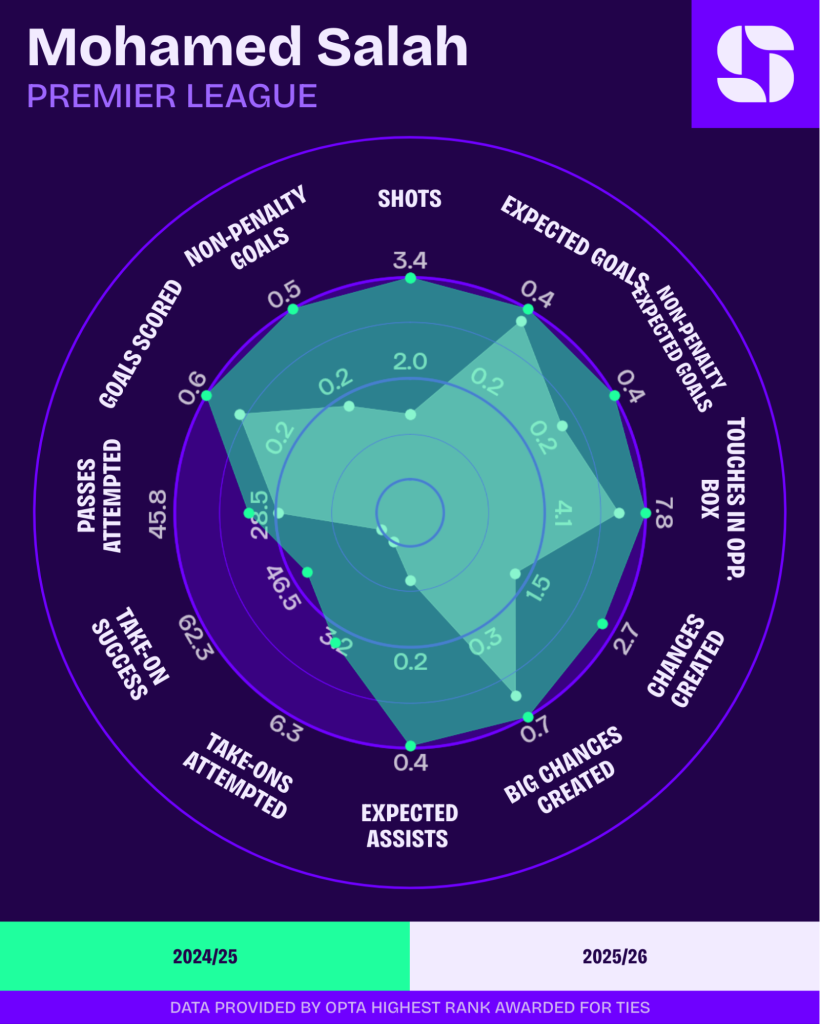
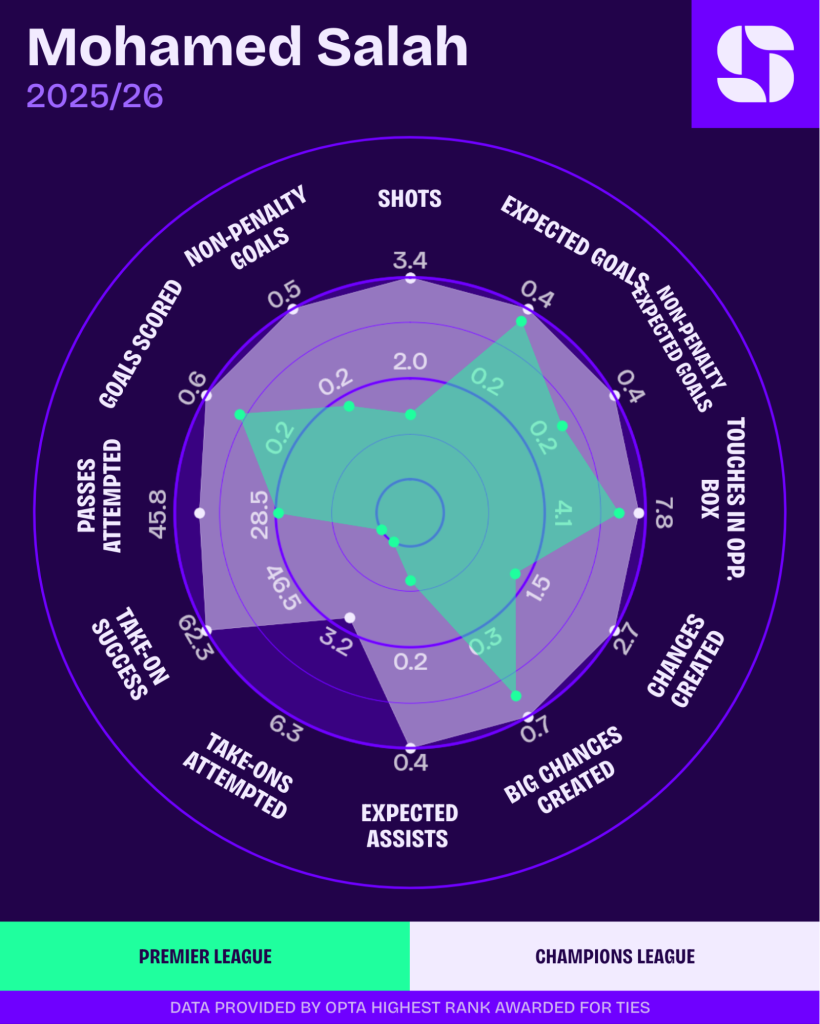
His shots have halved. His Non-Penalty Expected Goals average has taken a significant hit. Salah is creating fewer chances, has a lower Expected Assists average and is attempting fewer take-ons.
He’s nowhere near as much of a threat as he once was.
Salah’s new role
If everything was the same except his output, it’d be a Salah problem. But the numbers prove this isn’t a player issue. One of the most dangerous players in Premier League history has basically been sidelined by the role he’s been given within the team.
Granted, Slot needed to change things following an attacking overhaul this summer. It’s not as though the team is firing and it’s Salah on the periphery. The attack looks terribly disjointed. For context, midfielder Ryan Gravenberch and squad player Federico Chiesa are tied with Salah on two league goals.
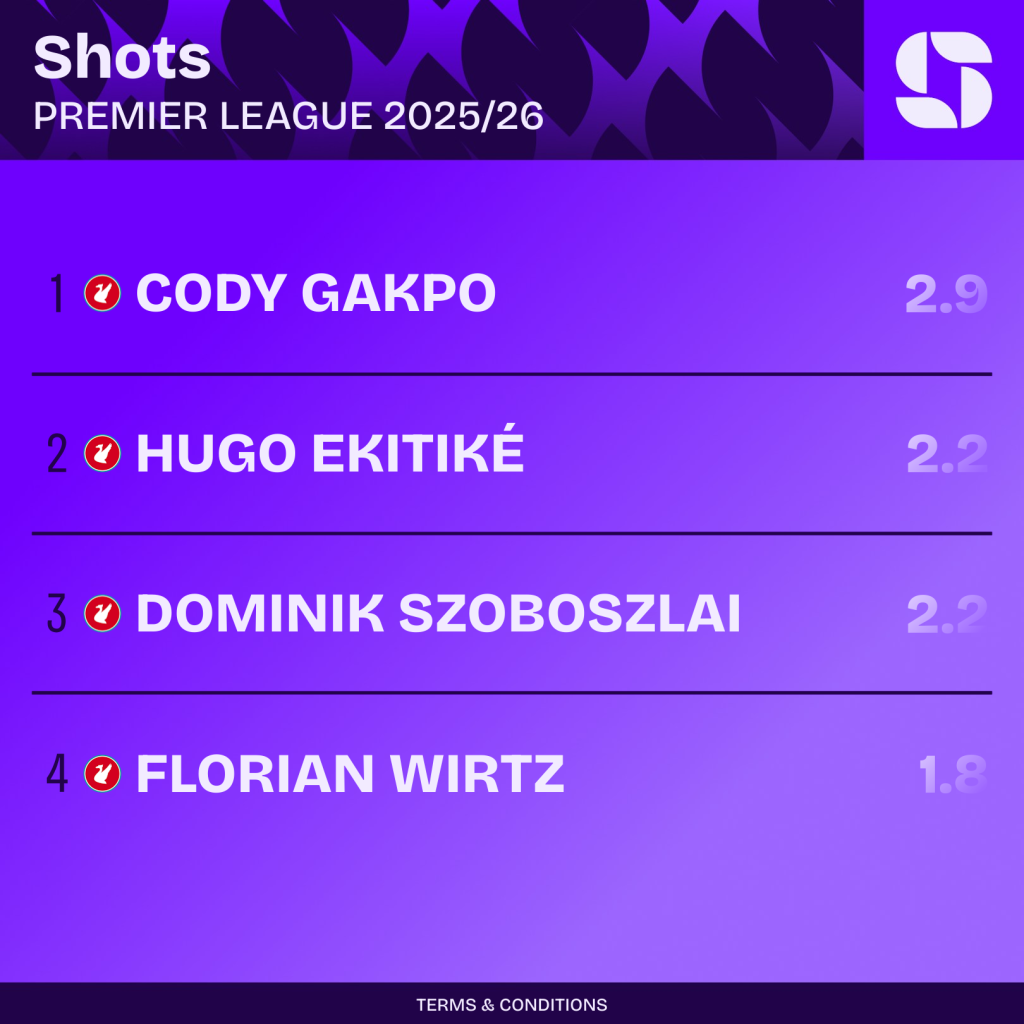
Salah has all but been a guarantee in his eight previous seasons with the club. But he’s now being treated as though he’s a support act in the attack. The Egyptian is averaging fewer shots than Cody Gakpo, Hugo Ekitike, Dominik Szoboszlai and Florian Wirtz.
Slot’s plan for Salah
The bizarre thing though is that this seemingly isn’t what Slot wants.
Following Salah’s best showing of the season against Atletico Madrid in the Champions League, Slot heaped praise on his attacker, saying: “I prefer to see him like he was in the Atletico game – really involved, touched the ball so many times. It was a joy to watch.”
Salah had 56 touches against the La Liga side. For context here, he had 50 against Bournemouth, 55 versus Burnley and 52 in the win over Everton. So Salah didn’t have an extraordinarily high touch count against Atleti. Yes, it was the highest touch count of the season. But only just.
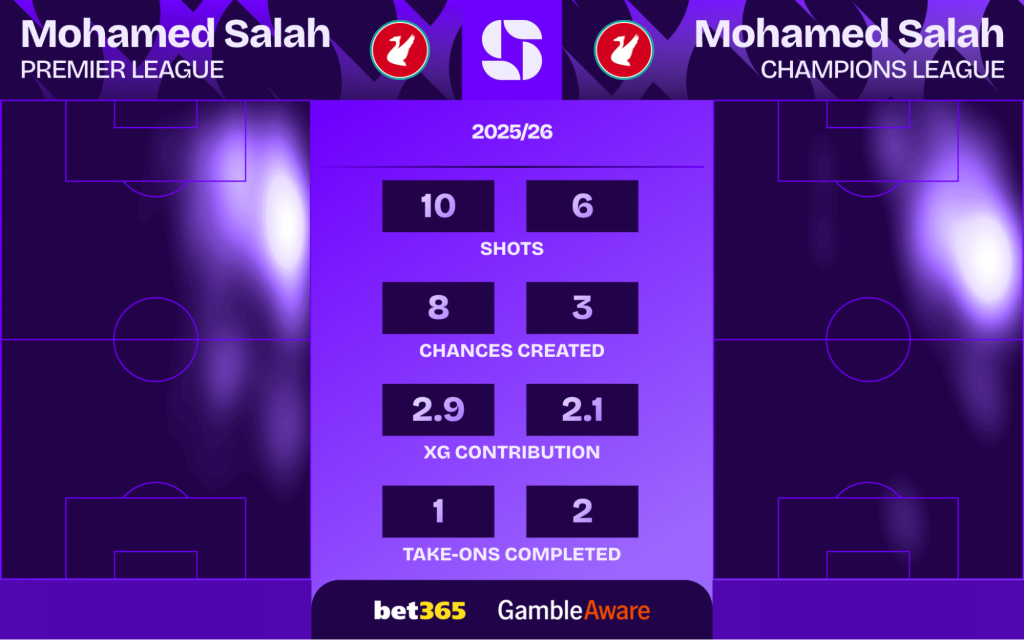
The difference was what he did in possession.
Salah had six shots, created three chances and posted 2.1 xG Contribution against Atletico Madrid. In the Premier League, Salah has 10 shots, eight chances created and 2.9 xG Contribution. He’s also completed more take-ons in one Champions League game than he has in six in the Premier League.
That one-off performance shows the Salah of yesteryear is still there. He just needs the right environment. Because in games against Everton and Burnley, when he had a total of 107 touches during his time on the pitch, he managed a total of three shots and created two chances. He had a Non-Penalty xG of 0.12 and an xA of 0.34.
It isn’t about getting Salah on the ball. It’s about getting Salah on the ball in the right areas and in the right situations. And this, not finding a way to get Wirtz, Ekitike and Alexander Isak firing, is probably Slot’s biggest challenge. Ultimately, if Salah is allowed to be dangerous, others will thrive too. It’s no coincidence that Wirtz’s best game for the Reds was that one against Atletico.
Salah isn’t finished. He’s just being wasted right now.