



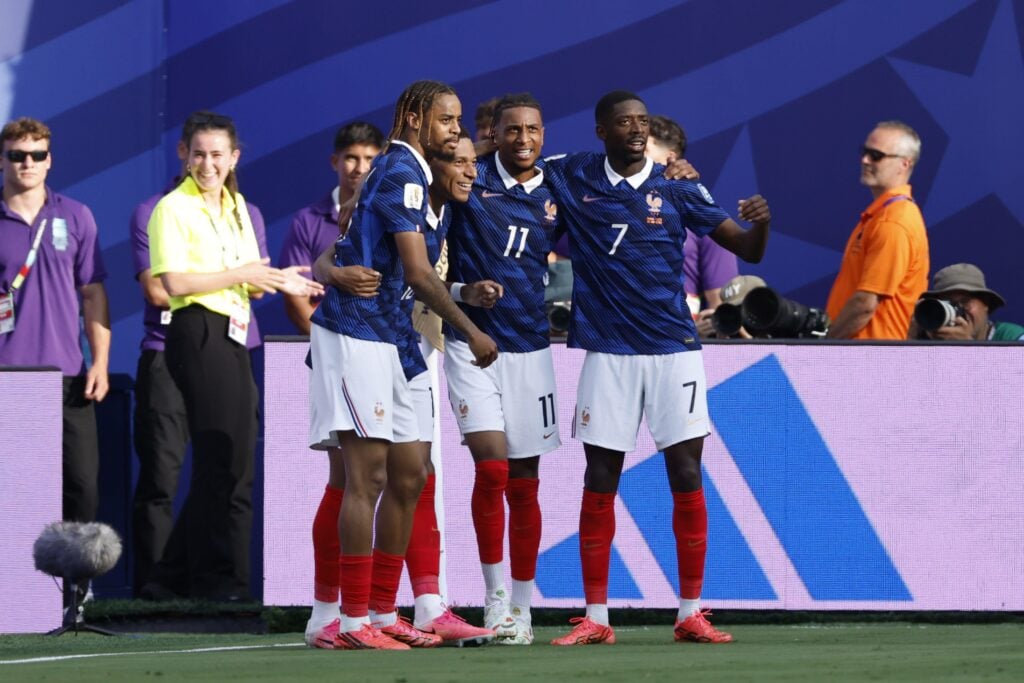
France beat Sweden 3-0 to reach the Round of 16, as Kylian Mbappe netted a brace to go level on goals with Lionel Messi.
Didier Deschamps’ side were knocking on the door consistently throughout the first half, taking 15 shots and creating two big chances.
It wasn’t until the 45th minute that Mbappe opened the scoring, with a well worked short corner giving the Frenchman space inside the box to generate the shooting opportunity.
France came out the blocks fast in the second half too, making it 2-0 in the 53rd minute through Bradley Barcola.
A beautifully worked goal between Mbappe and Michael Olise added the third and final goal, making it 3-0 and securing qualification to the next round where they will face Paraguay.
In this article, we’ll cover
France’s attacking organisation
Deschamps has done a brilliant job to optimise his attacking options, allowing freedom for the stars to get touches on the ball.
All three of Olise, Mbappe and Ousmane Dembele have plenty of freedom to drop from the last line and get touches outside the opposition block.
This allows the attack to flow through them, especially with Olise who took 94 touches in the game, more than any player on the pitch.
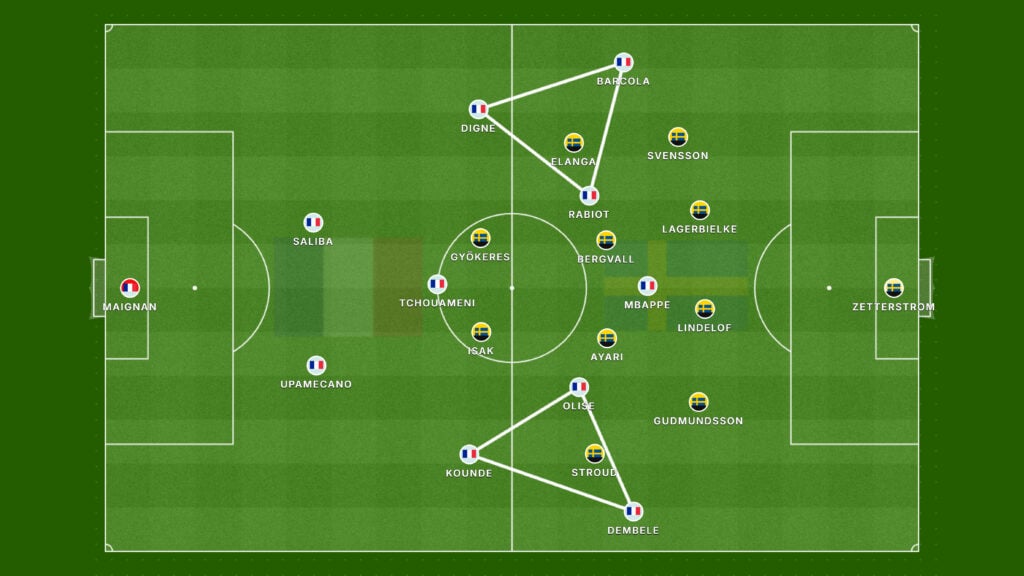
The dynamics of the attacking triangles helps to improve the conditions for the star attackers to accelerate moves.
At any given time, France want to have someone providing width, someone offering an inside passing option and someone below to circulate/protect.
On the left, those rotations between Lucas Digne, Adrien Rabiot and Bradley Barcola create space for Mbappe to spill out to the left and find space.
On the right, the off-ball movement from Jules Kounde allows Olise and Dembele to interchange, combine and find spaces inside or outside the block.
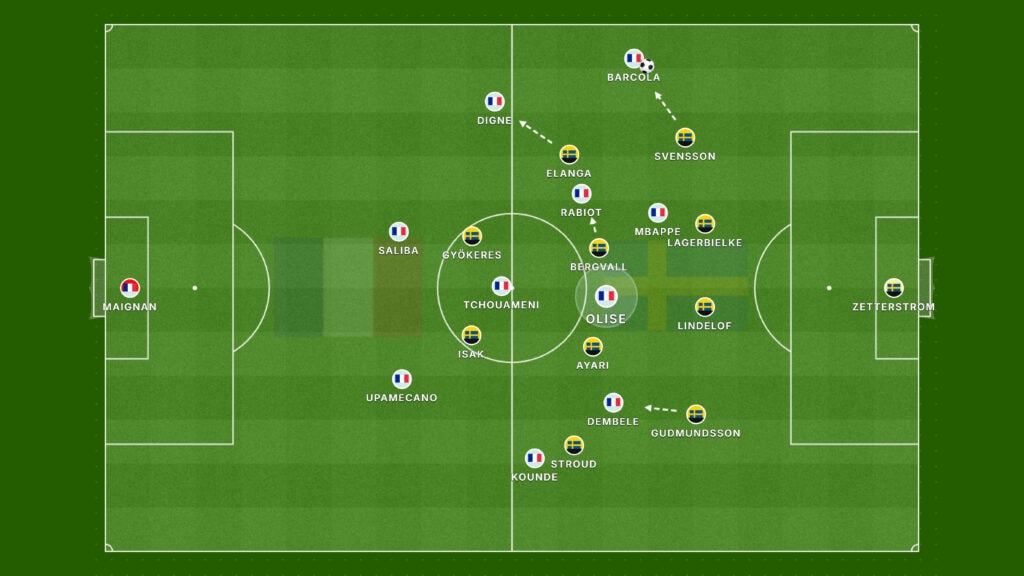
Sweden set up to defend in a 4-4-2, with their defensive and midfield lines close together to restrict spaces between the lines.
It was the movement and runs beyond that opened space for the attackers to carry and combine inside, forcing Swedish midfielders to track runs or pass markers.
While France try to disrupt the opposition block with their movement, there is also a clear emphasis on keeping a strong rest defence behind the ball.
This has been an improvement from earlier in the tournament, with France now looking to ensure someone is beneath in the wide triangles, protecting the half-spaces/wide channels in transition.
SpreadEx Sign-Up Offer:
SpreadEx are offering new customers the chance to get £60 in free bets when they join and place £10 in qualifying bets.
To claim this offer, follow these steps:
- Create your account by clicking this link or the image below.
- Register for your account by adding your details. It only takes a few minutes.
- Make your first deposit then place a £10 single or £10 each-way fixed odds bet at minimum odds of 1/2
- Get 3 x £10 free fixed odds bets, 3 x £5 Total Goals football spread bets and 3 x £5 Winning Favourites spread bets on consecutive days and a £1 racing Race Index spread bet

Spread betting losses can exceed deposit. 18+ www.gambleaware.org. Place a £10 fixed odds single or £10 each-way bet at minimum odds of 1/2 and get 3 x £10 free fixed odds bets, 3 x £5 Total Goals football spread bets and 3 x £5 Winning Favourites spread bets and a £1 racing Race Index spread bet.
Passive defence aids attack
But it isn’t just France’s attacking organisation that makes them so dangerous, as their defensive ideas also open different opportunities.
Deschamps’ side set up in a 4-4-2/4-1-4-1 off the ball, Olise playing as the attacking midfielder will drop to block one of the opposition pivot players.
Rabiot will then jump forward to apply pressure to the other pivot player, while Aurelien Tchouameni screens the back four, often giving France a +1 in their last line.
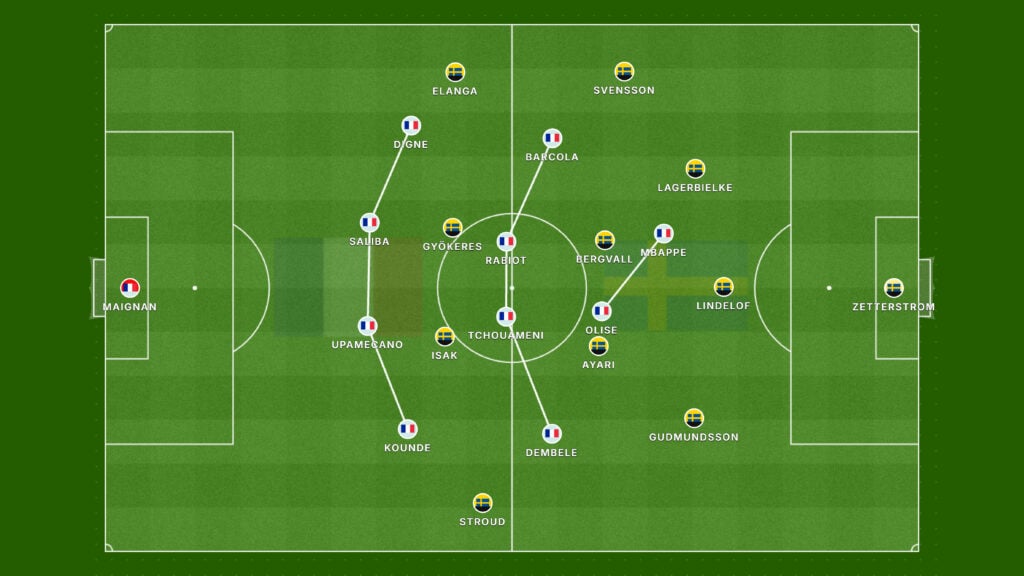
Where France are fairly passive in this shape, it allows the opposition team to build out, but this can leave space elsewhere if possession is lost.
France’s attacking unit has the pace to hurt teams on the break, so by lowering their line of engagement it opens up more space to break into.
This was seen for their second goal, as Sweden attempted to go long committing their front two and Anthony Elanga forwards.
But France winning possession then allowed them to get out into space, with Olise receiving between the lines (larger gaps) and finding Barcola to apply the finish.
Mbappe & Olise show
The France frontline has been purring throughout the tournament, as Deschamps’ side are the highest scorers in the World Cup so far.
But the pairing of Mbappe and Olise are particularly catching fire, as Mbappe now has six goals, while Olise has five assists.
Mbappe’s first goal included a combination between Olise, Dembele and himself to access space inside the Sweden box.
From here, Mbappe was able to face up the Sweden defender, putting him on his heels with a stepover and cutting inside to create the space to get his shot away, finding the far right corner.
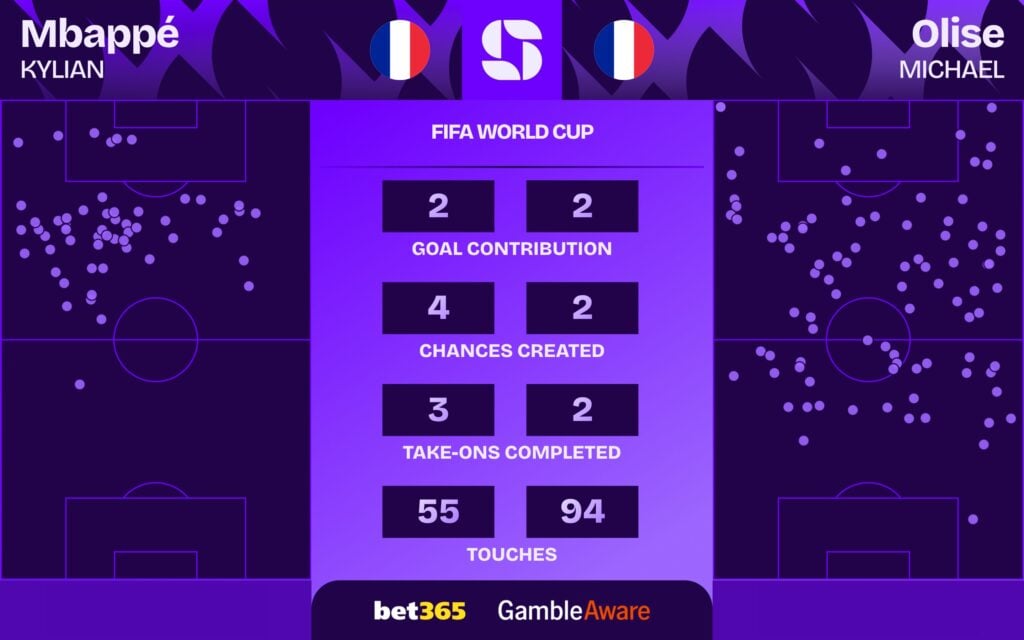
But it was the third France goal that highlighted the connection and qualities of both Mbappe and Olise playing together.
Olise getting on the ball in front of the Sweden midfield line, allowing him to provoke a defensive behaviour by shifting the ball.
This opened the space (although it was still an extremely tight angle) for Olise to execute a through ball for Mbappe arriving behind the defensive line.
Mbappe’s first touch then improved his shooting angle with the outside of his boot, allowing the second touch to be a curled effort into the far corner.
Read more: