






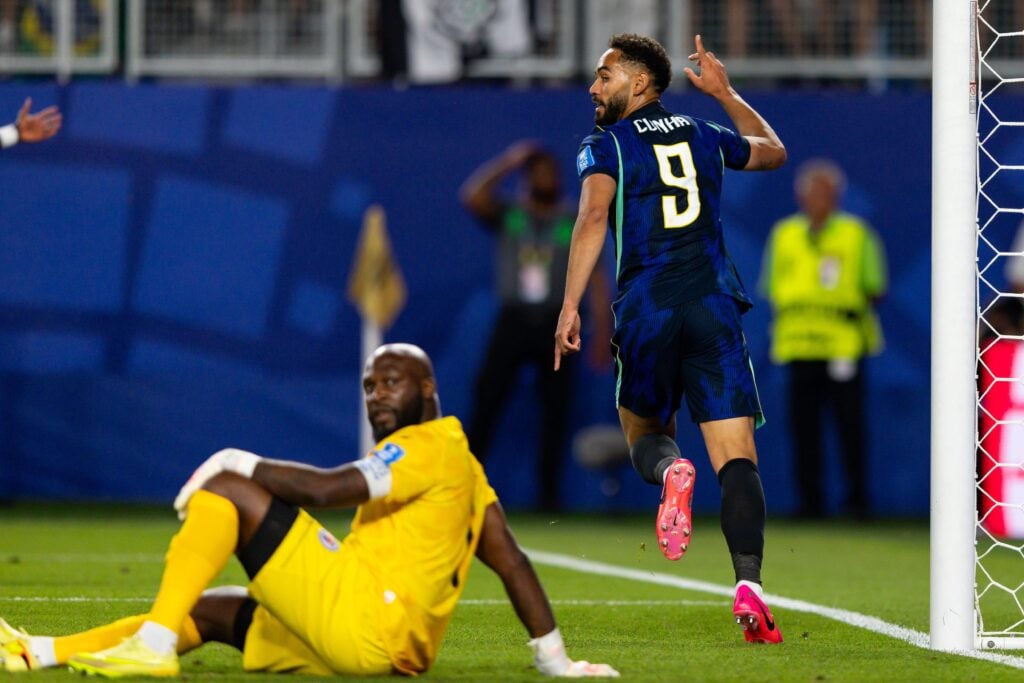
Brazil eased past Haiti to go top of Group C of the 2026 World Cup thanks to a few different defensive variations.
After a poor performance against Morocco in the opening match, the Selecao finally got themselves going.
Haiti played surpsingly well against Scotland despite the loss, so there were questions over how they would fare here. But they were no match for the five-time champions – which actually says more about the Scots than anything else.
And it might come across as a surprise considering the large scoreline. But what led Brazil to their comfortable 3-0 win was actually their out-of-possession work.

- Bet £10 get £40
- Super Fast Withdrawals
- Trusted Brand
#AD 18+. Play Safe. Online only. Ends 31.12.26. New UK customers only, registering with promo code FB40. Make your first deposit of £10+, then place a £10 single bet from main balance at odds of EVS+ (2.00+) on any sports market (excluding Virtuals). Get £40 in Free Bets (4x£10) after settlement. Each £10 Free Bet is valid on any Bet Builder, expires in 7 days, non-withdrawable and must be used in full (£10 each). Deposits via PayPal, Neosurf, Paysafe, Apple Pay, NETELLER, Skrill, ecoPayz, Kalibra/Postpay and WH PLUS Card excluded. One per customer. Full T&Cs apply. https://www.gamcare.org.uk/ . #ad
How did Carlo Ancelotti mastermind Brazil’s win over Haiti?
Defensive variations
Carlo Ancelotti sent Brazil to face Haiti in a 4-3-3. Matheus Cunha replaced Igor Thiago in the starting lineup acting mostly as a false nine, while Vinicius Junior and Raphinha stretched the pitch.
In midfield, Casemiro stayed put centrally with Bruno Guimaraes and Lucas Paqueta just ahead of him.
And though they did defend in a 4-3-3 when sitting deeper, they pressed in different formations. The most efficient one was a 4-1-3-2 that saw Vinicius and Raphinha drift inside to act as two strikers, not having to worry with tracking back on the wings.
Instead, Cunha dropped deep aligning with Guimaraes and Paqueta. It was a narrow zonal look that gave Haiti a false notion of confidence to play down the middle. The Selecao made it seem as though there were passing lanes available only for the midfield trio to step in and recover possession.
This is precisely what led to them scoring their first two goals. But none of it would have happened were it not for two midfielders in particular.
Bruno Guimaraes and Lucas Paqueta’s impact
Matheus Cunha might have won the tackle that led to his first goal, but Bruno Guimaraes did most of the work.
He was responsible for stepping up and coordinating Brazil’s press – a familiar work considering his role at Newcastle United. Guimaraes was the one dictating whether they pressed in a 4-1-3-2, a narrow 4-3-3 or a 4-4-2. He also had the freedom to join the forwards and smother opposing centre-backs.
Lucas Paqueta, meanwhile, had nearly twice as many recoveries (9) as any other player during his time on the pitch. Next closest was his teammate Matheus Cunha with five, while no Haitian had more than four.
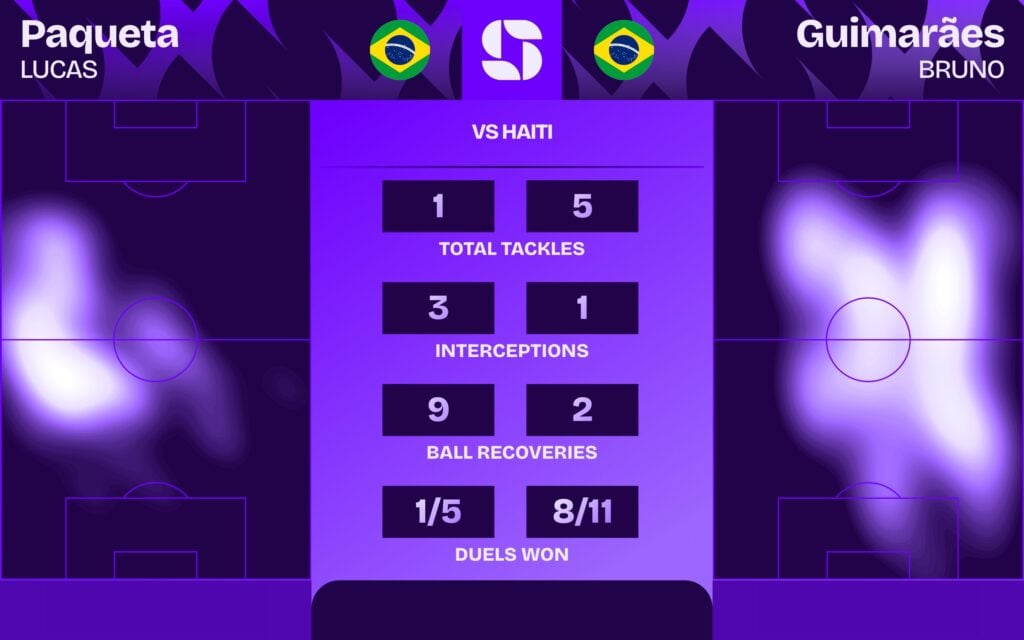
Both have been under heavy criticism for their subpar performances with the Brazilian national team. But both of them have justified Carlo Ancelotti’s choice and insistence on them so far.
Paqueta, in fact, was one of their more lucid creators early on and was crowned with a beautiful assist for Vinicius Junior’s goal. It was a near man of the match performance, were it not for Cunha’s brace.
- Bet £10 get £40
- Super Fast Withdrawals
- Trusted Brand
#AD 18+. Play Safe. Online only. Ends 31.12.26. New UK customers only, registering with promo code FB40. Make your first deposit of £10+, then place a £10 single bet from main balance at odds of EVS+ (2.00+) on any sports market (excluding Virtuals). Get £40 in Free Bets (4x£10) after settlement. Each £10 Free Bet is valid on any Bet Builder, expires in 7 days, non-withdrawable and must be used in full (£10 each). Deposits via PayPal, Neosurf, Paysafe, Apple Pay, NETELLER, Skrill, ecoPayz, Kalibra/Postpay and WH PLUS Card excluded. One per customer. Full T&Cs apply. https://www.gamcare.org.uk/ . #ad
Spot-on game plan
Not only did Ancelotti get things right out of possession, but also with the ball. Brazil were constantly looking for runs in behind from their front-three in the first half, trying to get the most out of Vinicius and Raphinha in particular. Cunha did his thing dropping deep but also got on the end of a few through balls himself.
With a 3-0 lead at the break, however, the Selecao slowed down in the second half – a bit too much in fact, perhaps.
Advanced Opta metrics show they progressed, on average, at a pace of 1.33 metres per second towards goal in the first half. In the second half, this number dropped to 1.10 m/s.
They also went back to playing in closer proximity rather than stretching the pitch both in terms of width and depth.
Of course, the match against Haiti was no real barometer of Brazil’s actual quality. But they beat who was in front of them and did it flawlessly – much thanks to Carlo Ancelotti’s strategies, especially in the first half.
Read more: