




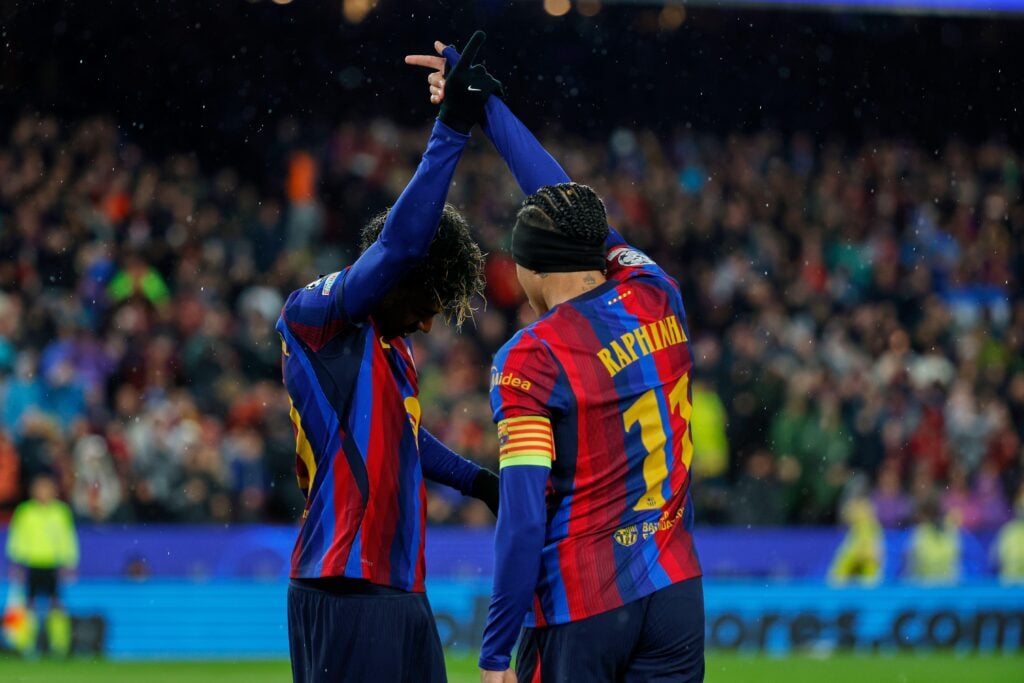
Barcelona beat Aston Villa 3-0 at Camp Nou, inflicting defeat on Unai Emery‘s side for the first time in Europe this season.
Hansi Flick‘s side came out the gates fast, suffocating Aston Villa with their high press and forcing a mistake from Joao Gomes, gifting the ball to Lamine Yamal who finished it calmly to make it 1-0 after seven minutes.
Despite both teams have chances to add to the scoreline in the first half, Barcelona took their 1-0 lead into the break.
But once again, Barcelona were quick out the blocks in the second half, with Raphinha making it 2-0 in the 52nd minute to give his side some breathing room.
Just 12 minutes later, Raphinha added a third to make it 3-0, after a beautiful trivela pass from Joao Cancelo, putting the game to bed and allowing both sides to make a flurry of changes.
In this article, we’ll cover
Barcelona’s suffocating press
Barcelona were looking to suffocate Aston Villa’s build up from the get go, which is exactly what saw Gomes gift the ball to Yamal for the opener.
Anthony Gordon was starting narrow, ready to jump in the press onto Victor Lindelof, while Raphinha arched his run to cut off the pass to Pau Torres and apply pressure to Zion Suzuki.
This left Suzuki with two options, going long into the front four which was matched up against Brian Farinas, Pau Cubarsi, Gerard Martin and Rodri, with Cancelo also adopting more of a half and half position, allowing him to stay lower and give Barcelona a +1 to deal with those long balls if Matty Cash wasn’t accessed via a bounce pass.
Or the second option, play into Gomes who had pressure on his back, who could then look to bounce it into Torres who was the free man.
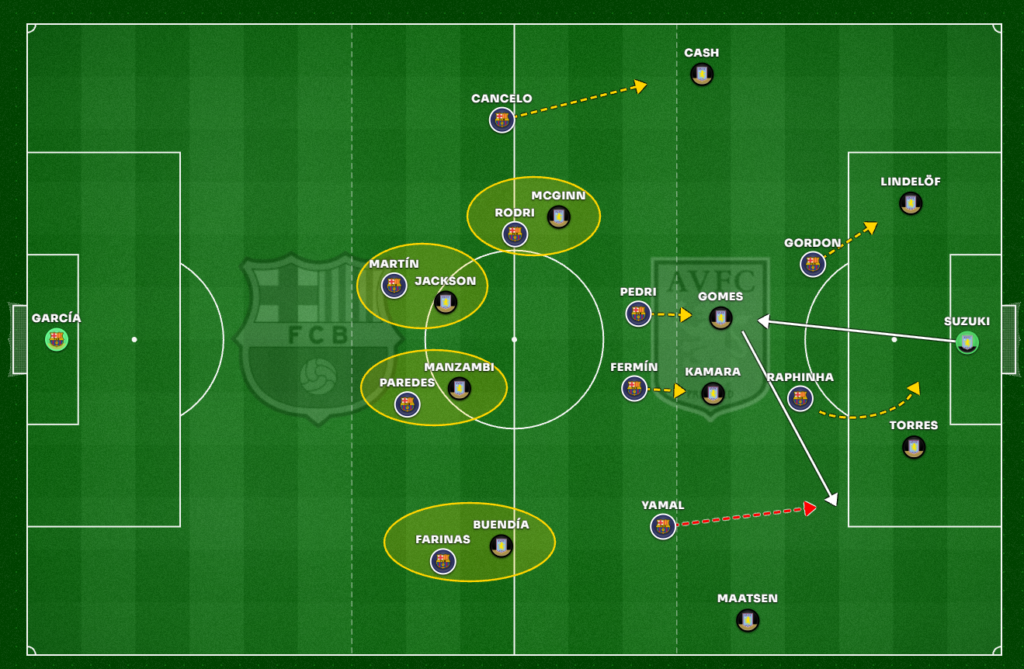
However, Yamal was switched on to the situation, starting to jump towards Torres as soon as the pass was played into Gomes, ready to pounce and cut it out.
Gomes’ pass was poor, as he isn’t expecting Yamal to be jumping towards Torres, meaning Gomes put the ball more into the space in front of the Spaniard, rather than into his feet, but it was that distance which allowed Yamal to pinch the ball.
From there, Yamal composed himself, slowed himself down, before shifting the ball inside and getting his shot off, finding the far left corner and making it 1-0 after just seven minutes.
The Manzambi plan?
Aston Villa clearly came into the game with a plan, knowing Barcelona would press aggressively, play with their highline and look to control the game.
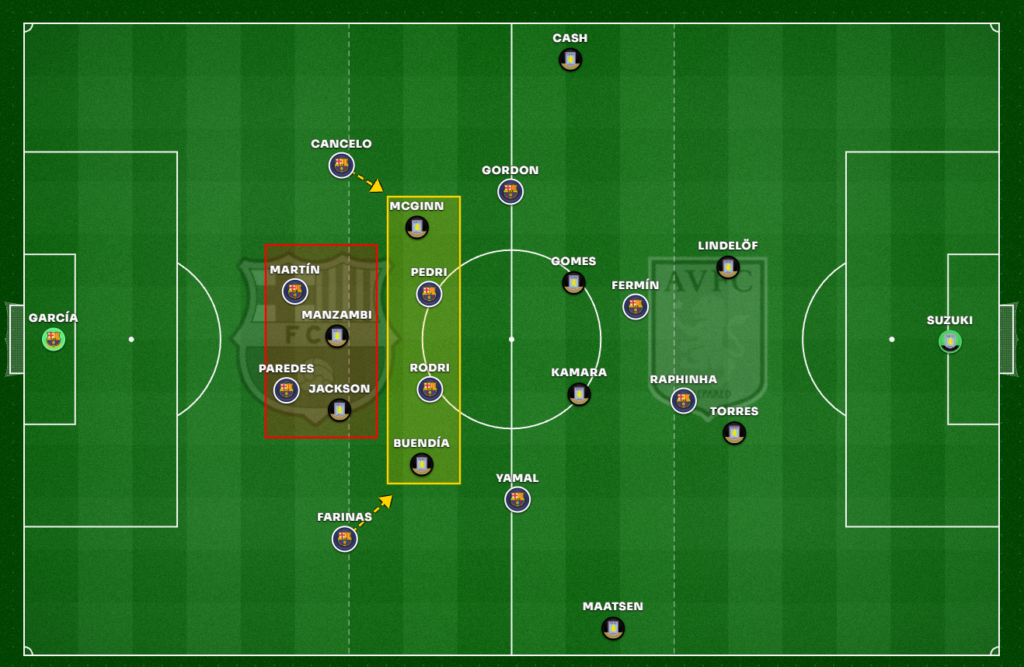
When Aston Villa managed to get moments of settled possession, they were looking to create tensions with the positioning of the front four.
Both John McGinn and Emiliano Buendia would drift narrow, creating tensions for both Pedri and Rodri and Cancelo and Farinas.
This allowed Johan Manzambi to start behind Barcelona’s midfield line, often creating 2v2s with Jackson against the Barcelona centre-backs.
Jackson and Manzambi could then make runs into the channels behind the Barcelona full-backs who were being dragged out by the narrow Villa wide men, or they could drop to overload the midfield two, before McGinn and Buendia looked to make their run beyond instead.
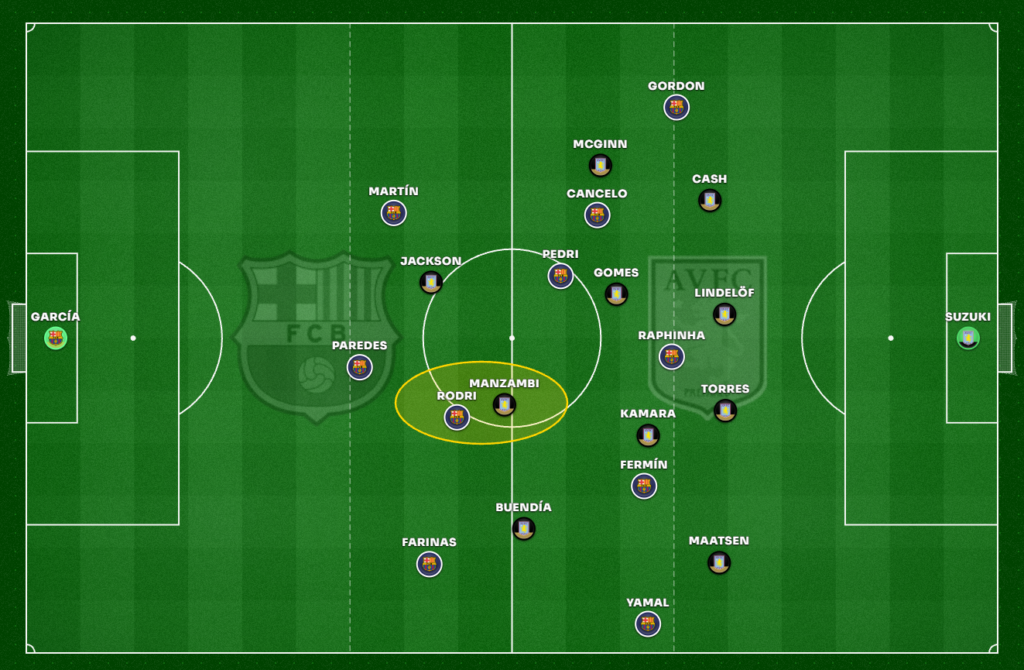
The plan with Manzambi off the ball was interesting though, as the Switzerland international was given the main reference of marking Rodri.
While it wasn’t touch tight man-marking, Manzambi often followed the movements of Rodri, staying in his vicinity and looking to stop him easily receiving the ball in front of the Aston Villa midfield line.
Then, once the ball was turned over, Manzambi would be able to drift away from Rodri to receive in space, making runs off of the Spanish midfielder and looking to threaten in transition.
On another day, with better decision making and quality in the final third, Aston Villa could have profited from their approach, grabbing a couple of goals and making the game interesting.
Villa’s left-side struggles
Barcelona found most of their joy coming down their right side, which is of no surprise with Yamal operating down that flank.
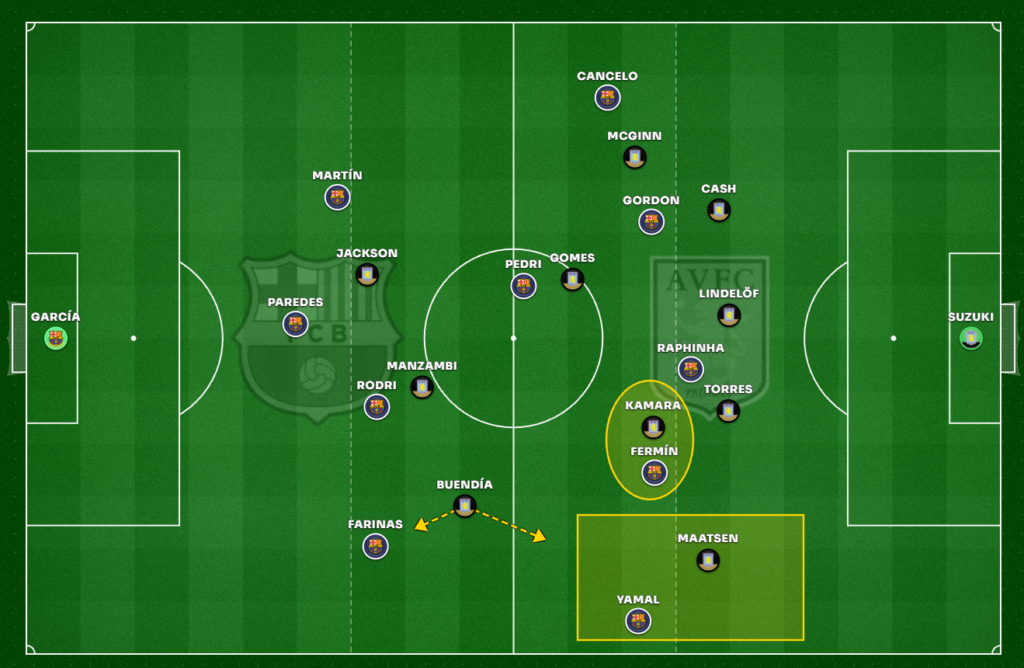
Barcelona had Farinas operating in a right-back position, starting with a lower start position to try and drag Buendia away from Yamal, who was looking to isolate Ian Maatsen 1v1.
Fermin Lopez’s movement kept Boubacar Kamara pinned inside, as his job was to protect the space behind Maatsen incase Lopez made an underlapping run between Torres and Maatsen.
This often allowed Yamal to receive the ball in an initial 1v1 against Maatsen, with Buendia having to work extremely hard to recover and double up.
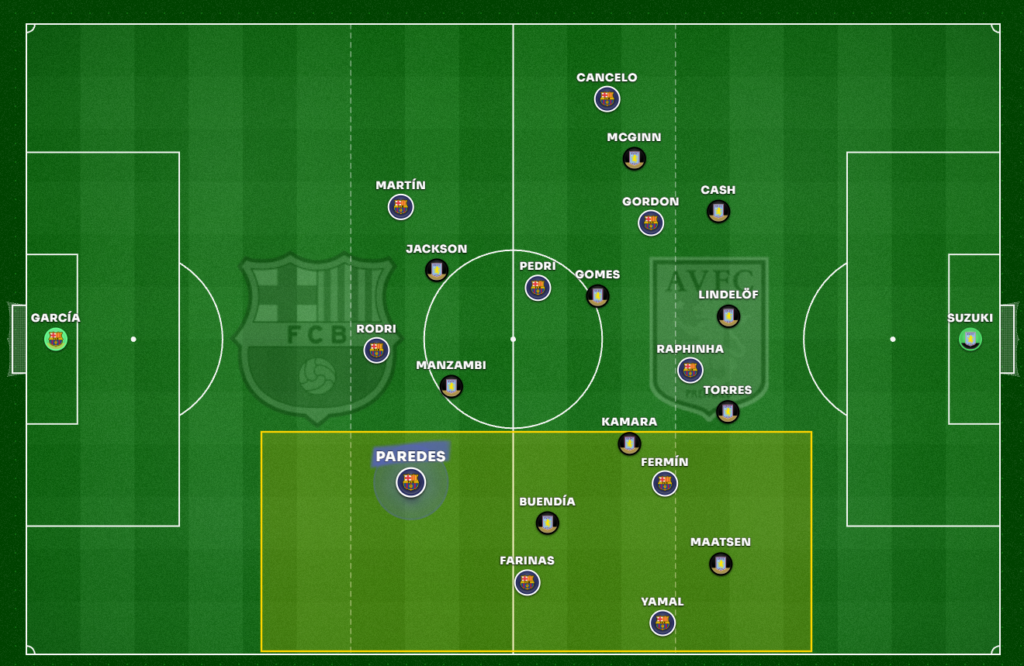
To make matters even worse, with Manzambi tasked with marking Rodri, the Spanish midfielder would often drop into the last line to create a 3v2 against Aston Villa’s front two, which with Jackson more towards the right, often left Cubarsi as the free man.
Cubarsi was then able to carry the ball forwards down the right, creating a 4v3 overload, which Barcelona took advantage of by feeding Yamal in isolations as often as possible and the movement of Lopez to attack space behind Maatsen when possible.
Barcelona quality prevails
The main quality in the game came from the Barcelona players, especially in the opening 25 minutes of the second half, where Raphinha’s brace put the game to bed.
For the second goal, Aston Villa were well set to defend the centre with their back four and midfield two in front of them.
But it was the carry from Lopez and a dropping movement from Gordon which provoked an opening in the block, with Lindelof orienting himself forward slightly to cover Gordon’s move inside and Gomes moving towards the ball in an attempt to challenge Lopez.
This opened up the pass from Lopez into Raphinha, checking his run and taking a little backwards step to open the route between Torres and Maatsen, which he took under control, shifted inside and got his shot away, forcing a block from Torres which deflected past Suzuki between the sticks.
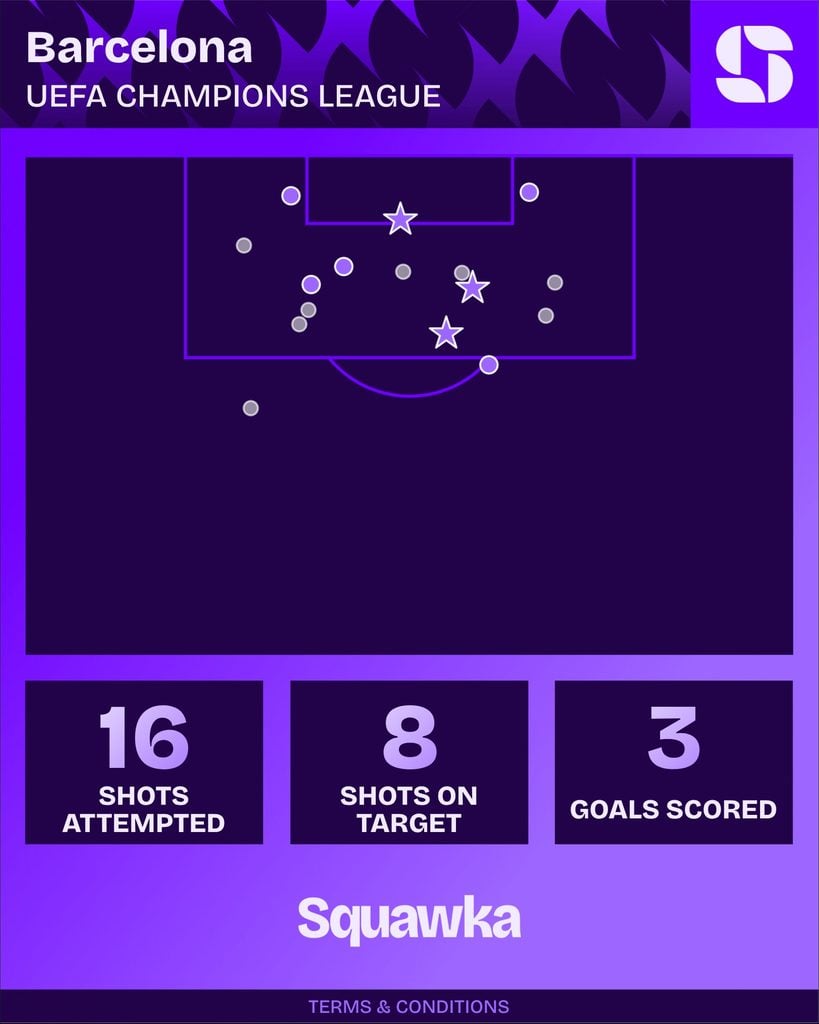
But Barcelona’s third goal was even better, with Cancelo receiving the ball out wide in a 1v1 isolation with McGinn, while Gordon had dragged Cash narrow.
Cancelo showed his technical quality in this passage, firstly bursting past McGinn in the 1v1 and attacking the space, but then providing a sumptuous trivela pass into the path of Raphinha who timed his run brilliantly to arrive and stay onside.
While Aston Villa came with a plan which could’ve proven more productive on another day, it was the quality of Barcelona, especially in that second half, which decided the game.