









Real Madrid made it 10 wins on the spin across all competitions in midweek. They were made to work for victory, however.
Ivan Perisic had fired PSV Eindhoven in front from the penalty spot on the half hour mark. And after going in at the break one-goal down, manager Jose Mourinho made a triple change at the break to swing the tie back into his side’s favour.

Superior distributors Ibrahima Konate and Dean Huijsen replaced Antonio Rudiger and Eder Militao. Jude Bellingham was introduced at the expense of Aurelien Tchouameni. Mourinho switched from a proactive setup to a forward-thinking system. And boy did it work.
In this article, we’ll cover:
Five minutes into the second half, Federico Valverde had fired Real Madrid level. From then, the floodgates opened. Jude Bellingham scored a sumptuous volley, Kylian Mbappe bagged a brace, before Vinicius Junior completed the five-star comeback.
It’s quite the turnaround in fortunes for Los Blancos, who at one stage were tipped to struggle in the La Liga title race. As Barcelona made a seemingly-unstoppable start to the campaign, the 2-1 Madrid Derby defeat to rivals Atletico proved the catalyst to kick off this flying run.
The streak includes a 2-1 Clasico win over Barcelona at Spotify Camp Nou as Real Madrid remain on the Blaugrana’s coattails. And having won all five European matches to date, we run through what Mourinho has changed since taking over as the capital side look back to their swashbuckling best.
Changed the shape
Last season, Real Madrid favoured a 4-4-2 setup, more so under Alvaro Arbeloa. The idea was to have Kylian Mbappe partner Vinicius Junior on the frontline, with the willingness of the duo to pull wide expected to open up space through the middle. However, with little in the way of ammunition for the attacking pair, the duo often cast frustrated figures in front of goal.
Mourinho, though, has reverted to his favoured 4-2-3-1 system. There is a foundation to protect the Real Madrid defenders, thus allowing the attacking stars greater freedom to wreak havoc in the final third.
As such, Real Madrid are able to commit more men forward once they do win the ball. In the process, this presents the Spanish giants with more opportunities to create overloads in key areas. An additional player in the middle of the park means Real Madrid aren’t so frequently overrun by opponents.
Pushed Jude Bellingham further forward
One of the main beneficiaries of the move to a 4-2-3-1 system is Jude Bellingham. The England star endured an indifferent 2025/26 campaign having been forced to play out wide on occasion. Mourinho, though, has pushed Bellingham into a more advanced number 10 role, and asked that he remain closer to leading striker Kylian Mbappe. To say it’s having the desired effect would be a huge understatement.
Bellingham has eight direct goal involvements in Spain’s top tier this term, having managed 10 in the entirety of the 2025/26 season. When asked the reason behind his exceptional showings thus far, the 23-year-old simply replied: “Mourinho. Full stop.”
Shots per 90 minutes have risen slightly from 2.4 to 2.6, but the big difference is the number of shots inside the penalty area per 90. This has increased from 1.2 to 2.1. Touches per 90 have dropped from 76.2 to 66.5, as have passes per 90 (55.2 to 43.3). However, that’s because Mourinho wants Bellingham less involved in the builup, and to affect games in attack.
Chances per 90 have increased from 1.7 to 2.1. Completed take-ons per 90 have gone from 1.7 to 2.8. Touches in the opposition box have seen a hefty increase from 5 to 6.4. Bellingham has continued his World Cup form, with Mourinho’s impact on the setup playing a key role.
Bernardo Silva’s influence
Bernardo Silva was one of a number of new arrivals at the Bernabeu over the summer. The Portuguese star was perhaps the one that attracted minimal fanfare as Silva swapped Manchester for Madrid.
And in the early weeks of the season, Mourinho routinely overlooked Silva. Indeed, four of his opening seven league outings were from the bench. However, he’s started Real Madrid’s last four La Liga matches, beginning from the 2-1 win at Barcelona.
The Portugal international’s press resistance enables Real Madrid to have greater control in matches. They’re able to retain the ball better and dictate the tempo far more regularly. What’s more, he provides the ideal link between the two banks of midfield, offering an outlet from deep, or greater thrust in the middle of the park. He’s playing an unheralded role in this Real Madrid side.
Shifted focus to the flanks
One key criticism of Real Madrid last season was that they routinely shuttled attacks through the middle. In a congested area of the pitch, they struggled to carve teams open. If opponents sat deep, then they were left frustrated in their efforts to secure victory on more than one occasion.
This season, however, Mourinho has instead shifted focus to the flanks. 28% of Real Madrid’s attacks came through the middle of the pitch in the 2025/26 La Liga campaign. That figure has dropped to 24%.
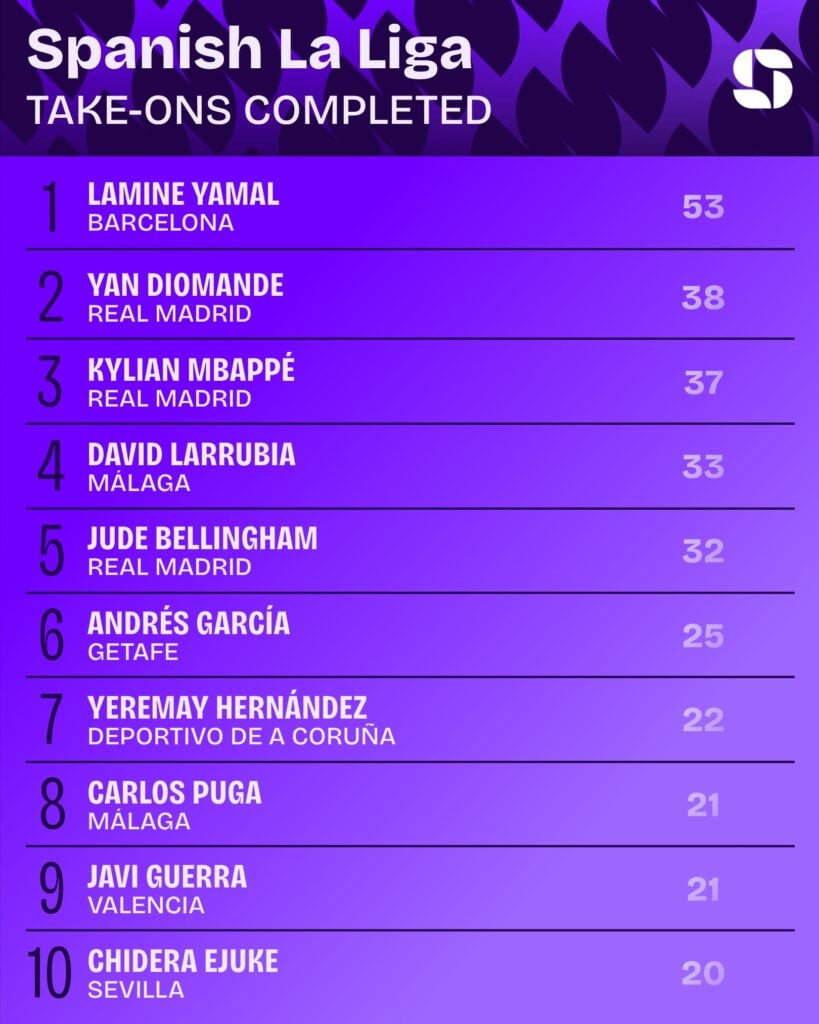
Mourinho has opted to use Arda Guler from the right flank, with Federico Valverde at right-back. Both are just as capable of coming inside as they are bursting down the flanks. On the left, wing-wizard Yan Diomande has usurped Vinicius Junior as first choice. The Ivorian has taken on the wing responsibilities superbly. 4.3 completed take-ons per 90 is the most for Real Madrid. Only Lamine Yamal (53) ranks higher for this metric than Diomande (38).
As a whole, Real Madrid are now averaging 12.3 completed take-ons per 90 this season, a rise on 10.3 last season. Mourinho wants his wide players to take markers on to help stretch the pitch. They are doing so superbly, opening up more channels with which to put teams to the sword.
Greater emphasis on quick transitions
The increase of completed take-ons has naturally presented Real Madrid with a greater emphasis on quick transitions. Possession has dropped from 59.4% to 53.8% as Mourinho’s side move the ball upfield at speed.
As a result, they have scored four counter-attacking goals already having managed eight in the entirety of the 2025/26 campaign. In addition, shots per 90 following counter-attacks have gone from 1.21 to 2. They may not have the same level of control as they did last season, but they are far more effective when they break forward.