






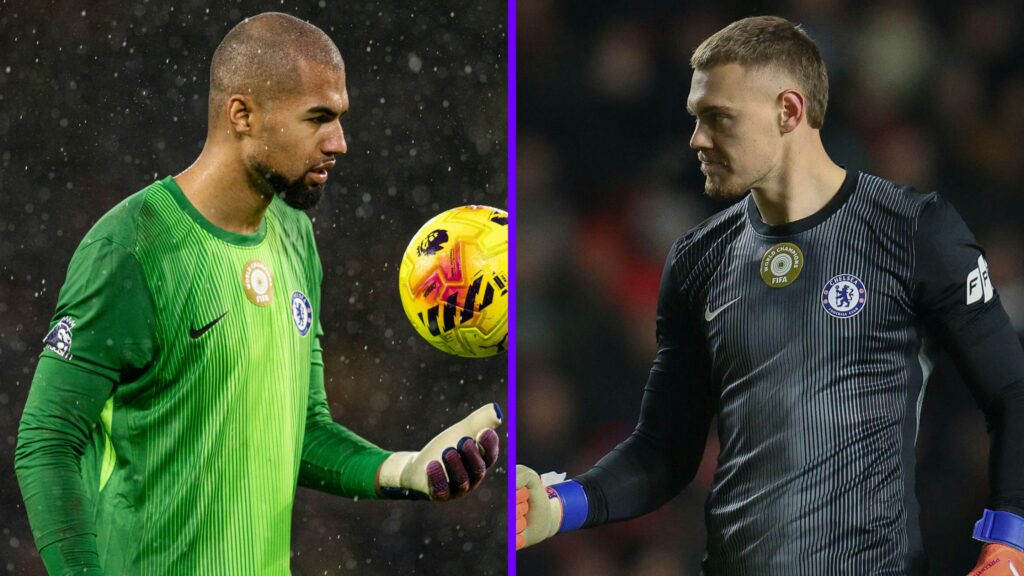
Chelsea have a goalkeeping dilemma on their hands.
That’s a statement that would have been true in a number of recent seasons. The Blues looked to have steadied the ship slightly this season, though.
Robert Sanchez became a goalkeeper Chelsea fans could rely on, and has been one of the Blues’ best players. But a bad game against Arsenal recently saw Liam Rosenior bring in Filip Jorgensen.
The Dane came under a lot of fire from fans for his performance in Chelsea’s 5-2 defeat to Paris Saint-Germain in the Champions League. Chelsea are on the brink of an exit, and many fans have pointed the finger at Jorgensen.
Many Chelsea fans are now demanding for Sanchez to be recalled ahead of the Premier League clash with Newcastle United this weekend. But no one can really tell what Rosenior will do.
The question is, what should he do?
Robert Sanchez vs Filip Jorgensen
Passing
The main reason for Jorgensen starting over Sanchez was his ability on the ball. Rosenior believed that Jorgensen brought a calmness on the ball that Chelsea hadn’t previously had. That wasn’t the case against PSG, but there is some evidence in the numbers.
Across the Premier League and Champions League, Sanchez has averaged 49.7 touches per 90 minutes. He’s slightly more involved than Jorgensen, who has averaged 45.46 touches per 90 across his six games in the league and Europe.
Sanchez has also attempted more passes per 90 at 39.5 to Jorgensen’s 38.47. That’s not much of a difference. And the real difference does come in the passes completed. Jorgensen has completed 30.74 passes per 90, with 79.9% success rate. Sanchez, meanwhile, has completed 69.67% of his total passes — averaging 27.52 per 90.
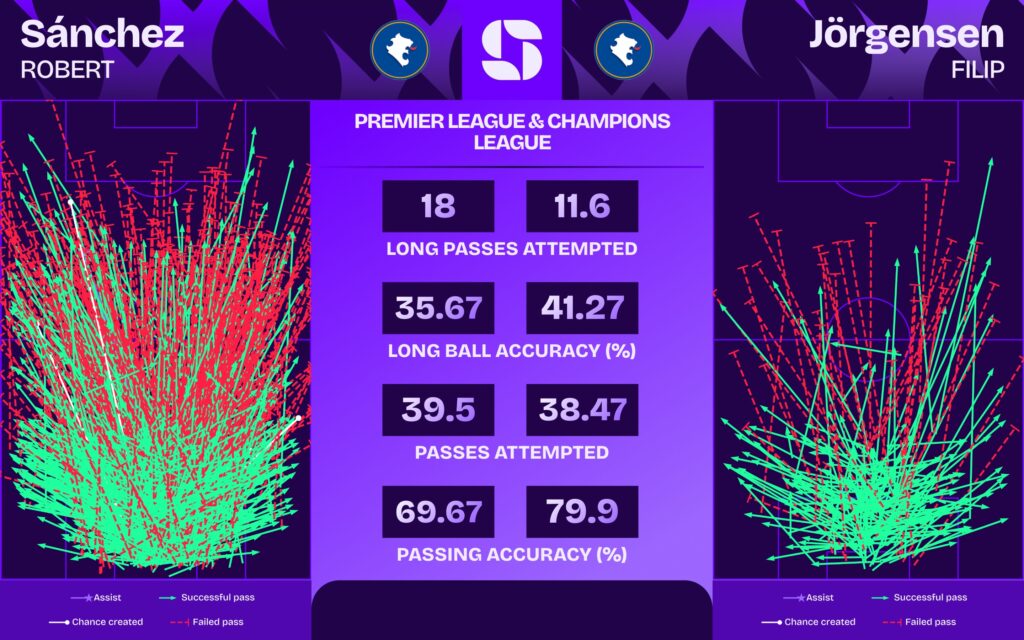
One of the main differences behind the passing accuracy will be the type of passes attempted. Sanchez has averaged 18 long passes per 90 compared to 11.6 from Jorgensen. Long passes are less likely to be accurate, especially when done to relieve pressure. But they also aren’t something dirty that should be avoided. Sanchez has started moves for goals with long balls, including one against PSG in the Club World Cup last summer. He’s even got an assist in the Premier League.
Sanchez has completed 6.42 long passes per 90, with Jorgensen completing 4.79. So Jorgensen does have better success at long passes, but there’s not too much difference at 41.27% to Sanchez’s 35.67%. Jorgensen has also been dispossessed, while Sanchez hasn’t.
Tote sign-up offer: Bet £10, get £30 in free bets
Not signed up to Tote yet? Here's how eligible readers* can take advantage of their welcome offer:
- Open an account at Tote using this link.
- Use code B10G40 on registration.
- Deposit and place a £10 bet on sports or racing at 1/1 or greater.
- When it settles, unlock £30 in free bets

#AD 18+ New customers online only. Eligibility restrictions apply. Bet min of £/€10 at odds of 1/1 (2.0) or greater across sports or racing (if EW then min £/€10 Win + £/€10 Place) within 7 days of registration. Receive £/€20 Tote Credit and £/€10 Free Sports Bet. Qualifying bet is the first racing pool or sports bet added to the bet slip. 7-day expiry. Full T&Cs apply. Gambleaware.org.
Shot-stopping
What of the actual job of a goalkeeper? Preventing your team from conceding.
Jorgensen is yet to keep a clean sheet in his six games in the Premier League and Champions League. He did help shut out Pafos in the group stage, but him and Sanchez played a half each – so neither would get credited with the clean sheet. Sanchez, meanwhile, has averaged 0.34 clean sheets per 90 in the league and Champions League.
Jorgensen has also conceded goals more frequently than Sanchez, at 1.84 per 90 to the Spaniard’s 1.2 per 90. And he’s made an error leading to a goal, while Sanchez has only made an error leading to a shot.
Sanchez is the all-round better shot-stopper, by some distance too. He has saved 67.44% of the shots he has faced in the Premier League and Champions League this season, averaging 2.67 saves per 90. Jorgensen, meanwhile, has averaged 1.66 saves per 90 with a save percentage of 47.37%. Those aren’t numbers you want to see when you’re trying to win trophies.
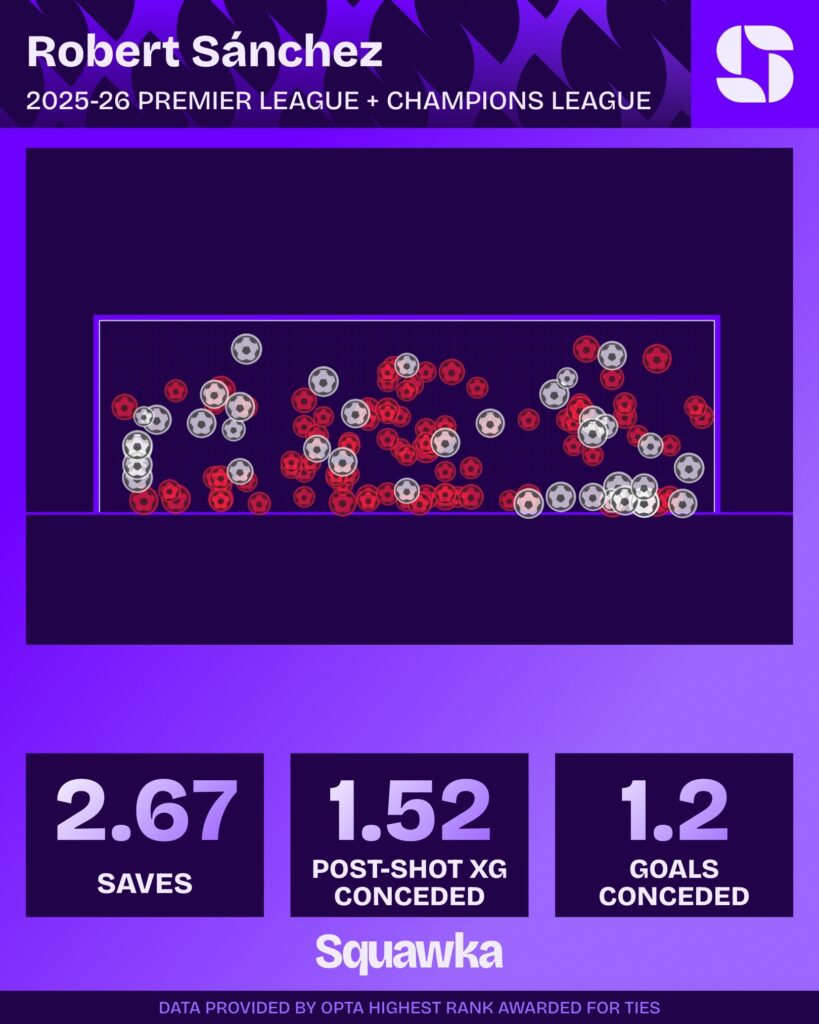
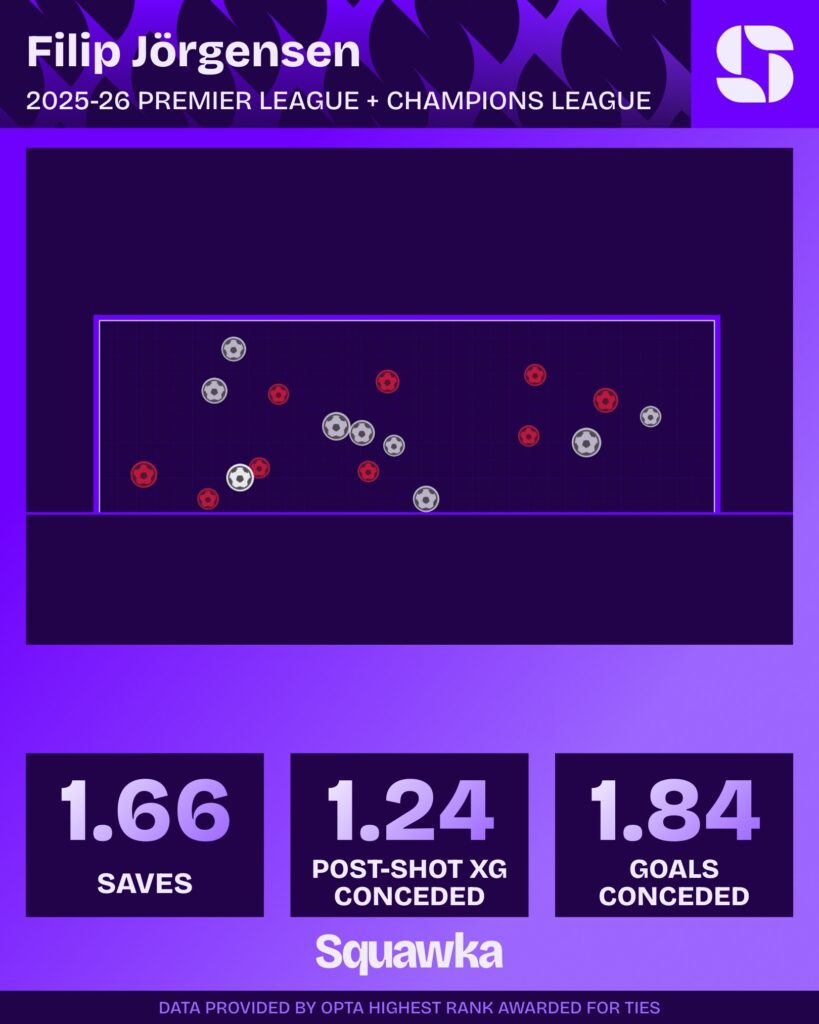
Another big difference comes in goals prevented. Sanchez has conceded 1.2 goals per 90 from 1.52 post-shot Expected Goals conceded. So he’s prevented 0.32 goals per 90. Jorgensen has conceded his 1.84 goals from 1.24 post-shot xGC. That’s -0.6 goals prevented. In short, he’s conceded more goals than he should have.
For some added context, only four goalkeepers with at least five games played in the Premier League and/or Champions League have a worse difference between goals conceded and post-shot xGC.
Box presence
Stopping goals isn’t just about saves. It’s also about prevented crosses and generally marshalling your area. Some goalkeepers stop opposition attacks on their commanding of their own box alone. A strong box presence can make the difference to a defence too.
Sanchez has averaged 1.14 crosses caught per 90 in the Premier League and Champions League this season. By comparison, Jorgensen has caught 0.55. Now, that doesn’t mean that Sanchez is simply better at catching crosses. There are many variables including opposition tactics and game states. But Chelsea fans will be encouraged in knowing they can rely on Sanchez to deal with crosses.
Things are a lot closer with punched clearances. Although Sanchez holds a slender lead, it is only at 0.22 per 90 to Jorgensen’s 0.18. We seem to go through phases of punched clearances being popular, regardless of fans’ feelings about them. It can be frustrating to see a goalkeeper punch a cross away when they could have caught it. Nonetheless, it’s good to know there is a realibility there.
There are other metrics and general ideas that managers like Rosenior will be taking into account when choosing a first-choice goalkeeper. But based on what we’ve seen, it’s hard to say that Jorgensen’s passing justifies the bigger drop in goal prevention in picking him over Sanchez.