






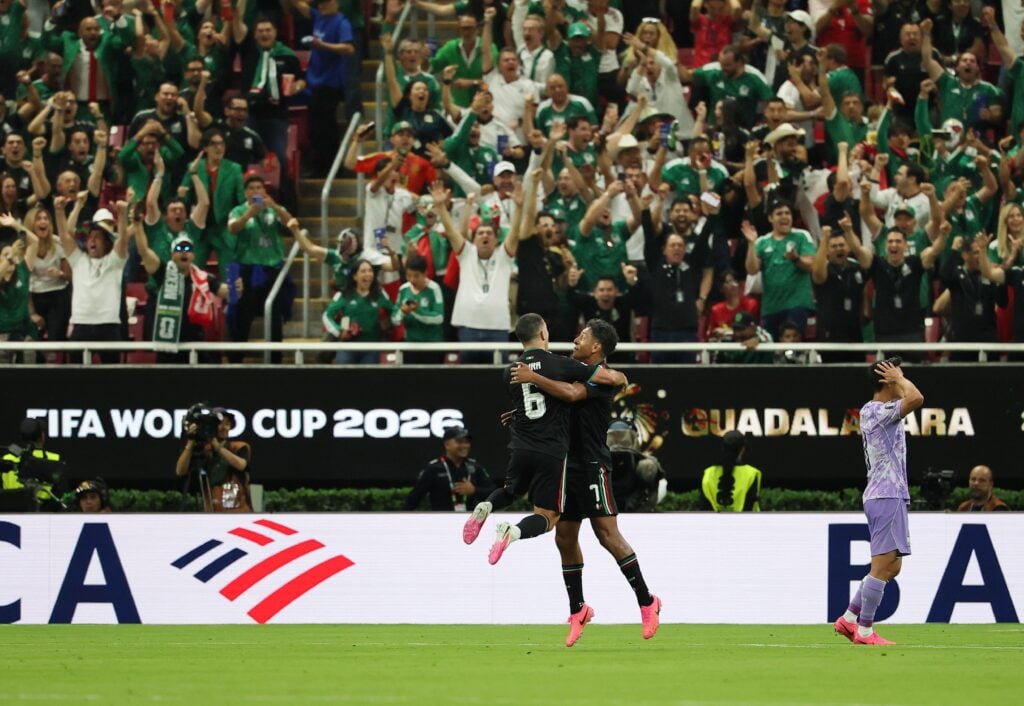
Mexico became the first team to qualify for the World Cup knockout phase, beating South Korea 1-0 and securing top spot in Group A.
It was a cagey first half from both sides, with Mexico controlling proceedings for the opening 30 minutes before South Korea had a stint of their own to end the half.
Both sides took just five shots between them in the first half, creating zero big chances and only generating 0.22 expected goals.
In the second half, Mexico started fast, grabbing a goal after a South Korea error, as Luis Romo was alive to the situation to stab it home, scoring in his home stadium at club level.
Despite South Korea dominating more of the ball from then on, they rarely managed to trouble Mexico, barring a few big chances from crosses into the box in the final minutes of the game.
In this article, we’ll cover
Mexico’s positional rotations
Mexico were the side that took early control in the game, looking to manipulate South Korea’s 5-2-3 shape and create the +1 in their build up.
Javier Aguirre set his side up in a 4-3-3 on paper, but Mexico looked to shift into more of a 4-2-4 in the first phase of build up, before shifting into a 3-2-5 further forwards.
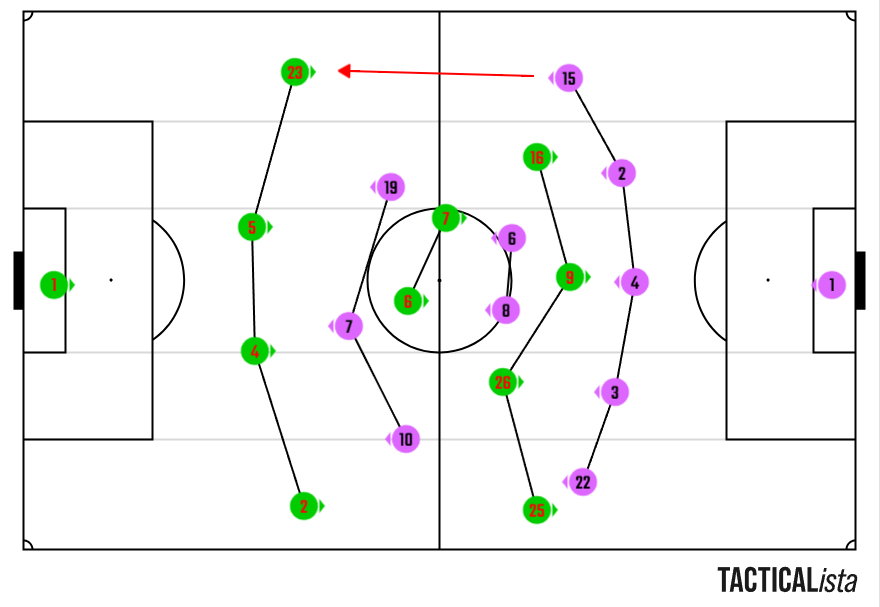
They were then able to use these positional rotations to manipulate the South Korea defensive unit, extending their pressing distances and allowing them to take more control in the game.
Jesus Gallardo, Luis Romo and Julian Quinones were key to this as that left-sided trio, as initially Gallardo would stay in a nominal right-back position, extending the distance for Kim Moon-hwan who had to jump from wingback to apply pressure to the Mexican full-back.
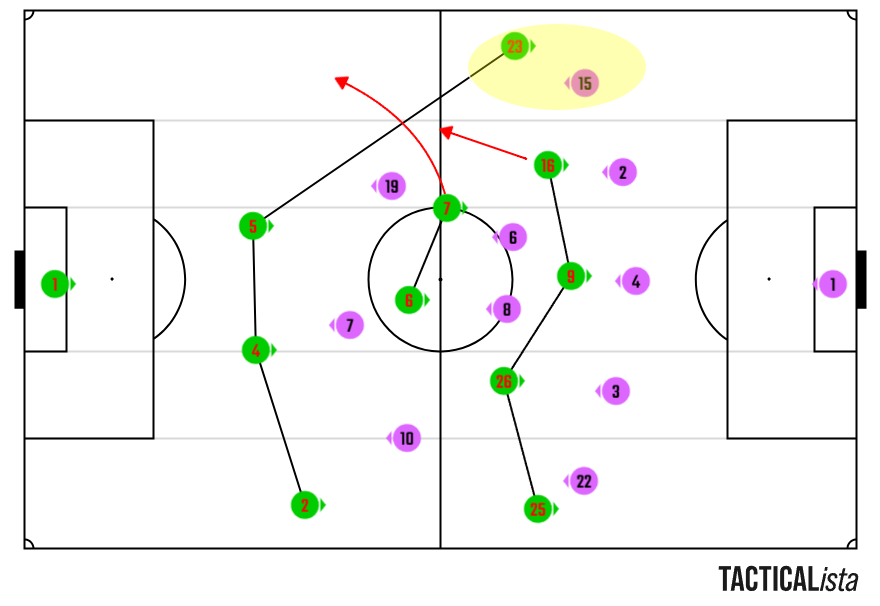
Gallardo could then move up on the right to provide width further forward, pinning Moon-hwan deeper and opening up space behind/beside Kang-In Lee.
Mexico looked to exploit this space by either rotating Romo into this space, testing Hwang In-beom and extending his distance to jump out to him, or by having Quinones drop in, testing Han-Beom Lee by extending his distance to follow.
If they didn’t follow their men, Mexico had an easy +1 in the build up phase, which helped their early control in the game, on the occasions they did jump fully, Mexico then had chances to progress play and access the space behind the jump.
SpreadEx Sign-Up Offer:
SpreadEx are offering new customers the chance to get £60 in free bets when they join and place £10 in qualifying bets.
To claim this offer, follow these steps:
- Create your account by clicking this link or the image below.
- Register for your account by adding your details. It only takes a few minutes.
- Make your first deposit then place a £10 single or £10 each-way fixed odds bet at minimum odds of 1/2
- Get 3 x £10 free fixed odds bets, 3 x £5 Total Goals football spread bets and 3 x £5 Winning Favourites spread bets on consecutive days and a £1 racing Race Index spread bet

Spread betting losses can exceed deposit. 18+ www.gambleaware.org. Place a £10 fixed odds single or £10 each-way bet at minimum odds of 1/2 and get 3 x £10 free fixed odds bets, 3 x £5 Total Goals football spread bets and 3 x £5 Winning Favourites spread bets and a £1 racing Race Index spread bet.
A couple of high lines
Both South Korea and Mexico utilised different variations of a five at the back shape off the ball, with South Korea in their 5-2-3, while Mexico were collapsing from their 4-3-3 into a 5-4-1.
Mexico had Roberto Alvarado dropping in at right wing-back off the ball, allowing Jorge Sanchez to shift across to right centre-back, allowing them to match up against South Korea’s front five on the ball.
But the similarities within both sides defensive schemes was their last line, with both sides utilising an active defensive line, stepping up to close the gaps behind the midfield, leaving space in behind instead.
Sanchez was often aggressively following Jae-sung Lee, who was operating in the left half space, often dropping off to try and link play with South Korea’s midfield two.
South Korea had similar principles in their defensive block, with both wide centre-backs following their counterpart (Quinones and Brian Gutierrez) when they dropped from high to low, not allowing them to access space between the lines.
South Korea’s bait plan
Mexico made it difficult for South Korea to play the way they wanted, as their group of technical players look to connect passes, attract pressure and then play through.
This was still evidently the plan against Mexico, with South Korea completing 299 passes inside their own half in their 3-2 base, looking to lure the midfield four forwards to create more space between their midfield and defensive lines.
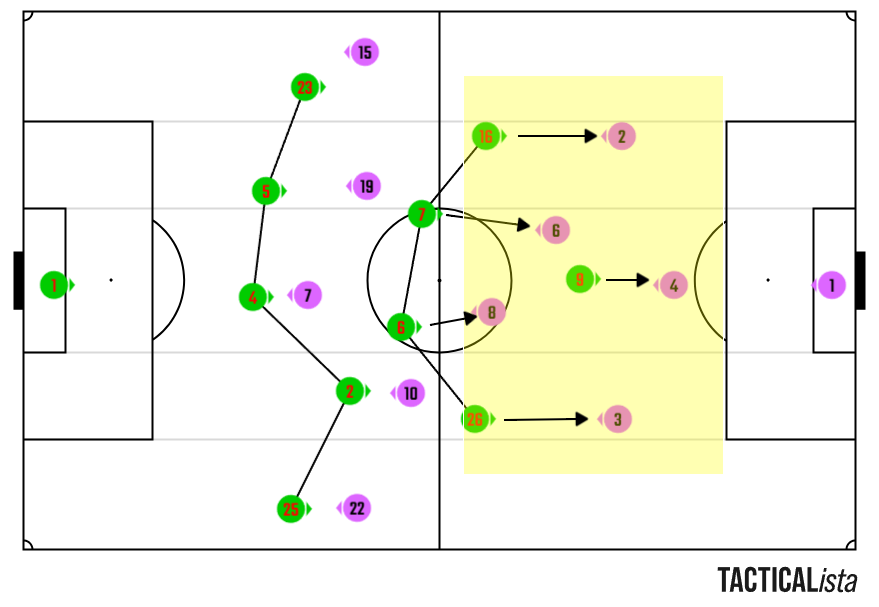
Where they often ended up in trouble though, was with how aggressive Mexico were being to squeeze the space behind the midfield line, even when they did step up, making it harder to access the space even if they did bait the midfield line forwards.
This forced South Korea to play it long more often than they would’ve liked, trying to access that space behind the stepping defensive line.
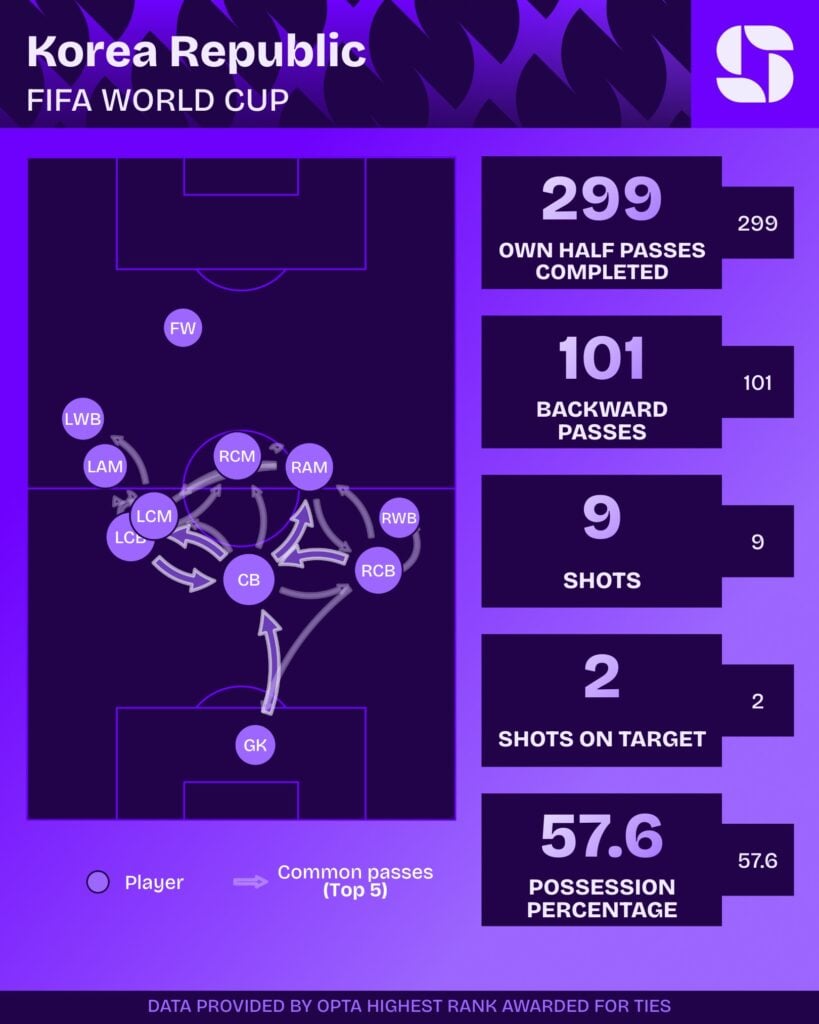
South Korea showed moments of trying to play backwards (regress) to play forwards (progress), making 101 backwards passes in the match.
While this did lead to a few occasions where South Korea could find a spare man between the lines and access that space, Mexico were quick to react, either swarming the ball with their midfield line retreating or making a foul to reset play.
A tale of two keepers
The only goal in the game came from a goalkeeping error, as South Korea’s Kim Seung-gyu came rushing out to claim a failed clearance.
Seung-gyu went to claim the ball while hanging over Gi-Hyuk Lee who stood his ground underneath the ball, causing a collision between the pair which saw Seung-gyu drop the ball into the path of Romo.
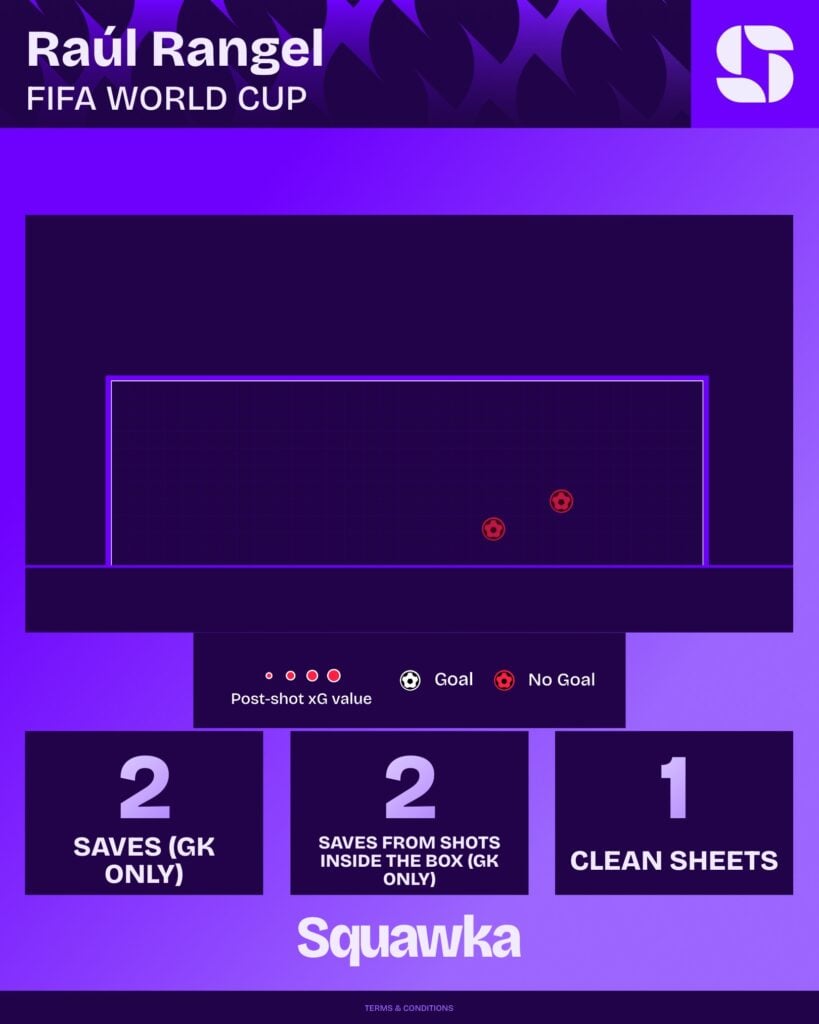
At the other end, Raul Rangel hadn’t been tested throughout the game, not facing a single shot on target until the 87th minute of the game.
However, Rangel was still alive when the situation came, saving a headed effort from Gue-sung Cho from point blank range, then also reacting quickly to sit up and save the second effort, making a double save to secure all three points.
Read more: