




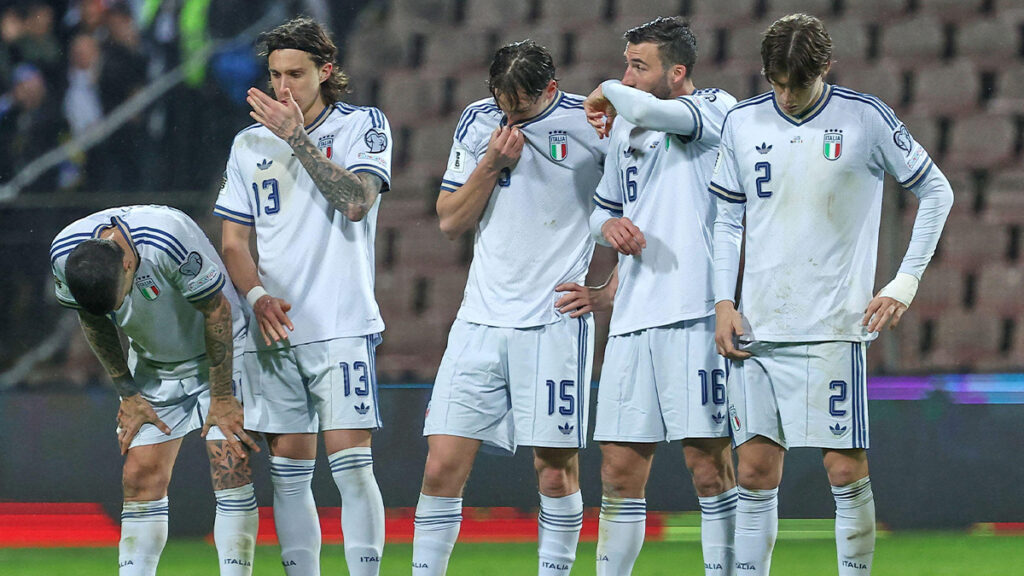
Italy are four-time world champions.
They’ve lifted the World Cup in 1934, 1938, 1982 and 2006. But the 2026 World Cup will be the third successive tournament that the Azzurri have missed out on.
It comes after back-to-back group-stage exits in 2010 and 2014. A fall from grace following the triumph of 2006. Even with the success at Euro 2021.
But why are they not at the 2026 World Cup?
Why aren’t Italy at the 2026 World Cup?
Unfortunate luck
At surface level, it cannot be overlooked that Italy did just get a bit unlucky with their qualifying draw. They were top seeds for their qualifying group, and were placed alongside Norway, Israel, Estonia and Moldova.
Despite the number of World Cup participants increasing to 48, Europe’s involvement only went from 13 teams to 16. So there were only three extra spots to fight for, and just one of those was added as a possibility for non-group winners.
Italy won six of their eight group games. They were unfortunately up against a Norway side finally clicking with all their star players. Erling Haaland was the top scorer of Uefa World Cup qualifying with 16 goals. He outscored 18 nations to have played eight matches. Martin Odegaard led qualifying with his seven assists in just five games, creating 25 chances.
Italy’s two defeats came to Norway, the difference in the group. And the manner of the defeats were a bit worrying for the Azzurri.
Problems at the back
Italy didn’t just lose home and away to Norway. They were battered. The Azzurri lost 3-0 in Oslo and 4-1 at the San Siro. The two defeats summed up one of Italy’s biggest problems — their defence.
When you think of Italy, and Italian football, you often think of defending. Paolo Maldini, Franco Baresi, Alessandro Nesta, Leonardo Bonucci, Giorgio Chiellini, Fabio Cannavaro. Gianluigi Buffon as one of the best goalkeepers ever.
But Italy conceded 12 goals in their eight World Cup qualifying group games. Sure, seven of those came against Norway, but Italy also conceded four in one game to Israel. Two of those were own goals, too. And there was a 13th goal conceded in qualifying, to Bosnia-Herzegovina in that crucial final defeat. That’s all despite keeping five clean sheets.
As a team, Italy made seven errors leading to shots in World Cup qualifying — with two leading to goals. That places them among the likes of Armenia and Estonia (both seven), Georgia and Lithuania (both six) and Cyprus and Greece (both eight). For more context, France and Spain only made one error leading to a shot or goal, and England and Germany made two each.
You have to look at the goalkeeping too. Italy’s 13 goals conceded across their 10 qualifying matches (including the play-offs) came from 12.25 Expected Goals Against. So they underperformed, albeit only slightly.
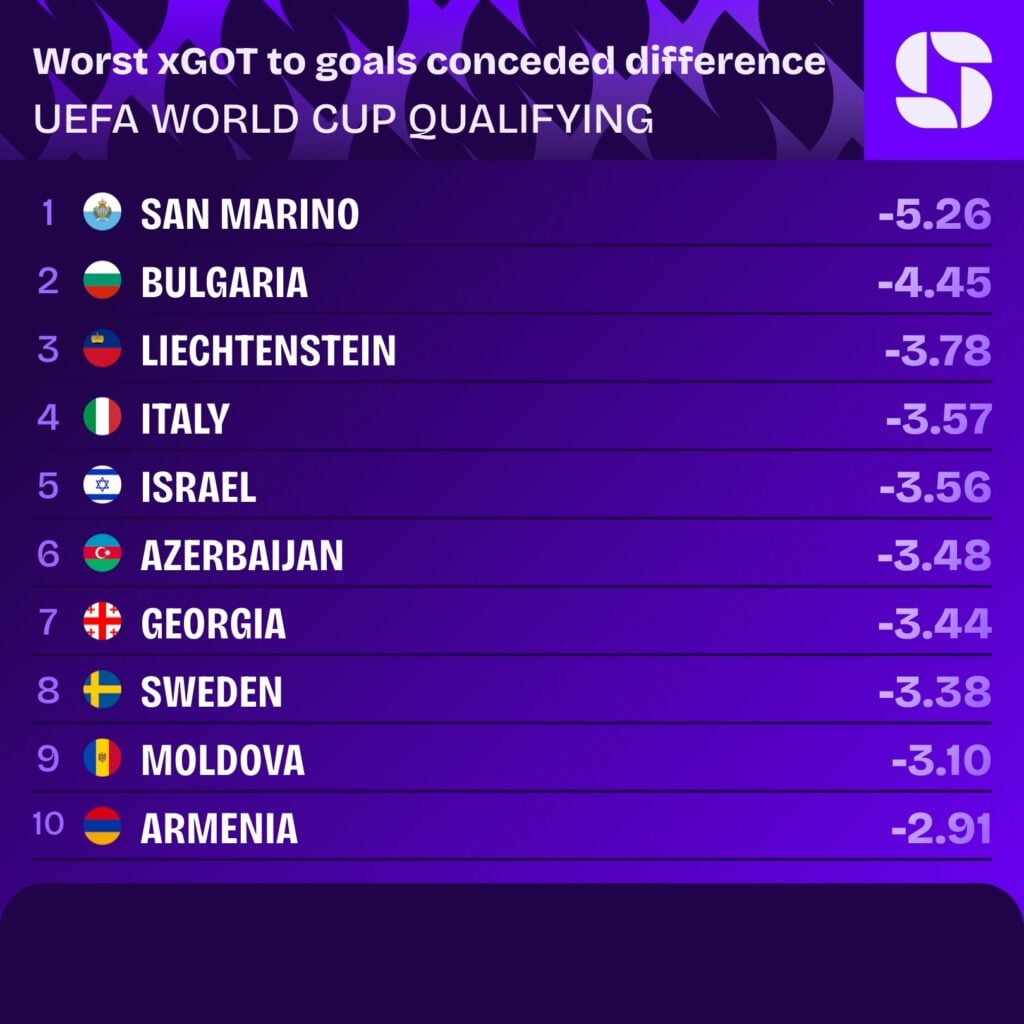
But even more damning is the difference between xG on Target Against and goals conceded. Italy faced 9.43 xGOT in World Cup qualifying, at an average of 0.94 per match. That ranked them 14th in qualifying, which isn’t among the best, but it also wasn’t too bad.
However, they still conceded 13 goals from that 9.43 xGOTC — a difference of 3.57. Only three teams had a bigger negative difference between xGOTC and goals conceded. They were San Marino (-5.26), Bulgaria (-4.45) and Liechtenstein (-3.78) — company you wouldn’t want to be keeping as an Italian fan.
Systemic failure
Italy’s problems are deeper than just what happens on the pitch, though. A week after their defeat to Bosnia-Herzegovina, Gabriele Gravina — who had resigned as president of the Italian football federation — released a scathing report on the “state of Italian football”. It was over 3,500 words and covered everything, including Serie A and women’s football.
Of course, some of it was self-serving. But some interesting truths were revealed, and sentiments were echoed across the Italian fanbase. There was something wrong with the system.
One of the biggest problems noted by Gravina’s report was the lack of minutes for young Italian players. Across Serie A this season, 565 different players have made at least one appearance. Of those, only 164 have are Italian. That’s just 29.03%. It’s not an Italian problem alone, with 29.51% of Premier League players with at least one appearance being English.
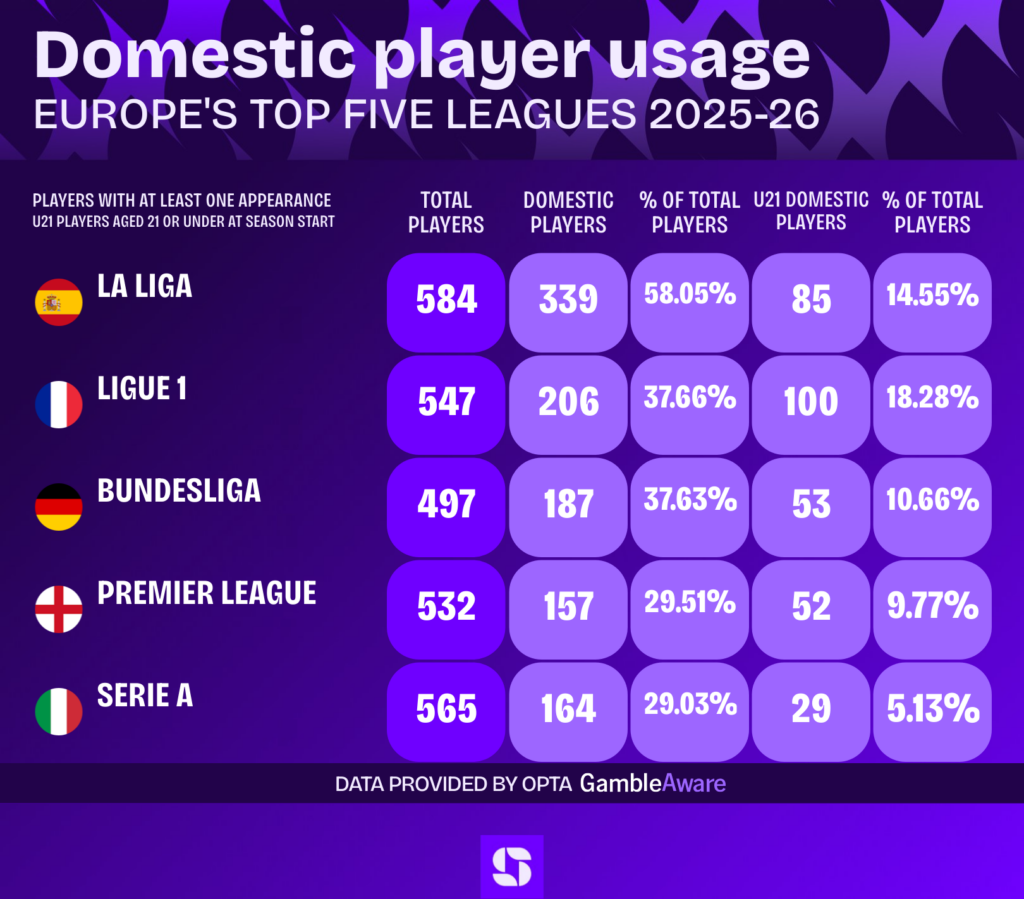
But of those 164 Italian players, only 29 started the season aged 21 or under — 5.13% of every player to make at least one Serie A appearance. And that includes the likes of Matteo Lavelli, who’s played seven minutes. And Giuseppe Ambrosino, who turned 22 in September and has 35 minutes across three appearances. The Premier League, meanwhile, has seen almost 10% of their appearances made by English players who started the season aged 21 or under.
Serie A sit bottom of Europe’s top five leagues for domestic player usage as a percentage of total players, and U21 domestic player usage. The top two are unsurprisingly France and Spain — the 2018 world champions and 2022 runners-up, alongside the reigning European champions.
Read more: