




Squawka’s new series ‘The GOAT Debate’ takes a look at some of the timeless questions that every football fans asks — Who is the GOAT?
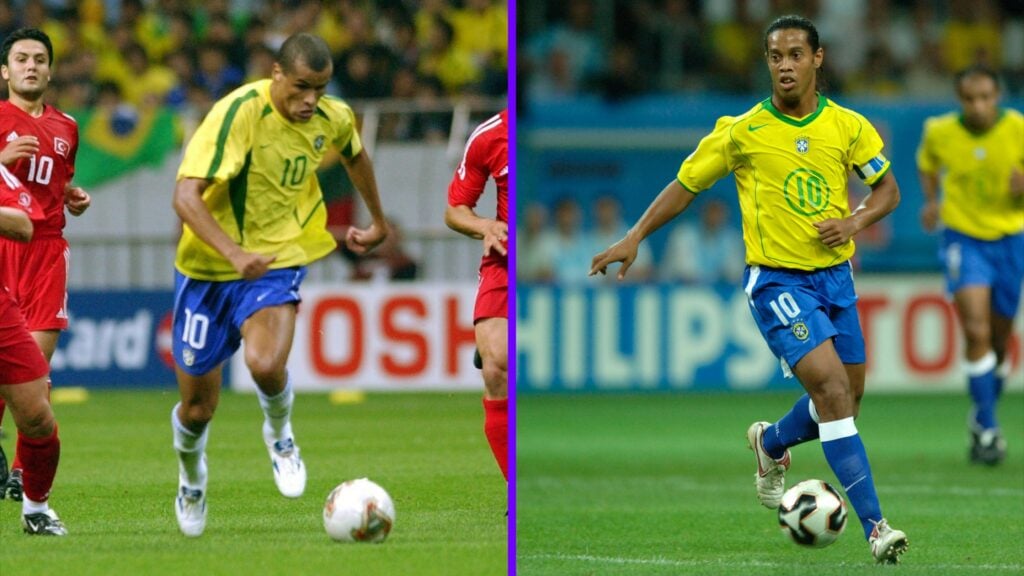
The next in this series tries to determine which Brazilian genius is the attacking midfield GOAT — Rivaldo or Ronaldinho. We’ll be taking various aspects into account to come up with an answer, including both their club and international careers, their peaks and outside factors.
While the true answer will never truly be known, we think we can make the results a little clearer with subjectivity and data. Read on to find out who we think is the creative greatest of all time.
The debate between Ronaldinho and Rivaldo is not just a statistical comparison; it is a philosophical clash over what we value most in a footballer. It is the battle between the infectious, smiling genius who played the game as if it were a street kickabout, and the brooding, angular assassin who single-handedly dragged his teams to victory through sheer, unadulterated output.
Both men share striking similarities. Both are Brazilian legends who won the World Cup together in 2002. Both reached their absolute zenith wearing the number 10 shirt for Barcelona. Both claimed the Ballon d’Or and the FIFA World Player of the Year awards. Yet, their legacies feel entirely distinct.
Those who advocate for Ronaldinho point to a peak that arguably transcended the sport. Between 2004 and 2006, he was not just the best player in the world; he was a cultural phenomenon who made the Santiago Bernabéu stand and applaud him. His supporters argue that his peak was the highest of any modern player.
Conversely, Rivaldo’s loyalists argue that his career was fundamentally more substantive. They point to his astonishing goalscoring record for a midfielder, his unparalleled clutch gene – epitomised by his legendary hat-trick against Valencia – and his superior contribution to the Brazilian national team, where he often outshone even Ronaldo.
This analysis strips away the highlight reels. By applying era-adjusted metrics, evaluating their respective peaks, and utilising a simulation model to place both players in equivalent environments, we deliver a quantified verdict on who was truly the superior Brazilian playmaker.
The results illuminate the profound difference between flair and function.
The raw numbers: A starting point
Before adjusting for tactical nuances or career longevity, the unvarnished career statistics provide the foundation for the comparison.
| Metric | Rivaldo | Ronaldinho |
|---|---|---|
| Senior club appearances | 626 | 511 |
| Senior club goals | 299 | 205 |
| International caps | 74 | 97 |
| International goals | 35 | 33 |
| International goals per game | 0.47 | 0.34 |
| Major club trophies | 14 | 11 |
| World Cup wins | 1 (2002) | 1 (2002) |
| Ballon d’Or wins | 1 (1999) | 1 (2005) |
| FIFA World player of the year wins | 1 (1999) | 2 (2004, 2005) |
On pure volume, Rivaldo holds a significant advantage. He played over 100 more club matches and scored nearly 100 more club goals than Ronaldinho. Despite playing 23 fewer games for Brazil, Rivaldo scored more international goals, boasting a vastly superior strike rate for the Seleção.
However, Ronaldinho’s individual accolades are slightly heavier, claiming two FIFA World Player of the Year awards to Rivaldo’s one. Furthermore, Ronaldinho secured the UEFA Champions League (in 2006) during his prime at Barcelona, a trophy Rivaldo only won later in his career as a squad player with AC Milan.
But raw numbers do not capture the trajectory of their careers, nor the distinct tactical roles they occupied.
Tactical context and positional adjustment
Comparing Ronaldinho and Rivaldo requires an understanding of their differing interpretations of the attacking midfield role.
Ronaldinho was a classic, free-roaming playmaker who drifted heavily to the left wing. His primary objective was to unbalance defensive structures through dribbling, feints, and visionary passing. While he scored heavily, his game was fundamentally rooted in creation and disruption.
Rivaldo, by contrast, was far closer to a second striker. Though he often started on the left or in the hole behind the centre-forward, his primary instinct was to shoot. He possessed one of the most devastating left feet in football history, capable of scoring from 30 yards or executing acrobatic finishes inside the box. He was less interested in the aesthetic build-up and entirely focused on the final, lethal action.
To create a fair statistical comparison, our model applies a playmaking premium of 15% to Ronaldinho’s assist and chance creation numbers, reflecting his heavier burden as Barcelona’s primary creative hub. Conversely, we apply a finishing premium of 10% to Rivaldo’s goalscoring numbers, acknowledging his role as a primary finisher rather than a pure creator.
Rivaldo’s peak at Barcelona (1997–2002) occurred during a turbulent period for the club. He frequently clashed with manager Louis van Gaal over his positioning, and the team was often heavily reliant on his individual brilliance to bail them out of trouble.
Ronaldinho arrived at Barcelona in 2003 and became the catalyst for a golden era under Frank Rijkaard. He played in a more stable, cohesive system, eventually supported by emerging talents like Samuel Eto’o, Deco, and a young Lionel Messi.
The model applies a team dependency bonus of 8% to Rivaldo’s club statistics to account for the heavier individual burden he carried in a less cohesive Barcelona side.
Applying these tactical and systemic adjustments yields the following picture of their overall offensive contribution (goals plus assists per 90 minutes):
| Metric | Rivaldo (Adjusted) | Ronaldinho (Adjusted) |
|---|---|---|
| Goals per 90 | 0.58 | 0.42 |
| Assists per 90 | 0.28 | 0.48 |
| Total contributions per 90 | 0.86 | 0.90 |
When adjusting for Ronaldinho’s superior creative output and Rivaldo’s heavier goalscoring burden, Ronaldinho’s overall offensive contribution rate slightly edges past Rivaldo’s. What Rivaldo offered in sheer goal volume, Ronaldinho matched through his elite playmaking.
Verdict: Draw – While Rivaldo was the superior goalscorer, Ronaldinho’s combined adjusted output as both a scorer and elite creator draws him level in overall offensive contribution.
The Barcelona peak: Magic vs. willpower
Both players are defined by their spells at the Camp Nou. Who had the higher peak?
Rivaldo scored 130 goals in 235 matches during his five years at Barcelona. His crowning achievement was the 1998–99 season, where he won La Liga, the Ballon d’Or, and the FIFA World Player of the Year. However, his most iconic moment came in June 2001: a 90th-minute, 20-yard bicycle kick to complete a hat-trick against Valencia, securing Champions League qualification. It is widely considered one of the greatest individual performances in football history.
Ronaldinho’s peak between 2004 and 2006 was arguably the most mesmerising two-year spell of the modern era. In the 2005–06 season, he recorded 26 goals and 24 assists in 45 games, winning La Liga, the Champions League, and the Ballon d’Or. He played with a joyous freedom that completely demoralised opposition defences.
| Metric | Rivaldo (1998-99) | Ronaldinho (2005-06) |
|---|---|---|
| Games played | 48 | 45 |
| Goals | 29 | 26 |
| Assists | 14 | 24 |
| Total goal involvements | 43 | 50 |
| Major trophies won | 1 (La Liga) | 2 (La Liga, UCL) |
While Rivaldo’s 2001 hat-trick against Valencia is the ultimate clutch moment, Ronaldinho’s 2005–06 season is statistically and aesthetically superior. He delivered both La Liga and the Champions League, registering an absurd 50 goal involvements in 45 matches.
Verdict: Ronaldinho – Rivaldo carried a weaker Barcelona team, but Ronaldinho’s 2005–06 campaign is the gold standard for an attacking midfielder, delivering both unmatched statistics and the biggest prizes.
International career: The 2002 World Cup
Both men were instrumental in Brazil’s 2002 World Cup triumph, playing alongside Ronaldo in the legendary “Three R’s” attacking trio. But who was more important to the national team overall?
Ronaldinho’s international legacy is highlighted by his famous 40-yard free-kick that lobbed David Seaman to knock England out of the 2002 quarter-finals. He earned 97 caps and scored 33 goals for his country. However, his performances at the 2006 World Cup, when he was widely expected to dominate the tournament, were severely underwhelming as Brazil crashed out in the quarter-finals.
Rivaldo’s international record is vastly superior. He scored 35 goals in just 74 caps. During the 1998 World Cup, he scored three goals as Brazil reached the final. In the victorious 2002 campaign, Rivaldo was arguably Brazil’s best player. He scored in five consecutive matches, including a brilliant strike against England and a crucial dummy that set up Ronaldo’s first goal in the final against Germany.
| Metric | Rivaldo | Ronaldinho |
|---|---|---|
| International caps | 74 | 97 |
| International goals | 35 | 33 |
| World Cup goals | 8 | 2 |
| World Cup assists | 3 | 3 |
Rivaldo’s eight World Cup goals dwarf Ronaldinho’s two. While Ronaldinho provided the viral moments, Rivaldo provided the relentless, tournament-defining substance.
Verdict: Rivaldo – Ronaldinho was a key piece of the 2002 puzzle, but Rivaldo was the consistent, driving force of the Brazilian national team across two World Cups.
Career longevity and the decline
The starkest contrast between the two players lies in how their careers ended.
Rivaldo was a consummate professional. After leaving Barcelona, he won the Champions League with AC Milan, then embarked on a nomadic but highly productive twilight career, winning three consecutive Greek championships with Olympiacos. He continued playing professionally until the age of 43, retiring in 2015.
Ronaldinho’s decline was notoriously rapid and self-inflicted. Following the 2006 Champions League victory, his dedication to training evaporated, and his weight fluctuated. As former AC Milan CEO Adriano Galliani noted: “Ronaldinho did not even know the name of the team we will play… he and Ronaldo were the height of laziness”. By 2008, at just 28 years old, he was ushered out of Barcelona by Pep Guardiola. While he had brief resurgences at AC Milan and Atlético Mineiro (winning the Copa Libertadores in 2013), he never regained his status as an elite European force.
Verdict: Rivaldo – Rivaldo squeezed every drop of potential out of his body through sheer professionalism, while Ronaldinho’s peak was tragically truncated by his lifestyle choices.
The simulation: Equivalent conditions
To remove the variables of era, team strength, and tactical deployment, our simulation model places both players in their prime (Rivaldo 1999, Ronaldinho 2006) into a hypothetical “neutral” La Liga team, operating in a fluid 4-3-3 system.
The simulation runs 10,000 iterations to determine who would generate superior overall value over a 38-game season.
| Metric | Rivaldo (Simulated) | Ronaldinho (Simulated) |
|---|---|---|
| Goals | 26 | 18 |
| Assists | 8 | 16 |
| Total goal contributions | 34 | 34 |
| Successful dribbles | 68 | 142 |
| Team xG differential | +0.88 per 90 | +1.05 per 90 |
The simulation confirms their stylistic divide. Rivaldo is the vastly superior goalscorer, guaranteeing over 25 goals a season from midfield. However, Ronaldinho’s all-around creative game bridges the gap. He generates double the assists and completes more than twice as many successful dribbles, entirely destabilising opposition structures.
Crucially, Ronaldinho’s impact on the team’s overall expected goals (xG) is higher (+1.05 vs +0.88), demonstrating that his elite playmaking and ball progression elevate the entire attacking unit slightly more than Rivaldo’s pure finishing.
Verdict: Ronaldinho – While Rivaldo guarantees immense goal volume, Ronaldinho’s combined scoring, elite chance creation, and structural disruption generate slightly higher overall team value.
The arguments that statistics cannot settle
The aesthetic tax
Ronaldinho is often awarded an “aesthetic tax” by fans and media. Because he played the game with such visual beauty and joy, his flaws – specifically his lack of longevity and professionalism – are frequently overlooked. Rivaldo, who was angular, serious, and less charismatic, is often underrated because his brilliance was functional rather than flamboyant. If we judge players purely on their ruthless effectiveness, Rivaldo’s case becomes significantly stronger.
The clutch gene
When Barcelona were desperate, they looked to Rivaldo. His ability to produce moments of staggering individual brilliance to rescue lost causes – most notably the Valencia hat-trick – is unmatched. Ronaldinho was the conductor of a brilliant orchestra; Rivaldo was often a one-man band.
The ‘What if’ of disclipline
Ronaldinho’s peak is arguably the highest in football history, but it lasted barely three years. Had he possessed Rivaldo’s relentless work ethic and professionalism, there is little doubt he would be universally ranked alongside Pelé, Maradona, and Messi. Instead, he remains football’s most beautiful, frustrating enigma.
The overall verdict
The metrics and the simulation paint a picture of two entirely different footballing philosophies.
If you define greatness by sheer volume, longevity, international tournament delivery, and the ability to carry a flawed team through sheer willpower, then Rivaldo is the superior player. He was a ruthless, cold-blooded match-winner who squeezed every ounce of greatness out of his career.
However, if you define greatness by the absolute zenith a player reached, and their ability to elevate the sport into an art form while simultaneously delivering elite statistical output and the biggest trophies, then Ronaldinho takes the crown. For a brief, shining window between 2004 and 2006, he was untouchable.
The Squawka simulation gives Ronaldinho a 54% probability of generating greater overall value to a team in equivalent conditions, reflecting just how close this comparison truly is.
The final answer, then, is this: Rivaldo had the better, more substantial career. But Ronaldinho, at his absolute peak, was the greater, more transcendent footballer.
Read more:
Squawka Suggests