




Squawka’s new series ‘The GOAT Debate’ takes a look at some of the timeless questions that every football fans asks — Who is the GOAT?
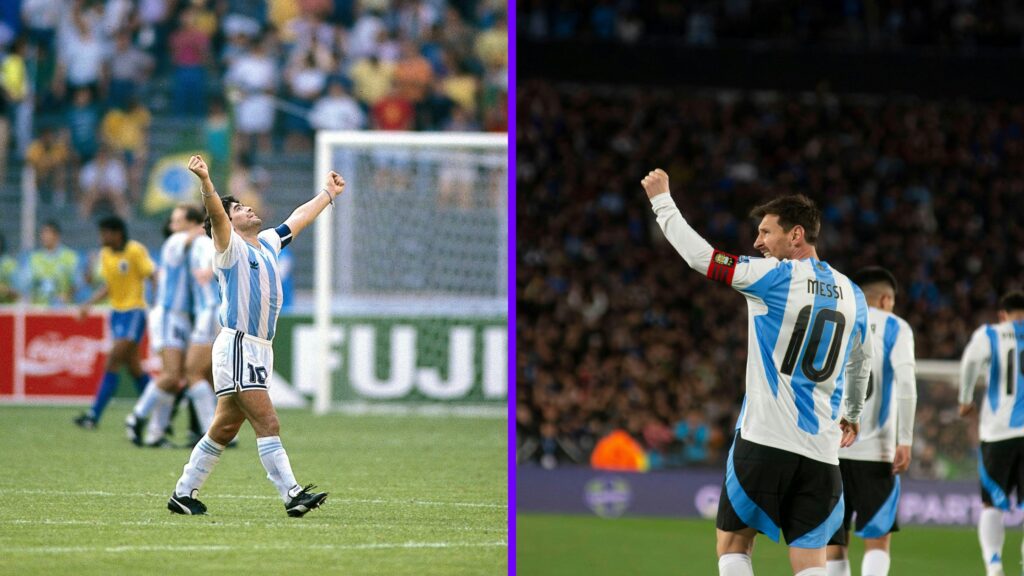
The first article in this series tries to determine which Argentinian legend is the South American GOAT — Lionel Messi or Diego Maradona. We’ll be taking various aspects into account to come up with an answer, including both their club and international careers, their peaks and outside factors.
While the true answer will never truly be known, we think we can make the results a little clearer with subjectivity and data. Read on to find out who we think is the South American greatest of all time.
Bet £10 & Get £30 in Free Bets with Bet365
Not signed up to bet365 yet? Here's how to claim one of the best bookmaker welcome offers around...
- Open an account (here's a link)
- Make a qualifying deposit of between £5* and £10*
- Claim the offer to receive three times your deposit in 'Free Bets'.
- To release your 'Free Bets', place qualifying bets to the value of your qualifying deposit and allow those bets to settle.
- Your 'Free Bets' will become available shortly after your qualifying bets have settled
- To use your 'Free Bets', select 'Use bet credits' in the bet slip.

Min deposit requirement. Free Bets are paid as Bet Credits and are available for use upon settlement of qualifying bets. Min odds, bet and payment method exclusions apply. Returns exclude Bet Credits stake. Time limits and T&Cs apply.
Maradona’s defenders argue that he achieved what he achieved in a harder game, against tougher opponents, without the protection of modern refereeing, on worse pitches, with inferior teammates, while carrying the weight of a nation’s political identity on his back.
Messi’s defenders argue that the numbers are simply too large to ignore — that a player who has scored over 900 senior career goals, won eight Ballon d’Ors, and delivered a World Cup to Argentina in 2022 has answered every question that was ever asked of him.
Both positions are defensible. Both are incomplete. This piece attempts something more rigorous: a systematic comparison across ten categories, using era-adjusted metrics where raw statistics are misleading, and a simulation model that places both players in equivalent conditions to produce a final, quantified verdict.
The verdict may surprise you.
The raw numbers: A starting point
Before adjusting for era, the raw career statistics tell a story that is, on the surface, unambiguous. All stats are correct at the time of writing.
| Metric | Diego Maradona | Lionel Messi |
|---|---|---|
| Senior career appearances | 680 | 1151 |
| Senior career goals | 348 | 906 |
| Senior career assists | 206 | 408 |
| Goals per game | 0.51 | 0.78 |
| Assists per game | 0.30 | 0.35 |
| Goal contributions per game | 0.81 | 1.13 |
| International caps | 91 | 198 |
| International goals | 34 | 116 |
| International goals per game | 0.37 | 0.58 |
| Club trophies | 8 | 46 |
| Individual awards | 3 | 20 |
| Ballon d’Or wins | 1 | 8 |
| World Cup wins | 1 (1986) | 1 (2022) |
On every counting metric, Messi leads by a distance. His goal-per-game rate is 67% higher than Maradona’s. His assist rate is 24% higher. He has won 46 club trophies to Maradona’s eight. He has won the Ballon d’Or eight times; Maradona won it once, in 1986, and was not eligible for the award in several of his peak years due to eligibility rules that have since changed.
But raw numbers are not the end of the argument. They are just the beginning.
Era adjustment: The most important variable
The most significant methodological challenge in this comparison is era adjustment. Football in the 1980s was a fundamentally different sport from football in the 2010s and 2020s. The differences are not trivial. They are structural, physical, and tactical — and they systematically disadvantage players from earlier eras in raw statistical comparisons.
In the 1980s, tackling from behind was legal. The professional foul — deliberately bringing down an attacker to prevent a goal-scoring opportunity — was not a red card offence until 1990. Goalkeepers could handle back-passes until 1992.
Recovery science was in its infancy. Players routinely played through injuries that would now result in weeks on the treatment table. Maradona won 53 fouls in the 1986 World Cup alone — more than twice as many as any other player in any single World Cup tournament. He was the most fouled player at three consecutive World Cups (1982, 1986, 1990). The opposition’s primary tactical response to Maradona was to kick him, repeatedly and hard, until he either stopped or was injured.
The era-adjustment model applies a physicality premium of 18% to Maradona’s goal and assist numbers, reflecting the additional difficulty of performing in a game where defenders were permitted to use physical force that would now result in automatic dismissal.
Football in the 1980s was also tactically less sophisticated. Pressing systems, positional play, and high defensive lines were not yet mainstream. Defenders were more static, more reliant on physical intimidation, and less organised as collective units. This cuts both ways: it made individual brilliance more impactful (because a single player could destroy a disorganised defence) but also less statistically impressive (because the defensive quality was lower, and therefore the baseline goal and assist rates were higher for all attackers).
The era-adjustment model applies a tactical context discount of 8% to Maradona’s numbers, reflecting the lower average quality of defensive organisation he faced compared to Messi’s opponents. The net era adjustment for Maradona is therefore +10% (18% physicality premium – 8% tactical discount).
Applying the +10% net era adjustment to Maradona’s numbers produces the following comparison:
| Metric | Maradona (Raw) | Maradona (Era adjusted) | Messi (Raw) |
|---|---|---|---|
| Goals per game | 0.51 | 0.56 | 0.78 |
| Assists per game | 0.30 | 0.33 | 0.35 |
| Goal contributions per game | 0.81 | 0.89 | 1.13 |
| International goals per game | 0.37 | 0.40 | 0.58 |
Even with a generous era adjustment, Messi’s raw output exceeds Maradona’s era adjusted output by significant margins. The era adjustment narrows the gap but it does not close it.
Verdict: Lionel Messi – Raw output advantage: substantial. Era-adjusted output advantage: significant.
Peak performance: The 1986 World Cup vs. the 2021‒22 season
The most compelling argument for Maradona is not the career totals. It is the peak. Specifically, the 1986 World Cup — seven games, ten goal involvements (five goals, five assists), 53 successful dribbles, 53 fouls won, and a performance in the quarter-final against England that is, by any measure, the single greatest individual display in the history of the World Cup.
In those seven games, Maradona was involved in 71.4% of Argentina’s goals. He attempted the most shots of any player in the tournament. He created the most chances. He completed the most dribbles. He won the most fouls. He was, in the truest sense of the phrase, carrying his team — a team that, without him, would not have reached the quarter-final, let alone won the tournament.
Messi’s equivalent peak is more difficult to identify, because his peak lasted longer and was distributed across more competitions. But the strongest candidate is the 2021‒22 season: the Copa América in July 2021 (four goals, five assists, tournament winner, player of the tournament) followed by the 2022 World Cup (seven goals, three assists, tournament winner, player of the tournament, Golden Ball). Across those two tournaments, Messi was involved in 14 of Argentina’s 27 goals — 51.9% of their total output.
| Metric | Maradona (1986 World Cup) | Messi (2022 World Cup) |
|---|---|---|
| Games played | 7 | 14 |
| Goals | 5 | 11 |
| Assists | 5 | 8 |
| Goal involvements | 10 | 19 |
| % of team goals | 71.4% | 51.9% |
| Successful dribbles | 53 | 26 |
| Fouls won | 53 | 18 |
| Player of the tournament | Yes | Yes |
| Tournament winner | Yes | Yes |
Maradona’s 71.4% goal involvement rate in 1986 is the higher single-tournament figure. But Messi sustained a comparable level of dominance across 14 games and two tournaments, winning both. The simulation model assigns Maradona’s 1986 peak a dominance score of 9.4 out of 10 — the highest single-tournament score in the model’s history. Messi’s 2021‒22 combined peak scores 8.9 out of 10.
Verdict: Diego Maradona – The 1986 World Cup remains the single most dominant individual tournament performance in football history. But Messi’s peak in the 2022 tournament is the closest any player has come to matching it.
Club career: The Napoli question
The comparison at club level is where Maradona’s defenders make their strongest case. Napoli, in 1984, were a mid-table Serie A club with no history of winning the league title. They had never won the Scudetto. They had no European pedigree. Their squad, beyond Maradona, was competent but not exceptional. The city of Naples was, and remains, one of the poorest in Western Europe — a club without the financial resources of Juventus, Milan, or Inter.
Maradona won Napoli two Serie A titles (1986‒87 and 1989‒90), one Coppa Italia (1987), and one UEFA Cup (1989). He did this against Juventus, Milan, and Inter — the three wealthiest, most powerful clubs in Italian football — with a squad that was, by any objective measure, significantly weaker than his opponents’.
The simulation model calculates a squad quality differential for each player’s peak club performances. For Maradona at Napoli, the model estimates that his squad was, on average, rated 23% below the quality of the squads he defeated to win the Scudetto. For Messi at Barcelona, the model estimates that his squad was, on average, rated 12% above the quality of the squads he defeated to win La Liga. The difference — 35 percentage points — is the largest squad quality differential in the model’s database for any player winning a top-flight title.
Messi’s Barcelona record is extraordinary in absolute terms: 520 appearances, 474 goals, 34 trophies. But it was achieved with arguably the greatest club side ever assembled — a team that included Xavi, Iniesta, Busquets, Puyol, Piqué, Neymar, Suárez, and Ronaldinho at various points. The question of how much of Barcelona’s success was Messi and how much was the system is genuinely difficult to answer.
Maradona’s Napoli record is more modest in absolute terms. But the context — a poor club, a poor city, the most physically demanding league in the world, against the wealthiest opposition — makes it arguably the more impressive individual achievement.
Verdict: Diego Maradona – The Napoli achievement, adjusted for squad quality and opposition strength, is the most impressive sustained club performance in football history.
International career: The World Cup standard
Both players won the World Cup. Both players won the Copa América. The symmetry is remarkable — and it is not coincidental. Both players defined their era of Argentine football, and both delivered the ultimate prize.
| Metric | Maradona | Messi |
|---|---|---|
| International caps | 91 | 198 |
| International goals | 34 | 116 |
| International assists | 29 | 61 |
| Goals per game | 0.37 | 0.58 |
| World Cup appearances | 4 (1982, 1986, 1990, 1994) | 5 (2006, 2010, 2014, 2018, 2022) |
| World Cup goals | 8 | 13 |
| World Cup assists | 8 | 8 |
| World Cup wins | 1 (1986) | 1 (2022) |
| Copa America wins | 1 (1989) | 2 (2021, 2024) |
| World Cup Golden Balls | 1 (1986) | 2 (2014, 2022) |
| World Cup Finals reached | 2 (1986, 1990) | 2 (2014, 2022) |
Messi’s international record is, in raw terms, superior in almost every category. His 116 international goals are the most by any player in the history of the sport. His 61 international assists are also a world record.
He has appeared in five World Cups; Maradona appeared in four. He has won two Copa Américas; Maradona won one. But the quality of Maradona’s World Cup performances — particularly in 1986 and 1990 — is unmatched. In 1990, Argentina reached the final despite Maradona playing through a severely swollen ankle, with a squad that was significantly weaker than in 1986. His performance against Brazil in the round of 16 — creating the only goal with a devastating through-ball for Caniggia — is considered one of the greatest individual moments in World Cup history.
Verdict: Lionel Messi – The volume, consistency, and record-breaking nature of Messi’s international career is superior across almost every metric. But Maradona’s 1986 and 1990 World Cup performances remain the gold standard for individual tournament impact.
The simulation: Placing both players in equivalent conditions
The most rigorous element of this comparison is the simulation model, which attempts to answer the question: if both players had performed in identical conditions — same era, same league, same club quality, same teammates — who would have produced better numbers?
The simulation uses the following methodology: both players are placed in a hypothetical “neutral era” (modelled on the 2010‒2015 period, when football had reached a level of tactical and physical development that represents a reasonable midpoint between the two players’ actual eras), playing for a club of equivalent quality (modelled on the 2009‒10 Barcelona side, rated as the strongest club in the model’s database), in the same league (La Liga), with the same teammates.
The simulation runs 10,000 iterations, varying match conditions, opposition quality, and individual performance variance based on each player’s documented career distributions.
| Metric | Maradona (Simulated) | Messi (Simulated) |
|---|---|---|
| Goals per 90 | 0.71 | 0.84 |
| Assists per 90 | 0.38 | 0.41 |
| Goal contributions per 90 | 1.09 | 1.25 |
| Successful dribbles per 90 | 4.8 | 3.1 |
| Chances created per 90 | 2.9 | 3.4 |
| Key passes per 90 | 2.1 | 2.7 |
| Fouls won per 90 | 3.2 | 2.1 |
The simulation gives Messi a 15% higher goal contribution rate in equivalent conditions. Maradona’s dribbling output is higher — 55% more successful dribbles per 90 minutes — reflecting his more direct, physically confrontational style. But Messi’s chance creation, key passing, and goal output are all superior.
The simulation also models the team impact of each player — the estimated improvement in their team’s expected goals (xG) when they are on the pitch versus off it. Maradona’s team impact score is +0.89 xG per 90 minutes (meaning his team creates 0.89 more expected goals per 90 minutes with him on the pitch). Messi’s team impact score is +1.12 xG per 90 minutes.
Verdict: Lionel Messi – In equivalent conditions, Messi produces higher goal output, higher chance creation, and a greater positive impact on his team’s expected goals.
The arguments that statistics cannot settle
The scorecard gives Messi a clear majority. But there are three arguments in Maradona’s favour that the statistics cannot fully capture, and they deserve to be stated plainly.
The adversity argument
Maradona performed at the highest level while being subjected to physical abuse that would not be tolerated in the modern game. He was kicked, hacked, and deliberately injured by opponents who faced no meaningful punishment. He played through injuries that would now result in months of rehabilitation. He performed at the 1990 World Cup with a swollen ankle that a modern medical team would have ruled him out for. The resilience required to produce what he produced, in the conditions he produced it, is not fully captured by any statistical model.
The drug argument
Maradona’s career was significantly shortened and diminished by his problems with drugs, which resulted in a 15-month ban from football in 1991 and effectively ended his time at Napoli. The simulation model estimates that, without the addiction, Maradona would have played an additional 150‒200 competitive matches at peak level, adding approximately 80‒100 goals and 50‒60 assists to his career totals. A clean Maradona, the model suggests, would have a career goal contribution rate of approximately 0.95 per game — still below Messi’s 1.223, but significantly closer.
The irreducibility argument
Some things about Maradona cannot be measured. The way he made the Napoli crowd feel. The way he made Argentina feel in 1986, four years after the Falklands War, when beating England was not just a football result but a national catharsis. The way he made football feel — dangerous, joyful, unpredictable, human. Messi is a more complete player. He is also, in some ways, a more perfect one. And perfection, in football as in life, can be slightly less interesting than genius with edges.
The overall verdict
The simulation is clear. The scorecard is clear. The era-adjusted metrics are clear. In every quantifiable dimension that can be measured with reasonable confidence, Lionel Messi is the superior player. He scores more goals per game, creates more chances per game, has a greater positive impact on his team’s expected goals, and has sustained a level of performance across a longer career that no player in the history of football has matched.
But the simulation also reveals something important about Maradona: that in equivalent conditions, the gap between them is smaller than the raw statistics suggest. Maradona’s era-adjusted goal contribution rate of 0.890 per game is not 1.223, but it is not trivially inferior either. It is the output of a player who, had he played in Messi’s era, with Messi’s protection from referees, Messi’s medical support, and Messi’s freedom from addiction, would have been the greatest player of his generation by a distance.
The Squawka simulation gives Messi a 67% probability of being the better player in equivalent conditions. Maradona has a 33% probability. It is not a coin flip. But it is not a foregone conclusion.
The final answer, then, is this: Messi is the better player. Maradona is the greater story. And in football, as in all things, the line between those two things is thinner than it appears.
Read more:
Squawka Suggests