






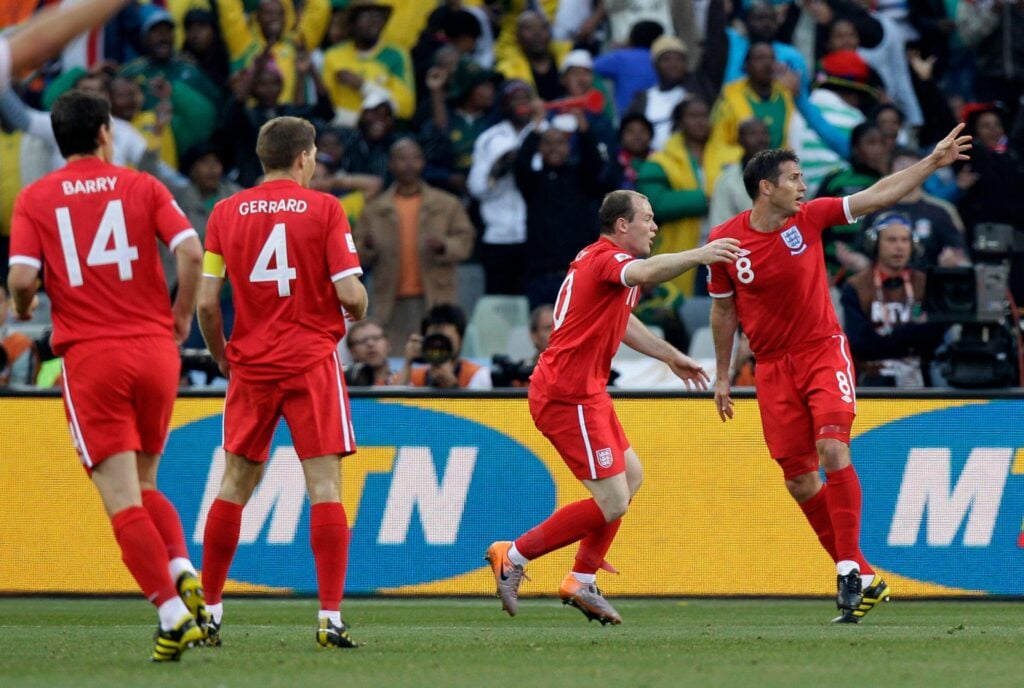
World Cup What Ifs, Squawka’s new alternative reality series, takes a look at what could’ve happened if some of the biggest moments in football had different outcomes.
The next in the series looks at Frank Lampard’s infamous ‘ghost goal’ against Germany at the 2010 World Cup. One of the key drivers behind goal line technology and, subsequently, VAR, what were the possible outcomes if the goal had, correctly, been awarded?
In this article we’ll cover:
The background
On 27 June 2010, England faced Germany in the round of 16 of the World Cup at the Free State Stadium in Bloemfontein. The match, played between two of European football’s most storied rivals, was already laden with historical baggage. But it was the events of the 38th minute that etched the game into footballing infamy.
Germany, managed by Joachim Low, had started the match with devastating efficiency. Miroslav Klose opened the scoring in the 20th minute, capitalising on a defensive lapse, before Lukas Podolski doubled their lead 12 minutes later. England, managed by Fabio Capello and fielding the remnants of their much-vaunted “golden generation”, looked entirely bereft of ideas.
However, Matthew Upson pulled a goal back in the 37th minute with a header from a Steven Gerrard cross. Suddenly, England had momentum. Less than 60 seconds later, Frank Lampard collected the ball on the edge of the penalty area and struck a looping shot over Manuel Neuer. The ball hit the underside of the crossbar, bounced a full yard over the goal line, and spun back out.
Uruguayan referee Jorge Larrionda waved play on. His assistant, Mauricio Espinosa, had not flagged for a goal. The score remained 2-1. England’s players protested furiously, but the decision stood. Germany went on to win 4-1, with Thomas Muller scoring twice in the second half as England chased the game.
Lampard’s “ghost goal” became a symbol of English grievance and a catalyst for the introduction of goal-line technology. It cemented the narrative of the golden generation as a group destined to fail on the biggest stage. But what if Espinosa had seen the ball cross the line? What if the goal had been given, and the score levelled at 2-2?
The match that went to extra time
To understand the alternative reality, we must first reconstruct the match itself. In the 38th minute, Lampard’s shot crosses the line. In this timeline, Espinosa raises his flag. Larrionda points to the centre circle. It is 2-2.
The psychological shift is immediate and profound. England, having been outplayed for the first 35 minutes, have erased a two-goal deficit in the space of 60 seconds. The momentum is entirely with Capello’s side. Germany, fielding the youngest squad they had sent to a World Cup since 1934, are suddenly vulnerable.
The simulation suggests that the second half plays out very differently. At 2-1 down, England were forced to chase the game in reality, leaving vast spaces behind their midfield that Muller and Mesut Ozil ruthlessly exploited on the counter-attack. At 2-2, the game state changes materially. England are not chasing; they are managing the game. Capello’s natural pragmatism comes to the fore. The defensive shape, anchored by John Terry and Upson, is more compact.
With the score at 2-2, Germany’s devastating counter-attacks in the 67th and 70th minutes do not occur, as England do not overcommit players forward. The match becomes a tense, tactical battle. Both managers make conservative substitutions. The game ends 2-2 after 90 minutes.
Extra time in Bloemfontein is a gruelling affair. England’s older squad – featuring the 32-year-old Lampard, 30-year-old Gerrard, and 29-year-old Terry – begins to tire against the youthful exuberance of the Germans. However, England’s experience in managing high-pressure situations proves invaluable.
The implications are seismic. Germany, the eventual semi-finalists in reality, are eliminated. The narrative of their young, dynamic team is delayed. England advance to the quarter-finals, their belief restored, to face Argentina.
The alternative quarter-final
If the round of 16 represents a moment of vindication for England, the quarter-final represents the ultimate test of their golden generation.
The actual 2010 quarter-final saw Germany dismantle Argentina 4-0 in Cape Town, exposing the tactical naivety of Diego Maradona’s management. In the alternative timeline, England face Argentina on 3 July 2010.
Argentina boast a terrifying attacking quartet of Lionel Messi, Carlos Tevez, Gonzalo Higuain, and Angel Di Maria. However, their midfield is unbalanced, and their defence is suspect. England, buoyed by their victory over Germany, are a team transformed. The midfield pairing of Lampard and Gareth Barry provides stability, allowing Gerrard to operate with more freedom.
The simulation projects a narrow victory for England. Capello’s rigid 4-4-2 system, heavily criticised in reality, proves perfectly suited to exploiting the spaces left by Maradona’s unbalanced formation.
The victory sends England into delirium. The scenes back home mirror the euphoria of Euro 96. Capello, previously maligned by the British press for his strict regime and poor communication, is hailed as a tactical genius. The golden generation, so often accused of failing to replicate their club form on the international stage, have finally delivered a defining tournament performance.
The alternative semi-final
The actual 2010 semi-final saw Spain beat Germany 1-0 in Durban, with Carles Puyol scoring a powerful header. In the alternative timeline, England face Spain on 7 July 2010.
Spain, managed by Vicente del Bosque, are the reigning European champions and the undisputed masters of possession football. Their midfield trio of Xavi, Andres Iniesta, and Sergio Busquets dictates the tempo of every match. England, exhausted from two consecutive knockout matches against elite opposition, are forced to defend deep and rely on counter-attacks.
The match is a stark contrast of styles. Spain dominate possession, patiently probing for openings. England’s defence, marshalled by Terry and Upson, holds firm for long periods. However, the physical toll of the tournament begins to show.
The simulation projects a slim, low-scoring victory for Spain, consistent with their actual tournament run of narrow, controlled wins. Spain advance to the final.
Despite the defeat, England’s exit is celebrated rather than mourned. They do not leave the tournament as victims of a cruel refereeing error or their own tactical ineptitude, but as a team that pushed the eventual champions to their limit. The scenes in London are of pride, not anger. The golden generation, having reached a semi-final, are given a hero’s welcome. Their legacy is secured as the most successful England team since 1990.
The butterfly effect – what the ghost goal broke
The awarded goal transforms the technological evolution of the sport. Football operates as a complex system, and the removal of its most controversial element from a tournament produces cascading effects that compound over time.
In reality, Lampard’s ghost goal was the definitive catalyst for the introduction of goal-line technology. Fifa president Sepp Blatter, previously a staunch opponent of technological assistance, cited the incident as the moment he changed his mind. The International Football Association Board (IFAB) approved goal-line technology in July 2012, and it was used at the 2014 World Cup in Brazil.
The immediate effect in 2010 was the most visible. Without the ghost goal, the narrative of the World Cup shifts from refereeing incompetence to English resilience. The urgency to implement goal-line technology is significantly reduced.
In the alternative timeline, the 2010 World Cup does not become the definitive argument for technological intervention. The debate over refereeing mistakes remains focused on positioning and human fallibility rather than the necessity of a technological safety net. The IFAB, notoriously conservative, delays the approval of goal-line technology by at least four years. It is not used at the 2014 World Cup.
The broader implementation of the Video Assistant Referee (VAR) is subsequently delayed. Without the successful integration of goal-line technology as a precedent, the push for video reviews faces stiffer resistance. The 2018 World Cup in Russia, which saw the widespread and largely successful use of VAR in reality, is played without it. The technological revolution of football is pushed back by a full World Cup cycle.
In this scenario, Espinosa’s decision to raise his flag was arguably more consequential for the sport’s administration than it was beneficial to English football – a decision that gave England a semi-final but cost the game its most significant technological leap.
The golden generation redeemed
The most profound impact of the awarded goal is perhaps the least tangible: the redemption of England’s golden generation. For over a decade, the narrative surrounding this group of players was one of unfulfilled potential and club rivalries superseding national pride.
In reality, the 2010 World Cup was the final nail in the coffin for the golden generation. The 4-1 defeat to Germany confirmed the suspicions of many critics: that these players, despite their individual brilliance, could not function as a cohesive unit on the international stage. The subsequent years saw the gradual phasing out of the old guard, with a sense of lingering disappointment.
In the alternative timeline, the narrative is entirely rewritten. The victory over Germany, achieved through resilience and tactical discipline, proves that the golden generation can perform when it matters most. The subsequent victory over Argentina cements their status as a truly great international team.
The psychological burden of past failures is lifted. The players are no longer defined by their inability to win a major tournament, but by their success in reaching a World Cup semi-final. This newfound confidence permeates the squad, creating a more positive environment for the younger players coming through the ranks.
The legacy of the golden generation is secured. They are remembered not as a group of underachievers, but as the team that restored English pride on the global stage. The narrative of English football shifts from one of perpetual disappointment to one of cautious optimism.
The verdict
The numbers tell a story of the true butterfly effect that one decision can make.
National team: England reach the 2010 World Cup semi-finals, their best performance since 1990. They defeat Germany Argentina 2-1 to reach the semi-final, before losing to eventual champions Spain. The golden generation’s legacy is secured, providing a much-needed boost to the domestic game and altering the trajectory of English football for a generation.
Managerial: Fabio Capello’s reputation is enhanced, and he remains England manager for Euro 2012. The narrative of his strict regime is rewritten, replaced by a deep appreciation for his tactical acumen and ability to manage high-pressure knockout matches. His continued presence at the helm ensures a smoother transition for the next generation of English talent.
Global football: The push for goal-line technology and VAR is delayed by at least four years, as the sport’s most infamous modern officiating error never occurs. The absence of the ghost goal means that the narrative of human error in refereeing lacks its most potent and universally recognised example, altering the trajectory of how the game is officiated globally.
The ghost goal deeply hurt English football, providing a narrative of grievance and misfortune that resonated deeply. But for the World Cup, and for the legacy of the game itself, the 38th minute of that round of 16 match represents one of the most consequential moments in the history of the sport – a moment whose full impact to England and the wider footballing world, both in terms of history lost and technological advancement spurred, is immeasurable.
Read more: