




World Cup What Ifs, Squawka’s new alternative reality series, takes a look at what could’ve happened if some of the biggest moments in football had different outcomes.
Next up in the series we examine what could’ve happened if Asamoah Gyan had scored his penalty against Uruguay in the quarter-final of the 2010 World Cup. It wasn’t just a missed penalty, but a cultural moment for his nation and African football in general.
In this article we’ll cover:
The background
On 2 July 2010, Ghana faced Uruguay in the quarter-finals of the World Cup at Soccer City in Johannesburg. The match, played in front of 84,017 spectators, carried the weight of an entire continent. The 2010 tournament was the first World Cup held on African soil, and Ghana were the last African team standing. They were not just playing for their nation; they were playing for a billion people who desperately wanted to see an African team break the glass ceiling of the quarter-finals.
The match itself was a tense, dramatic affair that ebbed and flowed with the rhythm of a classic knockout tie. Sulley Muntari opened the scoring for Ghana in first-half stoppage time with a stunning 40-yard strike that swerved violently in the Johannesburg air. Diego Forlan equalised for Uruguay in the 55th minute with a swerving free-kick that deceived goalkeeper Richard Kingson. The game went to extra time, and as the clock ticked past the 120th minute, Ghana won a free-kick on the edge of the penalty area.
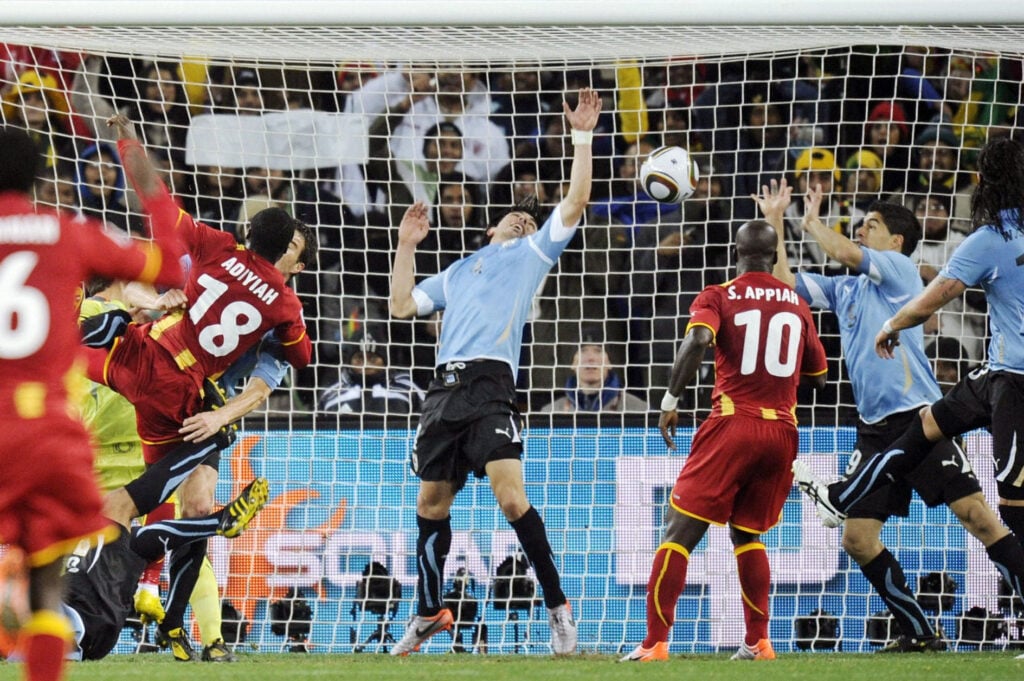
What followed is etched into footballing infamy. The ball was delivered into the box, causing chaos in the Uruguayan defence. Stephen Appiah’s initial shot was blocked on the goal line by Luis Suarez. On the rebound, Dominic Adiyiah headed the ball towards the net. Suarez, acting on pure instinct and desperation, swatted the ball away with both hands. Portuguese referee Olegario Benquerenca immediately pointed to the spot and showed Suarez a straight red card.
Asamoah Gyan, who had already scored two penalties in the tournament against Serbia and Australia, stepped up. He was the talisman, the man who had carried Ghana through the group stages and scored the extra-time winner against the United States in the round of 16. He struck the ball with immense power, but it crashed against the crossbar and flew over. Suarez, watching from the tunnel, celebrated wildly. The match went to a penalty shootout, which Uruguay won 4-2, culminating in Sebastian Abreu’s audacious Panenka chip.
Gyan’s miss became a symbol of African heartbreak. It cemented Suarez’s legacy as the ultimate pantomime villain – a player willing to sacrifice his own participation in a World Cup semi-final to give his country a lifeline. But what if Gyan’s penalty had been a few inches lower? What if the ball had hit the back of the net?
The semi-final that Africa deserved
To understand the alternative reality, we must first reconstruct the immediate aftermath of the goal. In the 120th minute, Gyan steps up and scores. The ball hits the back of the net. Soccer City erupts in a cacophony of vuvuzelas and unbridled joy. The referee blows the final whistle moments later. Ghana win 2-1.
The psychological shift is seismic. Ghana become the first African nation in history to reach a World Cup semi-final. The narrative of African underachievement on the global stage is shattered in an instant. The Black Stars are no longer just a football team; they are a pan-African phenomenon, carrying the momentum of a continent into a semi-final against the Netherlands in Cape Town.
The actual 2010 semi-final saw the Netherlands beat Uruguay 3-2. Uruguay, missing the suspended Suarez, relied heavily on Forlan, who scored a brilliant equaliser but could not prevent a Dutch victory.
In the alternative timeline, Ghana face the Netherlands on 6 July 2010. The Dutch, managed by Bert van Marwijk, are a formidable, pragmatic side. They had eliminated Brazil in the quarter-finals and boast an attacking quartet of Sneijder, Robben, Robin van Persie, and Dirk Kuyt. Ghana, managed by Milovan Rajevac, are disciplined, athletic, and riding a wave of unprecedented emotional momentum. They are, however, missing key personnel. Michael Essien had missed the entire tournament through injury, and the physical toll of consecutive extra-time matches against the United States and Uruguay begins to show.
The simulation projects a slim victory for the Netherlands. While Ghana’s momentum is a powerful variable, the Dutch side of 2010 possessed superior technical quality and tactical pragmatism.
Despite the defeat, Ghana’s exit is celebrated rather than mourned. They do not leave the tournament as victims of a cruel twist of fate, but as history-makers who pushed one of the tournament favourites to their absolute limit. The scenes in Accra, Johannesburg, and across the continent are of triumph, not tragedy. The Black Stars are given a hero’s welcome, their status as legends secured regardless of the result.
The alternative third-place play-off
The actual third-place play-off saw Germany beat Uruguay 3-2 in a thrilling, open match. In the alternative timeline, Ghana face Germany in Port Elizabeth on 10 July 2010.
The two sides had already met in the group stage, with Germany winning 1-0 through a Mesut Ozil strike. But the context of the third-place play-off is entirely different. Germany, reeling from a 1-0 semi-final defeat to Spain, field a rotated side, giving opportunities to younger players. Ghana, eager to secure a bronze medal for Africa and finish the tournament on a high, field their strongest available XI.
The simulation projects a narrow win for Germany and Ghana finish fourth — the highest finish by an African team in World Cup history. The narrative of the 2010 World Cup is defined not by Spanish dominance or Dutch pragmatism, but by the rise of Ghana.
The legacy of Asamoah Gyan
The consequences of the scored penalty extend far beyond the tournament itself. A single moment of conversion reshapes an entire career, altering the psychological foundations upon which a player builds his legacy.
In reality, the 2010 World Cup defined Gyan in two contradictory ways. He was the talisman who carried Ghana to the brink of history, scoring three crucial goals. But he was also the man who missed the penalty. The miss haunted him. He received death threats, faced intense public scrutiny, and eventually took an “indefinite break” from international football in 2012 after missing another crucial penalty in the Africa Cup of Nations semi-final against Zambia.
The immediate effect is on Gyan’s global standing. He is elevated from a very good striker to a global superstar. In reality, Gyan moved from Rennes to Sunderland for a club-record £13 million in August 2010. He had a successful first season in the Premier League, scoring 10 goals, before making a lucrative but surprising move to Al Ain in the UAE Pro League in 2011.
In the alternative timeline, a Golden Boot winner does not move to Sunderland. He is courted by elite European clubs. The simulation projects a transfer to a Champions League-calibre side – potentially Tottenham Hotspur, who were actively seeking a striker that summer, or even a club like Juventus or AC Milan. His career trajectory remains in Europe’s top five leagues for significantly longer, altering his legacy from a player who chased financial security in the Middle East to one who competed at the highest level of European football.
Furthermore, the psychological burden of the miss never exists. Gyan does not take a break from international football in 2012. He remains the undisputed, unburdened leader of the Black Stars. This continuity is crucial. In reality, Ghana suffered narrow, heartbreaking defeats in the 2012 and 2015 Africa Cup of Nations. With a confident, fully engaged Gyan leading the line, the simulation suggests a higher probability of Ghana converting one of those near-misses into continental silverware, ending a trophy drought that dates back to 1982.
What African football gained
It would be incomplete to consider only the individual perspectives. African football, in the actual timeline, acquired its most infamous case study in the cruelty of the sport. The missed penalty broke the hearts of a continent that had waited decades for a team to reach the semi-finals.
But even with the heartbreak, the 2010 World Cup was a watershed moment for African football. In the alternative timeline, with Ghana reaching the semi-finals, the impact is magnified exponentially. The 2010 World Cup quarter-final becomes the definitive argument for the tactical and technical maturity of African football.
The 2022 World Cup, which saw Morocco become the first African team to reach the semi-finals, is no longer a historic first. It is a continuation of a legacy established by Ghana twelve years prior. Without the constant, looming spectre of the 2010 quarter-final as the ultimate cautionary tale of African underachievement, the confidence of African teams on the global stage is significantly enhanced. In this scenario, Gyan’s penalty was arguably more consequential for the continent’s footballing psychology than it was for his own career – a goal that gave African football its defining triumph and altered the trajectory of how the game is perceived globally.
The financial and structural implications are also profound. A semi-final appearance guarantees a larger share of Fifa prize money, which, if reinvested correctly, accelerates the development of grassroots football in Ghana and across the continent. The success of the Black Stars serves as a blueprint for other African nations, proving that a well-organised, tactically disciplined side can compete with the traditional powerhouses of Europe and South America.
The verdict
The numbers tell a story of extraordinary counterfactual consequence.
Individual: Gyan secures a move to an elite European club rather than Sunderland, altering the trajectory of his club career. Suarez’s legacy is diminished; he is remembered as a great player whose desperate handball failed to save his team, rather than the ultimate footballing villain.
National team: Ghana reach the 2010 World Cup semi-finals, becoming the first African team in history to do so. They finish fourth after losing to Germany in the third-place play-off. The 2010 Ghana squad is immortalised, providing a much-needed boost to the domestic game and altering the trajectory of Ghanaian football for a generation. The psychological burden of the missed penalty is lifted, potentially leading to continental success in subsequent Africa Cup of Nations tournaments.
Continental: The psychological barrier of the World Cup quarter-finals is broken twelve years before Morocco achieved the feat in reality. The narrative of African underachievement is rewritten, replaced by a deep appreciation for the tactical acumen and technical quality of African teams. The continued presence of African teams in the latter stages of the World Cup becomes an expectation rather than an anomaly.
For African football, for the World Cup, and for the legacy of the game itself, the 120th minute of that quarter-final represents one of the most consequential moments in the history of the sport – a moment whose full cost, both in terms of history lost and psychological damage inflicted, will never truly be known.
Read more:
Squawka Suggests