





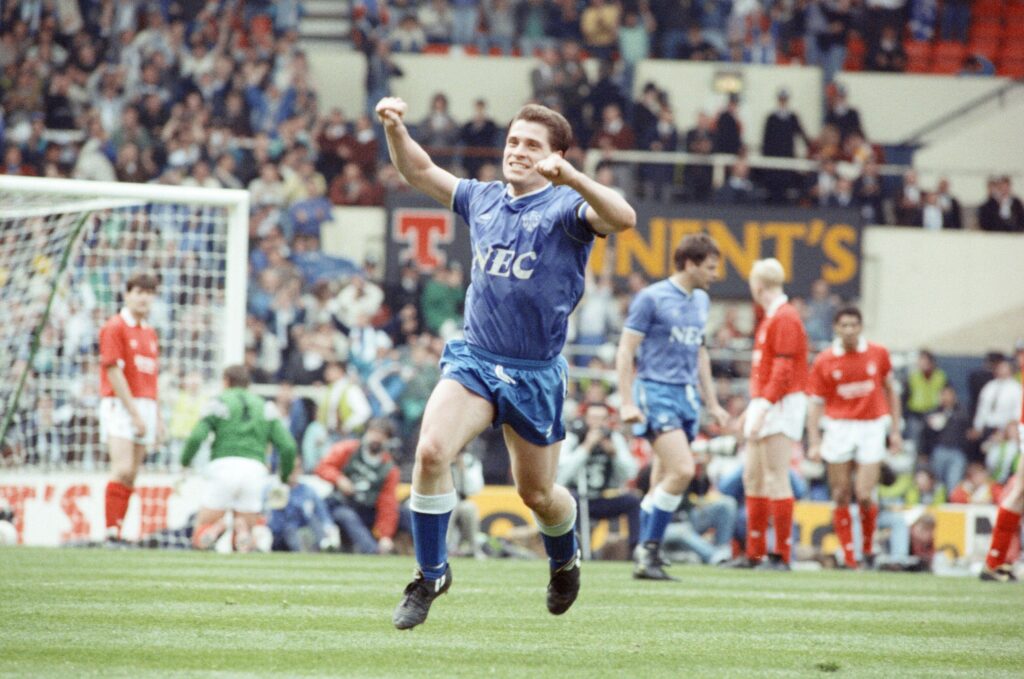
Former West Ham, Everton and Leicester striker, Tony Cottee, spoke to Squawka about his career and how he views the EFL in its current guise.
Cottee has experience as both a player and manager in the EFL, leading Barnet as player-manager in the 2000/2001 season, and was happy to reflect on a career that saw him net more than 250 times.
Cottee also shared his views on the playoffs expanding in the EFL and the use of VAR in the lower-leagues.
You joined Everton for a British record transfer fee in 1988. How did that pressure feel, and what were your initial impressions of the club and its ambitions?
To be honest, I didn’t enjoy it. I was only 23 years of age and it was hard to have all that responsibility put on your shoulders with the record transfer fee. I didn’t enjoy being labelled ‘the £2 million man’. Back in 1988 it was a hell of a lot of money, I had left my hometown club and there was massive, massive pressure on me right from the moment that I signed for the club.
Everton was a huge club at that point and the pressure was on to score goals. I had a great start to my Everton career but it never quite worked out exactly how I wanted it to in terms of winning trophies. I went there was to win trophies and it didn’t work out which was much to my great regret.
Scoring 99 goals for Everton places you ninth on the club’s all-time scoring list. Which goal stands out as the most memorable?
My debut for Everton saw me get my first goal after 34 seconds and, with all the pressure on me, that was huge. I got a hat trick in that game and followed it up with another goal in the next game against Coventry. I had four goals in two games, so it was a dream start for my Everton career. The other goals that stand out are the two goals against Liverpool in the 4-4 draw in the FA Cup in 1991. I came on as a sub and scored a couple of goals. They were the goals that stick in the memory and gave an extra buzz.
Your time at Leicester City culminated in winning the League Cup in 2000, your only major trophy. How did that success feel at the tail end of your playing career?
I’d been trying for so many years! I’d had 17 years of trying to win a trophy. I was only 17 when I made my debut for West Ham and didn’t win anything. From West Ham I went to Everton to win trophies and didn’t win anything.
At Leicester we played in the League Cup final in 1999 against Spurs but were beaten by a last minute goal and we lost 1-0. It just felt that my chance had gone and perhaps I was destined just to be one of those players that has a great career and scores a few goals but doesn’t ever win anything. It was just very frustrating.
But then in my third season at Leicester we beat Tranmere in the League Cup final in 2000 and to have that feeling of winning a trophy at Wembley was wonderful. It was a dream come true to get that winner’s medal.
How do you reflect on the transition from a prominent goalscorer at West Ham and Everton to a more experienced, influential figure at Leicester City?
The first season was very difficult. I wasn’t fit when I returned from Malaysia but in the second season I was top scorer and player of the year and third season I was top scorer again at Leicester. I wouldn’t say I had to reinvent my game, but I think I just became a better all round player.
I think I had the experience and the knowledge of over 600 games. I wasn’t as quick, not as prolific as in my early days but I think I was definitely a better all round player. And Leicester saw the benefit of that. We had we had a real good core of senior players. We had experienced heads like Steve Claridge, Matt Elliott, Gerry Taggart and Tim Flowers but also had some really good youngsters like Emile Heskey, Muzzy Izzet, Neil Lennon and Robbie Savage. It was a really good balance and it was great to be a leader in that side.
For me it was a bonus three years at the end of my career, I didn’t expect to have those three years at Leicester and I thoroughly enjoyed it and it was great being back in the Premier League.
You took over as player-manager at Barnet in 2000, your only foray into management. How did that come about?
Everything really happened quite quickly. I was talking to my agent and he long knew that I had visions of going into management and he said he’d been speaking to the Barnet owner and that there was an opportunity to go to Underhill as player-manager.
It was a great opportunity for me but the problems were pretty clear from the off. The moment I sat down with the owner and director of football I made it clear that I was signing for Barnet to develop as a manager. But I think I think they wanted Tony Cottee, the goal scorer, and I wanted to be Tony Cottee, the manager.
When I took over Barnet were in the top ten and looking to push on for the play offs. But we had a difficult spell over the Christmas period and then into the New Year and things weren’t helped by the structure at the club. Some of the players had a good relationship with John Still, who was the previous manager and had moved into a Director of Football role, and preferred to go to him with any issues instead of me.
I sat down with the chairman and John and they said they wanted me to go back to being just a player, with John coming back as manager. I didn’t agree with that at all. I wanted some support as manager but it wasn’t going to happen. I told them they had to make a choice and they went with John. That was the end of my time there.
If I did it now I would do things differently, I’d be a lot more knowledgeable and more experienced now but I think my managerial days are over! I’m 60 years of age. I’ve got no plans to go back into management, although Roy Hodgson has just gone in at Bristol City so never say never!
Leicester City finds itself in a difficult position, staring relegation to League One, just a season after relegation from the Premier League. Do you think they have a capability to bounce back?
Leicester is a is a fantastic football club. I loved my time there but I think they’ve just gone back to being Leicester. I don’t mean that horrible or a derogatory way but historically, Leicester don’t win the Premier League. They don’t win the FA Cup. They don’t play in the Champions League.
That was a exceptional period for them, everything aligned and they came together and had the best journey but before 2016 it was up and down. And now they’ve gone back to the other side of it. It’s not great for the club but they will bounce back. They’ve got Gary Rowett in charge, he’ll rebuild again and Leicester will be back!
The EFL Championship playoffs are set to expand from four to six teams starting in the 2026/27 season. What are your initial thoughts on this change, and do you believe it will genuinely increase excitement and opportunity, or simply dilute the achievement of reaching the playoffs?
I think as long as it’s done in the right way then it’s a good thing. I think the more clubs that are involved in the end of the season shakeup, the better.
If you can keep clubs playing for something until the very end, then that would be a good thing as long as it’s done in a way where it favours the teams that finish in third and fourth.
It’s the same with European football, in my opinion. The more Premier League teams that play in Europe, the better because you want to give as many people as possible the opportunity to have that experience.
A few seasons ago my club, West Ham, won the Conference League and it was a wonderful journey for all the West Ham fans. So whether it’s European football or playoff football, it’s a great thing to keep the season alive as long as possible.
You haven’t always been a big fan of VAR in the past. Have your feelings changed about VAR at all?
I’m now pretty pro-VAR. I think it just needs to be more clear for officials. Goal line technology has been fantastic. It’s a fact, rather than an opinion and it works.
I don’t understand the offside rule anymore. I think the decision should be made on your foot. The furthest foot forward of the striker and the last foot backwards for the last defender. That should be your line. I think the most stupid thing at the moment is they keep giving players offside when their shoulders in front of the last boot. How many goals have you scored seen scored with a shoulder?! The measurement should be from the feet. I think if we do that, that will help things.
I’d love to see an ex-player in Stockley Park. Just giving a bit of professional advice from a playing point of view rather than a couple of referees who haven’t played the game. From a professional point of view, it might help things along.
The biggest problem with VAR is the time. It’s so frustrating. You go to a game and it’s taking five minutes to make a decision. That isn’t clear and obvious. If you can’t see after 30 seconds, you can’t see after five minutes. You’re losing the spontaneity of scoring a goal. And we can’t have that in football. That’s the biggest thing about being a fan or playing, the celebration when a goal goes in and we’re losing that.
The Championship Play-Off Final is using VAR as well as goal line technology and semi-automated offside technology. Do you agree with that for a one off game?
I don’t think that VAR should filter down to Football League at the moment. I don’t think the facilities are there.
But having said that, I think the Championship Play-Off Final is probably slightly different. You’re looking at millions of pounds and playing Premier League football. With so much money being at stake, with Premier League football being at stake and the future of clubs being at stake, I think it should be in use for the Championship Play-Off Final only, but not for anything else to do with the EFL.
Read more:
- Latest football news
- Football betting tips
- Best betting sites
- Best free bet offers
- Football accumulator tips
Squawka Suggests