







Leeds United have taken four points from their past two games, against teams from last season’s top four.
Chelsea were beaten 3-1 at Elland Road, before a late strike earned Leeds a 3-3 draw with Liverpool.
Daniel Farke’s side put heavy emphasis on physicality with their recruitment strategy in the summer. The Whites signed a plethora of players standing at least six foot, spending just under £100million across 10 signings.
Sunderland have looked good since their promotion to the Premier League. So Leeds fans will be hoping they can also survive this season.
In this article, we’ll cover
Leeds’ tough start
Leeds had a fairly good start to life back in the Premier League. Farke’s side picked up two wins and one draw from their opening five games, losing the other two.
But the Whites then went on an extremely poor run of form, winning just once in eight games. They conceded 18 goals during that run.
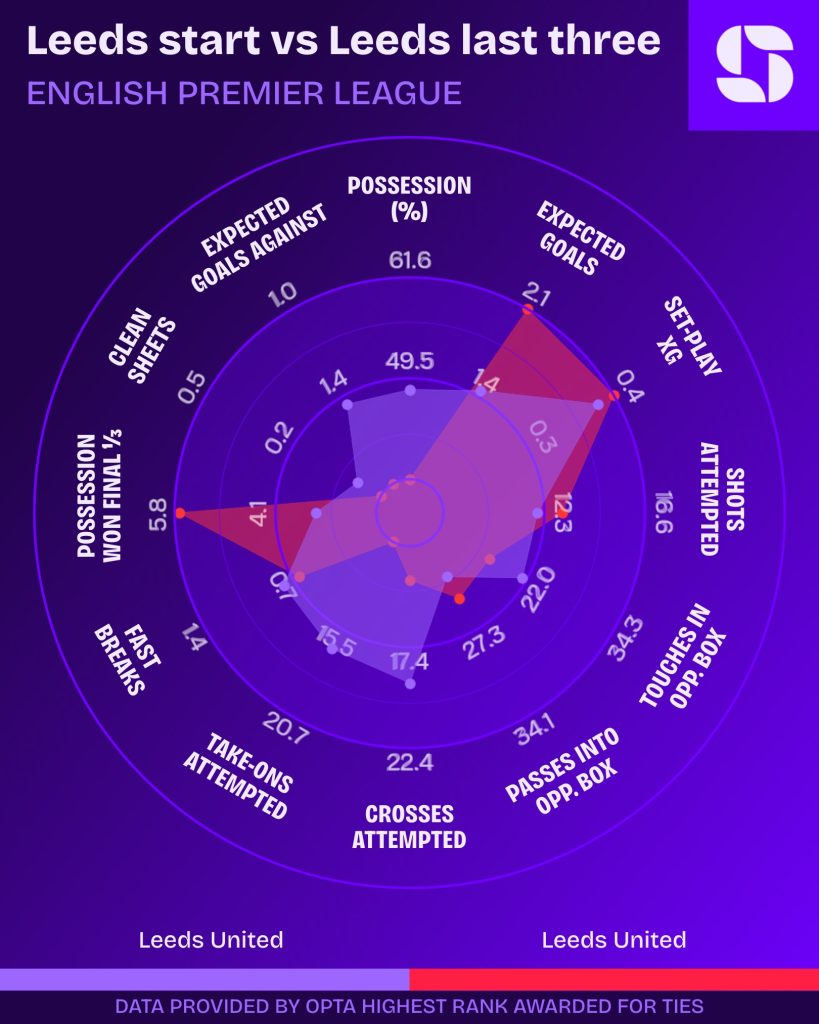
As a result, Leeds found themselves in the relegation zone after 13 games. And Farke was reportedly given two games to save his job, after a 3-2 defeat to Manchester City. That proved to be the key turning point.
Farke made a tweak to his system in the second half of that Man City defeat, causing the Citizens all kinds of trouble. The Whites got back on level terms before eventually falling to a late Phil Foden winner.
However, Farke kept with the system and took four points from his side’s next two games. His job has been saved, and Leeds fans will have plenty of hope for the rest of the campaign.
Farke’s new system
As mentioned, the switch came at half-time against Man City. Farke shifted from a 4-4-3 to a 5-3-2, swapping his wingers for an extra centre-back and striker.
When playing a 4-3-3, Farke’s side shifted into more of a 3-1-6 in possession. They looked to find overloads in wide areas and generate chances from there.
The swap to a 5-3-2 still allows them to shift to a 3-1-6 on the ball. There’s just a different set of profiles on the pitch, and more emphasis on using their physicality.
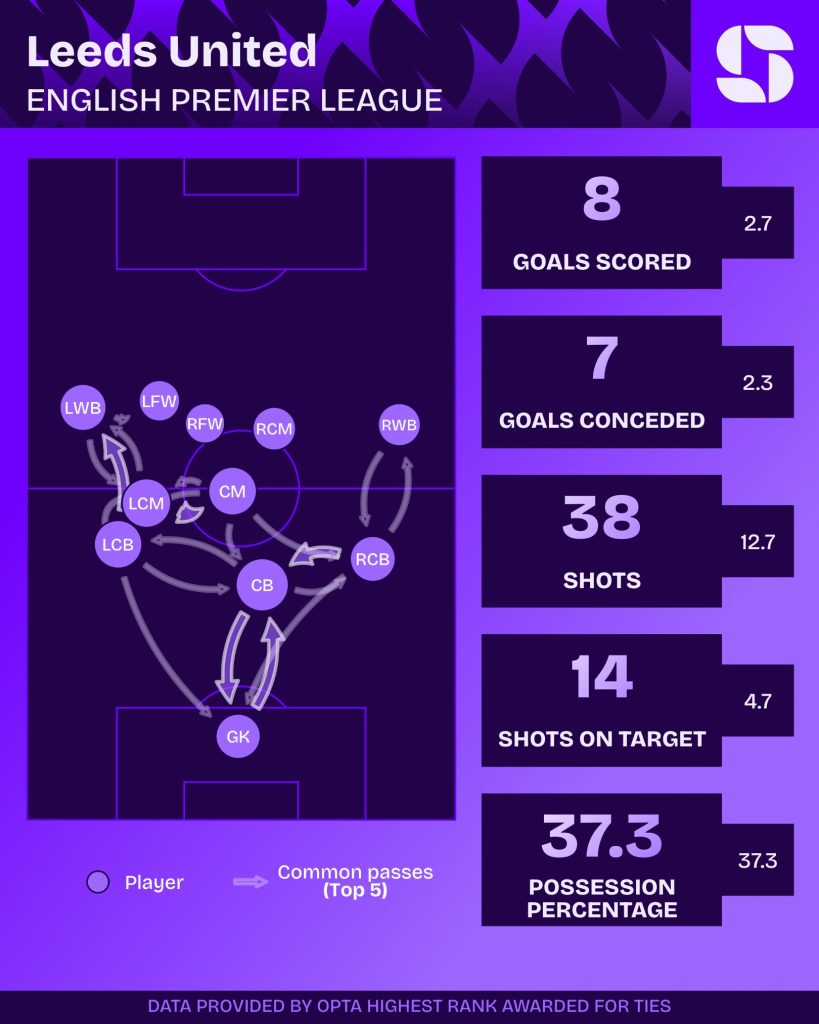
Leeds utilise two classic No.9s through the middle, happy to go direct from their 3-1 base, launching direct passes forward to be contested.
It allows Leeds to gain territory with ease. They can swarm their midfield and wing-backs around the strikers to win the second balls, and generate attacks quickly.
Positives can also be seen out of possession. Despite conceding three times against Liverpool, Leeds’ 5-3-2 shape allows them to effectively block central access, forcing teams to the flanks, dealing with the balls into the box.
Wide triangles
A key aspect of Farke’s Leeds side has been their usage of wide triangles and combinations. Especially in the Championship last season.
These patterns can still be seen in Farke’s new system. But we also saw Leeds return to their 4-3-3 against Liverpool after going 2-0 down. Farke looked to have his men more on the front foot, to pose Arne Slot’s side some different problems.
Combinations between the full-back, ball-side midfielder and winger are encouraged. The three players rotate to offer different solutions in wide 3v3/3v2 scenarios.
These were key to Leeds’ comeback against Liverpool. They progressed down the right flank with those combinations to win the penalty which Dominic Calvert-Lewin slotted home, and Anton Stach’s equaliser to make it 2-2.
Whether they are playing in a 4-3-3 or their new system, Farke will still want to keep those principles in place, building synergies on the flanks to pose teams different problems.
Midfield trio
The foundation of this Leeds team is built on their midfield trio. Ethan Ampadu and Stach are the mainstays, joined by one of Ao Tanaka or Sean Longstaff.
The current tactical meta of the Premier League is shifting heavily to man-to-man pressing, physical advantages and ability to win duels. So a strong midfield three can increase your chances considerably.
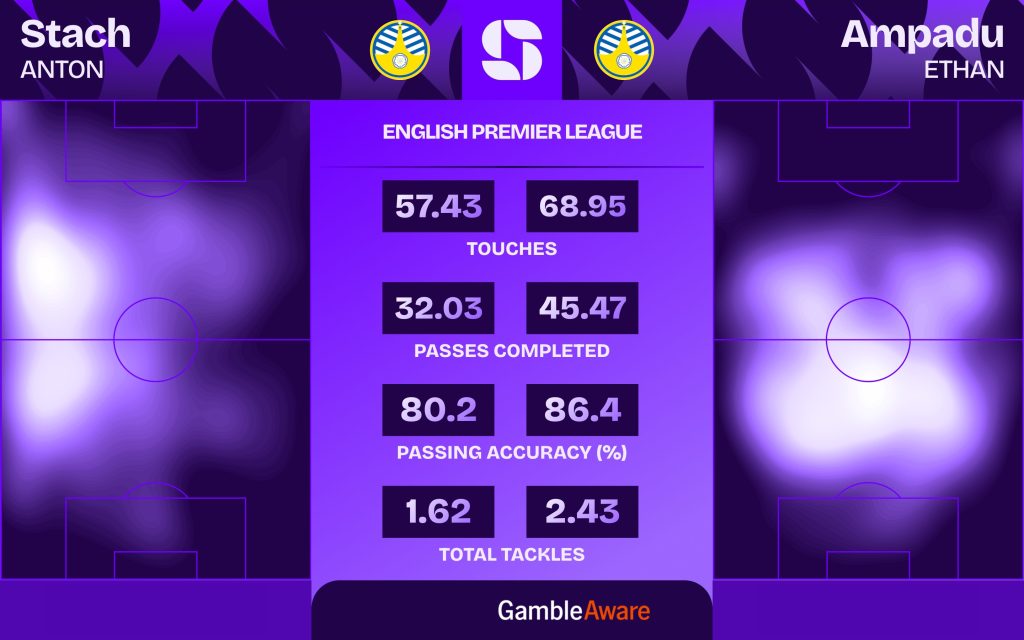
At the base, Ampadu offers steel out of possession, but also composure on the ball as the lone pivot. The Welshman averages 68.95 touches per 90 minutes in the league this season, only fewer than Jaka Bikol and Pascal Struijk.
The midfielders ahead of Ampadu are required to be more aggressive challenging for those second balls further forward, helping Leeds gain territory in the opposition half.
Stach is averaging 1.62 tackles per 90, but offers an aerial prowess from midfield winning 1.79 aerial duels per 90. Tanaka is slightly more mobile, nipping in for tackles and interceptions, making 1.8 tackles per 90 and 1.96 interceptions per 90.
An exciting factor for Leeds fans is also the fact they are yet to see Longstaff in Farke’s new and improved system. He has averaged a whopping 3.58 tackles per 90, so his inclusion could add even more steel in the middle of the park to win those second balls.
The big question for Farke’s side now is how they adjust against teams who will want to sit deeper. Will he look to add more details to his new system or will he go between that and the 4-3-3 for those types of fixtures?