







One of the most satisfying things to watch in football is to see a team chock full of resources and expensive players, frantically try to score against a well-organised team lower than them in the league.
Though the tactics surrounding a low block aren’t always associated with teams that necessarily prioritise staying in the Premier League, low blocks are often deployed by teams that aim to thwart a side with dangerous attackers, denying them space to play and reducing their chances of creating a goalscoring opportunity.
The tactic can be effective because it’s difficult to pick the lock of a team that has many men behind the ball.
Though the game has evolved over the last 15 years or so, with teams wanting to build out from the back, some of the most innovative and celebrated careers in coaching were built on the back of excellent performances that involved low blocks.
Think of Jose Mourinho’s Inter Milan vs Barcelona or Unai Emery at Villarreal.
But what is a low block exactly? Who is using it currently, and what does it mean within the game?
In this article we’ll cover:
What is a low block?
A low block is a defensive, out-of-possession strategy that involves defending deep, with the priority and purpose being to nullify opposition attacks by staying compact close to your own goal.
The key is that the defensive line is deep in their own half, with midfielders and attackers slightly ahead, helping to defend their goal.
It’s all about keeping distances extremely close together and keeping concentration high because it’s likely that the opponent who is attempting to break a low block down has many bodies in the half where they are trying to score a goal.
It’s often the case that if a team decides to defend a lead they have, they fall back into a low block and have many players close to their own box defending.
It’s an effective tool to defend against an attack as it frustrates opponents.
If you have many players behind the ball with the sole purpose of limiting space, teams tend to throw the ball into the box in hopes of finding a goal.
As there are many players inside defending the box, the low block can manage crosses.
It’s more so about the space a team fails to get when trying to score.
Which teams use it?
Historically, managers like Diego Simeone and Jose Mourinho made their mark by turning to the pragmatic tactic of using a low block to win in crucial classic matches.
I already mentioned the Inter Milan Champions League match in 2010 against Pep Guardiola’s Barcelona when Mourinho’s men went down to ten men.
In Simeone’s case, one of his most famous wins came against Guardiola as well, when his Atletico Madrid team impressively beat Bayern Munich in the Champions League semi-final in 2016.
Both managers have commented on the intensity of the second leg, as for almost the entire game, Atletico defended in a mid to low block.
In terms of current managers, Sean Dyche is one of the smartest coaches in terms of using a low block.Limiting space, counter-attacking and generally defending deep when needed is something Dyche is an expert at.
Currently, teams in the Premier League that use a low block are Burnley, Wolverhampton Wanderers, West Ham, Nottingham Forest, Everton, Brentford and Tottenham Hotspur.
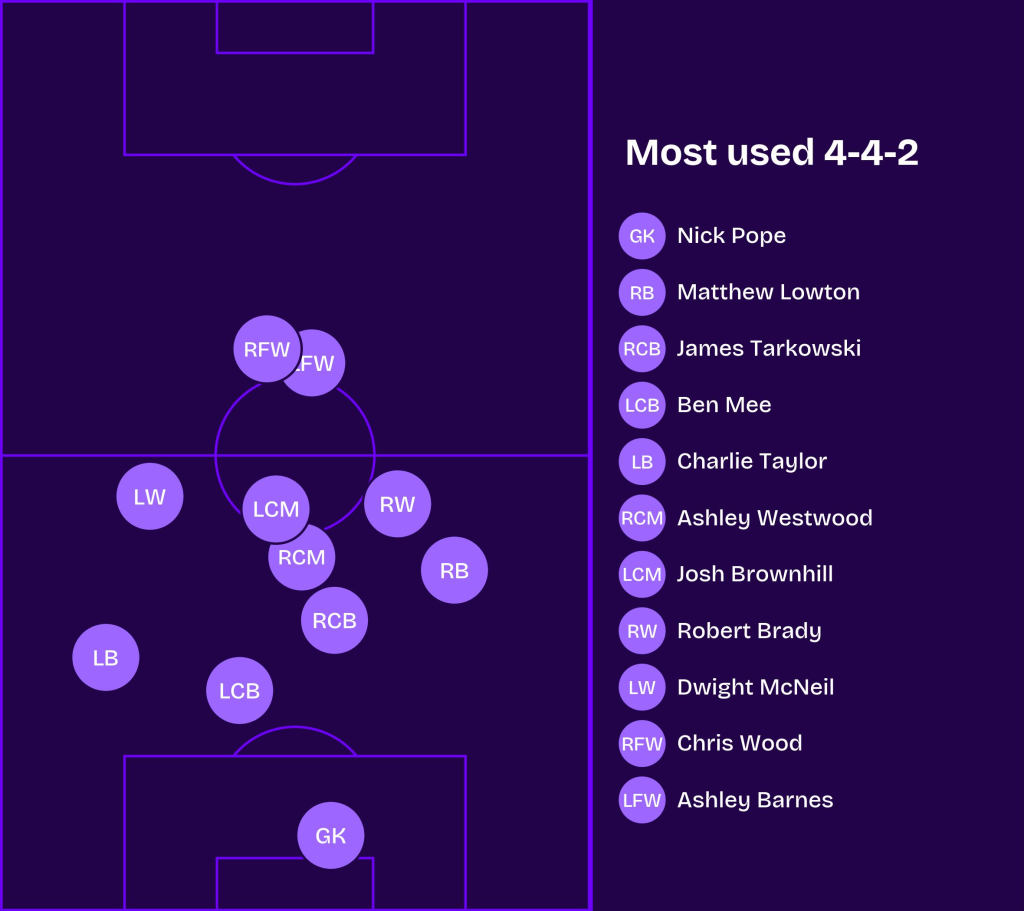
But the crucial thing to mention is that these teams don’t start all their games in a low block and mix it up depending on the opponent.
It’s more of a tactic that these teams predominantly use when they need to be solid. For instance, eyebrows have been raised with Thomas Frank at Tottenham Hotspur, who resorts to a low block, but it’s something he frequently did at Brentford and still clearly believes is useful.
Normally, against Liverpool, Man City, Arsenal and Chelsea, for example, teams may look to start games in a low block, but the tendency is not to stay so close to their own goal for most of the game, as that is too difficult.
It’s why we see many matches that spring a surprise and have the team that should be winning fall behind as teams score goals on the counter-attack when they may spend spells of the game in a low block.
As the team that has most of the ball is tasked with attacking and breaking down the team that is sitting deep, when an attack breaks down, the low-blocking team can break quickly on the counter.
It’s a tactic that many teams deploy, but it becomes difficult to perfect the longer you do it.
Hence, the focus on how teams use it tends to depend on what the game state is, e.g. what the game currently looks like and what the team needs to do to get something from it.
What does it mean within a game?
To follow on from the point above, if teams use it, it means they are prioritising compactness and not conceding a goal. Namely, the strategy is to defend first, scoring second.
The sole aim for teams using it is not to concede; it is one of the most defensive strategies in football. The momentum swing of a game heavily decides when a team goes into a low block.
For instance, Manchester City were beating Fulham 5-1 at Craven Cottage this week before The Cottagers pulled it back to 5-4. You wouldn’t expect a Guardiola team to drop into a low block, but he almost had no choice as Marcos Silva’s men came forward again and again.
Similarly, another time Guardiola used a low block was against Arsenal this season, as they defended a 1-0 early lead, and he felt as though, to concede less space and frustrate Arsenal, who struggled with breaking down deep blocks last season, it was the best tactic.
It goes to show that it’s often the best tactic to use against some of the most dangerous attacks in the world because they are forced to think more creatively as to how to create chances.
Whilst you invite pressure in a low block, you also infuriate the opposition.
It’s commonly seen as a hallmark of an elite manager, as to how good he is at breaking down a low block, as they are normally tasked with needing to do so for 80% or more of their season.
For instance, Hansi Flick at Barcelona often knows how to score against a low block, but Barcelona allow too many transitions and struggle to find a balance.
The low block’s back-to-the-wall approach, coupled with its ability to frustrate, means it will likely remain in the game forever.
The tactical approach is an equaliser and remains a conundrum for the best coaches in the world to figure out.
Read more:
- Latest football news
- Football betting tips
- Best betting sites
- Best free bet offers
- Football accumulator tips
Latest Betting Guides