







North London Forever has a rival.
The club anthem, brought in by Mikel Arteta in 2022, is played before the start of every home game. It celebrates the connection between the club and the local area. But at this point, it doesn’t define Arsenal in the same way this new contender does.
As Eberechi Eze rifled in a volley against Crystal Palace at the weekend, the Emirates erupted with another song.
“Set-piece again, ole, ole.”
Dead balls are synonymous with Arteta’s Arsenal, but it’s taken a step up this season. The Gunners have scored nine set-piece goals in nine Premier League games, plus another two in the Champions League.
Even for a side with Gabriel and Declan Rice, this is a bit silly. So it’s worth discussing the wider context behind the numbers. What are Arsenal doing right?
Dabble sign-up offer: Bet £10+ & Receive £10 In Free Bets
Not signed up to Dabble yet? Here's how to claim the Bet £10+ & Receive £10 In Free Bets welcome offer:
- Sign up to Dabble through this link
- Register your account with accurate personal details
- Place your first bet of £10 or more
- Receive your £10 in free bets when your qualifying bet has setted
- Use your Free Bet on any eligible sportsbook market within 7 days

#AD 18+ 7-day free bet expiry. Stake not returned. Promotional Terms Apply. GambleAware.org
In this article, we’ll cover:
Arsenal adding breadth to their set-piece depth
The ability to subtly reinvent yourself when everyone knows your schtick is a vital quality for would-be champions. Doubly so from a set-piece where your potential routes are finite. Arsenal are managing this in small but tangible ways to add extra layers of threat.
Firstly, they’re engaging with short options more, to play with their opposition.
In many ways, the consistency Arsenal have shown over the years, in their emphasis on Gabriel and exploiting big crashing runs to the back post, has given them their uber-solid base. Eliminating needless variety and adding minor tweaks when needed feels like mathematical optimisation rather than creative art. But that’s what Arsenal have needed.
However, with more set-piece coaches becoming aware of these plays, along with the awareness that Arsenal aren’t exactly samba-style in-possession, you need to add breadth as well as depth to your playbook.
Eberechi Eze’s impact
Arsenal’s use of short corners since Eze’s arrival has been notable. Even if his role is to redirect the ball to an arriving Rice, his positioning and willingness to bait pressure allows Arsenal to reshuffle the box and create new lanes for late arrivers.
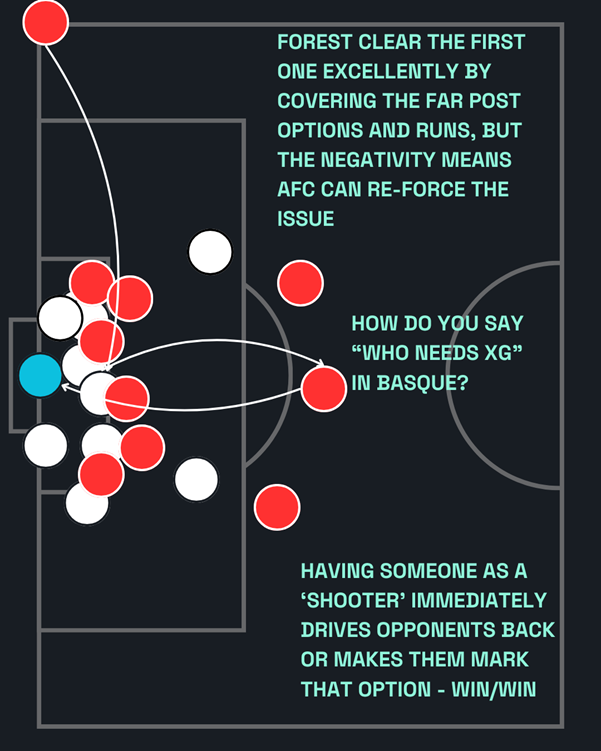
This is how Mikel Merino scored against Newcastle United, with no players in the six-yard box compared to the five there were just seconds before. It aws the same for Martin Zubimendi’s second against Nottingham Forest, creating a 3v1 at the far post despite a full-box from the free-kick. And this is how Gabriel and then Rice nearly grabbed a second at the weekend, by forcing the Palace zonal markers to rush out and away from the six awaiting men at the far post.
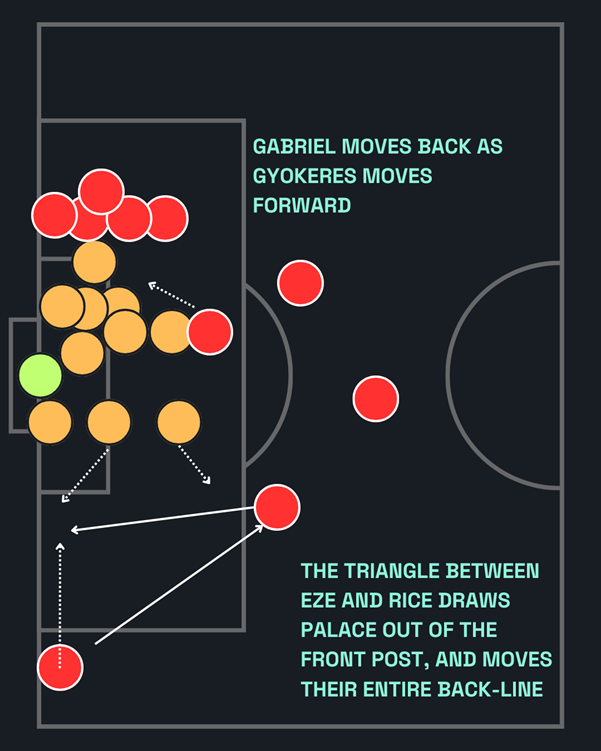
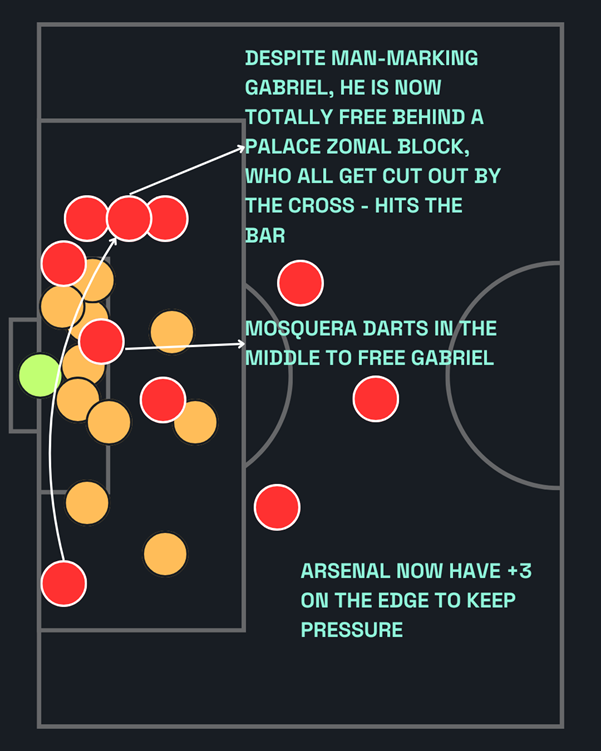
Eze’s value is not limited to being a glorified Chuckle Brother (to me, to you, etc.). He fits in with the wider squad addition of ‘range threat’. With his goal against Palace, and Martin Zubimendi’s thunderous volley against Nottingham Forest, Arsenal are making use of the gravity of their style. By adding players who are happy to ‘have a dig’, the space created by the runs of Gabriel et al can be used appropriately – snaps into the edge of the area to make use of an empty penalty spot and a clear sight of goal.
Arsenal’s domination
Add these to the classic routines: Gabriel driving to the front post, and Timber arriving behind; Saliba sitting on the goalkeeper and ensuring the six-yard remains Arsenal’s; Timber and Calafiori rushing to the back of the front-post markers and blocking their retreat, giving Gabriel a chance to climb and thunder down at the back-post. It’s an onslaught. And with goalkeepers being removed from the equation this season, teams are now relying on a bad delivery more than ever. Arsenal are dominating these moments in as many ways as possible.
But is this just Arsenal being good? It’s certainly worth countering that idea, as this boom goes hand-in-hand with the league.
Set-piece Premier League
Nineteen per cent of all Premier League goals this season have been scored from corners. Not just a set-piece in general, corners. And that now includes one direct from a corner too.
While Arsenal count for a hefty amount of that (2.9%), it’s worth noting that the league is widely shifting towards set-pieces as a dominant decider. And so the weight of these moments is increasing rapidly. Arsenal get the plaudits, but everyone is chasing it. Just within Arsenal’s games, the ‘game-state’ shifting goal (draw to win etc) has been a set-piece in all but two. One for and another against the Gunners. Dominick Szoboszlai’s free-kick and Nick Woltemade’s header both requiring a dead ball rather than an alive one to sneak past David Raya and co.
The league currently is full of press-triggers and dodgy inhalers, far-from-mid mid-blocks, and forwards salivating at the chance of a transition. Nullifying the moments where you’re vulnerable to these skillsets, the ‘alive balls’, and emphasising those you can almost enforce a structure onto an opponent, the dead ones, is very in vogue. While none quite match Arsenal, in style and in substance, nearly a third of all Premier League teams rely on set-pieces for over 30% of their goals. And nearly half do the same for Expected Goals.
The generation of ‘dead’ moments provides a neat shortcut for tactical solutions, letting chaos be on your terms, very visually doing so with the renaissance of long throws. While Arsenal have had a head-start, and are certainly adding some much-needed diversity to their portfolio this year, the rest of the league are buying in now too.
I look forward to “Throw on, Throw on” bellowing round Anfield sometime in 2026.