





From best to worst, the 10 poker hands are royal flush, straight flush, four of a kind, full house, flush, straight, three of a kind, two pair, one pair and high card. A hand in a higher category always beats one in a lower category, and suits never break a tie.
| Rank | Hand | Example | What it is | Odds (five cards) |
|---|---|---|---|---|
| 1 | Royal flush | A♠ K♠ Q♠ J♠ 10♠ | Ace-high straight flush | 1 in 649,740 |
| 2 | Straight flush | 9♥ 8♥ 7♥ 6♥ 5♥ | Five in sequence, one suit | 1 in 72,193 |
| 3 | Four of a kind | Q♠ Q♥ Q♦ Q♣ 7♠ | Four cards of one rank | 1 in 4,165 |
| 4 | Full house | K♠ K♥ K♦ 4♣ 4♠ | Three of a kind plus a pair | 1 in 694 |
| 5 | Flush | A♦ J♦ 8♦ 6♦ 2♦ | Five of one suit, not in sequence | 1 in 509 |
| 6 | Straight | 10♣ 9♦ 8♠ 7♥ 6♣ | Five in sequence, mixed suits | 1 in 255 |
| 7 | Three of a kind | 8♠ 8♥ 8♦ K♣ 3♠ | Three cards of one rank | 1 in 47.3 |
| 8 | Two pair | J♠ J♦ 6♣ 6♥ A♠ | Two different pairs | 1 in 21 |
| 9 | One pair | 10♥ 10♣ K♠ 7♦ 4♣ | Two cards of one rank | 1 in 2.37 |
| 10 | High card | A♣ J♦ 9♠ 6♥ 3♣ | None of the above | 1 in 2 |
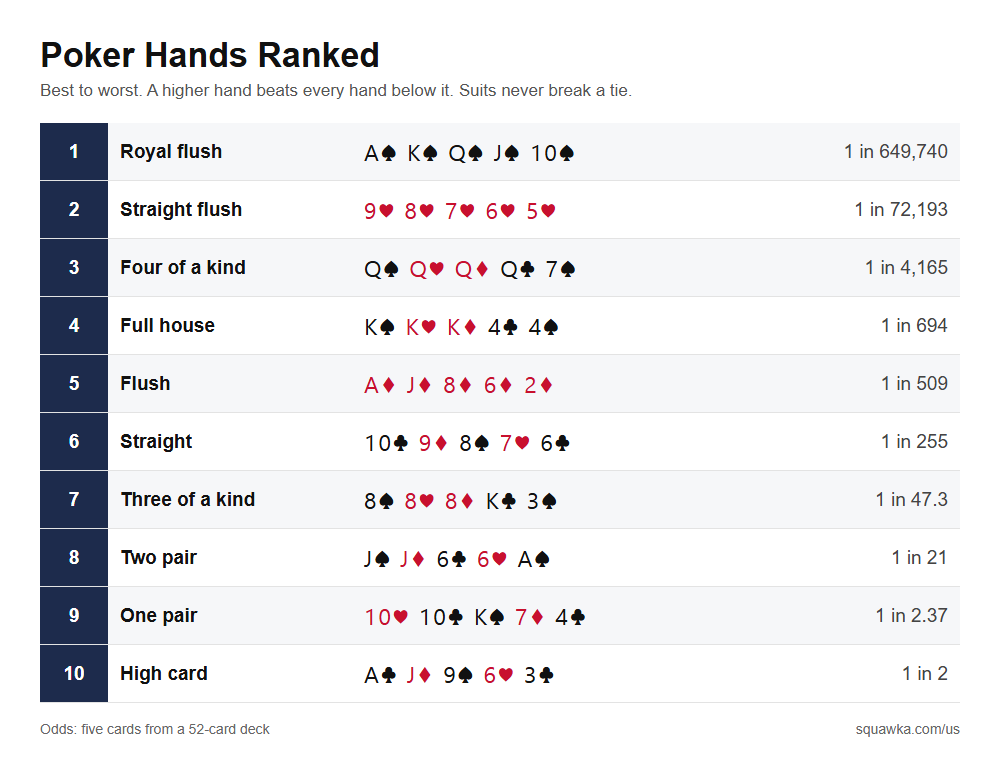
The odds in the chart are for five cards dealt from a full 52-card deck, the basis on which the order was set. Texas Hold’em gives you seven cards to choose from, which changes how often each hand turns up but not the order. The odds section below has both sets of numbers, which we calculated by counting every possible hand.
The 10 Poker Hands, Explained
Every poker hand is the best five cards a player can make, and each one falls into one of these 10 categories. When two players hold hands from the same category, the rules under each hand below decide the winner.
1. Royal Flush
A royal flush is an ace, king, queen, jack and 10 of the same suit, for example A♠ K♠ Q♠ J♠ 10♠. It is the best hand in standard poker, and there are only four of them, one per suit. Strictly, it is the highest possible straight flush, so some charts fold it into that category and count nine hands instead of 10.
You’ll make one in 1 of every 649,740 five-card deals, or about 1 in 30,940 hands when you have seven cards to choose from. In Texas Hold’em two players can’t both hold one unless all five community cards form the royal flush, and then everyone still in the hand splits the pot.
2. Straight Flush
A straight flush is five cards in sequence, all of the same suit, such as 9♥ 8♥ 7♥ 6♥ 5♥. When two straight flushes meet, the one with the higher top card wins. The lowest is 5-4-3-2-A of one suit, which players call a steel wheel, because the ace can play low in a straight.
There are 36 straight flushes below the royal flush in a 52-card deck, nine per suit, so a five-card deal makes one about once in every 72,193 hands.
3. Four of a Kind
Four of a kind, or quads, is all four cards of one rank plus any fifth card, such as Q♠ Q♥ Q♦ Q♣ 7♠. Higher quads beat lower quads. In Hold’em, when all four cards are on the board and every player shares them, the fifth card, called the kicker, decides the pot, so A♠ beats K♦ as the extra card.
Four of a kind turns up once in about 4,165 five-card hands and once in 595 seven-card hands.
4. Full House
A full house is three cards of one rank plus a pair of another, such as K♠ K♥ K♦ 4♣ 4♠, read as “kings full of fours”. Players also call it a boat. Between two full houses, the three of a kind decides first, so 3-3-3-A-A beats 2-2-2-K-K. Only when the three of a kind is shared, which can happen in Hold’em, does the pair decide.
A full house comes up once in about 694 five-card hands. With seven cards it is far more common, at 2.6% of hands, or about 1 in 38.5.
5. Flush
A flush is any five cards of the same suit that aren’t in sequence, such as A♦ J♦ 8♦ 6♦ 2♦. To compare two flushes, look at the highest card first, then the second-highest, and so on down to the fifth card. A♦ J♦ 8♦ 6♦ 2♦ beats A♣ J♣ 8♣ 5♣ 4♣ on the fourth card. The suit itself never matters, so a spade flush is no better than a club flush with the same cards.
There are 5,108 flushes in a 52-card deck, which works out to 1 in about 509 five-card hands and 1 in 33 seven-card hands.
6. Straight
A straight is five cards in sequence in mixed suits, such as 10♣ 9♦ 8♠ 7♥ 6♣. The higher top card wins, so the best straight is A-K-Q-J-10 (Broadway) and the lowest is 5-4-3-2-A (the wheel). The ace can play high or low, but not both at once: Q-K-A-2-3 is not a straight, because straights don’t wrap around the corner.
You can expect a straight in about 1 of every 255 five-card hands, and 1 in 21.6 seven-card hands.
7. Three of a Kind
Three of a kind is three cards of one rank plus two unrelated cards, such as 8♠ 8♥ 8♦ K♣ 3♠. Higher trips win, and if two players share the same three of a kind on the board, their two best kickers decide. In Hold’em, a set means a pocket pair plus one matching board card, while trips means one card in your hand plus a pair on the board. Both are the same hand for ranking purposes, but a set is better hidden from opponents.
Three of a kind is a 1-in-47 hand with five cards and a 1-in-20.7 hand with seven.
8. Two Pair
Two pair is two cards of one rank, two of another and one unrelated card, such as J♠ J♦ 6♣ 6♥ A♠. The higher pair decides first, then the lower pair, then the fifth card. So J-J-6-6-A beats J-J-5-5-K, and J-J-6-6-A beats J-J-6-6-Q on the kicker.
You make two pair in about 1 of every 21 five-card hands. With seven cards it is common, at 23.5% of hands.
9. One Pair
One pair is two cards of the same rank plus three unrelated cards, such as 10♥ 10♣ K♠ 7♦ 4♣. A higher pair wins. When the pairs match, the highest kicker decides, then the second, then the third.
One pair is the most common hand you’ll hold in Texas Hold’em, at 43.8% of seven-card hands.
10. High Card
High card is any hand that makes none of the above, such as A♣ J♦ 9♠ 6♥ 3♣, read as “ace high”. Two high-card hands are compared card by card from the top. The worst possible hand in standard poker is 7-5-4-3-2 in mixed suits, because 6-5-4-3-2 would be a straight and five cards of one suit would be a flush.
High card is half of all five-card deals (50.1%), but only 17.4% of seven-card hands, since the two extra cards usually pair something.
What Beats What in Poker
Each hand beats every hand below it in the chart. These are the match-ups players ask about most, with the reason in the numbers: the higher hand is always the rarer one in a five-card deal.
- A flush beats a straight. A 52-card deck has 5,108 flushes and 10,200 straights, so a straight is about twice as common.
- A full house beats a flush. There are 3,744 full houses against 5,108 flushes.
- Four of a kind beats a full house. Quads are six times rarer, at 624 hands against 3,744.
- A straight flush beats four of a kind. Only 40 straight flushes exist, the four royal flushes included, against 624 sets of quads.
- A straight beats three of a kind. In a five-card deal, three of a kind (54,912 hands) is more than five times as common as a straight (10,200).
- Three of a kind beats two pair, and two pair beats one pair. Each step down the chart roughly doubles or more the number of possible hands.
My tip for remembering the order: learn the two pairings people mix up, flush over straight and full house over flush, and the rest follows the chart.
Poker Hand Odds: Five Cards vs Seven Cards
The chance of each hand depends on how many cards you get to choose from. We counted all 2,598,960 possible five-card hands and all 133,784,560 possible seven-card hands, scoring each seven-card hand by its best five cards, as Texas Hold’em and Seven Card Stud do.
| Hand | Five-card hands | Share of five-card hands | Seven-card hands (best five) | Share of seven-card hands |
|---|---|---|---|---|
| Royal flush | 4 | 0.0002% | 4,324 | 0.0032% |
| Straight flush | 36 | 0.0014% | 37,260 | 0.028% |
| Four of a kind | 624 | 0.024% | 224,848 | 0.17% |
| Full house | 3,744 | 0.14% | 3,473,184 | 2.6% |
| Flush | 5,108 | 0.20% | 4,047,644 | 3.0% |
| Straight | 10,200 | 0.39% | 6,180,020 | 4.6% |
| Three of a kind | 54,912 | 2.1% | 6,461,620 | 4.8% |
| Two pair | 123,552 | 4.8% | 31,433,400 | 23.5% |
| One pair | 1,098,240 | 42.3% | 58,627,800 | 43.8% |
| High card | 1,302,540 | 50.1% | 23,294,460 | 17.4% |
| Total | 2,598,960 | 100% | 133,784,560 | 100% |
The table shows something hand-ranking charts rarely mention: the order matches five-card odds, not Hold’em odds. With seven cards, three of a kind (4.83% of hands) actually comes up more often than a straight (4.62%), yet a straight still ranks higher. High card is rarer than both one pair and two pair, yet it still ranks last. Poker kept the order from five-card games, so the ranking tells you which hand wins a showdown, not how often you’ll be dealt it.
How Ties Are Broken
When two hands fall in the same category, you compare the cards that make the hand first and the leftover cards, called kickers, after that. Only five cards ever count.
- Pairs and three of a kind: the higher pair or trips wins, then the highest kicker, then the next.
- Two pair: the higher pair, then the lower pair, then the kicker.
- Full house: the three of a kind, then the pair.
- Flush and high card: every card, from the highest down to the fifth.
- Straight and straight flush: the top card only, with the wheel (5-4-3-2-A) the lowest.
- Exactly equal five-card hands split the pot. Suits never break the tie.
Here is a kicker deciding a hand. You hold K♠ Q♦, your opponent holds K♥ 9♣, and the board is K♣ 8♦ 5♠ 3♥ 2♣. You both have a pair of kings, but your best five cards are K-K-Q-8-5 and theirs are K-K-9-8-5, so your queen wins.
Here is a kicker that doesn’t play. The board is A♠ A♦ K♣ K♥ Q♠, you hold J♣ J♦ and your opponent holds 4♣ 2♦. Both of you play A-A-K-K-Q from the board, because a third pair can’t be part of a five-card hand, so the pot is split. In my view, this “counterfeit” is the ruling beginners argue with most at the table.
When a pot can’t be split evenly, the Poker Tournament Directors Association (TDA) rules give the odd chip to the first player to the left of the button in games with a button, such as Hold’em. In stud games, they give it to the player with the highest card by suit. That is one of the few places a suit matters, and it only settles a chip, never which hand is better.
How to Read Your Hand in Texas Hold’em and Omaha
In Texas Hold’em, your hand is the best five cards out of your two hole cards and the five community cards. You can use both hole cards, one or neither. Using neither is called playing the board, and the best you can then do is split the pot with everyone else who plays it. Under TDA rules you have to show both hole cards to claim a share.
Take a board of A♠ K♦ Q♣ J♥ 10♠. Every player still in the hand has the same ace-high straight, since no one can make a flush with only two spades on the board, so the pot is split however strong the hole cards look.
Omaha uses the same hand rankings but a stricter rule: your hand must contain exactly two of your four hole cards and exactly three community cards. That catches out Hold’em players all the time. With a board of A♥ K♥ 7♥ 4♥ 2♣ and Q♥ J♣ 9♦ 9♠ in your hand, you don’t have a flush, because you hold only one heart. Your best Omaha hand is a pair of nines. The same cards in Hold’em would make an ace-high flush.
Hand Rankings in Other Poker Games
The standard order holds in Texas Hold’em, Omaha, Seven Card Stud and Five Card Draw. A few games change it, and two of them are casino games you’ll find at licensed US online casinos.
- Three Card Poker: with only three cards, a straight is rarer than a flush, so the order changes. It runs straight flush, three of a kind, straight, flush, pair, high card. Of the 22,100 possible three-card hands, 720 are straights and 1,096 are flushes.
- Video poker: games such as Jacks or Better use the standard five-card order, and the pay table rewards each hand by how rare it is, with the royal flush paying the most.
- Short Deck (Six Plus) Hold’em: the 2s through 5s are removed, leaving 36 cards. A flush beats a full house, because flushes become the harder hand to make. Whether three of a kind beats a straight varies by game and room, so check the house rules before you play. The ace can still play low, making A-6-7-8-9 the lowest straight.
- Ace-to-Five lowball (used in Razz and California lowball): the lowest hand wins, aces are always low, and straights and flushes don’t count, so the best hand is A-2-3-4-5.
- Deuce-to-Seven lowball (used in 2-7 Triple Draw): the lowest hand wins, aces are high, and straights and flushes count against you, so the best hand is 7-5-4-3-2 in mixed suits, the same hand that is the worst in standard poker.
- Wild cards: home games with jokers or deuces wild allow five of a kind, which ranks above a straight flush.
Poker Hand Nicknames
Players rarely use the formal names at the table. These are the ones you’ll hear most.
| Nickname | Hand |
|---|---|
| Boat or full boat | Full house |
| Quads | Four of a kind |
| Trips | Three of a kind using a pair on the board |
| Set | Three of a kind using a pocket pair |
| Broadway | The ace-high straight, A-K-Q-J-10 |
| Wheel or bicycle | The five-high straight, 5-4-3-2-A |
| Steel wheel | The five-high straight flush |
| The nuts | The best possible hand on a given board |
The Dead Man’s Hand
The dead man’s hand is two pair, black aces and black eights, the hand Wild Bill Hickok is said to have held when he was shot. The shooting is documented: Jack McCall shot Hickok in the back of the head during a poker game in a Deadwood saloon, in what was then Dakota Territory, on August 2, 1876.
The cards are legend. No record from the time says what Hickok held, accounts disagree on the fifth card, and the phrase “dead man’s hand” was used for other hands before it was linked to him. It is still the best-known hand in poker, and the one I’d tell you about first if you asked me for poker history.
Where You Can Play Poker for Real Money in the US
Regulated online poker against other players is live in six states: Nevada, New Jersey, Delaware, Pennsylvania, Michigan and West Virginia. You must be 21 or older and physically inside the state to play for real money. Under the Multi-State Internet Gaming Agreement, sites in member states can seat players from several states at the same tables, which Pennsylvania joined in April 2025.
Connecticut and Maine have also passed laws that allow online poker, but the sources we checked in November 2026 showed no site live in either state yet. Elsewhere, sweepstakes poker sites let you play with virtual chips and redeem prizes, but each sets its own list of excluded states and those lists change often, so check the site’s terms for your state.
Licensed online casinos also carry poker-based table games, such as video poker and Three Card Poker, where you play against the house rather than other players. Our state guides to New Jersey, Pennsylvania, Michigan, West Virginia and Delaware list the licensed casinos in each state, and our casino apps ranking shows which ones are rated best on iPhone and Android. If you’re outside those states, our sweepstakes casinos guide covers the no-purchase alternative.
FAQs
There are 2,598,960 possible five-card hands from a 52-card deck. Because suits don’t rank, many of those hands are equal in value, which leaves 7,462 distinct hand strengths.
Not in Texas Hold’em with separate royal flushes, because two different suits would each need three of the five board cards. Two players share a royal flush only when all five board cards form it, and then the pot is split.
Play responsibly. 21+. Real-money online poker and casino games are only for players physically located in a state where they’re legal. For help, call or text 1-800-MY-RESET or 1-800-GAMBLER, and see our responsible gaming help page.