


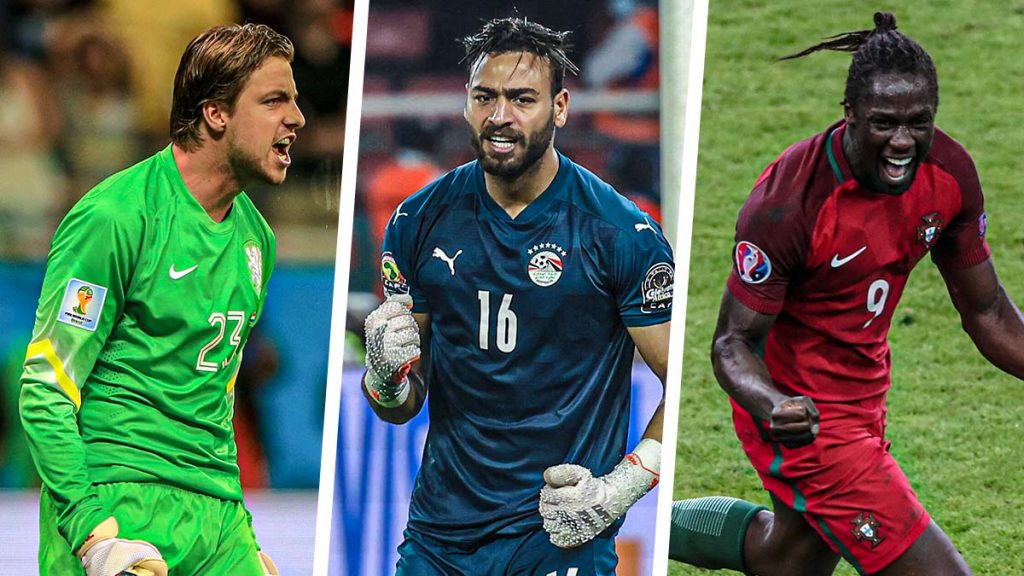
The 2025 Africa Cup of Nations is almost upon us.
Africa’s best players will travel to Morocco hoping to lead their nations to glory. And we can’t wait.
Everyone loves an international tournament. For the fans involved, it’s a chance to see your country win something. And for neutrals, international tournaments always seem to be filled with more drama.
International tournaments are also a chance for players to make a name for themselves. Perhaps ones that may otherwise slip under the radar at club level.
With that, we’ve chronicled a series of tournament cult heroes down below; those remembered for what they achieved in international football.

- Bet £10 get £30
- Excellent Football Betting Options
- Extensive Bet-Builder
- Multi-Award Winning Bookmaker
New customers can sign up using bonus code SQUAWKA365, bet £10 and get £30 in Free Bets. Min deposit requirement. Free Bets are paid as Bet Credits and are available for use upon settlement of bets to value of qualifying deposit. Min odds, bet and payment method exclusions apply. Returns exclude Bet Credits stake. Time limits and T&Cs apply. Registration Required. This code is for marketing and tracking purposes only. #Ad.

- Enhanced Offers
- Exceptional Customer Service
- Fantastic Promotions
#AD 18+ New customers only. Place a min £10 pre-event bet at min odds of 2.0. £40 worth of Free Bet Tokens awarded on bet settlement. 4 x £10 each with betting restrictions. 7 day expiry. Debit Card deposits only (exclusions apply). 18+ GambleAware.org. Bet The Responsible Way Full Terms apply
Oleg Salenko

The 1994 World Cup represents a who’s who of international cult heroes, many of whom we’ll document here. But the pick of the bunch was argubaly Oleg Salenko.
The former Rangers and Valencia forward only racked up eight caps for Russia in his entire career, though a return of six goals is certainly no mean feat. But all of those came in USA ’94 as he finished with the Golden Boot alongside Bulgarian immortal Hristo Stoichkov. Incredibly, Salenko netted five against Cameroon, setting a record for the most goals in a single game, a record that still stands to this day.
And he didn’t even make it to the knockouts. Salenko remains the only player in World Cup history to win the Golden Boot and get knocked out in the groups.
Saeed Al-Owairan
Staying stateside in 1994, Saudi Arabia were one of three new World Cup entrants that year alongside Greece and Nigeria. And boy did they mark their debut with a memorable showing.
Jorge Solari’s band of unpredictable mavericks made it to the knockouts after beating Morocco and Belgium in Group F. The latter result played witness to one of the great World Cup goals. Saudi Arabia’s spellbinding, often eccentric brand of football was typified by talisman Saeed Al-Owairan, whose solo effort against Belgium was ranked sixth in Fifa’s Goal of the Century rankings. Collecting the ball in his own half, Al-Owairan skipped past four players, travelled 69 metres and smashed the ball home. It was Diego Maradona-esque.
Roger Milla

Roger Milla has often been heralded as one of the pioneers of imaginative goal celebrations which are now seen regularly in football at all levels. But to remember the Cameroon legend for his corner-flag dance routine alone would be a huge disservice to one of Africa’s greatest players of all time.
He currently holds the record of being the oldest goalscorer in World Cup history, netting against Russia at the age of 42 at — you guessed it — USA ’94. But four years earlier he actually set that record at Italia ’90, scoring a quite absurd four goals at the ripe old age of 38. It even earned him a place in the tournament’s All-star team.
Tim Krul

Penalty shootouts have often been described as a lottery, a Russian roulette of fate. Louis van Gaal said ‘sod that’ in 2014 and decided to let his pragmatism dictate the outcome of the Netherlands’ quarter-final clash with Costa Rica.
In the 120th minute, he brought on Tim Krul for Jasper Cillessen just for their sudden death shootout. Fortunately for Van Gaal, we can all now laud his genius and the tactical foresight he had to make such an audacious move. Krul ultimately saved two penalties as the Netherlands advanced, and he remains the only goalkeeper sent on as a substitute solely for a penalty shootout in World Cup history. And Cillessen didn’t know what was coming…
“We said nothing to Jasper because we didn’t want him to know before the game,” van Gaal said after the game.
“But as I’ve explained, every keeper has specific qualities. Tim has a longer reach and a better track record with penalties than Cillessen. We had discussed it with Tim. He knew about their penalties because he needed to be prepared. It worked out. If it hadn’t, it would have been my mistake.”
Enner Valencia

Talking of the 2014 World Cup, we may as well look at Enner Valencia and how his performances earned him a move to West Ham United.
When it comes to strikers, the Hammers are notoriously scatter-gun with their approach. But ‘The Daves’ thought they nabbed a superstar when Valencia decided to join them shortly after the 2014 World Cup. In Brazil, Valencia scored all three of Ecuador’s goals and subsequently moved to a club he had only actually heard of because of the film Green Street.
Forget dusting off the ol’ corporate spiel ‘I have always dreamt of playing for club x since I was a child’, Enner had his heart set on eating jellied eels in The Shire.
Eder

The stage was set at the Stade de France in 2016. Cristiano Ronaldo was expected to be the protagonist. The solo artist sculpting his masterpiece. After 25 minutes he came off injured and danced his best Simeone as Portugal’s ultimate cheerleader on the sidelines.
As for events on the pitch, they would be decided by a Swansea flop. No, not Young Player of the Tournament Renato Sanches, who had not yet moved to South Wales — where a certain advertising hoarding would define his ill-fated stint — but rather Eder. A grand total of zero goals in 15 appearances at the Liberty Stadium didn’t exactly scream inspired when Fernando Santos turned to him in the 79th minute. However, he would ultimately prove the match-decider in a rare moment of brilliance.
Fabio Grosso

Not exactly known for his goalscoring prowess, Fabio Grosso bagged two crucial goals in the 2006 World Cup — though only one stands as an official strike.
The first was a 119th-minute winner against Germany in the semi-finals, with Alessandro Del Piero putting the seal on that triumph shortly after. Grosso then scored the winning penalty in the final shootout against France. In a side blessed with footballing immortals, few would have expected Grosso to transcend the likes of Gianluigi Buffon, Andrea Pirlo, Fabio Cannavaro, Alessandro Del Piero and Francesco Totti in Berlin.
Birkir Mar Saevarsson

Iceland’s 2016 squad could possibly be bracketed here as a single entity. But we’ve decided to include Birkir Mar Saevarsson purely for his redemption arc. Having kept a lid on Cristiano Ronaldo in Iceland’s curtain-raising draw with eventual Euro 2016 winners Portugal, Saevarsson conceded a late own goal in the following 1-1 draw with Hungary, shrouding the nation’s chances of progressing in doubt.
Ultimately, Lars Lagerback’s men would win their final group game, finishing above Portugal. They then script-defyingly knocked out England, before netting twice against France in the quarters. This was Saevarsson’s tournament debut, and having scored that own goal on matchday two, he bounced back expertly to make Icelandic history.
Antonin Panenka

In an age where every goal is micro-analysed, dissected, often set to dubstep on YouTube and rewatched countless of times on social media, it’s no wonder players are often finding innovative, expressive ways to display their talents. Just look at Erik Lamela’s 2021 Puskas-winning rabona in the north London derby. But, for Antonin Panenka in the Euro 1976 final between Czechoslovakia and West Germany, there were no glittering awards shows in Zurich waiting with bated breath to bestow him a shiny medal for his mantlepiece.
He simply had the pressure and weight of a nation on his shoulders. With a chance to win the European Championship in a penalty shootout, Panenka attempted the most gutsy of spot-kicks to dink Sepp Maier, earning universal recognition in style (and substance).
Angelos Charisteas

Angelos Charisteas enjoyed two cinderella stories in his career. And both came in 2004.
In 2003-04, Charisteas scored seven times to help Werder Bremen win their first-ever Double. That summer, he scored three goals to win Euro 2004 with Greece, a fairytale achievement up there with Leicester City winning the Premier League.
Charisteas netted the only goal in a 1-0 win over France in the quarters and then the only goal in a 1-0 win over Portugal in the final. He finished 11th in that year’s Ballon d’Or as a result.
John Jensen

Denmark’s Euro 1992 triumph is well-documented. Richard Moller Nielsen’s ‘Danish Dynamite’ famously didn’t qualify for the tournament. But they made the Swedish showpiece after Yugoslavia were disqualified.
Having to quickly shift from beach mode to tournament mode, Denmark embarked on a giant-killing spree that culminated in them claiming the scalps of several heavyweight nations and winning the entire thing. Jensen netted a sublime goal in the final against Germany and subsequently earned a move to Arsenal that summer. He was pretty unremarkable — to put it mildly — in north London. But his career remains defined by that summer in Sweden and not the ensuing years in England.
Gabaski
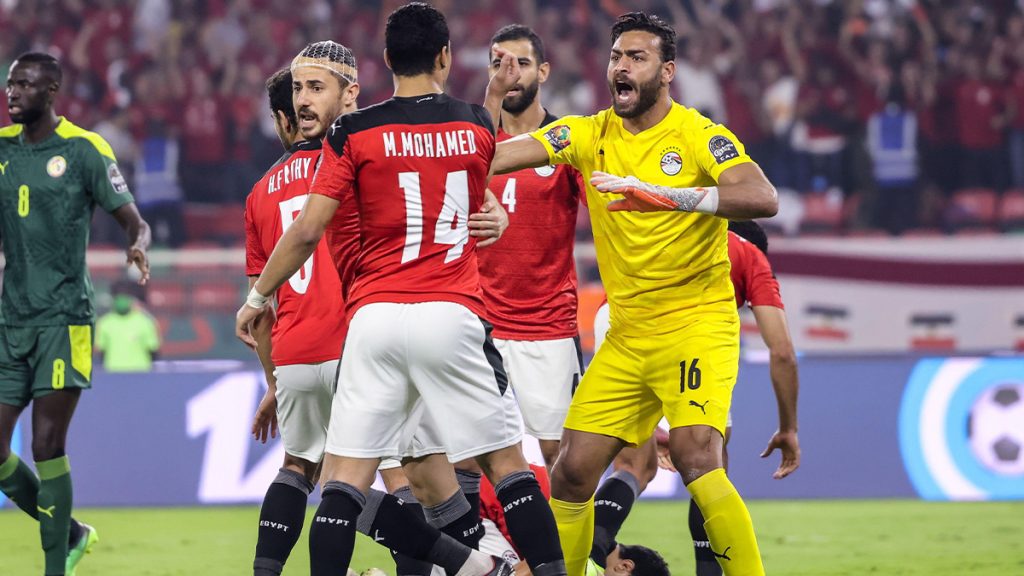
Mohamed Abou Gabal, also known as Gabaski, didn’t win the Best Goalkeeper award at AFCON 2021. But he won everyone’s hearts.
The Egyptian goalkeeper firmly etched his name in AFCON folklore after a string of high-dextrous performances saw him win two penalty shootouts for Egypt. He also won the Man of the Match award in the final, even though Egypt lost.
Gabaski was a bit of an unknown entity going into AFCON 2021. He went into the tournament with just three international caps. Even now that’s only been extended to 14. And never played club football outside of Egypt. But his near-impenetrable efforts between the sticks in Cameroon have now thrust his name into the limelight.