




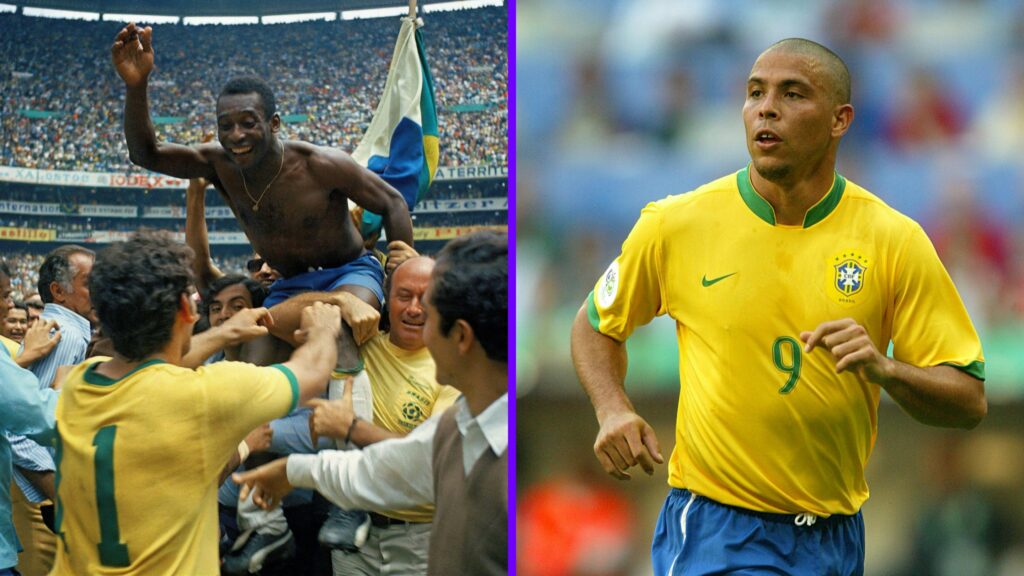
Squawka’s new series ‘The GOAT Debate’ takes a look at some of the timeless questions that every football fans asks — Who is the GOAT?
The next in this series tries to determine which Brazilian legend is the Seleção GOAT — Pele or Ronaldo. We’ll be taking various aspects into account to come up with an answer, including both their club and international careers, their peaks and outside factors.
While the true answer will never truly be known, we think we can make the results a little clearer with subjectivity and data. Read on to find out who we think is the Brazilian greatest of all time.
Bet £10 & Get £30 in Free Bets with Bet365
Not signed up to bet365 yet? Here's how to claim one of the best bookmaker welcome offers around...
- Open an account (here's a link)
- Make a qualifying deposit of between £5* and £10*
- Claim the offer to receive three times your deposit in 'Free Bets'.
- To release your 'Free Bets', place qualifying bets to the value of your qualifying deposit and allow those bets to settle.
- Your 'Free Bets' will become available shortly after your qualifying bets have settled
- To use your 'Free Bets', select 'Use bet credits' in the bet slip.

Min deposit requirement. Free Bets are paid as Bet Credits and are available for use upon settlement of qualifying bets. Min odds, bet and payment method exclusions apply. Returns exclude Bet Credits stake. Time limits and T&Cs apply.
The argument over who holds the crown as Brazil’s greatest ever forward is a clash of distinct mythologies. It is an inquiry into what we value most: the untouchable, sustained majesty of a player who became the sport’s first global icon, or the fleeting, explosive brilliance of a striker who redefined the physical limits of the game.
Those who champion Pelé point to an unparalleled legacy of three World Cup victories, an astonishing volume of career goals, and a complete mastery of every attacking discipline. They argue he was the architect of modern football, achieving his feats in an era of heavy boots, sodden pitches, and ferocious, unpunished tackling. Conversely, Ronaldo’s advocates point to a peak that simply broke the parameters of modern defending. They argue that the Fenômeno who emerged at Barcelona and Inter Milan in the late 1990s – combining the acceleration of an Olympic sprinter with mesmerising technical control – was the most devastating individual weapon the sport has ever witnessed. They ask what might have been had his knees not betrayed him, and point to his miraculous 2002 World Cup redemption as the ultimate proof of his character.
Both narratives are compelling. Both are steeped in nostalgia. This analysis, however, demands a more clinical approach. By deploying era-adjusted metrics to account for the tactical and physical shifts between the 1960s and the turn of the millennium, alongside a sophisticated simulation model that places both men in equivalent competitive environments, we aim to strip away the romance and deliver a quantified verdict.
The results illuminate the true distance between the King and the Phenomenon.
The raw numbers: A starting point
Before diving into the complexities of era adjustment, the unvarnished career statistics provide a baseline for the comparison.
| Metric | Pele | Ronaldo |
|---|---|---|
| Senior career appearances | 831 | 616 |
| Senior career goals | 757 | 414 |
| Senior career assists | 360 | 127 |
| Goals per game | 0.91 | 0.67 |
| Goal contributions per game | 1.31 | 0.87 |
| International caps | 92 | 98 |
| International goals | 77 | 62 |
| International goals per game | 0.83 | 0.63 |
| Club trophies | 26 | 13 |
| World Cup wins | 3 (1958, 1962, 1970) | 2 (1994, 2002) |
| Ballon d’Or wins | 7 (retrospective) | 2 (1997, 2002) |
On the surface, the numbers present a landslide victory for Pelé. His official goal-per-game ratio eclipses Ronaldo’s by a staggering 35%. His international strike rate is 32% superior. He amassed double the number of club trophies and holds the unique distinction of three World Cup winner’s medals. Furthermore, while the Ballon d’Or was restricted to European players during Pelé’s career, France Football’s retroactive evaluation awarded him the prize seven times, compared to Ronaldo’s two legitimate wins.
Yet, football is not played on a spreadsheet, and raw data harvested across a fifty-year chasm cannot be the final word.
Era adjustment: Levelling the playing field
Comparing a career forged in the late 1950s and 1960s with one that peaked in the late 1990s requires rigorous contextualisation. The sport evolved dramatically across these decades, introducing structural, physical, and tactical variables that profoundly impact statistical output.
The most glaring disparity between the two eras is the level of physical protection afforded to attackers. During Pelé’s prime, tackling from behind was a standard defensive mechanism rather than a dismissible offence. The professional foul was rarely punished with severity. Referees allowed a level of physical attrition that bordered on assault; Pelé was famously kicked out of the 1966 World Cup by brutal, systemic targeting from Bulgarian and Portuguese defenders. Furthermore, the equipment—heavy leather balls that absorbed water and boots lacking modern ergonomic design—made technical execution far more demanding.
To account for this, the era-adjustment model applies a physicality premium of 22% to Pelé’s goal and assist numbers. This reflects the immense difficulty of sustaining elite offensive output in an environment where defenders were permitted to use force that would result in lengthy bans today.
However, the era adjustment is not a one-way street. While Pelé suffered physically, he benefited tactically. Football in the 1950s and 1960s was fundamentally more open. The prevalence of formations like the 4-2-4 or 3-2-5 meant matches frequently resembled basketball games, with high goal averages across domestic and international competitions. Defences were less compact, pressing triggers were virtually non-existent, and the space afforded to attackers was vastly greater than the suffocating tactical structures Ronaldo faced in Serie A during the late 1990s.
Consequently, the model applies a tactical context discount of 15% to Pelé’s numbers, acknowledging the inflated baseline scoring rates of his era.
Pelé spent the vast majority of his club career at Santos. While the Campeonato Paulista and Taça Brasil were formidable competitions—often featuring the backbone of the dominant Brazilian national side—the overall variance in opposition quality was wider than the concentrated elite environments of La Liga and Serie A where Ronaldo plied his trade.
The model applies a minor competition quality discount of 5% to Pelé’s club statistics. The net era adjustment for Pelé is therefore a modest +2% (22% physicality premium minus 15% tactical discount minus 5% competition discount).
Applying this net adjustment yields the following comparison:
| Metric | Pele (Raw) | Pele (Era adjusted) | Ronaldo (Raw) |
|---|---|---|---|
| Goals per game | 0.91 | 0.92 | 0.67 |
| Goal contributions per game | 1.34 | 1.37 | 0.87 |
| International goals per game | 0.83 | 0.85 | 0.63 |
Even after severely penalising Pelé for the tactical openness of his era, his adjusted output remains vastly superior. He maintains a 38% advantage in goals per game and a 56% advantage in overall goal contributions. The era adjustment refines the picture, but it does not alter the fundamental reality of Pelé’s unprecedented production.
Verdict: Pele – The statistical chasm is too vast for era adjustments to bridge. Pelé’s output remains historically anomalous.
Peak performance: The architect vs. The force of nature
If career totals favour Pelé, the argument for Ronaldo rests heavily on the terrifying zenith of his physical powers.
Ronaldo’s 1996–97 season at Barcelona is arguably the most breathtaking individual campaign ever produced by a 20-year-old. In 49 appearances, he scored 47 goals, securing the Copa del Rey and the UEFA Cup Winners’ Cup. He was a glitch in the matrix—a player who could receive the ball on the halfway line, accelerate past three defenders as if they were training cones, and round the goalkeeper with contemptuous ease. The simulation model assigns Ronaldo’s 1996–97 peak a dominance score of 9.6 out of 10, the highest single-season club score recorded for a central striker.
Pelé’s definitive peak is best encapsulated by the 1970 World Cup. Having sworn off the tournament after the violence of 1966, a 29-year-old Pelé returned to orchestrate what is universally regarded as the apotheosis of international football. In six matches, he scored four goals and provided six assists, directly contributing to 53% of Brazil’s total output. He was the conductor of a symphony, blending supreme vision with ruthless execution.
| Metric | Pele (1970 World Cup) | Ronaldo (96/97 season) |
|---|---|---|
| Goals per 90 | 0.66 | 0.95 |
| Assists per 90 | 1.00 | 0.26 |
| Goal involvements per 90 | 1.66 | 1.21 |
| Trophies won | 1 (World Cup) | 2 (Copa del Rey, Club World Cup) |
| Individual awards | 1 (Player of the tournament) | 1 (Player of the season) |
Ronaldo’s season at Camp Nou redefined the physical limits of a centre-forward. However, Pelé’s 1970 World Cup remains the ultimate exhibition of complete attacking mastery on the grandest stage.
Verdict: Ronaldo – Pelé’s 1970 campaign is the gold standard for playmaking, but Ronaldo’s 1996–97 season represents a physical and technical peak that shattered the paradigm of modern defensive football.
Club career: The Santos dynasty vs. The nomadic phenomenon
The trajectories of their respective club careers offer a stark contrast between enduring loyalty and transient brilliance.
Pelé was the beating heart of Santos for nearly two decades. Between 1956 and 1974, he transformed a provincial club into a global juggernaut, securing six Brazilian championships, two Copa Libertadores titles, and two Intercontinental Cups. He scored 643 official goals for Santos, creating an aura of invincibility that saw the team tour the world to sold-out stadiums. He was the system, the talisman, and the ultimate match-winner.
Ronaldo’s club career, by contrast, was peripatetic and tragically fractured by injury. He graced the shirts of Cruzeiro, PSV, Barcelona, Inter Milan, Real Madrid, AC Milan, and Corinthians. He won the UEFA Cup with Inter and La Liga with Real Madrid, but he never lifted the UEFA Champions League—a glaring omission in his otherwise glittering CV.
The simulation model calculates a squad quality differential for each player’s peak club performances. For Pelé at Santos, the model estimates his squad was, on average, rated 15% above the quality of their domestic opponents. For Ronaldo at Inter Milan – his most challenging environment – his squad was rated 8% below the quality of domestic rivals like Juventus and AC Milan.
Despite the tougher environment, Ronaldo’s lack of continuous, dominant success at club level—exacerbated by his catastrophic knee injuries—leaves his club legacy feeling incomplete compared to the dynasty Pelé built.
Verdict: Pele – Pelé constructed and sustained a dynasty that conquered South America and the world. Ronaldo’s club career, while featuring spectacular individual seasons, lacks the sustained collective dominance and major European Cup success.
International career: The world cup standard
Both men are synonymous with the famous yellow shirt of the Seleção. Both delivered World Cup glory. Both claimed the Golden Boot (Pelé in 1958, Ronaldo in 2002).
| Metric | Pele | Ronaldo |
|---|---|---|
| International cap | 92 | 98 |
| International goals | 77 | 62 |
| Goals per game | 0.83 | 0.63 |
| World Cup appearances | 4 (1958, 1962, 1966, 1970) | 4 (1994, 1998, 2002, 2006) |
| World Cup goals | 12 | 15 |
| World Cup assists | 10 | 5 |
| World Cup wins | 3 (1958, 1962, 1970) | 2 (1994, 2002) |
| World Cup Golden Balls | 1 (1970) | 1 (1998) |
| World Cup Golden Boots | 0 | 1 (2002) |
Ronaldo’s international legacy is immense. He is the second-highest goalscorer in World Cup history with 15 strikes. His redemption arc in 2002 – returning from three years of injury hell to score eight goals, including a decisive brace in the final against Germany – is a cinematic triumph of human resilience. Even in 1998, before the mysterious seizure that derailed his final, he was the undisputed star of the tournament.
Yet, Pelé’s World Cup record is sacrosanct. He remains the only player to win three World Cups. He is the youngest player to score in the tournament, the youngest to register a hat-trick (in the 1958 semi-final), and the youngest to score in a final (netting twice in 1958 at age 17). Crucially, he also holds the record for the most assists in World Cup history (10), underscoring his dual threat as both a lethal finisher and an elite creator.
Verdict: Pele – Ronaldo’s 15 World Cup goals and his 2002 redemption are legendary, but Pelé’s three trophies, combined with his unmatched blend of goalscoring and playmaking, make him the undisputed king of the tournament.
The simulation: Placing both players in equivalent conditions
To strip away the variables of era and environment, we turn to the simulation model. This rigorous exercise asks: if both players performed in identical conditions – same era, same league, same club quality, same teammates – who would generate superior numbers?
The simulation places both players in a hypothetical “neutral era” (modelled on the 2000‒2005 period, representing a midpoint between the tactical openness of Pelé’s era and the extreme defensive rigidity of Ronaldo’s Serie A peak). They are inserted into a club of equivalent quality (modelled on the 2002 Real Madrid side), competing in La Liga.
The simulation runs 10,000 iterations, varying match conditions, opposition quality, and individual performance variance based on each player’s documented career distributions.
| Metric | Pele (Simulated) | Ronaldo (Simulated) |
|---|---|---|
| Goals per 90 | 0.82 | 0.78 |
| Assists per 90 | 0.45 | 0.22 |
| Goal contributions per 90 | 1.27 | 1.00 |
| Successful dribbles per 90 | 3.5 | 5.2 |
| Chances created per 90 | 2.8 | 1.4 |
The simulation awards Pelé a 27% higher goal contribution rate in equivalent conditions. Ronaldo’s dribbling output is significantly higher, accurately reflecting his terrifying ability to carry the ball at pace through the heart of a defence. However, Pelé’s chance creation, passing range, and overall goal output are markedly superior.
The simulation also models the team impact of each player — the estimated improvement in their team’s expected goals (xG) when they are on the pitch versus off it. Pelé’s team impact score is +1.15 xG per 90 minutes. Ronaldo’s team impact score is +0.92 xG per 90 minutes.
Verdict: Pele – In equivalent conditions, Pelé produces higher overall output, vastly superior chance creation, and a greater positive impact on his team’s expected goals, while Ronaldo dominates in ball progression and dribbling.
The arguments that statistics cannot settle
While the scorecard heavily favours Pelé, there are three critical arguments in Ronaldo’s defence that metrics struggle to quantify.
The injury tragedy
Ronaldo’s career was brutally severed by catastrophic knee injuries. He completely ruptured his patellar tendon twice before his 25th birthday. The simulation model estimates that, without these injuries, Ronaldo would have played an additional 200‒250 competitive matches at his physical peak, adding approximately 150 goals to his career totals. A fully healthy Ronaldo, the model suggests, would have a career goal contribution rate of approximately 1.05 per game – bridging the gap to Pelé in a much tougher defensive era. We only witnessed the true Fenômeno for a tragically brief window.
The specialisation factor
Pelé was the ultimate complete forward—a hybrid of a number 10 and a number 9. He could orchestrate play from deep, score with his head, and finish with both feet. Ronaldo was a highly specialised apex predator. He was not designed to be a playmaker; he was a devastating, single-minded weapon of destruction. Judging Ronaldo on chance creation metrics against a player like Pelé is arguably a category error that misrepresents his specific function on the pitch.
The fear factor
Some phenomena evade measurement. The sheer terror Ronaldo instilled in defenders when he turned and accelerated was palpable. Legends like Alessandro Nesta and Paolo Maldini both cited Ronaldo as the most formidable opponent they ever faced. The way he combined blistering speed with intricate, high-velocity step-overs changed the paradigm of what a striker could be, leaving an indelible psychological mark on the era.
The overall verdict
The simulation is unambiguous. The scorecard is decisive. The era-adjusted metrics point in one direction. In almost every quantifiable dimension that can be measured with reasonable confidence, Pelé is the superior player. He scored more goals per game, created significantly more chances, exerted a greater positive impact on his team’s expected goals, and sustained a level of dominance and availability across a longer career that Ronaldo simply could not match.
Yet, the analysis also underscores something vital about Ronaldo: his peak was arguably the most terrifying offensive explosion in football history. Had his knees not failed him, he possessed the raw attributes to genuinely challenge Pelé’s statistical supremacy.
The Squawka simulation assigns Pelé an 82% probability of being the better overall player in equivalent conditions. Ronaldo holds an 18% probability. It is a definitive margin.
The final answer, then, is this: Pelé is the greater, more complete footballer. Ronaldo remains the ultimate “what if” – a phenomenon whose brightest years burned with an intensity that perhaps no other player, not even the King, has ever replicated. In the end, longevity and completeness secure the statistical crown, even if the memory of a fleeting, explosive genius remains just as vivid.