






Arsenal have started the new season showning a whole new repertoire of routines in their set pieces.
The Gunners have attracted a lot of criticism from rival fans for relying too much on set pieces to unlock tough games.
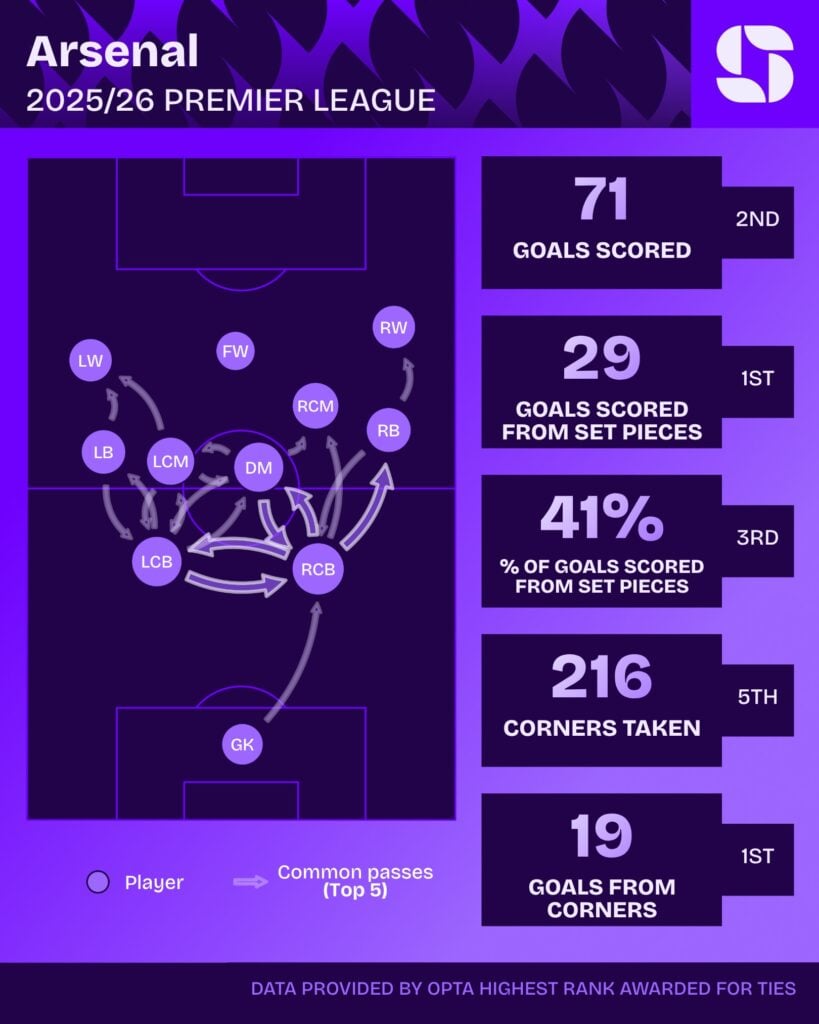
Mikel Arteta’s men led the Premier League last year during their title run in set-piece goals, with 29. Excluding penalties, the number dropped to 25 – but still ahead of everyone else.
Not only that, but they also ranked third overall in percentage of set-piece goals relative to their total amount: 41%. Only lower half of the table, scrapping sides Leeds United (47%) and Crystal Palace (46%) bettered this tally.
It’s still early days, but the initial signs from the 2026/27 shows a slight change in this approach in multiple ways.
How Arsenal are mixing things up in their set pieces
Less emphasis?
For starters, it may not mean much long-term, but it’s still worth pointing out. Two games into the new season and Arsenal are looking looser in possession.
Of course, Manchester City in the Community Shield and newly-promoted Coventry City aren’t the best parameters to measure how the Gunners will play for the rest of the season. But they were firing on all cylinders against both sky-blue sides.
Riccardo Calafiori and Christos Tzolis are making things click down the left, while Bukayo Saka and Martin Odegaard are taking care of the right flank.
Opta accounted over a third of Arsenal’s expected goals last season across all competitions in set pieces: 34%, 38.9 out of 113.4 xG. In these first two games, just 6.5% of their xG has come from dead-ball situations (0.26 out of 4.05 xG).
Things seem to be flowing more smoothly in open play. Perhaps finally winning the Premier League has taken a big burden off everyone’s backs, turning them into a lighter side.
And even their set pieces include short and quick passing sequences. Despite not having scored from them yet, they might seem even more impressive than in the past two seasons or so.
Short corners
Arsenal had eight corners against Coventry, but took four of them short. That’s the highest number of short corners the Gunners have taken over the last two Premier League campaigns (also 4 vs Newcastle last April).
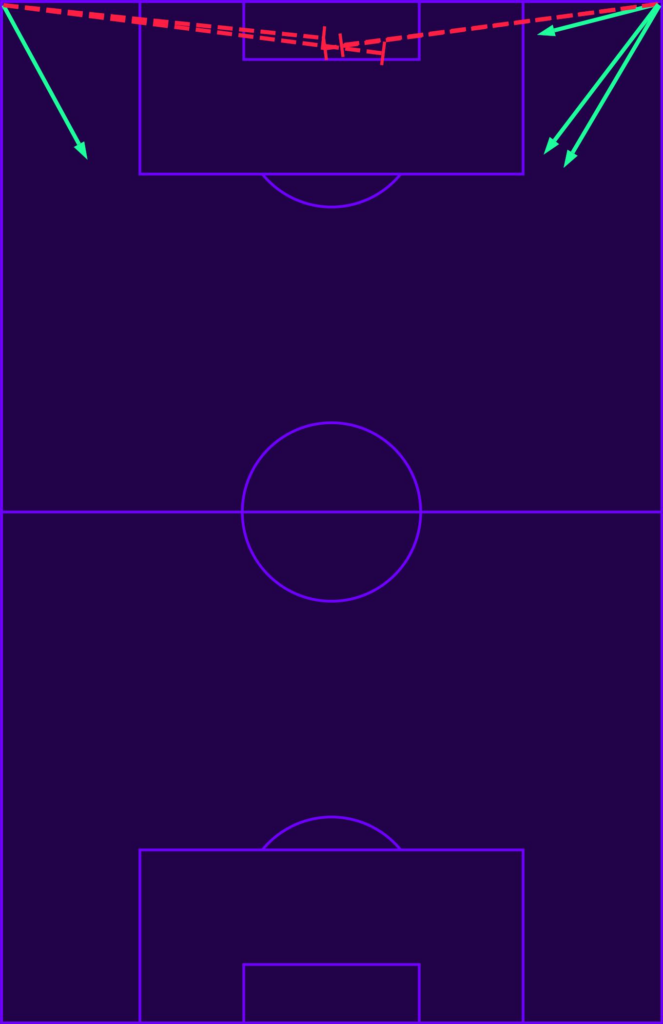
Teams have grown increasingly more afraid of their routines grouping players together in the six-yard box. This means that Arsenal have enough room elsewhere. Arteta and his staff have started leveraging the threat of their near/back-post crosses to free up space on the edge of the box or creating short combinations inside the penalty area.
In all fairness, this isn’t exactly new. The Gunners started tinkering with their routines towards the end of last season. Burnley of all teams reacted quite well to their variations. Newcastle, however, stood out negatively in this regard.
Arsenal took three consecutive short corners within a span of 150 seconds. All of them were designed to get Eberechi Eze shots from the edge of the box. And, you guessed it, he scored a belter in the third attempt.
Their first one against Coventry ended in similar fashion. They worked the ball a little more before setting up Christos Tzolis for a shot. It could have been a goal but Bobby Thomas cleared it off the line.
Declan Rice also presented himself as an option multiple times but only received the ball once. Martin Odegaard took a shot of his own as well.
However, the player sitting on the edge of the box was actually Arsenal’s plan B in those short corner routines.
Arteta has shown a preference for bringing four players near the ball to work in close proximity. Plus a fifth element – the one on the edge of the box. This one makes it so other teams can’t fully collapse on the quartet, giving them more space to work with, while also having an ‘outlet’.
Ben White and Myles Lewis-Skelly got touches in dangerous positions inside the box from those exchanges. There, they had the opportunity to cut it back, find the open man outside the box or even cross it to the far post.
This could be a safer way to guarantee a shot attempt. And they did in every single short corner they took last night. Tzolis in the first, Odegaard in the second, Rice in the third and Saka in the fourth.
And once opponents start adjusting to those short routines, they might go back to long corners, since there may be more space in the mix for their aerial threats to move around.