








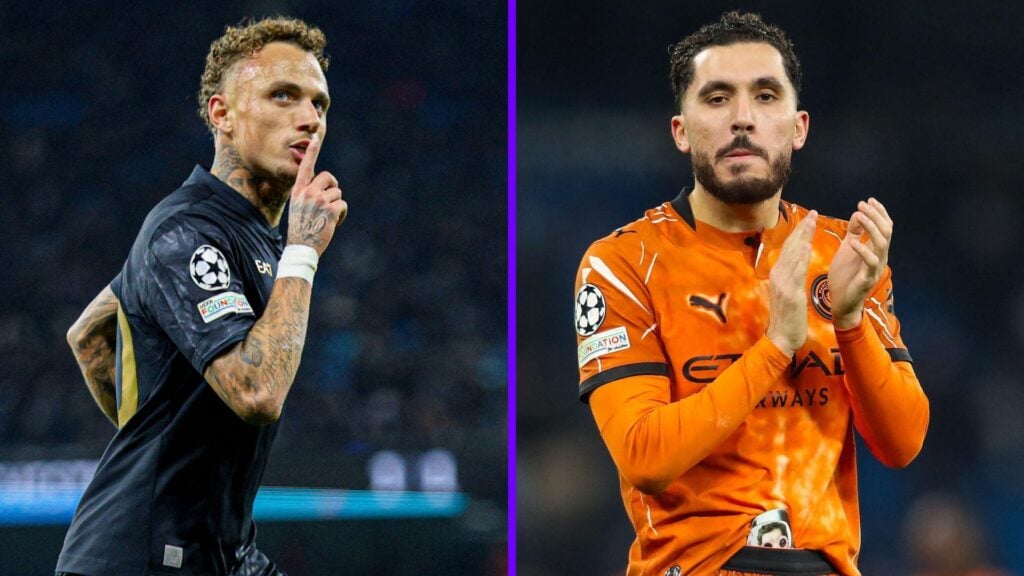
Manchester City and Napoli played out a riveting 2-2 draw in the Champions League on Tuesday night, a result which did neither side any favours.
Of the two sides, it was Napoli who found themselves in far more desperate need of a victory. The Partenopei have reached the halfway point of the Champions League group stage with just three points. For a while it seemed like they would secure the victory needed to climb back into the play-off positions, with Rasmus Hojlund firing them in front, only for Ayyoub Bouaddi to equalise.
Noa Lang restored the visitors’ lead in the 76th minute, but Rayan Cherki levelled things up to salvage a point for the hosts. For Napoli, who had lost seven of their last eight Champions League away matches, it is a marked improvement that they will be looking to draw inspiration from ahead of a busy home stretch.
Napoli’s struggles away from home
Napoli have consistently struggled on the road this season. The Italian side have lost five of their previous seven away games across all competitions and seven of their previous eight Champions League away matches.
They arrived at the Etihad seeking their first-ever victory on English soil at the 13th time of asking, with much of the pre-match attention centring on Kevin De Bruyne’s return to the stadium where he had established himself as one of the greatest midfielders in Premier League history. Having spent a decade orchestrating Man City’s attack, the Belgian was now tasked with unpicking their defence. And it didn’t take long for him to give his former employers a taste of their own medicine.
Massimiliano Allegri‘s gameplan hinged on congesting central areas, allowing Man City to circulate possession in less threatening positions before exploiting the space behind their advanced defensive line. With Hojlund providing an outlet up front and De Bruyne capable of bypassing multiple opposition players with a single pass, Napoli had the requisite tools to make Man City’s territorial dominance count for little.
Man City vs Napoli match momentum
Despite spending much of the opening period defending their own half, Napoli fashioned arguably the clearest opportunity before the break. Sam Beukema directed a powerful header toward goal from Matteo Politano’s delivery, only for Gianluigi Donnarumma to get down and palm it away.
Napoli continued to find gaps behind Man City’s backline, with Hojlund releasing Lang with a brilliant layoff, only for the Dutchman to make a mess of his finish. City continued to press the issue but remained vulnerable to counter-attacks, eventually shooting themselves in the foot after the break by coughing up possession while attempting to play out from the back. Billy Gilmour pounced on the error before releasing Hojlund, who put Marc Guehi on skates before coolly slotting home in the 55th minute.
Man City’s self-inflicted wounds
After a promising start to the Enzo Maresca era, Man City have started to unravel over the past month due to a number of self-inflicted wounds. Several of those can be traced back to Maresca himself.
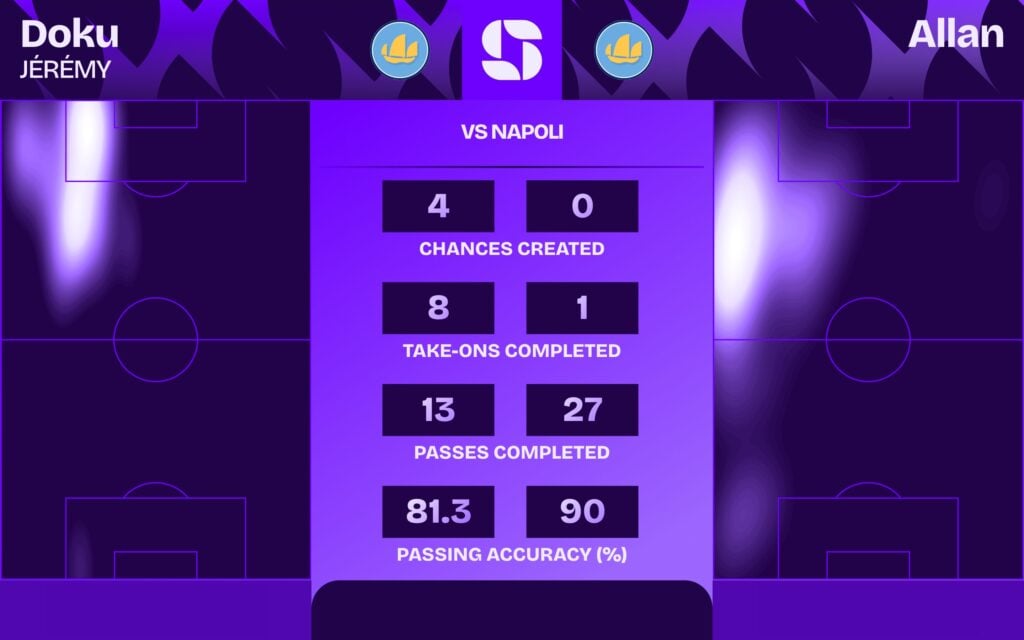
The Italian got his starting lineup wrong. But he demonstrated a willingness to rectify his mistakes by introducing Jeremy Doku for Allan and replacing Enzo Fernandez with Iliman Ndiaye.
Doku was at the heart of Man City’s second-half resurgence, capitalising on a short corner and teeing up Bouaddi for a sensational first-time finish. It had taken Bouaddi 108 senior appearances between Lille and Man City to open his account. At 19 years and 53 days, the Moroccan became Man City’s third-youngest Champions League goalscorer, behind Rico Lewis and Phil Foden.
Doku continued to cause all kinds of chaos in and around the penalty area, helping to liberate the previously inconspicuous Cherki. Having struggled while shoehorned out on the right, the Frenchman began to conjure up moments of individual brilliance in the final third. He forged a promising understanding with Matheus Nunes and provided Man City with the attacking incision they had sorely lacked in the first half. Doku’s ability to attract multiple defenders also afforded his teammates greater space to operate, enabling Man City to stretch Napoli’s defensive block rather than simply circulating possession in front of it.
A goal to sum up Man City
Just when it seemed like Man City were inching toward their first lead of the match, they tripped over their own feet once again.
Nico O’Reilly failed to deal with Scott McTominay’s switch of play, allowing Politano to release Leonardo Spinazzola down the right flank. The Italian had all the time in the world to pick out the unmarked Lang, who put Napoli ahead with a quarter of an hour remaining.
It was a goal that encapsulated Man City’s struggles under Maresca. Having committed bodies forward in pursuit of a winner, they lacked the defensive organisation to cope with a swift change in the point of attack, allowing Napoli to expose them on both flanks in the space of a few seconds.
Even on a night when Maresca elected to populate his midfield with an additional central midfielder, Man City remained susceptible to the very same transitional deficiencies that have plagued them throughout the campaign.
Man City refused to go down without a fight, continuing to pin Napoli deep and coming agonisingly close to an equaliser when Gvardiol struck the post. They needed something exquisite to undo Napoli’s deep block, the kind that they had grown accustomed to witnessing from De Bruyne, and they got it in the 86th minute. Ndiaye teed up Cherki, who manoeuvred his way out of Olivera’s grasp before firing home from an improbable angle.
Man City’s new KDB
On the night that De Bruyne received what may well have been his final standing ovation at the Etihad, Cherki demonstrated precisely why Man City had earmarked him as the Belgian’s successor last year. Only Erling Haaland (14), Thierno Barry (10) and Nicolas Jackson (nine) have scored more goals across all competitions among Premier League players than Cherki’s eight this season.
And yet, for all the individual quality at Maresca’s disposal, Man City struggled to translate their territorial superiority into high-quality chances. Their 17 shots amounted to just 1.41 Expected Goals, meaning that their average attempt carried an xG value of 0.08. Napoli, meanwhile, generated just 0.61 xG from nine attempts.
While neither side consistently threatened the opposition goalkeeper, Napoli came considerably closer to executing their desired game plan, restricting Man City’s attacking output and capitalising on lapses in concentration at the opposite end. And they’ll be thoroughly pleased with both the performance and the result.