







Benjamin Sesko is Manchester United’s latest attacking target as Ruben Amorim looks to address his side’s goalscoring challenges.
The Slovenian striker has agreed on personal terms with the Red Devils and a £74million deal with RB Leipzig is reportedly close to being finalized. Sesko, who scored 13 goals in the Bundesliga last season, is likely to slot in as United’s new starting striker.
United also added Bryan Mbeumo to their ranks this summer, signing the Cameroon international from Brentford for £65m. Along with Mbeumo, United have bolstered their squad with the acquisition of Matheus Cunha from Wolves for £62.5m. Paraguayan left-back Diego Leon has also joined the club, strengthening their defensive depth.
So, how could Amorim line up his side in 2025/26? We’ve taken a look at three setups he could use across the campaign.
Dabble sign-up offer: Bet £10+ & Receive £10 In Free Bets
Not signed up to Dabble yet? Here's how to claim the Bet £10+ & Receive £10 In Free Bets welcome offer:
- Sign up to Dabble through this link
- Register your account with accurate personal details
- Place your first bet of £10 or more
- Receive your £10 in free bets when your qualifying bet has setted
- Use your Free Bet on any eligible sportsbook market within 7 days

#AD 18+ 7-day free bet expiry. Stake not returned. Promotional Terms Apply. GambleAware.org
Traditional setup (3-4-2-1)
No matter how bad it got for Man Utd last season, Amorim remained impressively stubborn in his desire to play with three centre-backs and two wing-backs. So we’ll have to work around his obstinacy when judging where Sesko will fit in.
Most of the time, Amorim opted for a 3-4-2-1 with two No 10s either side of the central striker. In this case, we’d see Sesko spearheading the attack, with Mbeumo and Cunha supporting him as creative outlets.
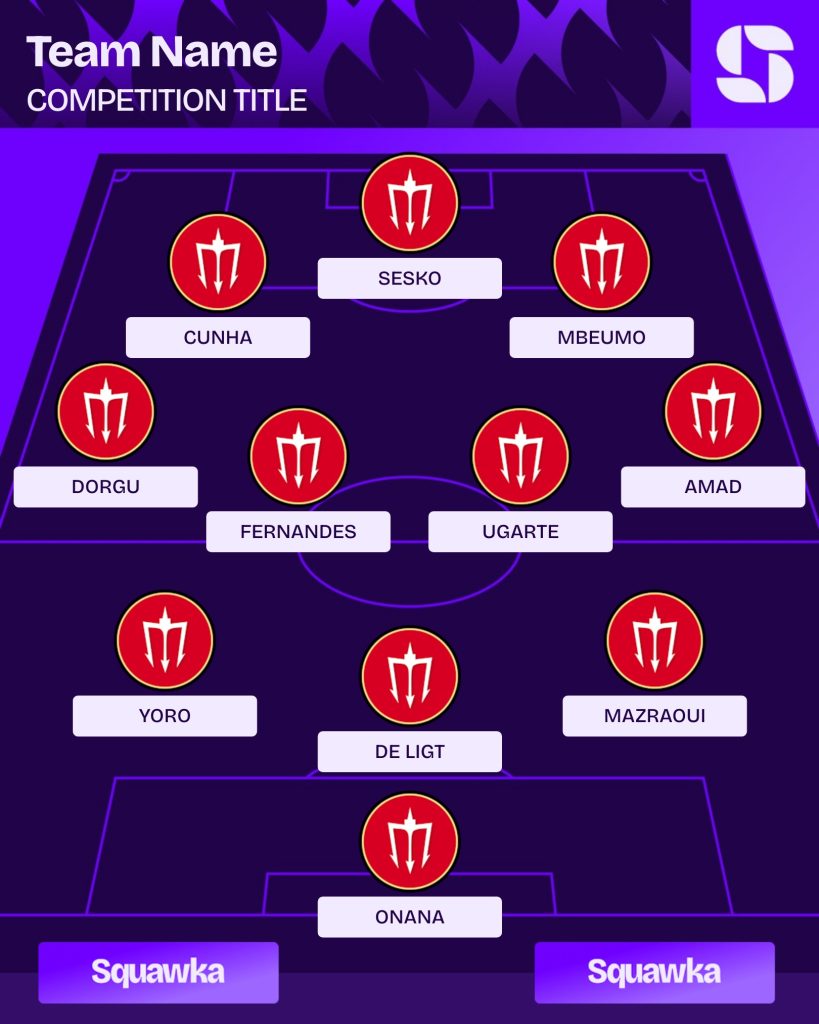
But since both of these players are also heavily attack-minded, Sesko may be asked to drop deep or often perform decoy runs to create more space around the box for Mbeumo and Cunha. He would not be strictly used as a target man considering the personnel he has next to him. Sesko has experience doing this, though, and you could argue it even brings the best out in him.
While he mostly operated as one of two strikers in Leipzig’s 4-4-2 setup, the Slovenian has occasionally played in a narrow front three with Leipzig setting up with a three at the back. Having had to accommodate for another striker alongside him for the last two years, Sesko is incredibly malleable; his attacking efficiency last season ranked at 49.32 – the fourth-highest of any Bundesliga striker. His game is not hindered by the presence of other attackers.
Two wingers (3-4-3)
This setup would see Sesko play as a central striker, flanked by two traditional wingers tasked with taking their man on and firing a high rate of crosses into the box. This is certainly compatible with Sesko’s play style, but it arguably does not maximise his effectiveness.
At 6ft 4in, Sesko won 70 aerial duels in the Bundesliga last season – the eight-most of any striker. He also scored three headers and had an xG overperformance of 4.43 – an incredible efficiency rate and the third-most of any striker. Sesko is capable of playing as an out-and-out striker if he is provided with the service. But does that bring the best out of him and, importantly, his £127.5m attacking partners – Mbeumo and Cunha?
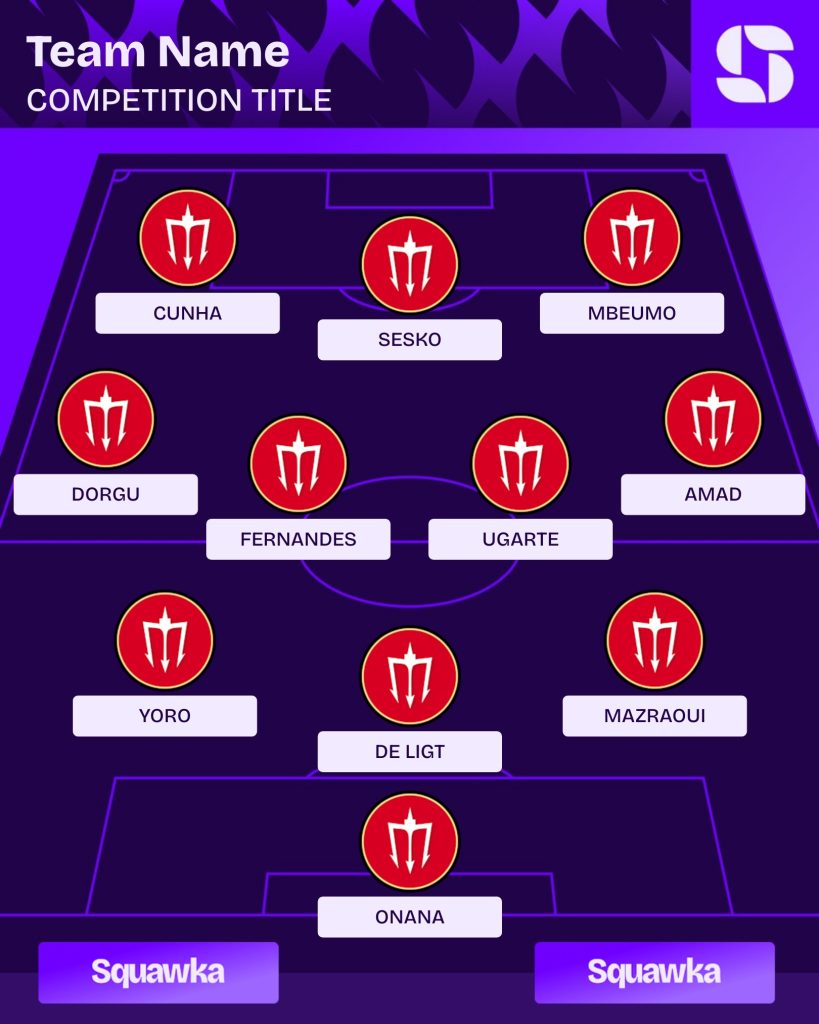
Why limit the fourth and eighth-highest goalscorers in the Premier League last season to service-providing wingers? Not to mention, Sesko is comfortable outside of the box and in transition. Of all Bundesliga strikers last season, he completed the fourth-most take-ons (39) and logged the third-most post-shot xG in fast breaks (5.59). Sesko was also involved in 120 team sequences with 10+ passes – the fourth-most of any striker in the German top-flight.
It’s clear that Sesko is more than a target man, and that Mbeumo and Cunha are more than mere touchline wingers. A 3-4-3 setup with Sesko up front could be useful in certain stages of the game or if Mbeumo and Cunha were resting, but Amorim should opt for other formations before selecting this.
Two strikers (3-4-1-2)
In a 3-4-1-2 formation, Amorim could deploy Sesko alongside Cunha in attack, with both players leading the line together. Sesko would likely be the central striker, with Cunha playing just off him or slightly to the side. Just like Sesko did with Lois Openda or Youssuf Poulsenhey at Leipzig, both players could interchange positions and create unpredictable attacking dynamics.
This fluidity would be key to United’s approach, especially given Cunha’s tendency to drift wide or drop deeper to receive the ball. Now, where might Mbeumo fit in here? It sounds audacious, but there is no reason why he could not hold his own at wing-back.
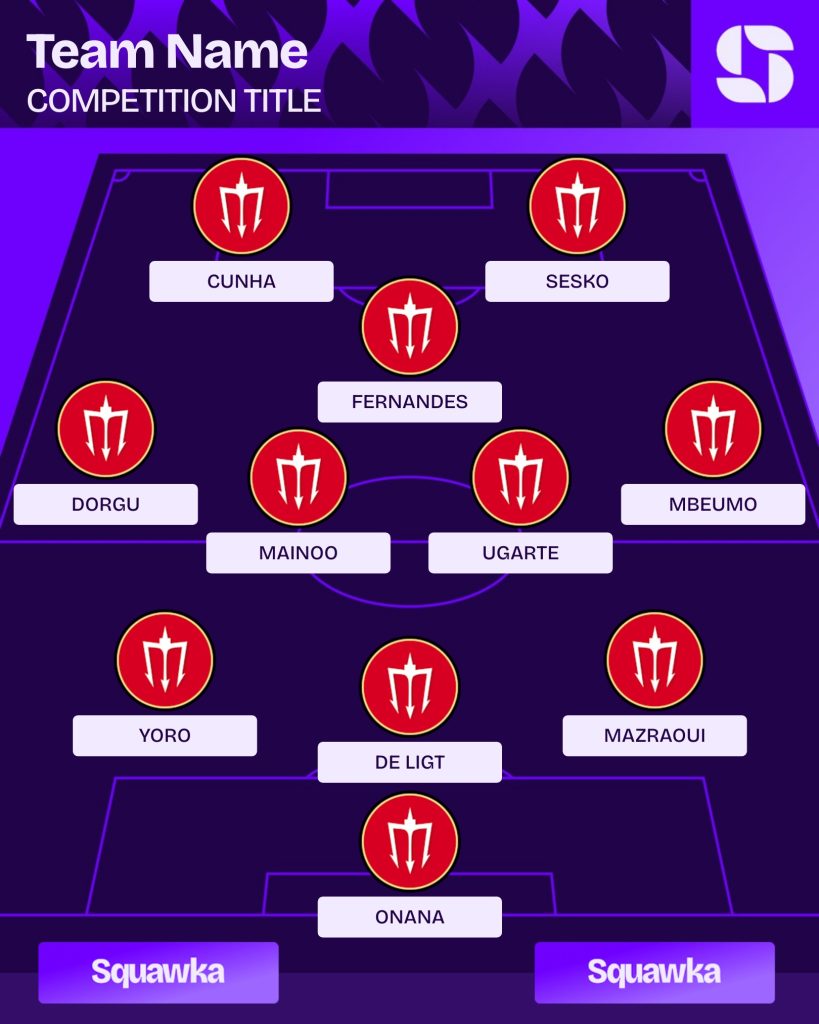
Last season, Mbeumo won the third-most possessions in the attacking third of anybody in the Premier League (32), while his defensive contributions were generous compared to other attackers. He made the fourth-most tackles of any forward (49), won the fifth-most duels (179) and logged the second-most blocks and clearances (74).
Amorim may not extract the most out of Mbeumo at wing-back, but the Cameroonian could certainly put in a shift.