




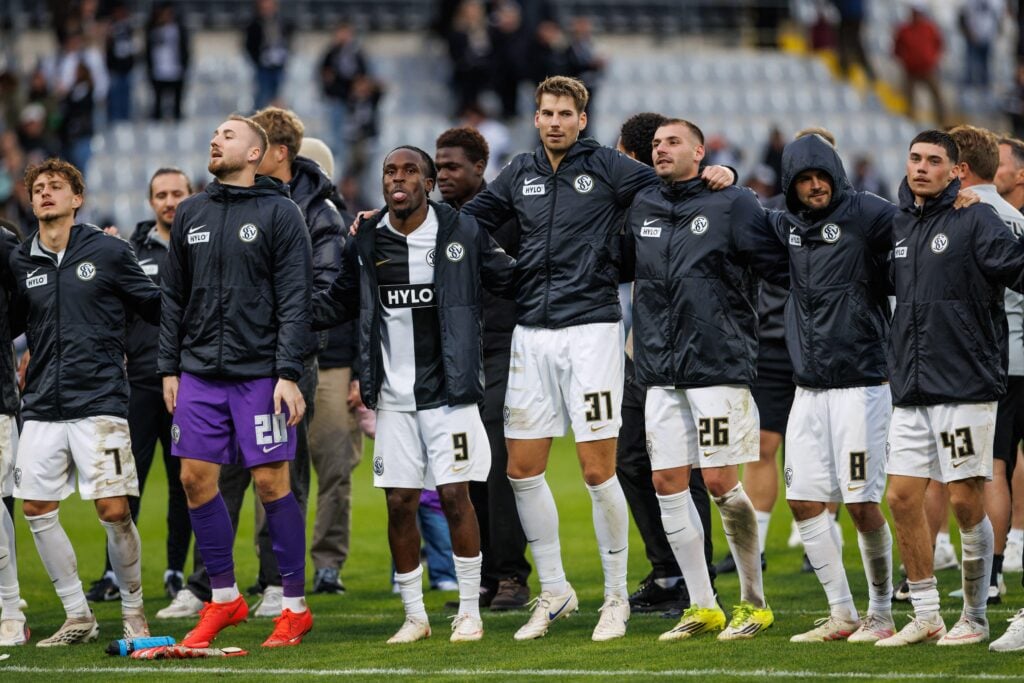
SV Elversberg returned to winning ways on Saturday to continue what has been one of the stories of European football so far this season.
Die Schwarz und Weiß are 119 years old, but this is their first-ever top-flight campaign, having achieved three promotions in five years.

You wouldn’t think they were such minnows, however. On Saturday, Vincent Wagner’s side raced into a 3-0 lead after just 28 minutes against Augsburg, eventually managing to ride out a comeback to win 4-3 for the second time this season — the first away at Borussia Monchengladbach in early September.
That ended a three-game winless streak for Elversberg, but during that time, they ran Bayern Munich close in a 2-1 defeat and are yet to lose a game by more than one goal.
Elversberg are sixth after six games with 10 points on the board, just four adrift of joint-leaders Bayern and Borussia Dortmund. That’s incredible for a side that hails from a town with a population of just 13,078 — less than the capacity of the Waldstadion an der Kaiserlinde in which they play (14,221).
How exactly is one of the smallest clubs ever to play in the Bundesliga competing at this level?
Goals and fast starts
Given their status, it’ll come as no surprise to see Elversberg happy to yield possession. Their 43.25% average share is the fifth-lowest in the Bundesliga, while they’re bottom for final third passes attempted (488) and 12th for overall passes attempted (2,294).
Instead, the Black and Whites are looking to soak up pressure before hitting teams on the counter-attack, using direct running and individual skill from pacey wingers.
Elversberg are third in the Bundesliga for take-ons attempted (118) and completed (53) and have two players in the league’s top 10 for the latter metric — American talent Cole Campbell and Lukas Petkov (both 10).
Whereas Elversberg are second-to-last for crosses attempted (73), they’re fifth for fast breaks (12), sixth for shots from fast breaks (10) and first for goals from fast breaks (3).
With all of that in mind, it’s no surprise to see winger Maurice Krattenmacher leading the goalscoring charge, netting three times so far. Centre-forward David Mokwa has scored twice, but even his primary function is to spearhead lightning-fast counter-attacks, sitting third among his teammates for take-ons completed (7).
Elversberg have also been experts in fast starts so far this season. In their 3-2 win over Bayer Leverkusen on the opening weekend, they were 2-0 up inside nine minutes, while, as mentioned, they were once again two to the good after seven minutes against Augsburg last time out. Six of their 12 Bundesliga goals have come in the first half, and they’ve only scored twice beyond the hour mark.
Saturday’s win over Augsburg ended a two-game goal drought for Elversberg. However, this very much seems like a return to normality for a plucky underdog playing without fear and putting far more established sides on the back foot with shock and awe.
Defending the box
As mentioned, Elversberg prefer to soak up pressure, rather than go hunting for the ball. This draws the opposition higher up the field and allows their pacey forwards more space to wreak havoc.
It’s a risky tactic and has given up a lot of goals, but that can be forgiven from a backline made up of players who helped them earn promotion from the 2. Bundesliga last season. Goalkeeper Nicolas Kristof and centre-back Lukas Pinckert even played for the club in the third tier.
Elversberg are bottom of the Bundesliga for possessions won in the attacking third (13), but third for possessions won in the defensive third (135) and clearances (201). So, while they’ve conceded 11 goals in six matches, this direct and no-nonsense approach has also yielded plenty at the other end.
And it’s not as if Elversberg don’t have a resolute edge. They conceded just three goals across three games combined against Bayern, Schalke and Union Berlin. Even if a goalless draw against Schalke was their only point during this run, they were able to ride out huge waves of pressure against clubs with far bigger reputations and budgets.
Pinckert has been the defensive leader so far, sitting first among his teammates for aerial duels won (25) and clearances (57), and second for blocks (11). But credit must be given to those ahead of him in a team effort, with winger Petkov’s 20 tackles eight clear of any other Elversberg player, while defensive midfielders Felix Keidel and Lukasz Poreba are tied with centre-back Maximilian Rohr on a team-high 10 interceptions.
What next for Elversberg?
Elversberg have already proven they can sink some of the Bundesliga’s biggest names, beating the likes of Bayer Leverkusen and Gladbach. Narrowly losing 2-1 to Bayern and remaining level until Harry Kane‘s 72nd-minute winner proved they do not even fear the biggest power in Germany.
There are plenty of big tests to come soon, however. Next up is a trip to RB Leipzig, and after a DFB-Pokal tie against Darmstadt, they’ll host Mainz, travel to Dortmund and then welcome Freiburg, who sit fifth, second and third, respectively.
But there is no reason to think that Elversberg will fall off from here. In fact, their simple-yet-bombastic style of play appears to have caught the Bundesliga’s best completely off guard, firing this plucky town of 13,000 into the spotlight.