


One summer ago, it seemed that Benjamin Sesko was poised to make a big move from RB Leipzig, but that transfer did not materialise. Now, a year later, it appears it could finally happen.
The talented striker has been linked to several clubs, including Real Madrid and Newcastle United. Currently, the latter are reportedly in negotiations with Sesko’s club, having submitted a formal offer of £65.5 million plus an additional £4.3 million in performance-related bonuses. bet365 have him at 5/4 to join the Magpies this summer, which translates to an implied probability of 44.4%.
Dabble sign-up offer: Bet £10+ & Receive £10 In Free Bets
Not signed up to Dabble yet? Here's how to claim the Bet £10+ & Receive £10 In Free Bets welcome offer:
- Sign up to Dabble through this link
- Register your account with accurate personal details
- Place your first bet of £10 or more
- Receive your £10 in free bets when your qualifying bet has setted
- Use your Free Bet on any eligible sportsbook market within 7 days

#AD 18+ 7-day free bet expiry. Stake not returned. Promotional Terms Apply. GambleAware.org
Squawka Scout: What position does Benjamin Sesko play?
Sesko made the move to RB Leipzig in July 2023, transitioning from sister club Red Bull Salzburg, where he had begun to carve out his reputation as a promising striker. Following in the footsteps of Erling Haaland, who also made a successful leap from Salzburg to a top European league, Sesko’s journey has been marked by potential rather than immediate stardom. His scoring record, while respectable with 21 goals in 55 league appearances at Salzburg, reflects a player still in the process of honing his craft.
Since joining Leipzig, his performance in the Bundesliga has been solid but not yet extraordinary, with a tally of 27 goals in 64 matches over two seasons. Nevertheless, these statistics underscore his significant potential and the promise of further development as he adapts to the demands of a more competitive league.
At RB Leipzig, Sesko has showcased his versatility by being deployed in various attacking roles, which has only increased his desirability as a player. Over the course of his time at the club, he has participated in 64 league matches, starting 47 of them, and has accumulated a total of 3,927 minutes on the pitch. This includes 17 appearances as a substitute, as well as 13 occasions where he completed the full 90 minutes, indicating his stamina and fitness levels are not yet at the optimal level, but that’s understandable, having only turned 20 earlier this year.
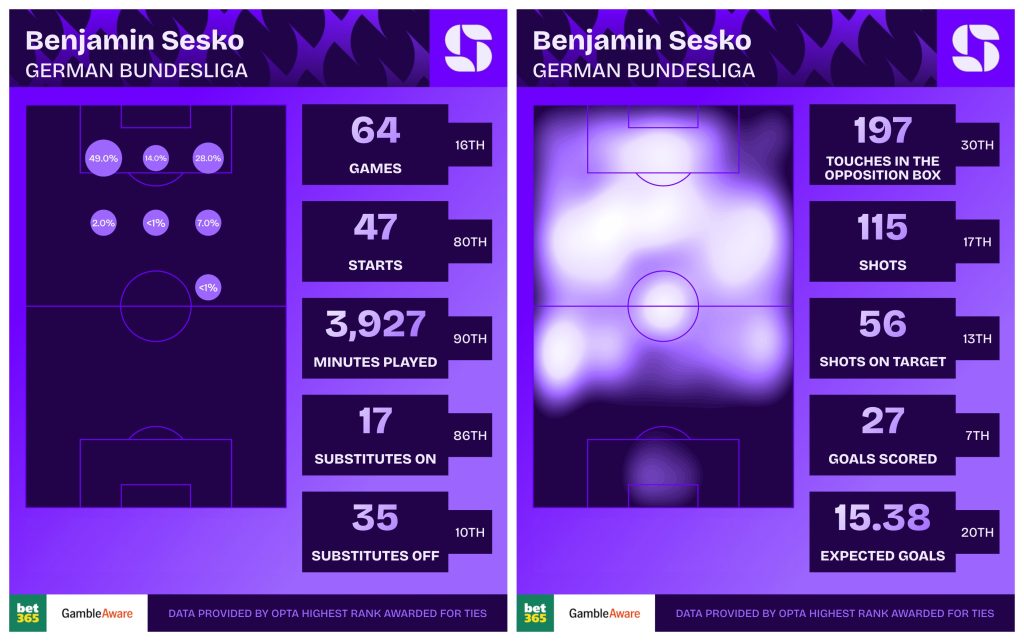
Primarily operating as a centre-forward, Sesko has thrived under the guidance of both Zsolt Löw and Marco Rose, who have favoured a two-striker system that plays to his strengths. This tactical approach has often seen him paired with fellow forward Loïs Openda, and this setup accounts for 77% of his league minutes, with an additional 14% spent in a solo striker role, where he’s showcased his ability to lead the line independently.
Furthermore, Sesko has gained experience as a second striker in a 3-4-2-1 formation, where he has partnered with Xavi Simons as one of the two number 10s. This variety in positioning not only highlights his tactical flexibility but also suggests that he is a player capable of evolving his game to meet the needs of his team, making him an exciting prospect for the future.
Squawka Scout: What are Benjamin Sesko’s strengths?
Last season, Sesko’s performance in the Bundesliga fell short of the high expectations set for him, as evidenced by his Squawka Score of just 58%. This score starkly contrasts with those of his peers, such as Hugo Ekitike (77%), Patrik Schick (78%), Jonathan Burkardt (78%), Serhou Guirassy (78%), and the prolific Harry Kane (85%).
One potential reason for this discrepancy could be the differing playing styles among these strikers. Many of them thrived in a one-striker system, allowing them to take centre stage and maximise their scoring opportunities. In contrast, Sesko often had to share the striking responsibilities, which may have limited his ability to shine. Despite this, it is worth noting that among Bundesliga strikers who played at least 1,530 minutes, only Schick outperformed Sesko in terms of non-penalty expected goals (xG) overperformance.
Delving deeper into Sesko’s statistics reveals a nuanced picture. His non-penalty xG overperformance of 0.17 per 90 minutes places him in the 80-95th percentile among strikers, indicating that he has demonstrated a commendable level of efficiency in converting chances into goals.
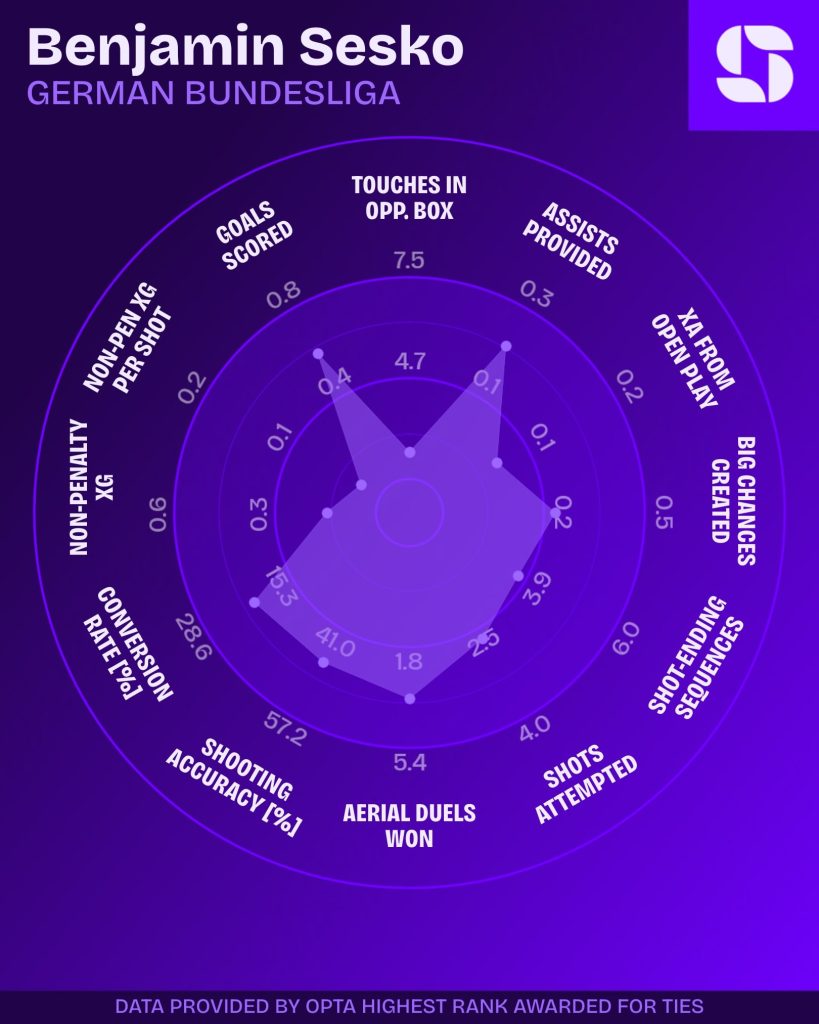
Additionally, Sesko has shown a knack for scoring from outside the box, averaging 0.11 goals per 90 minutes, which ranks him just behind Phil Harres, who averages 0.12.
Nevertheless, Sesko has demonstrated impressive ball control, making him a challenging player to dispossess; he completed an average of 1.46 take-ons per 90 minutes, a figure surpassed by only four other strikers.
Standing at 6 feet 5 inches, he also ranked in the 80th-95th percentile for headed goals, making him a formidable target for crosses from players like Jacob Murphy and Anthony Gordon.
Squawka Scout: What are Benjamin Sesko’s weaknesses?
However, there remains a notable area for improvement: Sesko’s non-penalty xG per 90 minutes ratio of 0.26 positions him in the 20th-40th percentile. This suggests that while he has been effective in certain aspects of his game, there is still significant room for growth in his ability to generate high-quality scoring opportunities.
For fans and analysts seeking a modern centre-forward with a creative edge, Sesko may not entirely fit the mould. His average of only 0.71 chances created per 90 minutes reflects a tactical approach under coach Zsolt Löw that prioritised his role as a striker rather than as a playmaker. This focus may have limited his contributions in creating opportunities for teammates.
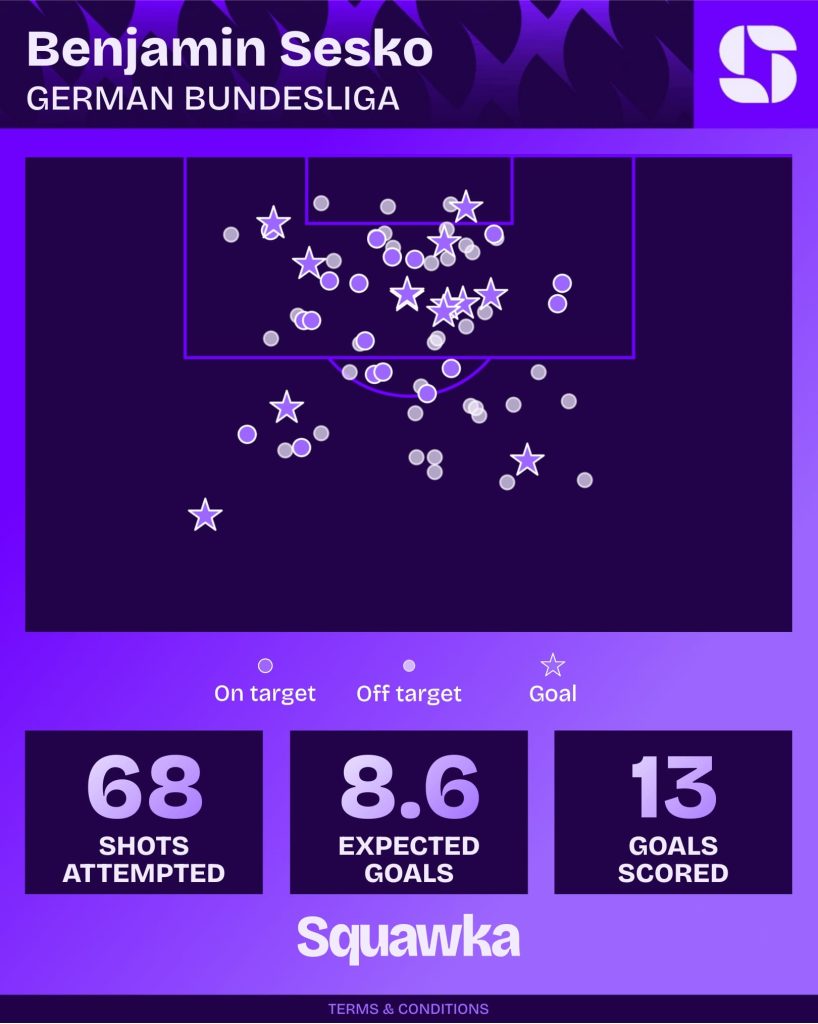
Sesko’s conversion rate of 19.12% falls short of the elite strikers, and his shot accuracy of 45.59% is similarly unimpressive. During the last Bundesliga season, he attempted 68 shots, successfully hitting the target 31 times, yet only managed to score on 13 occasions.
He also exhibited a tendency to be caught offside, averaging 0.68 offsides per 90 minutes. While this statistic is not the most alarming, it places him in the 60th to 68th percentile among strikers, highlighting a common frustration with players who frequently find themselves in offside positions.
Squawka Scout: How Benjamin Sesko compares…
With Newcastle likely to pursue Sesko, it is pertinent to draw comparisons with their previous striker, Alexander Isak, who has been rumoured to be leaving for Liverpool. Given Isak’s impressive performance, any potential replacement must meet or exceed his contributions. However, few strikers can match Isak’s output, and those who can are currently tied to larger clubs, making them unavailable to Newcastle.
A primary concern for Newcastle supporters is Sesko’s conversion rate, which falls short of Isak’s impressive 23.23% from last season. This discrepancy may lead some to view Sesko as a less favourable option. Nevertheless, the limited availability of strikers who can replicate Isak’s performance complicates the situation for the club.
On a more positive note, the gap in shot accuracy between the two players is minimal, with Sesko just one percentage point behind Isak at 46.46%. Additionally, while Sesko is three years younger and not particularly known for his creativity, he managed to record two fewer assists than Isak. Both players scored the same number of goals from outside the box, and their dispossession rates were identical at 55 times, indicating that Sesko may possess untapped potential that could benefit Newcastle.
More Benjamin Sesko comparisons
- Benjamin Sesko vs Ollie Watkins
- Benjamin Sesko vs Yoanne Wissa
- Benjamin Sesko vs Rasmus Hojlund
- Benjamin Sesko vs Hugo Ekitike
As touched upon, Newcastle fans should manage their expectations regarding the potential arrival of Sesko as a replacement for Isak, as the two players have different styles and will require time to adapt to the demands of Premier League football. Sesko will need to acclimate to a new system and build chemistry with his teammates, while Eddie Howe may employ different tactics than those he is used to. Although Sesko’s numbers from last season may not match Isak’s, there is potential for him to exceed expectations.